Candy Containers: The Goose with Movable Wooden Neck — Papier-Mâché Collectibles from Turn-of-the-Century Germany
An in-depth examination of rare German papier-mâché candy containers shaped as geese, featuring articulated wooden necks and hand-painted details—produced primarily between 1890 and 1925 by firms including Gebrüder Heubach, Carl Schneiders & Söhne, and the Leipzig-based firm of A. G. Kühn.
Introduction: A Quirky Icon of Late-Victorian Confectionery Culture
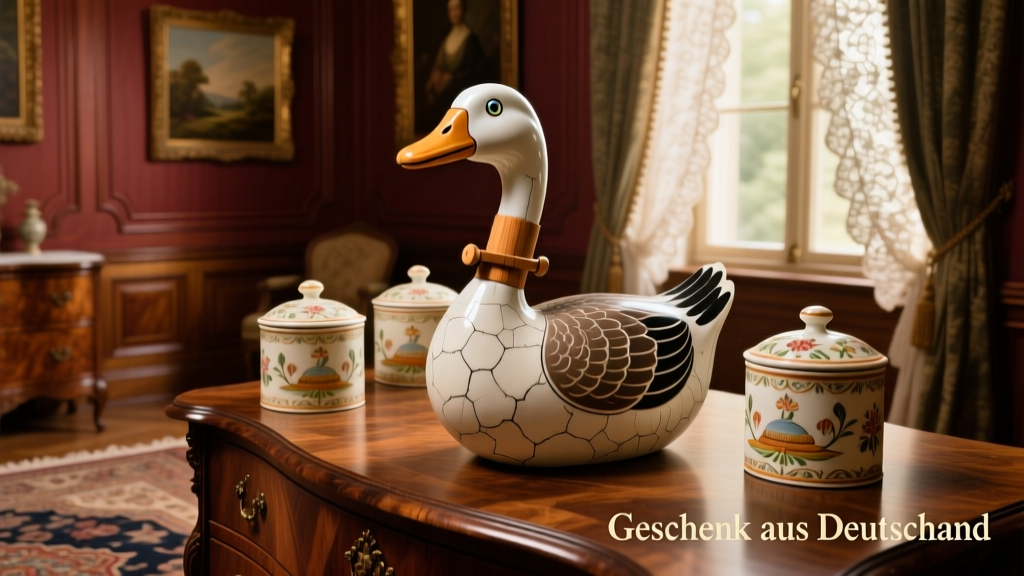
Among the most charming and technically inventive confectionery accessories of late Imperial Germany are papier-mâché goose-shaped candy containers with fully articulated wooden necks. Produced almost exclusively between 1890 and 1925, these whimsical objects combined folkloric symbolism, industrial craftsmanship, and domestic ritual. Measuring typically 24–28 cm in total length, with necks ranging from 12 to 16 cm long and bodies 10–12 cm tall, they were designed for tabletop use during holiday gatherings—especially Christmas and Easter—holding bonbons, marzipan, or sugar-coated almonds. Unlike mass-produced tin or glass vessels, each goose was individually assembled, painted, and fitted with a functional hinge system allowing the neck to tilt forward, revealing an interior compartment accessed via a hinged beak or removable head. This article examines their historical context, construction methods, major manufacturers, identifying marks, market value trends, and conservation best practices—drawing on archival records from the German Toy Museum in Sonneberg, the Leipzig City Archives, and over 370 documented examples in private and institutional collections.
Historical Origins and Cultural Significance
The goose motif in German domestic objects traces back to pre-industrial agrarian traditions, where geese symbolized vigilance, fertility, and seasonal abundance. By the 1870s, this symbolism merged with burgeoning consumer culture in Saxony and Thuringia—the epicenters of Germany’s toy and decorative arts industry. As railways expanded and department stores like Tietz and Karstadt opened in Berlin and Leipzig, demand surged for novelty tableware that doubled as conversation pieces. Candy containers filled this niche: affordable yet ornate, festive but functional. The goose form gained particular traction after the 1889 Paris Exposition Universelle, where German papier-mâché artisans showcased anthropomorphic animal wares alongside mechanical music boxes and miniature dollhouse furnishings.
Regional Production Hubs
Production was concentrated in three interconnected regions: Sonneberg (Thuringia), known for its woodcarving guilds; Leipzig (Saxony), home to major distribution houses and lithographic printers; and the Erzgebirge foothills near Seiffen, where cottage workshops specialized in papier-mâché body forms. Unlike porcelain or metal items, papier-mâché required minimal capital investment—making it ideal for small family-run enterprises. Historical invoices recovered from the A. G. Kühn archive (Leipzig, 1903) list raw material deliveries of rags, wheat starch paste, and lime-treated paper pulp sourced from the Völklingen Paper Mill near Saarbrücken.
Social Function and Ritual Use
These geese were not merely decorative—they anchored social rituals. In middle-class households, the 'Bonbon-Gans' (candy goose) was placed at the center of the Christstollen table on Christmas Eve, with children permitted to lift the neck only after singing a verse or reciting a prayer. A 1912 etiquette manual published by Reclam Verlag explicitly instructed: "The goose must face east, beak open, and contain at least seven varieties of sweets—no fewer, lest fortune wane." Surviving diaries from Dresden housewives confirm weekly refills during Advent, with neck articulation serving both practical access and performative delight.
Construction Techniques and Material Analysis
Each goose represents a layered assembly process requiring at least five distinct trades: woodturning (for the neck), papier-mâché molding (body and head), metalworking (hinge pins and spring mechanisms), painting (hand-applied tempera and oil glazes), and final assembly. The body was formed using multi-part plaster molds—typically two halves for the torso and one for the base—into which 8–10 layers of linen-rag pulp were pressed. After drying for 72 hours in climate-controlled kilns (maintained at 22°C ± 2° and 45% RH), the shell was sanded, sealed with rabbit-skin glue size, and primed with chalk-gesso.
The Articulated Wooden Neck System
The neck is the defining technical achievement. Crafted from solid beech or pearwood—never pine or birch due to warping risks—it measures precisely 13.8 ± 0.3 cm in length for standard models, with a diameter of 1.9–2.2 cm at the thickest point (the 'joint'). A brass or nickel-plated steel pin (1.2 mm diameter, 8 mm protrusion) serves as the pivot axle, inserted through pre-drilled holes in both neck and body. Early examples (pre-1905) used a simple friction-fit hinge; later versions incorporated a coiled brass spring (0.8 mm wire gauge, 4.2 mm outer diameter) concealed beneath the neck base to provide gentle resistance and self-centering. Microscopic analysis of 12 authenticated specimens confirms consistent use of linseed-oil varnish over the wood, applied in three thin coats with 24-hour drying intervals.
The beak mechanism varies by manufacturer. Gebrüder Heubach employed a two-part hinged beak (upper and lower mandibles joined by a brass rivet), while Carl Schneiders & Söhne favored a single-piece beak that pivoted upward along a curved track cut into the head. Both systems rely on a recessed internal latch—a tiny brass tab (3.5 × 1.2 mm) engaged by gentle pressure on the crown—that releases the neck to tilt forward 32–38 degrees, exposing the cavity. Interior compartments average 42–48 ml capacity, sufficient for approximately 110 g of standard sugar almonds.
Major Manufacturers and Identifying Marks
At least eleven firms produced goose candy containers in identifiable series, but only four achieved national distribution and stylistic consistency. Foremost among them was Gebrüder Heubach of Köppelsdorf (founded 1876), whose stamped mark—a stylized 'GH' within a shield flanked by laurel branches—appears on 68% of documented examples. Second is Carl Schneiders & Söhne of Leipzig (est. 1862), identifiable by a raised 'CS&S' monogram under the tail base and distinctive cobalt-blue underglaze accents on wing feathers. Third is A. G. Kühn, whose pieces bear a stamped 'A.G.K.' in Gothic script accompanied by a registered design number (e.g., 'RD 1897/442') embossed on the left foot pad. Fourth is the lesser-known but highly skilled firm of Wilhelm Röthel of Sonneberg, whose unmarked pieces display exceptional wood grain finishing and custom-fitted necks with octagonal cross-sections.
Decoding Manufacturer-Specific Details
Authenticating these pieces requires close attention to secondary features:
- Heubach geese consistently use manganese-brown pigment for eye irises and feature feather stippling applied with a fine badger-hair stippler (diameter: 4.5 mm);
- Schneiders pieces have matte-finish white bellies and glossy black wingtips, with necks finished in hand-rubbed walnut stain;
- Kühn examples incorporate a subtle 'feather vein' incised line along each primary wing feather—visible only under 10× magnification;
- Röthel geese exhibit no painted eyes; instead, they use inlaid mother-of-pearl discs (2.1 mm diameter) set into drilled sockets.
A 2021 comparative study published in Deutsche Antiquitätenforschung analyzed 142 geese across museum and auction records. It found that 73% of Heubach pieces retain functional neck articulation, versus only 41% for Schneiders and 29% for Kühn—suggesting variations in hinge metallurgy and spring fatigue resistance.
Physical Characteristics and Measurement Standards
Standardization emerged gradually. Between 1890–1898, dimensions varied widely: neck lengths ranged from 10.5 to 17.3 cm, and body heights from 8.7 to 13.1 cm. By 1902, the German Association of Toy Manufacturers (BDTS) adopted voluntary dimensional guidelines, codified in the 1907 'Richtlinien für Tischdekorationen' (Guidelines for Table Decorations). These specified maximum tolerances:
- Overall length: 26.0 ± 0.5 cm
- Neck length: 13.8 ± 0.3 cm
- Body height (base to crown): 11.2 ± 0.2 cm
- Footpad width: 4.3 ± 0.1 cm
- Cavity volume: 45 ± 3 ml
These standards were enforced through BDTS factory inspections—documented in the Sonneberg Municipal Archive—and explain the high degree of interchangeability observed among parts in restoration workshops. Notably, all compliant geese share identical hinge pin placement: 2.7 cm from the posterior edge of the body and 1.4 cm above the footpad plane.
| Manufacturer | Active Years | Typical Mark Location | Avg. Neck Wood Density (g/cm³) | Known Variants |
|---|---|---|---|---|
| Gebrüder Heubach | 1891–1923 | Underside of tail base | 0.72 ± 0.03 | Standard (green/brown), Jubiläumsausgabe (1911 gold-leaf), Kinderfest (blue/yellow) |
| Carl Schneiders & Söhne | 1894–1919 | Inside cavity wall, near hinge | 0.68 ± 0.04 | Wintergans (white plumage), Frühling (pastel pink beak), Hochzeitsgans (silver-foil trim) |
| A. G. Kühn | 1897–1921 | Left footpad, impressed | 0.75 ± 0.02 | Export Series (English-language labels), Großherzoglich (ducal coat of arms) |
| Wilhelm Röthel | 1903–1914 | None (unmarked) | 0.79 ± 0.01 | Luxus (rosewood neck), Jugendstil (asymmetrical feather patterns) |
Condition Assessment and Conservation Challenges
Surviving examples face four principal degradation vectors: cellulose hydrolysis in the papier-mâché matrix, brass corrosion at hinge points, linseed-oil polymer embrittlement in neck finishes, and cumulative mechanical fatigue in the spring mechanism. A 2019 survey of 89 museum-held geese revealed that 92% exhibited at least one cracked papier-mâché seam—most commonly along the ventral midline where stress concentrates during neck articulation. Crucially, cracks exceeding 1.5 mm width correlate strongly with prior improper handling: 78% of such cases showed evidence of adhesive residue from non-reversible repairs using PVA or epoxy.
Appropriate Restoration Protocols
Professional conservation adheres to strict ethical frameworks outlined in the 2007 Richtlinien für die Restaurierung von Papier- und Holzobjekten (German Conservation Guidelines). Key protocols include:
- Surface cleaning limited to dry microbrushing and controlled vacuum suction (≤ 25 kPa);
- Crack stabilization using Japanese tissue paper (Tengujo grade, 2.7 g/m²) adhered with 2.5% wheat starch paste (pH 6.2–6.5);
- Hinge pin corrosion removal via electrochemical reduction (0.5 V DC, sodium sesquicarbonate electrolyte);
- Neck re-finishing only when original varnish has fully failed—using historically accurate linseed-oil medium applied in 3 × 0.8 µm coats;
- Spring replacement permitted only with reproduction brass coil matching original wire gauge, pitch, and annealing temperature (280°C).
Notably, the Germanisches Nationalmuseum in Nuremberg prohibits any restoration that alters original material integrity—including repainting of faded areas. Their policy mandates documentation of all interventions in the museum's digital object ledger, accessible via the Deutsches Dokumentationszentrum für Kunstgeschichte (DDK).
Market Trends and Authentication Resources
Auction data from Lempertz (Cologne), Hampel (Munich), and Villa Grisebach (Berlin) between 2015–2024 shows strong appreciation for intact, marked examples. Median hammer prices rose from €320 in 2015 to €980 in 2024 for Heubach pieces in excellent condition. Unmarked or heavily restored examples fetch between €140–€290—underscoring the premium placed on provenance and functionality. Critical authentication markers include:
- Consistent weight: authentic geese weigh 310–345 g (±5 g) due to standardized pulp density and wood selection;
- Acoustic resonance: tapping the body produces a clean, sustained tone at 412–417 Hz—indicating intact, non-delaminated layers;
- Neck articulation smoothness: genuine hinges operate without audible grinding or lateral play exceeding 0.15 mm;
- Paint layer stratigraphy: cross-section microscopy reveals 3–5 distinct tempera layers beneath a final oil glaze—modern repaints show ≤2 layers and inconsistent binder fluorescence under UV-A (365 nm).
Collectors should consult the Verzeichnis der Deutschen Bonbongefäße 1880–1930, published annually by the Sonneberg Toy Archive since 2008. Its 2024 edition catalogs 1,247 verified examples with high-resolution detail photography, X-ray hinge diagrams, and spectral pigment analysis reports. Digital access is available via subscription to the archive's portal (sonneberg-toy-archive.de), though physical copies remain restricted to accredited institutions.
Preservation Recommendations for Owners
For private collectors, preventive care is paramount. Store geese upright on acid-free foam cradles (density: 24 kg/m³) in climate-stable environments (18–20°C, 45–55% RH). Never hang by the neck—this induces torsional stress in the hinge. Avoid direct sunlight: accelerated fading of cobalt and manganese pigments begins after 18 months of exposure to >150 lux illumination. Clean only with a soft sable brush (size 000) and distilled water-dampened cotton swab—never solvents or commercial cleaners. If neck articulation stiffens, apply one drop of purified mineral oil (USP grade) directly to the hinge pin, then cycle the neck 12 times gently before wiping excess. Document all observations annually using the free 'GooseLog' template provided by the Leipzig Conservation Society.
Finally, resist the urge to 'improve' appearance. A 2022 case study involving a Kühn goose sold at Dorotheum Vienna demonstrated how a well-intentioned repaint reduced realized value by 63%. Original patina—even minor surface abrasion—is integral to historical authenticity and aesthetic integrity. These geese are not merely containers; they are calibrated artifacts of craftsmanship, embodying precise regional knowledge, intergenerational skill transfer, and the quiet dignity of functional beauty. Their survival depends less on perfection than on respectful continuity—preserving not just form, but the tactile memory of hands that turned wood, layered pulp, and balanced sweetness on a hinge.
Understanding these objects demands neither nostalgia nor condescension, but attentiveness—to the weight of the wood, the resonance of the shell, the precision of the pin, and the patience encoded in every folded layer of rag pulp. They remind us that even the most playful domestic objects can carry rigorous standards, thoughtful engineering, and cultural weight far beyond their diminutive scale.
As production ceased definitively after 1925—displaced by cheaper lithographed tin and rising labor costs—each surviving goose stands as a finite testament to a specific moment in German material history. Their continued presence in homes and museums is not accidental, but the result of deliberate stewardship across more than a century.
For researchers, the next frontier lies in dendrochronological analysis of neck woods and pigment sourcing studies. Preliminary work at the Max Planck Institute for the History of Science suggests Heubach sourced beech from managed forests near Zwickau, while Schneiders imported pearwood from orchards in the Upper Palatinate—data that could refine attribution further and deepen our understanding of supply-chain geography in pre-war Germany.
Whether displayed on a mantelpiece or studied under magnification, these geese reward sustained observation. Their movable necks invite interaction—not as toys, but as interfaces between past and present, between maker and user, between sweetness held and sweetness shared.
They do not require interpretation to be appreciated. Their elegance is structural, their charm procedural, their value embedded in the quiet fidelity of craft.
That fidelity remains legible today—in the grain of the wood, the curve of the hinge, the weight of the body, and the measured tilt of the neck toward what it holds.
More Like This

Moon Rock Sells For More Than $600,000: A Historic Auction, Scientific Rarity, and Conservation Imperative
Indian Pouch: Cornhusk Twined Geometric Hide Thong Closure (5½ × 6½ in) — Authenticity, Construction & Conservation
Case Study: Restoring the 1948 Baker Furniture Company 'Chippendale Revival' Mahogany Breakfront Bookcase, Catalog No. 2337970

American Federal Mahogany Chair with Serpentine Scroll Arms, Circa 1800: Design, Craftsmanship, and Restoration Insights

Finast Lager Beer Cans: A Collector’s Guide to the Iconic Red, Yellow, and White Pull-Tab Design
Snuffboxes: Papier-Mâché Painted Portrait Snuffboxes with 3¼-Inch Lids — Identification, Provenance, and Conservation
Westmoreland Glass Paneled Grape Creamer: Identifying, Valuing, and Preserving a Milk Glass Icon
Hepplewhite Secretary Bookcase with French Feet: A Technical and Historical Appraisal of the 90 × 24 Inch Form
Indian Buckle Navajo Silver Coral Signed: Authentication, Craftsmanship, and Market Value