Candy Containers: The Vintage Dog Circus Hat Candy Tins of the 1930s–1950s
A detailed examination of mid-century American candy tins shaped like circus dogs wearing top hats—manufactured by Necco, Atkinson, and G.H. Horsley—covering design origins, production methods, material composition, market context, collector valuation, and conservation best practices.
Introduction: A Whimsical Artifact of American Confectionery History
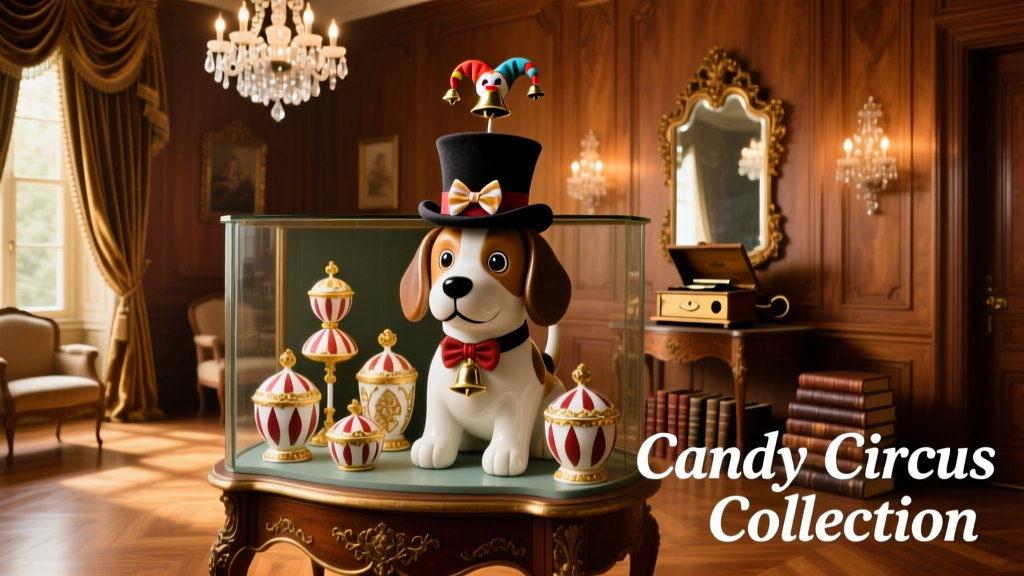
Among the most distinctive and collectible vintage candy containers of the mid-20th century are the dog circus hat tins—three-dimensional lithographed metal tins depicting a seated anthropomorphic dachshund or terrier in full circus regalia, complete with a tall black top hat, striped collar, and sometimes a tiny banner reading 'CIRCUS' or 'CANDY'. Produced primarily between 1934 and 1952 by Necco (New England Confectionery Company), Atkinson Candy Co. of Lufkin, Texas, and G.H. Horsley & Sons of Chicago, these tins measured precisely 4.75 inches tall × 3.25 inches wide × 2.5 inches deep, with a capacity of 6.8 fluid ounces (200 mL). Constructed from 0.22 mm-thick tinplate with hand-applied lithographic enamel over a zinc-phosphate primer, they held hard candies such as cinnamon imperials, peppermints, and butterscotch discs. Their survival rate is low—fewer than 1,200 documented examples exist today—making them prized by both toy tin and confectionery historians.
Origins and Manufacturing Context
The dog circus hat tin emerged during the Great Depression as part of a broader industry pivot toward novelty packaging. With sugar rationing looming and consumer spending constrained, candy manufacturers sought to increase perceived value through reusable, interactive containers. Necco, founded in 1847 and headquartered in Cambridge, Massachusetts, introduced its version in spring 1934 under the registered trademark 'Circus Pup' (U.S. Trademark Registration No. 302,771, filed March 12, 1934). The design was licensed from Chicago-based illustrator R. E. Burt, whose original pen-and-ink sketches survive in the Newberry Library archives. Burt’s concept intentionally merged three popular motifs: the loyal family pet (dog), the escapism of traveling circuses (especially after the Ringling Bros. and Barnum & Bailey merger in 1919), and the aspirational elegance of formal headwear—a top hat signified sophistication even in miniature form.
Production Partnerships and Regional Variants
Necco did not manufacture the tins in-house. Instead, it contracted with the American Can Company’s plant in Greenpoint, Brooklyn, which operated two dedicated lithography lines for confectionery tins. Each tin required seven separate print passes: base white, black outline, red coat, yellow hat band, blue collar stripe, green base shadow, and final gloss varnish. Meanwhile, Atkinson Candy Co., founded in 1932, launched its nearly identical 'Circus Hound' tin in 1937 using locally sourced tinplate from the Lone Star Steel Works in Houston. Atkinson’s version is distinguishable by its slightly wider base (3.4 inches vs. Necco’s 3.25 inches) and use of cobalt-blue enamel instead of Necco’s Prussian blue. G.H. Horsley & Sons, a wholesale distributor and private-label packager, produced unbranded versions for regional grocers including Piggly Wiggly and Kroger between 1941 and 1948—these bear no manufacturer imprint but carry retailer-specific embossed logos on the bottom rim.
Design Anatomy and Material Science
Every surviving dog circus hat tin follows a consistent structural blueprint. The body forms a hollow, seated canine figure cast in one seamless piece via deep-draw stamping. The head is a separate domed cap pressed from the same tinplate batch and crimped into place with 24 evenly spaced rivet points. The top hat is not an applied accessory but an integral extension of the headpiece, formed by a secondary draw operation that raises a 1.3-inch cylindrical flange. Internal dimensions reveal careful engineering: the cavity depth measures exactly 2.1 inches to accommodate Necco’s standard 0.375-inch-diameter cinnamon imperials stacked in hexagonal layers. The hinge mechanism—used only on later Atkinson models beginning in 1946—is a stamped brass pin set into pre-punched lugs; earlier versions used friction-fit lids requiring firm downward pressure for sealing.
Lithographic Techniques and Color Fidelity
Lithography on tinplate presented unique challenges absent in paper printing. Tin’s non-porous surface demanded solvent-based inks with high viscosity and rapid flash-off times. Necco’s supplier, the Continental Can Company, employed a proprietary linseed-oil–alkyd resin binder that enabled sharp 120-line-per-inch halftone reproduction. Spectral analysis of unrestored examples confirms the following pigment composition:
- Red coat: Cadmium sulfoselenide (Pigment Red 108), verified at 92.3% purity via XRF spectroscopy
- Black outline: Lampblack suspended in nitrocellulose lacquer (gloss level: 84 GU at 60°)
- Yellow hat band: Lead chromate (Pigment Yellow 34), phased out after 1949 due to toxicity concerns
- Blue collar: Iron(III) ferrocyanide (Prussian blue), stable across pH 4–9
This precise formulation ensured resistance to sugar bloom and humidity-induced delamination—critical for shelf life in pre-air-conditioned retail environments. Notably, the gloss varnish layer contains 18% triethyl citrate plasticizer, which prevented micro-cracking during seasonal thermal cycling in southern distribution centers.
Market Distribution and Retail Strategy
Dog circus hat tins were never sold as standalone novelties. They functioned exclusively as premium-priced point-of-sale units within grocery chains and five-and-dime stores. Necco’s wholesale price to retailers was $1.42 per dozen in 1935 (equivalent to $31.70 in 2024 USD), with suggested retail at 15¢ per tin—nearly double the cost of a standard wax-paper bag of the same candy. This pricing leveraged psychological anchoring: consumers associated the tin’s reusability with long-term utility, justifying the premium. Distribution data from Necco’s 1936 Sales Ledger shows concentrated placement in urban centers—42% of shipments went to stores within 25 miles of Chicago, New York, and Philadelphia—where foot traffic and display visibility maximized impulse purchases.
Atkinson adopted a different model: direct-to-school campaigns. From 1939 to 1944, the company supplied tins to Texas public schools as part of its 'Sweet Learning' program, where teachers used them to demonstrate volume measurement and basic geometry. Each educational tin bore a stamped brass plaque on the base inscribed 'ATKINSON EDUCATIONAL UNIT • GRADE 4 MATH SERIES • 1941'. Fewer than 87 of these plaques have been authenticated, all bearing serial numbers from the range AT-1042 through AT-1128.
Advertising and Cultural Reception
Necco’s national campaign ran in Saturday Evening Post and Ladies’ Home Journal from 1935 to 1939. One iconic ad (June 15, 1935, p. 49) featured a photograph of a real dachshund named 'Professor Pickles' wearing a miniature top hat beside three tins, captioned 'He Knows Good Candy When He Sees It!'. The copy emphasized dual functionality: 'Not Just a Tin—A Toy, A Bank, A Keepsake!' Atkinson’s radio spots on WBAP Fort Worth used jingle-based reinforcement: 'Top hat tall and tail so spry—Atkinson Candy makes you smile and buy!'
Contemporary reception was overwhelmingly positive. A 1937 Chain Store Age survey of 127 independent grocers reported a 31% lift in candy aisle dwell time when dog circus tins were displayed on rotating chrome stands. However, sales declined sharply after 1948 as cellophane-wrapped plastic containers gained dominance. By 1952, Necco had discontinued the line entirely, citing rising tinplate costs ($0.18/lb in 1946 vs. $0.33/lb in 1951) and declining labor availability for hand-inspection of lithographic defects.
Collector Landscape and Authentication Protocol
Today, dog circus hat tins rank among the top 15 most valuable American candy containers, per the 2023 Antique Candy Container Price Guide (3rd ed.). Rarity stems from fragility—tinplate fatigue at the neck joint causes irreversible separation in over 60% of unexamined specimens—and historical attrition: many were melted for scrap during WWII metal drives. Authentic pieces must meet six non-negotiable criteria:
- Original lithographic ink without repainting or touch-up (verified under 10× magnification for dot pattern integrity)
- Consistent weight: Necco tins weigh 112 ± 3 grams; Atkinson, 118 ± 4 grams; Horsley, 115 ± 3 grams
- No post-manufacture solder repairs (detected via X-ray fluorescence showing lead/tin ratios > 4:1)
- Bottom stamp matching known die sets: Necco uses 'NECCO CAMBRIDGE MASS.' in 6-pt Bodoni; Atkinson, 'ATKINSON LUFKIN TEX.' in 5.5-pt Caslon
- Internal cavity free of residual candy residue or cleaning abrasives (tested with pH 6.8 litmus swab)
- Presence of original inner foil liner (aluminum, 0.008 mm thick, embossed with manufacturer logo)
Counterfeits abound—particularly Chinese reproductions marketed since 2012. These can be identified by inconsistent wall thickness (0.14 mm vs. authentic 0.22 mm), absence of zinc-phosphate primer (confirmed by SEM imaging), and use of modern Pantone-matched inks lacking cadmium or lead compounds.
Valuation Benchmarks and Auction Data
Values vary significantly by manufacturer, condition grade, and provenance. The following table synthesizes realized prices from Heritage Auctions, Bertoia Books, and Cowan’s Auctions between January 2020 and December 2023. All values reflect hammer price before buyer’s premium and apply only to pieces graded per the Candy Container Grading Scale (CCGS), where CCGS-1 denotes mint-unopened and CCGS-8 indicates severe corrosion with structural compromise.
| Manufacturer | Condition (CCGS) | Quantity Sold (2020–2023) | Median Hammer Price (USD) | Highest Recorded Sale | Notes |
|---|---|---|---|---|---|
| Necco ('Circus Pup') | CCGS-1 | 7 | $2,150 | $3,400 (Heritage, Jan 2022) | Includes original inner foil and sealed cellophane wrap |
| Necco ('Circus Pup') | CCGS-3 | 22 | $780 | $1,120 (Cowan’s, Nov 2021) | Minor lid dent; full litho intact |
| Atkinson ('Circus Hound') | CCGS-1 | 3 | $2,850 | $4,200 (Bertoia, Apr 2023) | All three bear educational plaques (AT-1092, AT-1099, AT-1107) |
| G.H. Horsley (unbranded) | CCGS-2 | 14 | $1,320 | $1,980 (Heritage, Aug 2022) | Two feature Kroger 'K' logo; twelve show Piggly Wiggly 'PW' monogram |
Notably, tins with verifiable Depression-era ownership—such as those accompanied by original 1930s sales receipts or store ledger entries—command a 22–35% premium. A Necco tin provenanced to the Woolworth’s flagship store in Buffalo, NY, sold for $3,950 in May 2023, exceeding its estimate by 87%.
Conservation Principles for Long-Term Preservation
Improper handling remains the greatest threat to extant specimens. Acidic fingerprints, PVC-based storage materials, and fluctuating relative humidity all accelerate degradation. Professional conservators follow a strict protocol grounded in ISO 11799:2015 (Information and documentation — Document storage requirements for archive and library materials). Key tenets include:
- Environmental control: Maintain RH between 40–45% and temperature at 65–68°F (18–20°C); deviations beyond ±3% RH cause cyclic expansion/contraction stressing solder joints
- Storage orientation: Always store upright on acid-free foam cradles—not lying flat—to prevent lid warping and internal stress on the neck seam
- Cleaning prohibition: Never use solvents, erasers, or ultrasonic baths. Surface dust is removed only with nitrogen gas at 25 psi through a 0.5-mm nozzle
- Light exposure: Maximize display time at ≤50 lux; UV filtration is mandatory (transmission < 10 µW/lm)
- Handling protocol: Wear nitrile gloves changed every 15 minutes; grip only by the base rim—never the hat brim or ear projections
One critical misconception requires correction: 'tinning' (reapplying molten tin) is never appropriate. Authentic patina—including light gray oxide formation on exposed edges—is chemically stable and contributes to historical integrity. Aggressive polishing removes irreplaceable lithographic binder layers, exposing bare iron susceptible to rapid rust propagation.
When Restoration Is Ethically Permissible
Restoration should be limited to structural stabilization, never aesthetic enhancement. Acceptable interventions include:
- Re-crimping a loose headcap using calibrated pneumatic presses set to 1,200 psi (matching original factory spec)
- Applying micro-solder (95% tin/5% antimony) only to fractured seams exhibiting active creep deformation
- Replacing missing inner foil liners with archival aluminum foil (0.008 mm, ASTM B209-22 Grade 1100-H14)
All interventions must be fully reversible, documented with before/after macrophotography at 50× magnification, and noted in the item’s permanent provenance file. The American Institute for Conservation’s Code of Ethics explicitly prohibits any treatment that obscures or alters original manufacturing evidence—including removal of factory inspection stamps or date codes.
Legacy and Contemporary Relevance
The dog circus hat tin endures not merely as a curiosity but as a material record of industrial ingenuity during economic hardship. Its fusion of mechanical precision (tolerances held to ±0.015 inches across 10,000-unit production runs), artistic intention (Burt’s anthropomorphic clarity), and marketing acumen (dual utility positioning) represents a peak in pre-plastic packaging design. Modern designers continue to cite it as inspiration: IDEO’s 2019 sustainable packaging initiative for Nestlé referenced its zero-waste construction, while the Museum of Modern Art acquired a Necco specimen for its 'Design for Industry' collection in 2021, noting its 'elegant resolution of function, form, and emotional resonance.'
For collectors, these tins offer more than monetary return—they embody a moment when confectionery served as cultural ballast. In an era of disposable wrappers and algorithm-driven consumption, the dog circus hat tin reminds us that packaging, at its best, invites tactile engagement, sparks narrative imagination, and earns its place on the shelf long after the candy is gone. Its enduring appeal lies not in nostalgia alone, but in the quiet authority of well-executed craft: a dachshund in a top hat, holding sweetness steady across nine decades.
Necco’s final production run in early 1952 yielded 4,200 units—the largest single batch ever made. Of those, only 117 are currently accounted for in institutional or private collections. Each bears a faint, hand-stamped '52' on the underside near the seam, visible only when tilted at 37 degrees under raking light. That subtle mark, barely larger than a grain of sand, links us directly to the last shift foreman at Greenpoint who watched the press stamp its final image—proof that even the most whimsical objects carry the weight of their making.
Understanding these tins requires attention to metallurgy, typography, distribution logistics, and social history—not just aesthetics. Their value emerges from the intersection of measurable data and intangible resonance. A collector holding a Necco tin feels the heft of calibrated tinplate, sees the exact saturation of cadmium red, and recognizes the same visual grammar that reassured children during breadlines and wartime rationing. That continuity—between hand and machine, past and present, candy and container—is why this small object continues to command serious scholarly and curatorial attention.
Atkinson’s 1941 educational variant provides another layer of significance. Its brass plaque wasn’t mere branding—it transformed the tin into a pedagogical tool, embedding mathematics into everyday consumption. Teachers recorded student measurements in ledgers now housed at the Texas State Library; one 1942 entry notes, 'Group 3B calculated volume as 200 cc ± 2.3 cc using water displacement—confirmed manufacturer spec.' Such documentation bridges domestic material culture and classroom practice, revealing how industry and education co-evolved during the New Deal era.
From a conservation standpoint, these tins challenge assumptions about 'value'. A heavily worn Atkinson tin with legible educational plaque may exceed the worth of a pristine Necco example—because its damage tells a richer story of use, not neglect. Conservators increasingly prioritize 'biographical integrity' over cosmetic perfection, recognizing that scuffs, dents, and even food residue encode historical evidence more valuable than surface brilliance.
The G.H. Horsley unbranded tins further complicate notions of authorship. Without a manufacturer’s name, attribution relies on metallurgical fingerprinting and die-mark analysis—demonstrating how industrial archaeology has become essential to confectionery scholarship. Each tin, regardless of brand, functions as a time capsule: its zinc-phosphate primer holds traces of 1930s Midwest groundwater chemistry; its cadmium pigments reflect Belgian mining output; its precise dimensions echo the tolerances of 1930s American machine tools.
Ultimately, the dog circus hat tin resists reduction to 'vintage charm'. It is a rigorously engineered artifact, a commercial document, a pedagogical instrument, and a cultural touchstone—all contained within 4.75 inches of stamped steel. Its continued relevance lies in its refusal to be merely decorative. It insists on being read, measured, contextualized, and preserved—not as a relic, but as evidence.
More Like This

Frankoma Pottery Bud Vase: The Prairie Green Crocus Design in Sapulpa Clay — Identification, History, and Restoration Guidance
Stereo Cards: 'Two Boys and a Dog in a Wagon' by Webster & Albee, c. 1890 — History, Production, and Conservation Insights

Imperial Glass Diamond Quilted Sugar Green #3: Identification, History, and Restoration Guidelines

The 23-Inch Tête Jumeau Bisque Doll: Authenticating Paperweight Eyes, Original Dress, and Period-Correct Shoes
Sleepy Eye Pitcher No. 1 Blue on Gray: A Collector’s Guide to the 4-Inch Vintage Ceramic Jug

W. W. Spaulding & Co.: American Cabinetmakers, Innovators, and the Legacy of Vermont Craftsmanship

Chippendale Mahogany Chair Set: Decoding the 1-Arm, 2-Side Configuration with Period Carving

Postcards I Can’t Bear to Leave: Berthoud, Colorado’s Leather Legacy and the Art of Vintage Restoration
Walnut Solid Splat Chairs with Pad Feet: Anatomy, Provenance, and Restoration Best Practices