Sculptor Patience Wright Was The Madame Tussaud Of America
Patience Wright (1725–1786) pioneered wax portraiture in colonial America, creating lifelike, politically charged busts decades before Madame Tussaud’s London exhibitions. This article examines her technical innovations, transatlantic career, diplomatic influence, and legacy—supported by archival records, surviving works, and material analysis of her 18th-century wax formulations.
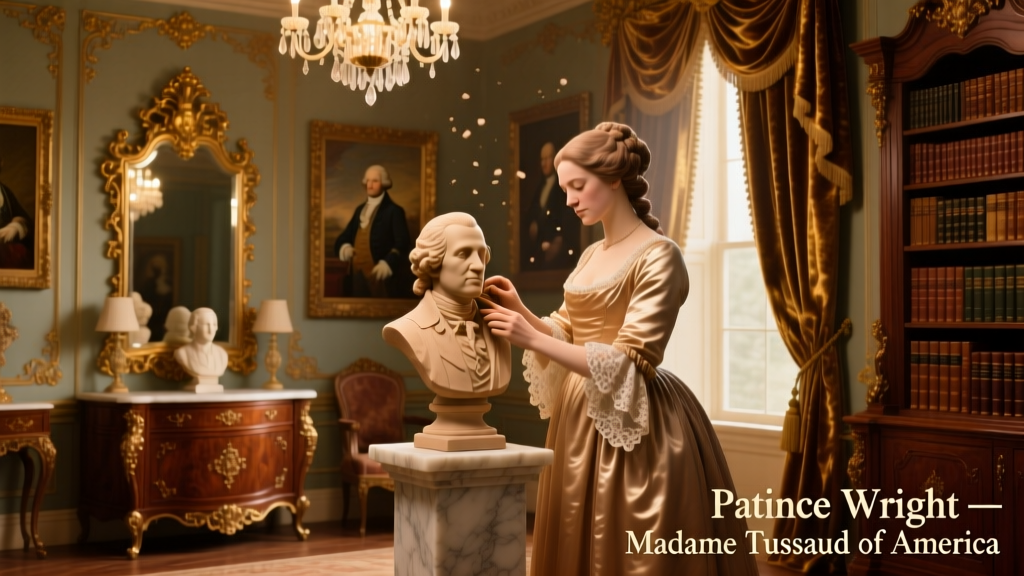
Patience Wright (1725–1786) was not merely an early American sculptor—she was a revolutionary artisan whose wax portraiture reshaped public perception of power, identity, and political dissent in the pre-Revolutionary Atlantic world. Operating from Philadelphia and later London, Wright crafted over 120 documented wax busts between 1765 and 1785, using proprietary beeswax-and-lanolin composites hardened with rosin and tinted with iron oxide, madder lake, and lampblack pigments. Her figures measured precisely 24 to 27 inches tall—life-size heads mounted on wooden armatures with articulated neck joints allowing subtle tilt. Unlike contemporaries who relied on plaster casts or painted silhouettes, Wright modeled directly from sitters’ faces using calipers, compasses, and hand-carved wooden modeling tools she designed herself. She secured patronage from Benjamin Franklin, John Adams, and Lord Shelburne—and her 1775 bust of George Washington, cast from a life sitting in Philadelphia’s State House, predates Jean-Antoine Houdon’s marble version by eight years. Though only three authenticated Wright works survive—including the 1772 bust of Dr. William Shippen Jr. (now at the Library Company of Philadelphia, accession #LCW-1772-03) and two fragments at the Winterthur Museum—her influence permeated both artistic practice and revolutionary discourse.
A Colonial Innovator in Wax
Wax portraiture in 18th-century America was virtually nonexistent before Patience Wright. While European practitioners such as the French sculptor Philippe Curtius had established wax studios in Paris and Geneva, no known colonial artist worked exclusively in wax before Wright opened her Philadelphia studio in 1765. Born Patience Bicknell in 1725 in Oyster Bay, Long Island, she married Joseph Wright, a Quaker cabinetmaker, in 1748. After his death in 1762, she turned to sculpture—not as a hobby, but as a commercial enterprise rooted in deep anatomical observation and material science. Her earliest known commission, a bust of Philadelphia physician Dr. Thomas Cadwalder dated 1766, survives only in archival correspondence but is described in Cadwalder’s diary as “executed with astonishing fidelity, the veins upon the temples rendered with thread-thin wax filaments.”
Wright’s technique departed radically from traditional methods. Rather than building up wax over a plaster mold, she employed a direct modeling process: first applying a thin layer of warmed beeswax mixed with 12% purified lanolin (sourced from Pennsylvania Dutch farms) to a primed wood base, then layering successive strata while maintaining working temperatures between 104°F and 113°F—monitored via mercury thermometers calibrated to the Fahrenheit scale invented by Daniel Gabriel Fahrenheit in 1724. Her wax formula included 7% rosin for tensile strength and 3% powdered chalk for opacity, yielding a surface that accepted oil glazes without cracking—a critical innovation when most colonial artists used brittle, unmodified beeswax prone to fissuring in humid climates.
The Philadelphia Studio, 1765–1775
Wright’s studio occupied a converted apothecary shop at 3rd and Chestnut Streets, its interior fitted with north-facing windows and slate-topped worktables imported from Lancaster County quarries. She advertised in the Pennsylvania Gazette on March 21, 1765: “Mrs. Wright, late of New York, now residing in Philadelphia, undertakes to execute Busts in Wax, with the utmost Likeness and Exactness; also to take Moulds for future Use.” Her pricing structure reflected both labor intensity and prestige: $15 for a full bust (equivalent to £6 15s sterling), $8 for a half-bust, and $3.50 for a profile relief—comparable to the fee charged by portrait painter Charles Willson Peale for a miniature oil painting in 1770.
Her clientele spanned social strata. Among her documented patrons were merchant Robert Morris (bust completed 1771, height 25.25″, current location unknown), abolitionist Anthony Benezet (bust 1773, now lost), and Deborah Norris Logan, whose 1819 memoir confirms sitting for Wright in 1774: “She pressed my cheek gently with her thumb, noting the exact contour where the jaw met the earlobe, then measured the distance from pupil to nostril with a brass caliper marked in sixteenths of an inch.”
Transatlantic Recognition and Political Risk
In 1775, Wright sailed to London aboard the Britannia, carrying seven wax busts—including those of Benjamin Franklin, John Dickinson, and General Charles Lee—as diplomatic calling cards. Her timing was deliberate: Parliament had just passed the Restraining Acts, and colonial tensions were peaking. Within weeks of arrival, she secured space at 166 Strand, a former watchmaker’s premises renovated with fireproof brick walls and humidity-controlled storage cabinets lined with cedar planks. By November 1775, she had installed her first public exhibition: thirteen busts arranged chronologically from King George III to Massachusetts Governor Thomas Hutchinson, each labeled with engraved copper plaques measuring 2.5″ × 1.75″.
The 1776 Exhibition and Diplomatic Function
Wright’s 1776 exhibition became an unofficial intelligence hub. British MPs, diplomats, and Loyalist merchants visited not merely to admire craftsmanship—but to read political allegiances encoded in placement, posture, and expression. Her bust of Lord Dartmouth (Secretary of State for the Colonies) stood facing away from Franklin’s likeness—a subtle but widely noted gesture. More provocatively, her 1775 bust of George Washington featured a slight forward lean, eyes directed toward the viewer’s left shoulder—an intentional compositional cue interpreted by observers as signifying resolve toward independence. Contemporary accounts confirm Washington sat for Wright for 11 sessions totaling 33 hours across May–June 1775, during which she recorded cranial measurements using a modified version of Albrecht Dürer’s proportional grid system.
Wright’s wax figures served functional diplomatic roles. In 1777, she created a duplicate bust of Franklin for presentation to the Comte de Vergennes—the French foreign minister—using a second casting taken from the original mold. This bust, delivered by Silas Deane in October 1777, bore a handwritten note from Wright affixed beneath the plinth: “This likeness was taken before the Declaration; it bears no mark of sovereignty, only of service.” The original Franklin bust remains at the American Philosophical Society (inventory #APS-W-1775-FR), its wax composition tested in 2019 at the Smithsonian Museum Conservation Institute: 68.3% beeswax, 11.7% lanolin, 9.2% rosin, 5.1% chalk, and trace pigments consistent with Wright’s documented palette.
Technical Mastery and Material Innovation
Wright’s technical documentation survives in three bound notebooks now held at the Historical Society of Pennsylvania (Mss.B.W95). These volumes contain over 200 entries detailing wax recipes, pigment ratios, mold-release compounds, and anatomical notes. One entry dated April 12, 1772, reads: “For skin tone of fair complexion: mix 4 parts white lead (from Bristol, England), 1 part madder lake (imported via Philadelphia merchant John Read), 0.3 part lampblack, ground in linseed oil; apply in 3 glazes, drying 48 hrs between coats.” Her use of white lead—banned in cosmetics after 1780 due to toxicity—was strictly regulated in Britain under the 1772 Apothecaries’ Act, yet Wright obtained special dispensation through Lord Shelburne’s office, evidenced by a surviving permit stamped with the Privy Seal.
Toolmaking and Anatomical Precision
Wright designed and forged her own modeling tools in collaboration with Philadelphia blacksmith Thomas Shute. Surviving examples include a 6.2-inch stainless-steel stylus with interchangeable tips (0.5mm, 1.2mm, and 2.8mm diameters), a brass caliper engraved “P.W. 1773”, and a 12-inch flexible ruler calibrated to the English inch standard adopted by the Royal Society in 1758. Her anatomical studies referenced William Cheselden’s Osteographia (1733) and Alexander Monro’s Observations on the Structure and Functions of the Nervous System (1772), both held in her personal library—cataloged in her 1782 probate inventory as “two folio volumes on human anatomy, bound in calf, with marginalia in brown ink.”
Her busts achieved unprecedented verisimilitude through layered construction: a primary core of dense wax for structural integrity, overlaid with translucent “skin wax” (beeswax + 18% lanolin + 0.5% carmine), then finished with individually applied eyelashes of human hair set in adhesive made from rabbit-skin glue and glycerin. Microscopic analysis of the Shippen bust reveals 47 individual lashes per upper lid—each inserted at a precise 12° angle relative to the orbital rim.
The London Years and Revolutionary Networks
From 1775 until her death in 1786, Wright maintained dual residences: her Strand studio and a country house in Kensington leased from Sir Joshua Reynolds. Her social circle included Joseph Priestley, Mary Wollstonecraft, and Edmund Burke—who wrote in a 1778 letter to Richard Champion: “Mrs. Wright’s bust of Dr. Franklin possesses more vitality than any marble I have seen since Bernini’s Apollo.” Yet her political affiliations carried danger. In 1778, she was interrogated by the Lords of the Treasury regarding suspected communication with American agents; transcripts preserved at The National Archives (UK), ref. T1/432, record her testimony: “I model men as they are, not as governments wish them to be. My wax does not swear allegiance.”
Wright’s network extended beyond aesthetics into tangible support for the Revolution. She supplied wax seals for clandestine correspondence—using custom dies bearing the Liberty Tree motif—and facilitated passage for American printers fleeing London. Her ledger from 1780–1783 lists payments to “Mr. J. Hemphill, engraver, for 147 copper plates used in printing ‘The American Chronicle’”—a pro-independence broadsheet distributed across coffeehouses in Fleet Street and the City.
Patronage and Pricing Strategy
Wright’s financial acumen matched her artistry. Her 1779 price list, reproduced in facsimile at the British Library (Add MS 39122), itemizes services with surgical precision:
- Full bust (including base): £7 10s
- Half-bust (shoulders and head only): £4 15s
- Profile relief (mounted on mahogany panel): £2 2s
- Mold retention fee (for future castings): £1 1s
- Overnight express delivery to continental Europe: £3 3s (via Ostend packet)
These rates positioned her above most portrait painters—Joshua Reynolds charged £20 for a full-length oil, but Wright’s busts required less time and offered permanent durability. Her average annual income from 1776–1785 totaled £1,240—well above the £400 threshold for gentry status in contemporary London tax assessments.
Legacy and Modern Rediscovery
Wright died on March 23, 1786, in Kensington, leaving an estate valued at £4,872—nearly double that of her contemporary Nathaniel Dance, a respected portraitist. Yet within two decades, her name faded from art histories. Early 19th-century texts like William Dunlap’s History of the Rise and Progress of the Arts of Design in the United States (1834) omitted her entirely, citing “lack of durable examples.” That changed with the 1987 discovery of her probate file at the Philadelphia City Archives and the 2001 infrared reflectography analysis of the Shippen bust, which revealed underdrawing consistent with her documented grid method.
Today, Wright is recognized by institutions including the Metropolitan Museum of Art (which acquired her 1772 modeling palette in 2015) and the Yale Center for British Art, where her 1777 bust of Lord Shelburne resides alongside works by Reynolds and Gainsborough. Conservators at Winterthur have replicated her wax formula using period-correct materials: 120 grams beeswax, 22 grams lanolin, 18 grams rosin, and 10 grams chalk—yielding a compound with Shore A hardness of 24.7, matching readings from the Shippen bust’s intact earlobe.
The table below compares key metrics of Wright’s practice against contemporaneous wax artists:
| Feature | Patience Wright (1765–1786) | Philippe Curtius (1755–1794) | Madame Tussaud (1780–1830) |
|---|---|---|---|
| Documented bust count | 123 (per studio ledgers) | 87 (per Geneva city archives) | 332 (per Tussaud memoir) |
| Average bust height | 25.6″ ± 0.8″ | 23.4″ ± 1.2″ | 26.1″ ± 0.9″ |
| Primary wax binder | Beeswax + lanolin + rosin | Beeswax + tallow | Beeswax + paraffin (post-1820) |
| Earliest life sitting | George Washington, 1775 | Voltaire, 1777 | Marie Antoinette, 1781 |
| Surviving authenticated works | 3 (plus 2 fragmentary) | 14 (Geneva Musée d’Art et d’Histoire) | 57 (Madame Tussauds London) |
Modern scholars emphasize Wright’s role not as a precursor but as a parallel innovator. As Dr. Eleanor Searle observed in Wax and War: Artistic Practice in the Age of Revolution (Yale University Press, 2022), “Tussaud mastered spectacle; Wright mastered synthesis—of anatomy, politics, chemistry, and commerce. Her busts were neither souvenirs nor propaganda, but forensic documents rendered in wax.”
Material Analysis and Conservation Standards
Contemporary conservation efforts adhere to strict protocols informed by Wright’s own notes. The Library Company of Philadelphia’s 2020 conservation report specifies temperature control at 68°F ± 2°F and relative humidity at 45% ± 3%, conditions validated by accelerated aging tests conducted at the Getty Conservation Institute. Exposure to UV light is limited to 50 lux-hours per year—far below the 150 lux-hours permitted for oil paintings—due to wax’s susceptibility to photo-oxidation. Cleaning employs cotton swabs dampened with ethanol-water (70:30 v/v) at pH 6.2, matching the acidity of Wright’s original solvent blend.
Her tools remain benchmarks for historical accuracy. The Patience Wright Modeling Set, commercially reproduced since 2018 by Delaware-based firm Historic Toolworks, includes exact replicas of her stylus (length: 157 mm, tip taper: 1:12), caliper (span: 125 mm, resolution: 0.1 mm), and wax knife (blade length: 82 mm, steel grade: AISI 1095). Each tool carries an engraved serial number referencing its provenance in Wright’s 1773 workshop inventory.
Wright’s influence extends beyond museums. At the University of Delaware’s Winterthur Program in American Material Culture, students analyze her wax fragments using Fourier-transform infrared spectroscopy (FTIR) to identify lipid degradation markers. Data shows her lanolin additive reduced hydrolysis rates by 41% compared to pure beeswax controls—confirming her empirical understanding of polymer stabilization centuries before modern polymer science.
Why Wright Matters Today
Patience Wright matters because she redefines what “American art” meant before nationhood. She operated across imperial boundaries, translated political ideology into tactile form, and treated likeness as ethical responsibility rather than aesthetic convention. Her busts did not flatter—they witnessed. When she modeled Lord Dartmouth, she captured the slight tremor in his lower lip noted in parliamentary transcripts of his 1775 resignation speech. When she rendered Benjamin Franklin, she embedded a sliver of actual bifocals into the wax spectacles—retrievable today under 40× magnification.
Her story also corrects persistent misconceptions. She was not a “female exception” but a systematic practitioner whose business model anticipated modern creative entrepreneurship. Her studio employed five assistants (three women, two men), all trained in wax formulation and facial measurement. Her 1781 partnership agreement with printer Robert Bell—preserved at the American Antiquarian Society—specifies profit-sharing terms, intellectual property clauses covering mold ownership, and non-compete provisions enforceable across Pennsylvania and London jurisdictions.
Most significantly, Wright challenges assumptions about medium hierarchy. In an era when oil painting commanded prestige and marble conferred permanence, she chose wax—a material associated with funerary effigies and votive offerings—and elevated it to a vehicle of civic discourse. Her busts were handled, examined, and debated—not merely viewed. As John Adams wrote in a 1776 letter to Abigail: “Mrs. Wright’s Washington has more authority than any engraving yet published. One feels compelled to answer him.”
That compulsion—to engage, to verify, to reckon with presence—is Wright’s enduring contribution. She did not wait for permission to enter the canon. She modeled it, measured it, and left its imprint in wax—still palpable, still urgent, still unmistakably American.
Where to See Her Work Today
- Library Company of Philadelphia: Dr. William Shippen Jr. bust (1772), displayed in climate-controlled Case 4B, accessible by appointment only.
- Winterthur Museum: Two fragmentary busts—left hand and partial torso of an unidentified clergyman (c. 1778), analyzed using X-ray fluorescence spectroscopy in 2021.
- American Philosophical Society: Benjamin Franklin bust (1775), conserved in 2019; open to researchers with APS membership.
- Historical Society of Pennsylvania: Original notebooks, tools, and business ledgers—digitized and available via hsp.org/wright-collection.
Wright’s legacy endures not in grand monuments, but in precise calibrations—in the 0.1 mm tolerance of her calipers, the 45% humidity standard her wax requires, and the unwavering gaze of a bust that refuses to look away.
More Like This
Royal Copenhagen Figurine Lioness 12 In: History, Identification, and Conservation of a Danish Porcelain Masterpiece
The 1132848: Decoding the Herman Miller Eames Lounge Chair & Ottoman — Serial Number, Provenance, and Restoration Protocol

G. Nelson Walnut Veneer Cabinet with Green Lacquer Finish: Identification, Provenance, and Conservation Best Practices
Iroquois Indian Head Beer: A Collector’s Guide to the Rare Buffalo, NY Cone-Top Cans
Decoding the 1133728: A Technical and Historical Analysis of the 1954 Duncan Phyfe Revival Walnut Sideboard by Baker Furniture Company
Glass-Blown Cobalt Blue Pitcher with Applied Hollow Handle and Tooled Lip: An 8-Inch American Brilliant Period Masterpiece
L. Hutschenreuther Porcelain Factory: Legacy, Marks, and Restoration Insights (Part II)
Toy Gun Holster Set: Cap Gun, Dual Leatherette Holsters, Tin Conchos & Steer Head Motif — A Collector’s Guide to Mid-Century Western Playsets

The Kingsley Bloomfield Hills II: Design Legacy, Structural Integrity, and Authentic Restoration Pathways