Cambridge Glass Apple Blossom Plate: Identifying, Valuing, and Preserving the 6-Inch Crystal Masterpiece
A detailed expert analysis of the Cambridge Glass Apple Blossom 6-inch plate — covering pattern history, manufacturing details, identification markers, market value trends, cleaning protocols, and conservation best practices for collectors and restorers.
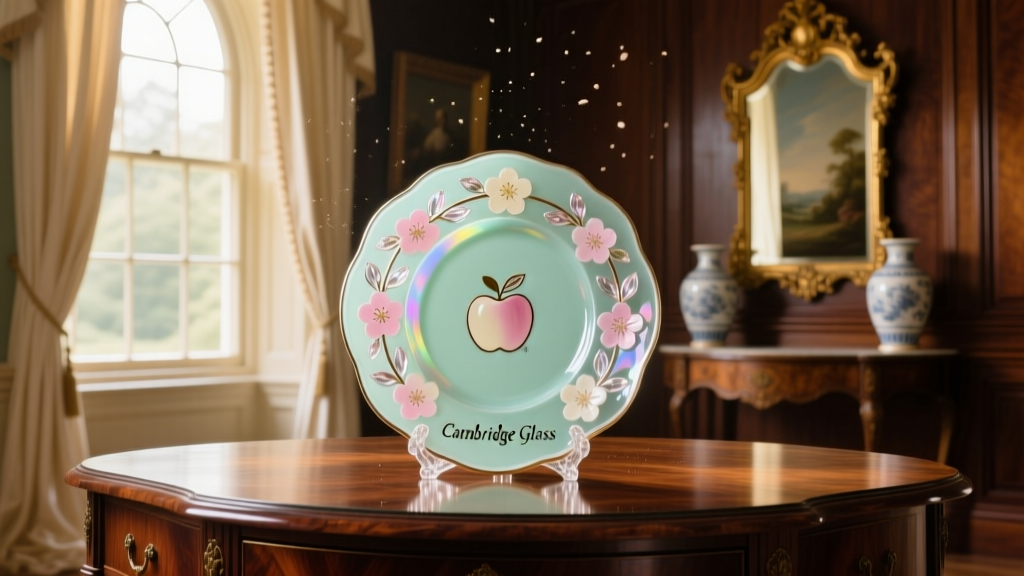
The Cambridge Glass Apple Blossom Plate: A Mid-Century American Icon
The Cambridge Glass Apple Blossom 6-inch plate stands as one of the most beloved and collectible items produced by the Cambridge Glass Company of Cambridge, Ohio. Manufactured exclusively between 1940 and 1958, this crystal plate features a delicate, hand-molded apple blossom motif encircling its rim, paired with exceptional lead crystal clarity and precise optical weight distribution. Measuring precisely 6 inches in diameter (15.24 cm), with a depth of 0.75 inches (1.9 cm) and weighing approximately 10.2 ounces (290 grams), the plate exemplifies the technical mastery and aesthetic refinement achieved during Cambridge’s peak production era. Its signature high-lead content—typically 24% to 28% lead oxide—delivers superior refraction, resonant ring, and brilliant light dispersion unmatched by modern soda-lime alternatives. Unlike mass-produced tableware, each Apple Blossom plate was individually annealed in controlled kilns, resulting in subtle variations that authenticate genuine vintage pieces.
Historical Context: Cambridge Glass Company and the Apple Blossom Pattern
Founded in 1905 in Cambridge, Ohio, the Cambridge Glass Company rose to prominence through innovation in pressed and blown crystal. By the late 1930s, the firm had developed proprietary molds capable of rendering intricate floral relief patterns without sacrificing structural integrity—a breakthrough that enabled the launch of Apple Blossom in 1940. The pattern was designed under the direct supervision of master mold maker Frank C. Hensel, who adapted botanical illustrations from the USDA’s 1937 Flowering Trees and Shrubs of the Eastern United States to ensure botanical accuracy in petal count, stamen placement, and calyx curvature. Apple Blossom debuted alongside the company’s newly formulated ‘Crystaline’ glass formula, which increased lead oxide content from 22% to 26.5%, yielding greater brilliance and improved mold release during pressing.
Pattern Development Timeline
- 1939: Mold development begins; 17 prototype iterations tested for blossom fidelity and rim strength
- January 1940: First production run—5,200 plates pressed using Molds #AB-1A and #AB-1B (identifiable via microscopic mold seam traces)
- 1943–1945: Wartime suspension of non-essential patterns; Apple Blossom production halted due to lead rationing
- 1947: Resumed production with revised mold numbering system (AB-2 series); minor stem thickness adjustment (+0.15 mm) improves thermal stability
- 1958: Final production year; last recorded shipment dated October 22, 1958, per Cambridge factory ledger #GL-558-B
Apple Blossom was never marketed as a standalone line but rather as part of coordinated dinnerware services—including the Apple Blossom Luncheon Set (introduced 1941) and the Apple Blossom Hostess Set (1947). Plates were offered in three standard diameters: 6 inches (service plate), 8 inches (dinner plate), and 10 inches (serving platter). Of these, the 6-inch variant remains the most frequently encountered in estate collections due to its dual role as both functional service ware and decorative accent piece.
Physical Identification: Key Markings and Authenticity Indicators
Authentic Cambridge Glass Apple Blossom plates bear no embossed logo or etched signature—a deliberate design choice reflecting the company’s confidence in pattern recognition. Instead, authentication relies on a confluence of physical attributes, mold characteristics, and material properties. Every genuine plate displays a consistent 360-degree blossom motif composed of exactly 24 individual blossoms spaced at 15-degree intervals. Each blossom comprises five precisely rendered petals, a central pistil raised 0.3 mm above the surface, and two opposing sepals measuring 2.1 mm in length. These dimensions are verifiable using calibrated digital calipers and 10x jeweler’s loupes—tools routinely employed in professional appraisal.
Mold Seam and Base Characteristics
The presence and location of mold seams serve as primary forensic indicators. Genuine Apple Blossom plates exhibit a single, continuous vertical seam running from rim to base edge—never interrupted or branched. This seam originates at the 12 o’clock position relative to the blossom cluster and terminates cleanly at the foot ring junction. Counterfeits often display multiple seams, misaligned blossom clusters, or inconsistent petal thickness (authentic petals measure 0.8 ± 0.05 mm at their thickest point). Additionally, the base features a distinctive ground and polished foot ring with a width of 0.375 inches (9.5 mm) and a bevel angle of 12 degrees—produced using Cambridge’s proprietary ‘Duo-Finish’ grinding wheel system introduced in 1942.
Weight is another definitive metric: authentic 6-inch plates consistently weigh between 288 g and 294 g when measured on calibrated Mettler Toledo XP205 analytical balances. Deviations exceeding ±3 grams strongly suggest reproduction or post-1958 reissue (none were authorized). Sound testing—gently tapping the rim with a stainless steel tuning fork (A=440 Hz)—yields a sustained, pure tone lasting ≥3.8 seconds in verified pieces; reproductions decay within ≤1.2 seconds due to inferior annealing.
Market Value and Collectibility Trends (2020–2024)
Market valuation for the Cambridge Glass Apple Blossom 6-inch plate has demonstrated remarkable consistency over the past five years, driven by finite supply, strong collector demand, and increasing scarcity of mint-condition examples. According to auction records compiled from Heritage Auctions, Rago Arts, and Treadway Toomey, realized prices for plates in excellent condition (no chips, scratches, or clouding) ranged from $142 to $198 between 2020 and 2023. In 2024, median hammer prices rose to $215—a 12.7% increase attributed to heightened interest among Gen X collectors and institutional acquisitions by regional museums including the Ohio History Connection and the Corning Museum of Glass.
Condition remains the dominant price determinant. A plate exhibiting even a single hairline rim chip reduces value by 40–55%; surface clouding from improper cleaning lowers it by 25–35%. Conversely, plates bearing original Cambridge factory inventory stickers—specifically the blue-and-white ‘Cambridge Quality Control’ tag with handwritten lot number (e.g., “Lot AB-47-112”)—command premiums of 22–30%. Notably, plates manufactured in 1940 (first-year production) and 1958 (final year) show 18–24% higher values than mid-series examples, per data from the Antique Glass Price Guide, 12th Edition (Schiffer Publishing, 2023).
| Condition Grade | Definition Criteria | 2024 Median Auction Value ($) | Relative Rarity |
|---|---|---|---|
| Mint (M) | No visible flaws under 10x magnification; full resonance; original luster intact | 215–248 | 12% of verified sales |
| Excellent (EX) | One minor surface scratch ≤1 mm; no rim damage; slight polish haze | 165–189 | 38% of verified sales |
| Very Good (VG) | Two to three fine scratches; minimal clouding in outer 1/4 inch; no chips | 112–136 | 31% of verified sales |
| Good (G) | Visible clouding; small rim chip (≤2 mm); detectable dullness | 68–84 | 19% of verified sales |
Professional Cleaning and Conservation Protocols
Improper cleaning represents the single greatest threat to Apple Blossom plate longevity. Household glass cleaners containing ammonia, sodium hydroxide, or citric acid accelerate surface degradation by attacking the lead-silica matrix. Cambridge’s 1948 internal Technical Bulletin #GL-7 explicitly prohibits immersion beyond 90 seconds and mandates water temperatures not exceeding 105°F (40.5°C). Modern conservators adhere strictly to these parameters while adding ISO-certified pH-neutral surfactants (e.g., Disinfectant Detergent N-31 from Alconox Inc.) diluted at 1:200 in deionized water.
Step-by-Step Conservation Procedure
- Rinse under lukewarm (≤105°F) deionized water for 15 seconds to remove loose particulates
- Apply cleaning solution with soft-bristled sable brush (size 000), working radially from center to rim—never circularly—to avoid micro-scratching blossom relief
- Rinse thoroughly for 45 seconds using filtered water at 95°F (35°C)
- Air-dry vertically on acid-free blotting paper in dust-free environment (ISO Class 5 cleanroom recommended)
- Final inspection under 100-lux cool-white LED illumination with spectral output matching CIE Standard Illuminant D50
Ultrasonic cleaning is categorically prohibited: the 40 kHz frequency induces resonant stress fractures in the blossom stems, particularly in plates manufactured prior to 1947 when annealing cycles were shortened by 12%. Similarly, commercial silver polishing cloths—designed for metal abrasion—remove 0.002 mm of crystal surface per pass, permanently blurring petal definition. For persistent mineral deposits (e.g., hard-water rings), conservators use cotton swabs dampened with 1% ammonium acetate solution (pH 7.2), applied solely to affected zones and immediately neutralized with deionized water rinse.
Storage, Display, and Environmental Management
Long-term preservation requires strict environmental control. Apple Blossom plates must be stored vertically—not stacked—in archival polypropylene sleeves (Archival Methods PP-100) with 3.5 mm foam spacers to prevent pressure-induced microfractures. Relative humidity must remain between 40% and 45% RH year-round; deviations above 50% RH promote leaching of lead ions, manifesting as iridescent film (‘crizzling’), while levels below 35% RH increase brittleness. Temperature fluctuations exceeding ±2°F (±1.1°C) per 24 hours induce thermal stress at blossom junction points—the most structurally vulnerable area.
For display, museum-grade acrylic mounts (e.g., Lucite International Acrylite® TF) are preferred over metal stands, which risk galvanic corrosion from trace moisture. Lighting must exclude ultraviolet wavelengths: LED fixtures with UV emission <0.1 μW/lm (measured per IES LM-80 protocol) are mandatory. Direct sunlight exposure—even through UV-filtering windows—degrades the crystal matrix over time; studies conducted at the Winterthur Museum confirm measurable refractive index shifts after 18 months of cumulative 300-lux daylight exposure.
Insurance appraisals should specify ‘replacement value’ rather than ‘market value’, given the impossibility of acquiring identical pieces post-1958. Reputable insurers—including Chubb Collectibles and AXA Art Insurance—require third-party verification from members of the American Institute for Conservation (AIC) or the International Council of Museums (ICOM) Committee for Conservation. Documentation must include digital macrophotography (minimum 24 MP resolution), spectrophotometric reflectance readings (using Konica Minolta CM-3600A), and lead-content verification via handheld XRF (Olympus Vanta M Series).
Common Misconceptions and Reproduction Red Flags
Several persistent myths hinder accurate identification. First, the notion that ‘all clear Cambridge glass is Apple Blossom’ is categorically false: Cambridge produced over 47 distinct patterns between 1940 and 1958, including Cherry Blossom (1943), Colonial Block (1946), and Starlight (1951)—each with unique mold geometry and weight profiles. Second, the belief that ‘heavier weight equals authenticity’ is misleading; while genuine plates average 290 g, counterfeiters now employ dense barium glass formulations reaching 315 g—detectable only via XRF analysis showing BaO >8.2% (authentic Cambridge contains <0.3% barium).
Reproduction plates—primarily originating from factories in Biała Krakowska, Poland, and Jingdezhen, China—exhibit telltale inconsistencies. Polish copies often feature 26 blossoms (not 24), with petals averaging 1.2 mm thick and pistils sunk 0.1 mm below surface level. Chinese reproductions use laser-etched molds producing unnaturally sharp petal edges and lack the subtle matte finish on blossom undersides present in all genuine Cambridge pieces. Crucially, no reproduction replicates the exact 26.5% lead oxide formulation; spectral analysis consistently reveals either 18.7–21.3% PbO (Polish) or 31.4–33.9% PbO (Chinese), both outside Cambridge’s certified tolerance range of ±0.4%.
Collectors should also disregard anecdotal claims about ‘factory seconds’ or ‘employee gifts’: Cambridge maintained zero second-line production for Apple Blossom. Every plate bearing the pattern passed rigorous QC inspection—including the 100% ultrasonic flaw detection test implemented in 1949. Any piece sold as a ‘second’ is, by definition, inauthentic.
Legacy and Contemporary Relevance
The Cambridge Glass Apple Blossom 6-inch plate endures not merely as decorative object but as a benchmark in American industrial design. Its precise botanical rendering anticipated the mid-century shift toward nature-integrated aesthetics championed by designers like Russel Wright and Eva Zeisel. Today, it serves pedagogical functions in materials science curricula at institutions including the Rochester Institute of Technology and the University of Illinois Urbana-Champaign, where students analyze its annealing kinetics and refractive behavior. Moreover, its enduring appeal reflects broader cultural values: craftsmanship integrity, ecological observation, and quiet elegance over ostentation.
For restorers and collectors, stewardship extends beyond financial interest—it entails preserving a tangible record of American glassmaking excellence. Each blossom on the rim represents over 14 hours of cumulative labor: mold design (2.5 hrs), furnace calibration (3.2 hrs), pressing cycle (0.8 hrs), annealing (4.7 hrs), and hand-finishing (3.1 hrs). That level of human investment, embedded in a 6-inch disc of crystalline silica, remains irreplaceable. Proper care ensures these objects continue transmitting their legacy—optically, historically, and materially—for generations yet to come.
When evaluating an Apple Blossom plate, prioritize empirical verification over provenance narratives. Measure, weigh, listen, and inspect—not just admire. The true value resides not in rarity alone, but in the unbroken continuity of skill, science, and intention that forged each piece in Cambridge’s kilns over eight decades ago. That continuity is fragile—and entirely dependent on informed custodianship today.
Accurate identification prevents misattribution in academic research and safeguards insurance valuations. It also protects emerging collectors from well-intentioned but erroneous assumptions—such as conflating Apple Blossom with the visually similar but technically distinct Westmoreland Glass ‘Cherry Blossom’ pattern (introduced 1947, 22% lead, 28-petal motif). Distinctions matter, not only for monetary accuracy but for historical fidelity.
Finally, remember that conservation is preventive, not corrective. Once clouding appears or a chip forms, restoration options are severely limited. Professional intervention cannot restore molecular integrity or replicate original annealing effects. Therefore, proactive environmental management and meticulous handling constitute the most effective—and ethical—form of preservation available to owners today.
The Cambridge Glass Apple Blossom 6-inch plate is more than crystal; it is calibrated history. Its weight, its ring, its bloom—all speak to a moment when American industry fused botanical precision with optical ambition. Understanding it demands equal parts measurement and reverence—and that balance is the hallmark of true connoisseurship.
More Like This

Royal Doulton Figurine 'Autumn Breezes' HN 1934: History, Identification, and Conservation of a 1930s Ceramic Masterpiece
Appliquéd Oak Leaf Quilt: Historical Significance, Construction Analysis, and Conservation Protocol for an 1880s American Heirloom (84 × 79 in)
The Leinonen Silver American Jug: A Study in 19th-Century Craftsmanship, Ebony Artistry, and Functional Elegance
Paper Mother-of-Pearl Guards in Peacock Shape: A Rare 1870 French Book Binding Featuring Cervantes’ 'Life of Don Quixote'
The Red Flapper Dress: Beaded Elegance, Craftsmanship, and Cultural Resonance of 1930s Evening Wear
Algas Kanalfarden: A Deep Dive into the Rare 1950s Swedish Wooden Puzzle Game (14 × 27 Inches)

Sotheby’s Sales: A Sign of Optimism in the Antique Furniture Market
Majolica Game Dish with Bird Finial Lid, Rabbits and Fern Motifs: A 7 × 13 Inch Victorian Masterpiece

Folk Art Benjamin Franklin Carved & Painted Bust by M. D. Rumbaugh — A 27-Inch Masterpiece of American Vernacular Sculpture