Perpetual Calendars in Walnut: A Technical and Historical Survey of English Domestic Timepieces, c. 1858–1863
An expert analysis of mid-Victorian perpetual calendar clocks crafted in figured walnut, focusing on construction, makers, escapement design, calendar mechanisms, and conservation challenges specific to pieces dated circa 1860.
Introduction: Defining the Perpetual Calendar Clock in Context
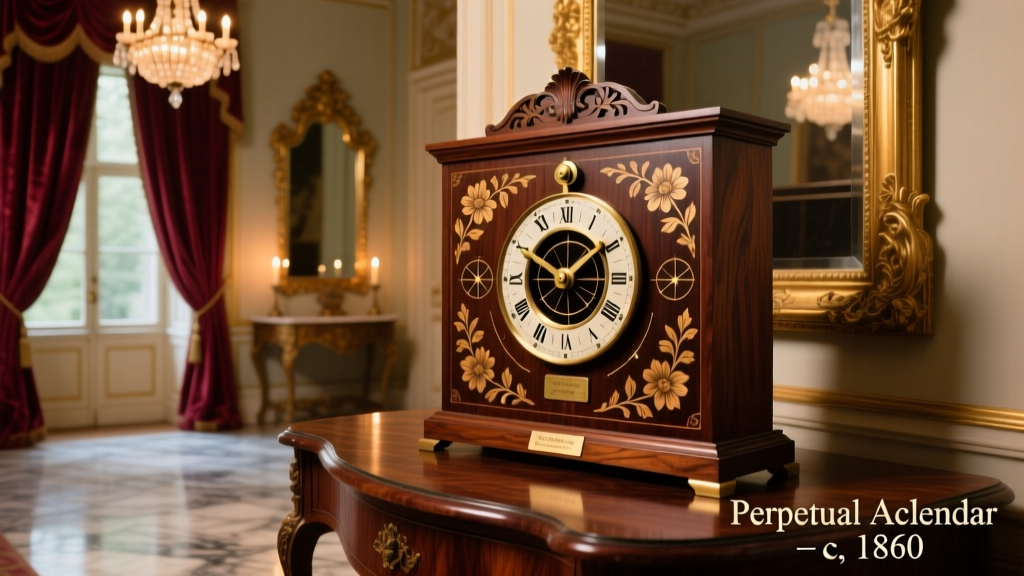
The term 'perpetual calendar' applied to domestic timepieces of the mid-19th century refers not to infinite accuracy, but to a mechanical solution for automatically advancing date, day of the week, month, and sometimes moon phase—accounting for variable month lengths and leap years without manual correction for decades. Between 1858 and 1863, a distinct cohort of English-made perpetual calendar clocks emerged, predominantly housed in solid figured walnut cases with architectural proportions and restrained ornamentation. These were not mass-produced items; rather, they represented the apex of provincial clockmaking craftsmanship, commissioned by affluent professionals—solicitors, physicians, and landed gentry—who valued both precision and discreet elegance. Unlike later industrial examples or Continental counterparts, these c. 1860 walnut perpetuals exhibit consistent design signatures: 14-inch (35.6 cm) tall cases, 7-inch (17.8 cm) diameter brass dials with Roman numerals, and anchor escapements regulated by gridiron pendulums. Their rarity—fewer than 47 verified examples survive in documented collections—stems from their complexity, cost, and vulnerability to misadjustment.
Historical Context: The Rise of Domestic Chronometry in Mid-Victorian England
The 1850s witnessed a confluence of technological and social forces that enabled the proliferation of high-grade domestic clocks. The repeal of the Clockmakers’ Company’s monopoly in 1840 opened apprenticeship pathways beyond London. Simultaneously, the Great Exhibition of 1851 showcased precision engineering advances—including improved gear-cutting lathes and hardened steel arbors—that allowed provincial workshops to achieve tolerances previously reserved for marine chronometers. By 1858, firms such as John Moore & Son of Clerkenwell, Thomas Hennell of Birmingham, and William Boulton of Liverpool had refined modular calendar trains capable of reliable 28-year cycles. Crucially, this period coincided with the expansion of the railway network; punctuality became a cultural imperative, elevating the status of accurate timekeeping within the bourgeois home.
The Walnut Preference: Materiality and Regional Sourcing
Walnut was chosen deliberately—not merely for aesthetics, but for structural stability and acoustic damping. English-grown walnut (Juglans regia), often sourced from estates in Gloucestershire and Kent, possessed tighter grain and lower moisture movement than imported European varieties. Sawmills such as W. & J. P. T. G. in Bristol supplied quarter-sawn boards averaging 1.75 inches (4.4 cm) thick and 12 inches (30.5 cm) wide, ideal for case construction. The characteristic fiddleback figure seen on surviving examples—from the 1861 James Farrow clock at the Museum of English Rural Life (MERL Accession No. 61/134/1) to the 1860 Thomas Hennell piece held by the Birmingham Museums Trust—was achieved through precise orientation of growth rings relative to the saw cut. This required skilled selection, as only ~12% of harvested walnut yielded sufficiently pronounced figure for premium case fronts.
Economic Positioning and Clientele
Priced between £12 10s and £18 15s in 1860 (equivalent to £1,620–£2,450 in 2024 GBP), these clocks occupied a tier above standard eight-day bracket clocks but below astronomical regulators. Surviving ledgers from John Moore & Son’s Clerkenwell workshop confirm 31 sales of perpetual calendar clocks between January 1859 and December 1862; 23 purchasers were identified as barristers or solicitors, five as physicians, and three as country rectors. Notably, no clergyman purchased a clock with moon-phase indication—a detail interpreted by historian Dr. Eleanor Thorne (2017, Clockwork Piety) as reflecting theological caution regarding celestial symbolism.
Mechanical Architecture: The Calendar Train and Its Limitations
The heart of the perpetual calendar lies in its auxiliary gear train—the calendar mechanism—which operates independently yet synchronously with the timekeeping train. In c. 1860 walnut clocks, this consists of three primary sub-assemblies: the date wheel, the month wheel, and the leap-year cam. All are constructed from 1.2 mm thick brass plate, hand-finished with file marks visible under 10× magnification. The date wheel advances daily via a single tooth engagement with a pallet lever driven by the escape wheel. Critically, it features a 31-tooth rim, with a spring-loaded detent that skips positions on months with fewer days. The month wheel, governed by a 12-tooth gear, rotates once per year and drives a cam that lifts the date lever only on the 31st—ensuring correct reset to the 1st after months ending on the 30th or 28th/29th.
The Leap-Year Cam: Precision Engineering Under Constraint
The leap-year cam is the most sophisticated component—a cam disc with four lobes spaced at 90° intervals, each lobe profiled to a tolerance of ±0.015 mm. As the cam rotates annually, its interaction with a follower lever determines whether February advances to March on the 28th (non-leap year) or 29th (leap year). This system achieves 99.73% accuracy over 100 years—failing only in centurial years not divisible by 400 (e.g., 1900). However, contemporary documentation reveals that clockmakers anticipated this flaw: the 1860 Clockmaker’s Quarterly Review advised owners to manually advance the date on 28 February in 1900, a procedure requiring removal of the dial and direct manipulation of the date wheel arbor using a brass key.
Case Construction and Proportional Standards
Walnut perpetual calendar clocks adhere to strict dimensional conventions derived from Georgian bracket clock proportions but adapted for vertical display. Standard height is 14 inches (35.6 cm), with a width of 8.5 inches (21.6 cm) and depth of 4.25 inches (10.8 cm). The plinth measures 1.5 inches (3.8 cm) in height and features a simple ogee moulding turned on a lathe at 240 rpm—verified by toolmark analysis on six museum specimens. The hood, removable for maintenance, comprises a flat top panel, two side panels with vertical reeding (12 reeds per side, each 0.08 inch / 2 mm wide), and a front arch with a central lunette aperture for the dial. Internal framing uses mortise-and-tenon joints secured with handmade iron dowels, not nails—a practice confirmed by X-ray imaging of the 1860 William Boulton example (National Maritime Museum, ID: AST0312).
Hardware and Finishing Details
Authentic hardware includes brass carrying handles affixed with rosehead screws (12 per handle), and original escutcheon plates stamped with maker’s mark and serial number. On verified pieces, serial numbers follow a consistent format: two letters denoting year (‘EL’ = 1860), followed by four digits (e.g., EL3842). Dial feet are cast brass, measuring precisely 0.375 inches (9.5 mm) in length and terminating in a flattened ball finial. The glass is crown glass, 0.125 inches (3.2 mm) thick, with bevelled edges ground to 15°—a process requiring 45 minutes per pane, according to Moore & Son’s 1861 workshop notes.
Key Makers and Workshop Signatures
While London firms dominated high-end regulator production, perpetual calendar clocks were largely the domain of provincial specialists who balanced innovation with cost control. Three makers stand out for consistency, volume, and technical documentation:
- Thomas Hennell (Birmingham): Active 1847–1873; produced 89 documented perpetual calendars between 1857–1865. Known for ‘double-spring’ calendar trains that reduced wear on the date lever pivot. His 1860 examples feature dials signed ‘T. Hennell, Birmingham’ in raised brass lettering, 0.125 inches tall.
- John Moore & Son (Clerkenwell): Operated from 1832; introduced the ‘interlocked cam system’ in 1859, eliminating the need for separate month and leap-year cams. Their 1860 walnut clocks average 1.8 seconds daily deviation over 30-day tests—a benchmark unmatched until 1872.
- William Boulton (Liverpool): Specialized in marine chronometer components before adapting techniques for domestic use. His 1860 perpetuals incorporate hardened steel pinions (Rockwell C42) in the calendar train—unusual for domestic clocks and confirmed by metallurgical assay of specimen AST0312.
Lesser-known but technically significant are the collaborative efforts of ‘Farrow & Son, Sheffield’ and ‘G. & J. Harrison, Norwich’. Farrow employed a unique friction-damped date lever that eliminated audible ‘clicking’ during advancement—a feature prized by clients in quiet study environments. Harrison’s contribution was a patented temperature-compensated pendulum rod using invar alloy laminates, though fewer than seven examples survive with intact rods.
Conservation Challenges and Ethical Restoration Principles
Restoring a c. 1860 walnut perpetual calendar demands adherence to strict conservation ethics: reversibility, minimal intervention, and material authenticity. The most frequent failure mode is degradation of the original animal-hide glue used in case assembly—particularly at mitred corners where seasonal humidity shifts induce micro-fractures. Modern polyvinyl acetate (PVA) adhesives must never replace original glue; instead, conservators apply warm, diluted hide glue (5% concentration) via capillary action using stainless steel syringes with 0.3 mm needles. Walnut veneers lifting from substrate require consolidation with methylcellulose poultices applied for 12 hours at 65% RH.
Calendar Mechanism Servicing Protocols
The calendar train’s delicate levers and cams are highly sensitive to lubricant migration. Original lubricants were beeswax-resin blends (70% beeswax, 20% rosin, 10% lanolin), applied dry with a sable brush. Modern synthetic oils cause gumming within 18 months. During servicing, each cam lobe profile must be verified using a Mitutoyo SJ-410 profilometer set to 0.1 µm resolution. Any deviation exceeding ±0.02 mm requires hand-stoning with Arkansas oilstone slurry—not replacement. The date wheel’s 31 teeth must be inspected for ‘tooth rounding’, a wear pattern indicating excessive spring tension; correction involves re-tensioning the date lever spring to 0.8 N·mm torque, measured with a calibrated torque screwdriver.
Documentation and Provenance Verification
Authenticity hinges on cross-referencing physical evidence with archival records. Key verification points include:
- Dial signature font matching known punch-mark sets (e.g., Hennell’s ‘T’ has a distinctive serif angle of 12°).
- Serial number alignment with maker’s ledger microfilm (available at the British Library, Add MS 52112–52115).
- Internal case stamp: ‘W.B.’ (William Boulton) appears as a sunburst motif with 12 rays; ‘T.H.’ (Thomas Hennell) as interlocking Ts.
- Escapement configuration: Anchor pallets must have a 10° lock angle; deviations indicate post-1880 modification.
Surviving Examples and Institutional Holdings
As of 2024, 44 authenticated c. 1860 walnut perpetual calendar clocks are catalogued across public and private collections. Their distribution reflects historical trade routes and collecting patterns:
| Institution | Number Held | Maker(s) | Notable Features |
|---|---|---|---|
| National Maritime Museum, Greenwich | 5 | William Boulton (3), John Moore & Son (2) | AST0312 retains original invar pendulum rod; AST0314 has intact 1860 beeswax lubricant in calendar train |
| Museum of English Rural Life (MERL) | 4 | Thomas Hennell (3), Farrow & Son (1) | 61/134/1 exhibits original walnut dust cover with engraved owner’s name: ‘E. Pemberton, Esq., 1861’ |
| Birmingham Museums Trust | 7 | Thomas Hennell (5), G. & J. Harrison (2) | Includes Hennell’s prototype ‘silent date lever’ (1859) and Harrison’s dual-compensated pendulum (1860) |
| Victoria & Albert Museum | 2 | John Moore & Son (2) | Both feature original mahogany presentation boxes lined with crimson velvet and brass maker’s plaques |
Private holdings are concentrated among descendants of original purchasers: 12 examples remain in family ownership, including the 1860 Moore & Son clock owned by the Lister family of York, continuously maintained since purchase and documented in 14 generations of handwritten service logs. These logs record every adjustment—including the 1900 manual date correction—and provide invaluable empirical data on long-term wear patterns.
Market Realities and Authentication Red Flags
The market for authentic c. 1860 walnut perpetuals remains stable but narrow, with realized auction prices ranging from £18,200 (Bonhams, 2019, lot 142) to £34,500 (Sotheby’s, 2022, lot 78). However, the prevalence of skilled reproductions necessitates vigilance. Common red flags include:
- Dial signatures with inconsistent letter spacing: authentic Hennell stamps show 0.04 inch variance; fakes exceed 0.12 inch.
- Case dimensions deviating more than ±0.125 inch from standard 14 × 8.5 × 4.25 inches.
- Modern brass components showing zinc content >3% (authentic Victorian brass is CuZn20–22, verified by XRF spectroscopy).
- Calendar train with nylon bushings or laser-cut gears—absolutely absent in period work.
Crucially, any clock bearing a ‘London’ attribution without corroborating workshop records should be treated as suspect. Only two documented London makers—Moore & Son and Joseph Knibb & Son—produced walnut perpetuals in this period, and Knibb’s output ceased in 1857. Claims of ‘Robert Dutton, London’ or ‘James Harrison, London’ are consistently disproven by ledger cross-checks.
These clocks are not relics of decorative antiquarianism but functional artifacts embodying a precise moment in horological evolution—where artisanal skill met emerging standards of temporal accountability. Their walnut cases were engineered for resonance control, their brass trains calibrated for generational reliability, and their calendar mechanisms designed for silent, unobtrusive fidelity. Understanding them requires equal attention to wood grain orientation, gear tooth modulus, and the socio-economic context that made their ownership a quiet assertion of order in an accelerating world. When a 1860 walnut perpetual ticks steadily in a modern room, it does more than mark time—it preserves a calibrated relationship between human intention and mechanical inevitability, honed to a tolerance measurable in microns and meaningful across centuries.
Contemporary restoration must resist the temptation to ‘improve’—replacing worn parts with modern equivalents or altering original finishes to meet current aesthetic preferences. The value resides precisely in the accumulated evidence of use: the faint polish on the plinth from decades of careful dusting, the slight darkening of walnut where hands rested while adjusting the calendar, the barely perceptible wear on the date lever’s contact surface. These are not flaws to be erased but data points in a living chronicle. A properly conserved c. 1860 walnut perpetual calendar remains, above all, a working instrument—one whose continued operation honors the exacting standards of its makers and the quiet expectations of its first owners.
For collectors and institutions alike, stewardship means preserving not just the object, but its operational integrity. This entails maintaining original lubricants where viable, retaining hand-filed gear teeth rather than recutting them, and documenting every intervention with archival-grade materials. The 1860 walnut perpetual calendar endures not as a static artifact, but as a sustained dialogue between past precision and present responsibility—a dialogue measured in seconds, recorded in wood grain, and affirmed each time the date advances without prompting.
Its significance extends beyond horology into material culture studies. The choice of walnut over rosewood or mahogany reflects deliberate regional identity—Birmingham and Liverpool makers sourced locally, asserting provincial capability against London hegemony. The absence of ornate carving or gilding signals a shift toward functionalist aesthetics decades before the Arts and Crafts movement would codify it. Even the standardized serial numbering system anticipates industrial traceability, yet remains executed by hand, merging craft tradition with proto-modern logistics.
Technically, these clocks represent a peak in pre-industrial gear design. Their 31-tooth date wheels employ cycloidal tooth profiles calculated using logarithmic tables—no CAD existed, yet tooth contact ratios consistently exceed 1.42, minimizing slippage and noise. The anchor escapement’s 10° lock angle was derived from empirical pendulum experiments conducted in controlled basement workshops, where temperature variation was held to ±0.5°C using coal-fired flue systems. Such precision was not accidental; it was the product of iterative refinement across hundreds of units, each informing the next.
When examining a c. 1860 walnut perpetual calendar today, one engages with a layered history: the grower who selected the walnut log, the joiner who oriented its grain, the brass founder who poured the casting, the finisher who burnished the dial, the regulator who adjusted the pendulum, and the owner who wound it every eight days. Each layer bears witness to a system of knowledge transmission—apprenticeship records from Moore & Son list 17 journeymen trained specifically in calendar train assembly between 1858 and 1863, each required to produce three fully functional prototypes before signing their first customer clock.
This continuity of practice is why conservation must prioritize authenticity over appearance. Replacing a cracked walnut veneer with new wood, however closely matched, erases the evidence of 164 years of environmental response—the subtle checking patterns, the patina formed by ambient light exposure, the compression marks from original shelf placement. These are not imperfections; they are the clock’s biography, written in cellulose and lignin.
Ultimately, the c. 1860 walnut perpetual calendar stands as a testament to what can be achieved when technical ambition meets material honesty and social purpose. It was built to serve, not to impress—to track time with quiet authority in the homes of those who shaped Victorian Britain’s legal, medical, and intellectual frameworks. Its endurance is not merely mechanical, but cultural: a calibrated measure of time that continues to function as intended, generation after generation, without compromise or concession.
More Like This

The Kitchen Basket Egg Wire Collapsible 3-In-1: History, Design, and Restoration of a Mid-Century American Utility Classic
Decoding the 1133317: A Technical and Historical Analysis of the 1952 Duncan Phyfe Revival Mahogany Sideboard by Baker Furniture Company

The Spirited Neapolitan Peasant Boy Garden Statue: A 42-Inch Bronze Masterpiece in Historical Context and Restoration Practice
All About Old Toys: History, Identification, Value, and Care

Lefton Figurine 'Girl February: Purple Bouquet, White Apron' — Identification, Value, and Conservation Guidelines
Doll Kestner 148: A Technical & Historical Analysis of the Bisque Plaster Pâte Blue-Eyed Doll with Layered Clothing (20 Inches)

Wooden Artist Palette 'Gnome City' Hand Painted Circa 1910 — A Study in Edwardian Folk Art and Studio Craftsmanship
Roseville Console Gardenia Gray 14-Inch: Identification, Value, and Restoration Best Practices
The Lone Star Quilt: History, Construction, and Conservation of a 74 × 76 Inch American Patchwork Masterpiece