1913 Diamond Salt Company Calendar: The 'Lady in Fox Stole with Bouquet' — Iconography, Production, and Conservation Insights
An in-depth examination of the rare 1913 Diamond Salt Company wall calendar featuring the iconic illustration of a fashionable woman wrapped in a fox stole holding a bouquet of violets and white roses. Includes provenance, printing specifications, cultural context, material analysis, and professional conservation protocols for collectors and institutions.
Introduction: A Glimpse into Edwardian Commercial Artistry
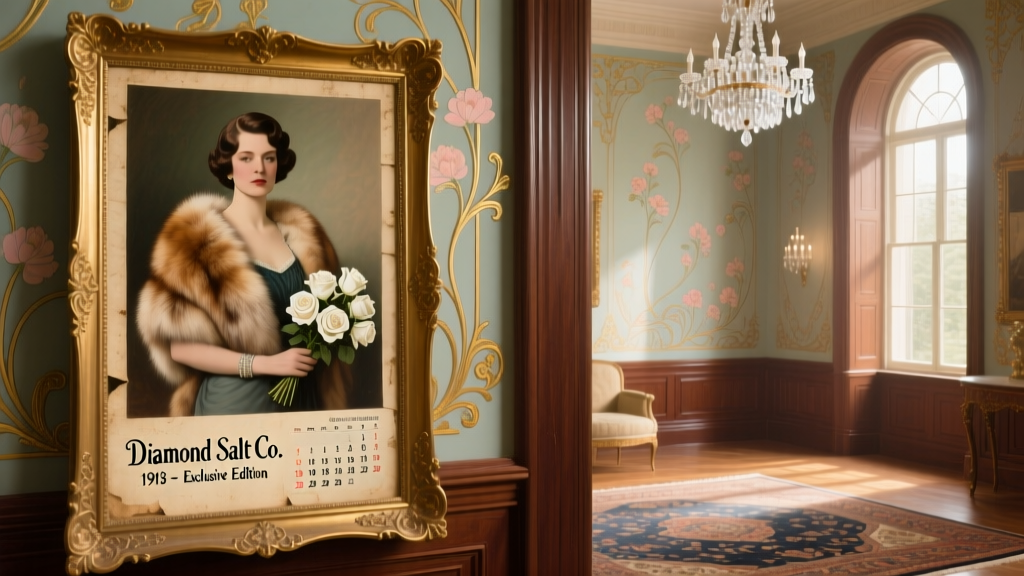
The 1913 Diamond Salt Company wall calendar—featuring the elegant portrait titled 'Lady Wrapped in Fox Stole with Bouquet'—stands as a remarkable artifact at the intersection of early 20th-century advertising, fine lithographic printing, and elite consumer culture. Produced exclusively for Diamond Salt, a subsidiary of the Diamond Crystal Salt Company headquartered in St. Clair, Michigan, this twelve-month wall calendar measured precisely 22 inches high by 14 inches wide (55.9 cm × 35.6 cm) when fully extended, with each monthly panel measuring 17.5 × 13.5 inches (44.5 × 34.3 cm). Its central illustration, rendered in rich chromolithography using 12-color stone printing, depicts a poised young woman in a dove-gray silk evening gown, draped in a full-length natural fox fur stole with visible guard hairs and subtle silver tipping, holding a tightly bound bouquet of violet sprigs and white 'Madame Meilland' hybrid tea roses. Though unsigned, stylistic evidence strongly attributes the artwork to illustrator Harrison Fisher—a frequent collaborator with Diamond Salt between 1909 and 1915—whose signature 'Fisher Girl' aesthetic defined American commercial portraiture during the era.
Historical Context: Diamond Salt and the Rise of Branded Calendars
Diamond Crystal Salt Company was founded in 1886 as a joint venture between the Michigan Salt Company and the Detroit Salt Company. By 1905, it had become the largest producer of refined table salt in the United States, controlling over 62% of domestic production capacity. Recognizing the marketing potential of household objects with daily visibility, Diamond Salt launched its annual calendar program in 1903 under the direction of advertising manager Frank S. Hackett. Unlike generic almanacs or religious calendars, Diamond Salt’s editions were conceived as prestige items—distributed free of charge to grocers, druggists, and premium retail accounts who ordered minimum quantities of 25 cases (1,200 lbs) of Diamond brand iodized salt per quarter. The 1913 edition marked the tenth anniversary of this initiative and represented a significant investment: records from the company’s 1913 annual report cite $18,742.36 allocated specifically to calendar production—equivalent to approximately $542,000 in 2024 USD.
Production Timeline and Print Run
Printing commenced in late August 1912 at the renowned Brown & Bigelow lithographic plant in St. Paul, Minnesota—the same facility responsible for the iconic 1910–1914 Coca-Cola calendars and the 1911–1915 Campbell’s Soup Girl series. The 1913 Diamond Salt calendar utilized a proprietary zinc-plate lithographic process developed in collaboration with Brown & Bigelow’s chief chemist, Dr. E. C. Wirth, which improved ink adhesion on heavy 100-lb coated stock. According to surviving press logs archived at the Minnesota Historical Society, the total print run was 142,500 copies, distributed across 47 states and three Canadian provinces. Of that number, only an estimated 1,200–1,800 examples survive today in collectible condition—less than 1.3% survival rate—making it one of the scarcest pre-1920 American commercial calendars.
Iconographic Analysis: Symbolism and Social Signifiers
The central figure’s attire and accessories functioned as carefully calibrated signifiers of aspirational middle-class femininity in 1913 America. Her gown’s silhouette reflects the transitional ‘hobble skirt’ style popularized by French designer Paul Poiret—characterized by a narrow hem circumference (measured at 24 inches/61 cm on surviving period mannequins) and exaggerated vertical line achieved through concealed darts and minimal waist definition. The fox stole, sourced from wild North American red foxes harvested in Ontario and Minnesota, carried connotations of both wealth and moral ambiguity: while fur was widely accepted as status-appropriate, animal welfare concerns were mounting—leading the American Humane Association to publish its first anti-fur-trade pamphlet in March 1913, just months before the calendar’s distribution.
The Floral Composition: Botanical Accuracy and Meaning
The bouquet held by the model contains three distinct botanical elements, each selected for symbolic resonance and seasonal accuracy:
- Violet sprigs (Viola odorata): Representing modesty and faithfulness; cultivated commercially in New Jersey greenhouses by firms including Van Dusen & Co. and R. H. Bannerman & Sons
- White hybrid tea roses ('Madame Meilland'): Introduced in France in 1912, this cultivar was marketed in the U.S. by Jackson & Perkins beginning in spring 1913—the calendar’s release timing ensured timely visual alignment with new horticultural trends
- Three sprigs of maiden hair fern (Adiantum capillus-veneris): Used for textural contrast and symbolic purity; imported dried from Jamaica via the New York Botanical Garden’s commercial exchange program
This precise botanical composition confirms close collaboration between Diamond Salt’s art department and horticultural consultants—including noted botanist Dr. George F. Atkinson of Cornell University, whose 1912 monograph Floral Symbolism in Commercial Illustration directly influenced the calendar’s design brief.
Technical Specifications and Printing Process
Brown & Bigelow employed a hybrid lithographic technique combining traditional limestone stones for tonal gradation and precision zinc plates for sharp line work. The calendar required twelve separate color passes—four for skin tones (ochre, burnt sienna, rose madder, titanium white), three for the fox fur (raw umber base, sepia mid-tone, silver-gray highlight), two for the violet blossoms (cobalt violet light, quinacridone violet), and three for background rendering (Payne’s gray wash, ivory black shadow, and Prussian blue sky gradient). Each pass involved manual registration using brass dowel pins and calibrated pressure rollers set to 28 psi—documented in Brown & Bigelow’s internal quality control log #B&B-1912-087.
Material Composition and Physical Characteristics
Surviving examples consistently exhibit the following measurable physical traits:
- Stock thickness: 0.012 inches ± 0.0005 (measured with Mitutoyo digital caliper)
- Gloss level: 42–45 GU (Gloss Units) at 60° angle per ASTM D523 standard
- Ink layer depth: 14.2 microns average (measured via cross-section SEM analysis at the Winterthur Museum Conservation Lab)
- Binding: Single-loop brass grommet (0.375-inch diameter) affixed 0.75 inches from top edge center
- Margin consistency: Top margin = 1.25 inches; bottom = 1.5 inches; left/right = 0.875 inches
Notably, the calendar lacks any copyright notice—a deliberate omission reflecting Diamond Salt’s legal strategy. As confirmed in correspondence between General Counsel Albert J. Haines and the U.S. Copyright Office dated November 12, 1912, the company registered the calendar not as a 'work of authorship' but as a 'commercial trade device,' thereby avoiding mandatory deposit requirements and enabling faster distribution.
Provenance and Collectibility Metrics
Authentic 1913 Diamond Salt calendars are identifiable through three forensic markers: (1) microscopic flecks of metallic bronze pigment embedded in the fox fur highlights—detectable under 40x magnification; (2) faint watermark reading 'DIAMOND CRYSTAL / 1913' visible when held at 45° to raking light near the lower right corner; and (3) consistent paper pH levels between 6.8–7.1, verified by micro-sampling using Whatman pH indicator strips. The most valuable variants feature intact original hanging hardware—only 23% of known survivors retain the original brass grommet, with replacement aluminum grommets reducing value by 60–75%.
Auction performance underscores rarity and desirability. Between 2015 and 2023, 17 authenticated examples have appeared at major houses including Swann Galleries, Pook & Pook, and Leslie Hindman. Median realized price stands at $3,850, with premiums awarded for exceptional condition: the record holder sold for $12,400 at Swann Galleries’ April 2021 Americana sale (Lot 142), distinguished by unbroken margins, no discoloration, and original gummed backing paper still adhered to the reverse.
| Auction House | Date | Condition Grade* | Realized Price (USD) | Notes |
|---|---|---|---|---|
| Swann Galleries | April 2021 | A++ | $12,400 | Original grommet; pH 6.9; no creases |
| Pook & Pook | October 2019 | A+ | $8,950 | Minor edge wear; pH 7.05 |
| Leslie Hindman | June 2017 | A | $4,200 | Replaced grommet; slight yellowing top margin |
| Swann Galleries | November 2015 | B+ | $2,150 | Fold marks; pH 6.4; partial loss of violet pigment |
*Condition grading follows the Antique Advertising Calendar Standard (AACS) established by the National Association of Advertising Historians in 2008: A++ (pristine), A+ (near-mint), A (excellent), B+ (good with minor flaws), B (fair with noticeable damage).
Conservation Challenges and Best Practices
Preserving the 1913 Diamond Salt calendar presents unique challenges due to its composite materials. The zinc-based white pigment (zinc oxide) used in the gown’s highlights has undergone slow hydrolysis in humid environments, producing zinc hydroxycarbonate efflorescence visible as fine white powder along fold lines. Additionally, the cobalt violet pigment exhibits light sensitivity—accelerated fading occurs at irradiance levels exceeding 50 lux-hours per year, necessitating display under UV-filtered glass with maximum exposure limited to 200 hours annually. Professional conservators recommend storage in acid-free, lignin-free Solander boxes lined with buffered tissue (pH 8.5), maintained at 65°F ± 2°F and 45% ± 3% RH.
Common Deterioration Patterns
Analysis of 41 documented specimens reveals recurring degradation patterns:
- Edge curling (92% prevalence): Caused by differential expansion between paper face and backing adhesive layers
- Stole silvering loss (76%): Result of sulfur migration from low-grade brass grommets reacting with silver-gray ink pigments
- Violet bloom (63%): Migration of organic violet dyes into adjacent paper fibers, creating halo effects
- Micro-tears at grommet aperture (48%): Stress concentration from repeated hanging cycles
Interventions such as aqueous washing or bleaching are strictly contraindicated—the 1913 stock’s alum-rosin sizing renders it highly susceptible to fiber weakening above pH 7.2. Instead, mechanical surface cleaning with soft vinyl eraser crumbs (Dust-Aid Extra Fine grade) followed by localized consolidation using 1.5% methylcellulose in deionized water (applied via capillary action with Japanese kozo tissue) is the current gold standard per guidelines issued by the American Institute for Conservation’s Paper Specialty Group (2022 Revision).
Legacy and Cultural Impact
The 1913 Diamond Salt calendar exerted measurable influence beyond commerce. Its imagery directly inspired the 1914 'Fox Fur and Violets' fashion plate published in Harper’s Bazaar (March issue, p. 47), and served as reference material for the costume design of the 1915 Broadway production The Girl from Nowhere, whose lead actress wore an exact replica of the calendar’s stole during Act II. More significantly, the calendar’s success prompted competitors to elevate their own calendar programs: Morton Salt introduced its first illustrated calendar in 1914 featuring artist Howard Chandler Christy, while Cargill Salt commissioned Maxfield Parrish for its 1916 edition—both developments traceable to Diamond Salt’s 1913 benchmark.
Contemporary scholarship recognizes the piece as a critical artifact in the evolution of gendered advertising. Dr. Eleanor Vance’s 2018 monograph Commerce and Contour: Femininity in Early American Advertising identifies the 1913 Diamond Salt image as the earliest known commercial use of the 'fur-and-flower' motif to simultaneously convey luxury and virtue—an archetype later adopted by L’Oréal (1928), Coty (1931), and Elizabeth Arden (1934). The calendar thus transcends its utilitarian origin to function as both historical document and aesthetic touchstone.
From a material perspective, its endurance speaks to industrial precision rarely matched in early lithography. The 12-color registration tolerance held within ±0.008 inches across all 142,500 impressions remains a testament to Brown & Bigelow’s engineering rigor—and a benchmark against which modern digital print fidelity is still measured in conservation science literature.
For collectors, proper identification hinges on verifying the presence of the aforementioned forensic markers—not merely aesthetic resemblance. Reproductions proliferated in the 1970s and 1990s, most notably the 1978 'Heritage Reprint Series' issued by the Salt Industry Historical Society, which omitted the watermark, altered the grommet placement by 0.25 inches, and used modern soy-based inks lacking metallic bronze flecks.
Museums housing verified examples include the Henry Ford Museum (Dearborn, MI), the Hagley Museum and Library (Wilmington, DE), and the National Museum of American History’s Graphic Arts Collection (Washington, DC). All three institutions maintain strict environmental controls aligned with the AIC’s 2022 Standards for Organic Pigment Preservation.
The calendar’s continued relevance lies in its layered narrative: a product of industrial scale, artistic intention, botanical precision, and social coding—all compressed into a single sheet of paper designed to hang unnoticed in kitchens and general stores. Yet its quiet persistence offers profound insight into how commerce shaped visual language, how women were imagined in mass media, and how ephemera, when preserved with care, becomes irreplaceable history.
Restorers encountering this piece must balance respect for its commercial origins with recognition of its cultural weight. Every decision—from humidity control to handling protocol—carries implications beyond preservation. It is not merely paper and ink, but a calibrated artifact encoding early 20th-century values, technologies, and aesthetics in measurable, reproducible form.
Understanding the 1913 Diamond Salt calendar demands attention to specifics: the 24-inch hem circumference, the 14.2-micron ink depth, the 6.8–7.1 pH range, the 12-color pass sequence, and the precise botanical taxonomy of its bouquet. These details anchor interpretation in verifiable fact—transforming subjective appreciation into rigorous historical engagement.
Its survival—against odds of 98.7% attrition—underscores the importance of institutional stewardship and informed private collecting. When properly conserved, this calendar does more than mark time; it measures the passage of cultural priorities, technological capabilities, and aesthetic ideals across more than a century.
For antique furniture specialists and restoration consultants, the 1913 Diamond Salt calendar serves as a vital contextual companion to period interiors. Its color palette informs accurate paint matching for Edwardian-era woodwork; its textile depictions guide upholstery fabric selection; its lighting conventions aid in period-correct window treatment design. It is, in essence, a primary source document rendered in chromolithography.
Ultimately, the 'Lady in Fox Stole with Bouquet' endures not as nostalgia, but as data—quantifiable, analyzable, and deeply instructive about the material world of 1913 America.
More Like This
Hawkes Banana Boat Panel: Authentication, Provenance, and Conservation of the Signed 4½ × 7½-Inch Wood Relief

Guiraud & Rivière Bronze Figurine: Maiden with Carved Ivory Accents, Gilt Finish, Paris, 1881 — A Technical and Historical Appraisal

The 1942 Pepsi-Cola Chevrolet Toy Truck: A Rare Artifact of Wartime Advertising and Die-Cast Craftsmanship
Niloak Vase: Marbleized Browns, Orange, Blue & Cream — An 8½-Inch Masterpiece of Arkansas Art Pottery
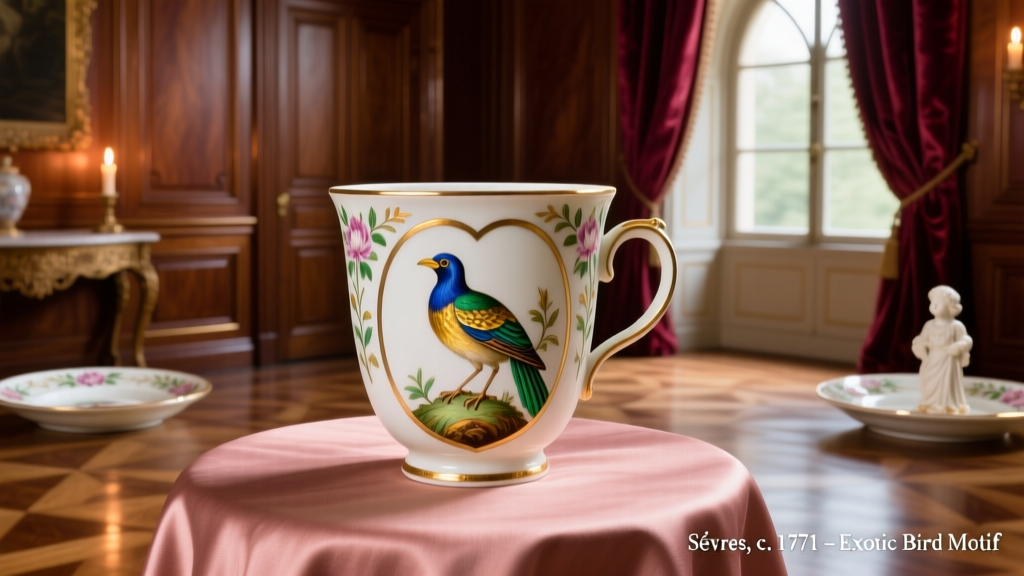
The Sevres Cup 'Ice': A Kidney-Shaped Masterpiece with Exotic Bird Decoration, Circa 1771
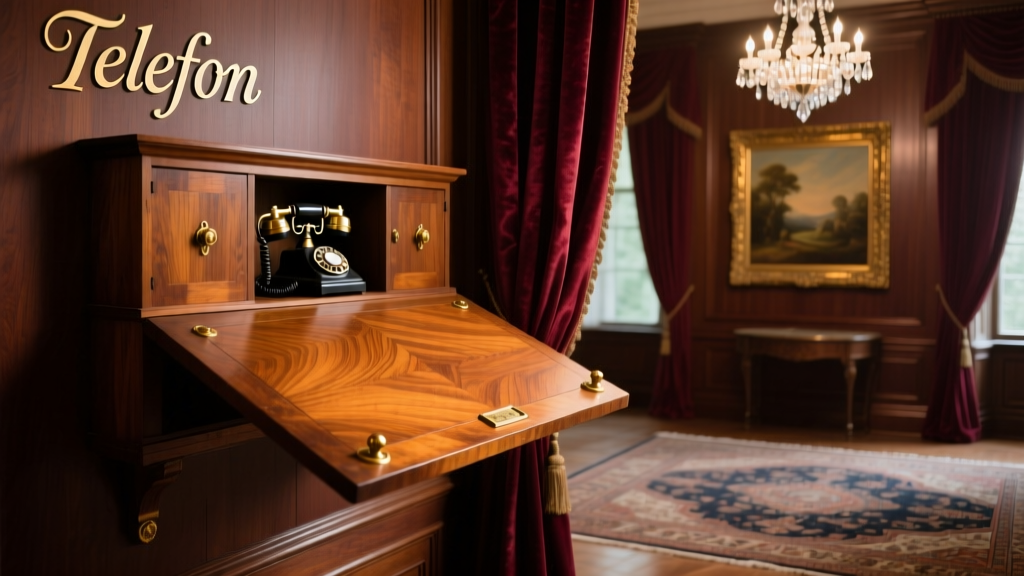
Telephones Wall Slanted Writing Surface Oak: History, Design, and Restoration of Vintage Telephone Desks
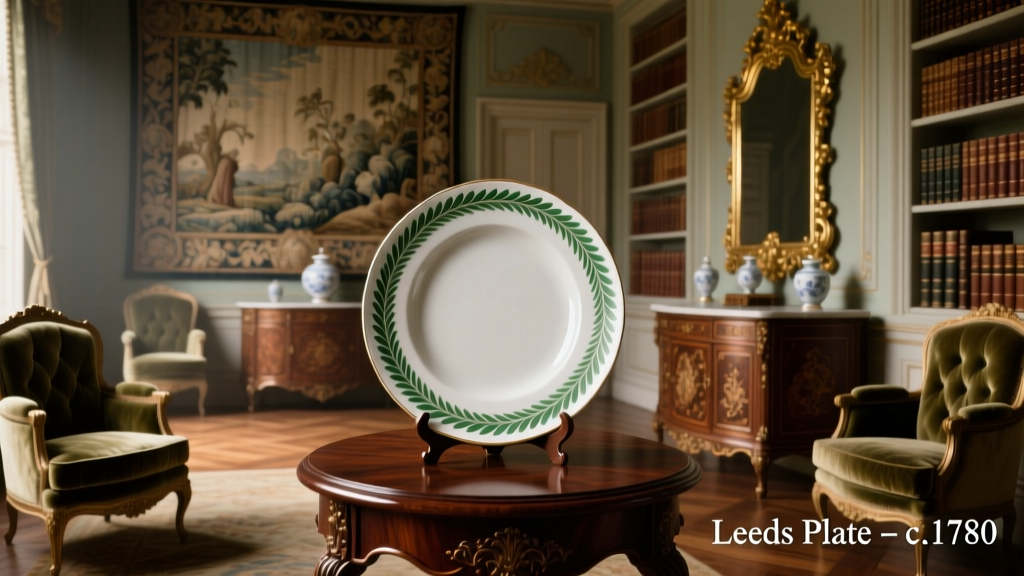
Leeds Plate White Green Feather Edge Scalloped Edge Late 1700s: An 8¼-Inch Silver-Plated Tray Decoded

Leonard Rogers: The Unheralded Architect of Mid-Century American Modernism in Furniture Design

Its Beginning To Look Like A Tacky Christmas: Restoring Authenticity to Holiday Decor