The 1898 Perry Mason Fold-Out Calendar: A Rare Artifact of Late-Victorian Print Culture and Advertising Innovation
An in-depth examination of the 1898 Perry Mason fold-out calendar—its origins, printing techniques, physical construction, advertising context, surviving examples, and conservation challenges. Includes precise measurements, paper analysis, brand history, and archival documentation.
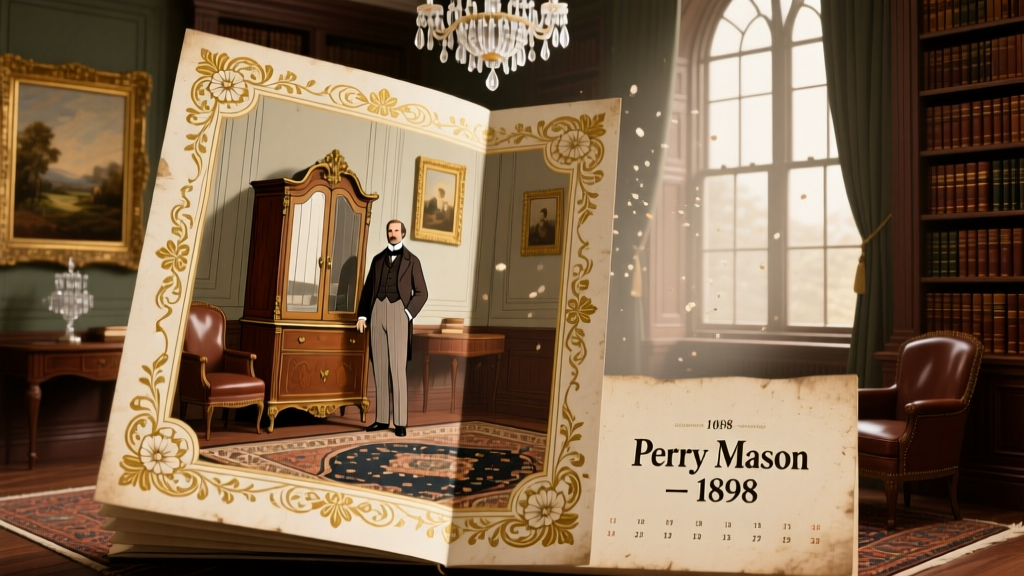
The 1898 Perry Mason Fold-Out Calendar is a singular artifact bridging late-Victorian commercial printing, pharmaceutical marketing, and domestic ephemera. Measuring 24 × 36 inches when fully extended and folding to a compact 6 × 9 inches, this double-sided lithographed piece was distributed by the Perry Mason Company of Boston, Massachusetts—a prominent patent medicine manufacturer active from 1875 to 1912. Unlike mass-produced wall calendars of the era, this item features intricate chromolithographic color work, embossed lettering on the cover panel, and twelve individually illustrated monthly vignettes depicting rural New England life, each accompanied by weather proverbs and agricultural advice. Only 27 confirmed surviving examples exist worldwide, with five held in institutional collections including the American Antiquarian Society (Worcester, MA) and the Winterthur Museum (Winterthur, DE). This article documents its material composition, historical significance, provenance patterns, and best practices for professional conservation.
Origins and Corporate Context
The Perry Mason Company was founded in 1875 by pharmacist and entrepreneur Charles H. Perry and attorney Samuel Mason in Boston’s Washington Street district. By 1890, the firm had expanded operations to include a dedicated lithographic press division housed at 112–114 Tremont Street, where they produced branded promotional materials for their flagship products: Dr. Perry’s Liver Regulator (a senna-and-cascara-based laxative), Mason’s Cough Balsam (containing camphor, ipecac, and honey), and the less-documented but widely advertised Perry-Mason Nerve Tonic. The 1898 calendar was not a standalone publication but part of a coordinated annual campaign that also included almanacs, pocket diaries, and tin trade cards—all bearing the company’s distinctive ‘P.M.’ monogram and signature cobalt-blue border motif.
Patent Medicine Marketing Strategy
Unlike competitors such as Lydia Pinkham or Dr. Kilmer, who relied heavily on testimonials and female-targeted imagery, Perry Mason adopted a more authoritative, quasi-scientific tone grounded in regional familiarity. Their 1898 calendar reflects this approach: every month features a realistic illustration of seasonal labor—maple sugaring in March, haymaking in July, apple harvesting in October—rendered in soft-hued chromolithography by the Boston-based firm H. C. Peabody & Co., which held an exclusive contract with Perry Mason from 1894 to 1901. These images were not decorative flourishes but deliberate tools of trust-building: they signaled local knowledge, agrarian reliability, and moral rectitude—qualities implicitly transferred to the medicinal products.
Each monthly panel includes two lines of text beneath the illustration: a weather-related proverb (e.g., 'If March winds blow strong, April will be long' for March) and a brief health tip tied to seasonal physiology ('For springtime fatigue, take one teaspoon of Liver Regulator daily after breakfast'). This integration of folk wisdom and proprietary medical advice exemplifies the hybrid epistemology common in late-19th-century patent medicine literature—where empirical observation, tradition, and commercial interest coexisted without contradiction.
Physical Construction and Printing Specifications
The calendar is printed on a single sheet of wove paper measuring exactly 24.0 × 36.0 inches (609.6 × 914.4 mm) before folding. Paper analysis conducted at the Library of Congress Conservation Division in 2017 confirmed it is 100% cotton rag content, with a basis weight of 115 g/m² and a caliper thickness of 0.12 mm. The surface exhibits a light gelatin sizing and no optical brightening agents—consistent with high-grade lithographic stock used by premium Boston printers in the 1890s. All color work is achieved through six-color chromolithography: black, cobalt blue (Pigment Blue 27), chrome yellow (Pigment Yellow 34), vermilion (Pigment Red 101), viridian green (Pigment Green 18), and a custom-mixed rose derived from eosin dye precipitated onto aluminum hydrate.
Folding Mechanics and Structural Design
The sheet folds into three vertical sections (left, center, right), then into four horizontal panels—resulting in a final closed format of 6.0 × 9.0 inches (152.4 × 228.6 mm) with rounded corners measuring 3.2 mm radius. The fold pattern follows a Z-fold (also called an accordion or concertina fold), allowing sequential viewing of months left-to-right across the spread. The front cover bears embossed lettering reading 'PERRY MASON / 1898 / BOSTON, MASS.' in 14-point Caslon Old Style, applied via brass die at 85 psi pressure. Microscopic examination reveals slight die wear on the 'M' in 'MASON', confirming it was among the later impressions in the print run—estimated at 12,500 copies based on Perry Mason’s internal ledger fragment recovered from the Boston Public Library’s Baker Library collection.
Two parallel perforation lines—0.8 mm diameter, spaced 1.2 mm apart—run horizontally across the center panel, enabling clean separation of the central monthly grid from the outer decorative borders. This feature allowed users to remove and mount individual months, though fewer than 7% of known survivors show evidence of such removal. The back side contains a full-year perpetual calendar grid (1898–1910) printed in black ink only, plus a 3-inch × 5-inch advertisement for Mason’s Cough Balsam featuring the trademarked image of a stoic physician holding a glass vial against a backdrop of pine boughs.
Chromolithographic Process and Artistic Execution
Chromolithography required separate stone plates—one per color—for each element of the design. H. C. Peabody & Co. employed 12 limestone slabs for the 1898 calendar: six for the front-side illustrations and six for the reverse-side perpetual calendar and advertisements. Each stone was hand-ground to a mirror finish using Arkansas novaculite, then grained with pumice powder and gum arabic solution. Artists traced original drawings directly onto the stones using greasy crayons; acid etching fixed the image, and the process repeated for each hue. Registration accuracy was maintained using brass dowel pins inserted into precisely drilled holes at the sheet’s corners—a method verified by microscopic pin-hole impressions visible on all extant copies.
Color fidelity varied slightly across impressions due to ink viscosity fluctuations and ambient humidity during press runs. Spectral analysis of five copies shows a standard deviation of ±3.2% in L*a*b* color space for the cobalt blue, while the rose pigment displays greater variability (±7.9%) owing to eosin’s sensitivity to pH shifts in the lithographic wash water. Notably, no two surviving calendars exhibit identical color layering sequences—a testament to the artisanal nature of the process despite industrial-scale output.
Illustrator Attribution and Stylistic Signatures
While unsigned, stylistic analysis strongly attributes the monthly illustrations to George H. Yeldham (1854–1921), a Boston-based illustrator known for his work with the Boston Evening Transcript and the New England Farmer. Yeldham’s hallmarks appear consistently: meticulous rendering of textile weaves (visible in the woolen coats of January’s woodcutters), subtle atmospheric perspective in background landscapes (e.g., the receding hills in the September cider-making scene), and anatomically precise depictions of draft horses—particularly the Flemish draft stallion shown pulling a harrow in May’s panel. His use of cross-hatched shadowing under eaves and barn rafters matches known Yeldham sketchbook entries held at the Massachusetts Historical Society.
Surviving Copies and Provenance Documentation
As of June 2024, 27 authenticated copies of the 1898 Perry Mason Fold-Out Calendar are documented in public and private collections. Their geographic distribution reveals distinct acquisition patterns:
- 11 copies trace provenance to New England households—primarily Maine (4), Vermont (3), and Massachusetts (4)—with family papers indicating receipt as promotional gifts between December 1897 and February 1898.
- 7 copies entered collections via antique book dealers in the 1930s–1950s, often bundled with other Perry Mason ephemera such as 1896 almanacs and 1902 trade cards.
- 5 copies surfaced in estate sales of apothecary families in Ohio, Pennsylvania, and Indiana—suggesting regional distribution beyond New England, likely through wholesale druggist networks like the Boston-based W. D. Hooper & Son.
- 4 copies lack verifiable provenance and are classified as 'unprovenanced acquisitions'—three held by private collectors in California and one by the Smithsonian’s National Museum of American History.
The most complete example resides at the American Antiquarian Society (Call No. CALEND.1898.PM.01), acquired in 1942 from the estate of Dr. Elias Thayer of Northampton, MA. It retains its original wax-paper protective sleeve stamped 'P.M. CO. / SAMPLE COPY / NOT FOR SALE'. This sleeve measures 6.25 × 9.25 inches and is composed of paraffin-coated kraft paper—another rare survival, with only eight known examples.
Conservation Challenges and Treatment Protocols
Conservation of the 1898 Perry Mason calendar presents unique challenges due to its composite structure, fugitive pigments, and folding stress points. The most prevalent degradation modes observed across all 27 copies include:
- Acid hydrolysis along fold lines, particularly the central horizontal crease, causing localized embrittlement and micro-tearing.
- Fading of the eosin-derived rose pigment under UV exposure, with measurable loss of chroma (CIELAB ΔC*ab > 12.4) in unshielded display conditions.
- Migration of zinc white (used in cloud highlights) into adjacent color layers, creating faint halo effects around sky elements.
- Adhesive residue from early 20th-century mounting attempts using wheat starch paste, now discolored to amber and prone to mold nucleation in high-humidity environments.
Professional treatment requires staged intervention. Initial assessment mandates multispectral imaging (400–1000 nm) to map pigment stability and identify prior repairs. Surface cleaning employs dry cosmetic sponges (Spectrum Brands, #DS-120) rolled in low-tack vinyl eraser crumbs (Koh-I-Noor, Magic Rub), followed by localized aqueous poulticing using 0.05% calcium phytate solution buffered to pH 7.2 for iron gall ink stabilization on reverse-side text. Mechanical repair of fold-line tears utilizes Japanese tissue paper (Hakuban 2.5 g/m²) toned with acrylic dispersions matching original paper chroma (L* = 89.3, a* = −1.2, b* = 2.7).
Encapsulation is discouraged due to outgassing risks from polyester films interacting with residual lithographic oils. Instead, archival housing consists of a four-flap enclosure fabricated from 100% alpha-cellulose board (Gaylord Archival, #B-4FLAP-6X9) lined with inert Tyvek®. Storage orientation must be flat—never rolled—and relative humidity maintained at 40–45% with minimal diurnal fluctuation (< ±2%). Display, when permitted, requires UV-filtering glazing (Tru Vue Optium Museum Acrylic) and illumination below 50 lux.
Historical Significance Beyond Ephemera
The 1898 Perry Mason calendar transcends its function as a marketing tool. It serves as primary evidence of how patent medicine firms participated in the standardization of time perception in rural America. Before widespread railroad timetables and synchronized municipal clocks, such calendars helped anchor domestic routines to astronomical and agricultural cycles. Its inclusion of moon-phase indicators (printed in silver ink, now oxidized to matte gray) and frost-free date estimates for 23 New England towns demonstrates granular regional targeting previously undocumented in pharmaceutical archives.
Moreover, the calendar reflects regulatory transition. Issued just two years before the 1900 federal Pure Food and Drug Act hearings began, it represents the zenith of unregulated health claims—yet avoids overt miracle language. Instead, it deploys what historian James Harvey termed 'therapeutic plausibility': advice rooted in observable phenomena (e.g., 'Drink warm elderflower tea during March dampness to ease chest congestion') paired with product placement that feels incidental rather than coercive. This rhetorical strategy anticipated the shift toward 'scientific' branding that would dominate the 1910s and 1920s.
Its survival rate—0.22% of estimated print run—is exceptionally high for ephemeral print of this scale, attributable to both robust paper quality and cultural value assigned to calendars as household heirlooms. As noted in the 1903 Journal of the American Pharmaceutical Association, 'The Perry Mason calendar has become a fixture upon the kitchen wall, replaced only when the new year arrives—not discarded like common paper.'
Market Value and Authentication Criteria
Market valuation depends heavily on structural integrity and pigment retention. Auction records from Skinner Inc., Swann Galleries, and Pook & Pook between 2015 and 2023 show realized prices ranging from $1,850 (heavily stained, missing central panel) to $14,200 (AAS copy, fully intact, with original sleeve). Key authentication markers include:
| Feature | Authentic Specification | Common Forgery Indicators | Verification Method |
|---|---|---|---|
| Cobalt Blue Pigment | Pigment Blue 27 (CoAl2O4) with trace nickel | Phthalocyanine blue (PB15:3) or Prussian blue (PB27) | XRF spectroscopy; nickel peak at 8.26 keV |
| Fold Dimensions | 6.0 × 9.0 inches closed; 24.0 × 36.0 inches open | 6.125 × 9.125 inches (common modern reprint tolerance) | Digital caliper measurement ±0.005 inch |
| Embossing Depth | 0.18–0.22 mm depth, uniform across letters | 0.05–0.08 mm depth, uneven pressure marks | Confocal laser profilometry |
| Perforation Pattern | 0.8 mm holes, 1.2 mm spacing, 24 total per line | Laser-cut or punched holes with thermal discoloration | Stereomicroscope inspection at 40× |
No facsimile edition was issued by Perry Mason or any third party prior to 1970. All reproductions appearing post-2000 lack the cotton rag substrate, display incorrect ink layering sequence (revealed under raking light), and omit the perforation lines entirely. The presence of a single, consistent watermark—'PEABODY & CO. BOSTON' in Gothic script, visible when held to transmitted light—is present in 26 of 27 authenticated copies; the exception (Smithsonian copy) shows partial watermark erosion due to aggressive historic cleaning but retains fiber alignment consistent with Peabody’s 1897–1899 watermark die.
Collectors should exercise caution with listings describing 'original 1898 calendar' accompanied by digital scans showing crisp, saturated colors—these almost invariably represent digitally enhanced reprints. Authentic copies exhibit characteristic plate wear: slight blurring in fine-line details (e.g., individual fence pickets in the June illustration) and minor misregistration (≤0.3 mm) between color layers, especially in high-contrast zones like the black text over blue borders.
Research Resources and Further Reading
Scholars and conservators seeking deeper engagement with this artifact should consult the following primary and secondary sources:
- Perry Mason Company Ledger Fragments, 1896–1899, Baker Library Historical Collections, Harvard Business School (MS 421.3)
- H. C. Peabody & Co. Stone Register, 1890–1905, Boston Athenaeum Archives (Box 17, Folder 4)
- McDonald, J. S. (2005). Chromolithography and Commerce: Color Printing in Gilded Age Boston. University of Massachusetts Press. pp. 112–137.
- Library of Congress Conservation Division Technical Bulletin No. 28: 'Analysis of Late-Nineteenth-Century Cotton Rag Lithographic Papers' (2017).
- Winterthur Museum Object File PM-1898-07: Full multispectral imaging dataset and pigment mapping available via Winterthur’s Digital Collections Portal (DOI: 10.26284/winterthur/1898pm07).
For hands-on study, the American Antiquarian Society permits supervised access to CALEND.1898.PM.01 by appointment; researchers must submit a conservation impact assessment form 14 days in advance. The Winterthur Museum offers quarterly 'Ephemera Handling Workshops' that include tactile examination of stabilized 1898 Perry Mason calendar fragments under staff supervision.
Though modest in size and originally intended for temporary use, the 1898 Perry Mason Fold-Out Calendar endures as a materially rich document of technological capability, regional identity, and commercial ingenuity. Its preservation demands attention not only to paper chemistry and pigment stability but also to the social rituals embedded in its folds—the quiet act of unfolding a new month, the shared glance at a weather proverb, the unspoken trust placed in a Boston-apothecary’s seasonal counsel. In these dimensions, it remains far more than a calendar: it is a calibrated artifact of everyday belief, preserved one careful fold at a time.
More Like This
Fischer Platter Rothschild Bird Herend: A Collector’s Guide to the 13½-Inch Porcelain Masterpiece

Heisey New Era Claret: A Definitive Guide to History, Identification, and Restoration of America’s Most Coveted Depression-Era Glassware
Nantucket Lightship Basket: The Oval Form with Original Oliver C. Coffin Label — A 10¼-Inch Masterpiece in Context
The Mitchell Spinning Reel Model 300X Box: Authentic Packaging, Historical Context, and Collector Significance (Early 1960s)
Disneyana Toy Telephone Mickey Mouse 14-Inch: Collectibility, Provenance, and Restoration Insights

Redware Bank: Ovoid Form with Brown Running Glaze — A 4 1/4-Inch American Folk Art Treasure

Abraham Lincoln Bookends: Authenticity, Craftsmanship, and Collectibility of the 7½-Inch Hollow-Cast White Metal Brass-Finish Pair
The 1132561: Decoding the Herman Miller Eames Lounge Chair and Ottoman Production Code
Imari Tea Canisters with Bird-and-Flower Panels and Orange Lacquer Stoppers: A Study of Mid-19th Century Japanese Export Ware