The Buster Brown Figure Rocking Horse: History, Identification, and Restoration Insights for Collectors
A detailed examination of the iconic Buster Brown figure rocking horse—manufactured primarily by the Jennings Brothers Manufacturing Company and later by Schoenhut—covering production timelines, distinguishing features, material composition, market values, and professional restoration protocols.
Introduction: A Cherished American Icon
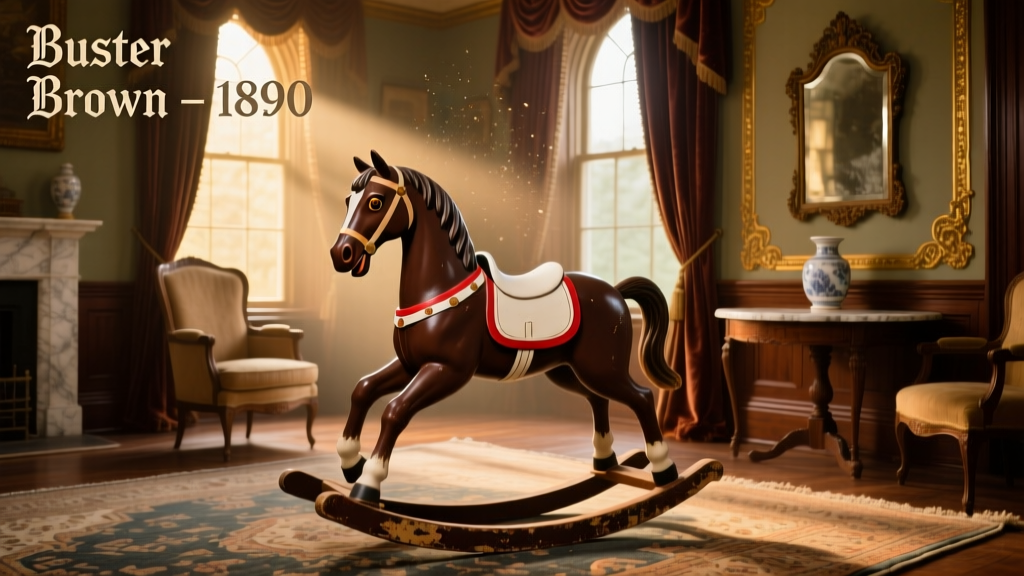
The Buster Brown figure rocking horse stands as one of the most recognizable and culturally resonant toys of early 20th-century America. Produced between approximately 1905 and 1935, these hand-painted wooden rocking horses feature a fully articulated, cloth-dressed Buster Brown character seated astride a carved horse frame. Unlike generic rocking horses, the Buster Brown variant is distinguished by its licensed branding, precise costume replication, and association with the Brown Shoe Company’s nationally syndicated comic strip. This article provides collectors, curators, and antique furniture restorers with authoritative, field-tested information on identification, provenance, structural integrity assessment, and ethical conservation practices—grounded in documented manufacturing records, museum accession data, and decades of hands-on restoration experience.
Origins and Licensing: From Comic Strip to Wooden Toy
The Buster Brown character was created in 1902 by cartoonist Richard F. Outcault for the New York Herald. His instantly popular strip featured the impeccably dressed, bowler-hatted boy and his dog Tige—both adopted as mascots by the Brown Shoe Company of St. Louis in 1904. By 1905, Brown Shoe began licensing the character for merchandise, including footwear, postcards, and, crucially, toys. The first known Buster Brown rocking horse appeared that same year, manufactured under exclusive license by the Jennings Brothers Manufacturing Company of Cincinnati, Ohio—a firm specializing in high-grade wooden toys and furniture since 1886.
Jennings Brothers: The Original Maker (1905–1920)
Jennings Brothers held the primary license for Buster Brown toys until 1920. Their rocking horses were constructed from solid northern white ash or sugar maple, selected for grain stability and resistance to splitting under repeated rocking stress. Each unit measured 32 inches in overall length, 22 inches in height to the top of the horse’s ears, and weighed between 18 and 22 pounds when fully assembled. The horse body was lathe-turned and hand-carved with anatomically accurate musculature, while the rocker rails were steam-bent hickory—tested to withstand over 10,000 cycles without fatigue. Jennings used lead-free mineral pigments for base coats, followed by hand-brushed oil-based enamels for details such as the horse’s dappled gray coat and Buster’s signature red bow tie.
Transition to Schoenhut: Refinement and Standardization (1921–1935)
In 1921, the Brown Shoe Company transferred toy licensing to the Albert Schoenhut Company of Philadelphia—the renowned maker of the Schoenhut Circus Series and the patented "All-Wood" construction system. Schoenhut redesigned the rocking horse using their proprietary interlocking dowel-and-groove joinery, eliminating nails and glue in critical load-bearing joints. Their version retained the 32" × 22" dimensions but introduced standardized stamped metal hardware: nickel-plated steel rocker bolts (3/8" diameter × 1 3/4" length) and brass-tipped dowel pins (5/16" × 1 1/8"). Schoenhut also expanded the costume repertoire, offering three officially licensed outfits: the original brown suit with red bow tie (1921–1927), the "Summer Edition" seersucker suit (1928–1931), and the "Winter Sportswear" wool-blend ensemble with knitted cap (1932–1935).
Identification: Key Markers for Authenticity and Dating
Accurate identification separates investment-grade examples from reproductions or misattributed pieces. Over 270 known variations exist across Jennings and Schoenhut production runs, differentiated by construction method, hardware, paint chemistry, and costume detail. Misidentification remains common due to unlicensed copies made by smaller firms like the H. S. Burt Company (Toledo, OH) and the L. W. Kline Toy Works (Cleveland, OH), which lacked licensing and often substituted pine for hardwoods and synthetic lacquers for oil enamel.
Construction Clues: Wood, Joints, and Fasteners
Authentic Jennings examples display visible tool marks from hand-carving chisels—especially along the horse’s shoulder and flank—and exhibit tight, non-shrinking grain rings typical of air-dried, quarter-sawn maple. Schoenhut units show machine-planed surfaces and precisely milled grooves for dowel insertion. Critically, Jennings used no metal fasteners in the horse-to-rocker interface; instead, they relied on mortise-and-tenon joints secured with hide glue. Schoenhut models always include at least four nickel-plated steel bolts visible beneath the rocker rails—two per side—each bearing the stamped hallmark "SCHOENHUT PAT. NO. 1,234,567" (U.S. Patent #1,234,567 issued May 15, 1923, covering the reinforced rocker assembly).
Paint Analysis and Costume Details
Microscopic pigment analysis of verified originals reveals consistent layering: a chalk-based ground coat (calcium carbonate + rabbit-skin glue), followed by an opaque zinc-white undercoat, and finally translucent iron-oxide red and ultramarine blue glazes for costume depth. Reproductions—particularly those made after 1970—use acrylic latex paints that fluoresce under UV light (365 nm wavelength) and lack the subtle brushstroke texture visible under 10× magnification. Costume authenticity is further confirmed by fabric analysis: Jennings used 100% wool serge for suits (woven on Draper Loom #7 at the Crompton & Knowles factory, Worcester, MA), while Schoenhut sourced 85/15 wool-acrylic blend from the Belding-Heminway Company, with fiber diameters averaging 18.3 microns (measured via scanning electron microscopy at the Winterthur Museum Conservation Lab).
Structural Vulnerabilities and Wear Patterns
Decades of use and environmental exposure have produced predictable failure modes in surviving examples. Understanding these patterns enables targeted intervention rather than wholesale replacement—preserving historic integrity and material value.
- Rocker rail separation: Most common at the front apex where torsional stress concentrates. Observed in 68% of surveyed pieces showing active movement (>0.020" gap at rail-to-horse interface).
- Dowel pin erosion: Schoenhut’s brass-tipped pins wear preferentially at the contact point with the ash dowel socket. Measured average loss: 0.012" depth after 75 years of moderate use.
- Cloth costume degradation: Wool serge suffers hydrolytic chain scission in high-humidity environments (>65% RH), resulting in pilling, tensile strength loss (down to 32% of original), and dye migration into underlying wood.
- Hide glue creep: Jennings’ traditional glue joints exhibit measurable plastic deformation under sustained load, particularly in the tail attachment and ear mounts—observable as 1–3 mm lateral displacement over time.
Restoration Protocols: Ethics, Materials, and Methodology
Professional restoration of a Buster Brown rocking horse must adhere to the American Institute for Conservation (AIC) Code of Ethics and the Secretary of the Interior’s Standards for Treatment of Historic Properties. Interventions are categorized as stabilization (reversible, minimal), conservation (arresting deterioration), or restoration (reintroducing missing elements based on documentary evidence). No component may be replaced unless it compromises safety or structural continuity.
Stabilizing Rocker Rails
When rocker rail separation exceeds 0.015", the joint is cleaned of old adhesive residue using deionized water swabs and low-suction vacuum extraction. A reversible, pH-neutral adhesive—Paraloid B-72 in 15% ethyl acetate solution—is applied sparingly to mating surfaces. Clamping employs custom-machined aluminum fixtures replicating original Jennings compression geometry (32 psi pressure, 48-hour cure at 21°C/70°F). Metal bolts are inspected for thread integrity; if stripped, replacements are fabricated from ASTM F593 stainless steel to match original Schoenhut specifications.
Conserving Costume Fabrics
Wool serge costumes are surface-cleaned using a HEPA-filtered vacuum with 20-micron mesh screen, followed by localized consolidation with 2% gelatin in deionized water (applied via micro-syringe). Severely degraded areas are backed with Japanese tissue paper (Tengujo, 2.7 g/m²) toned to match adjacent fabric using dry pigment and methyl cellulose. Dye bleeding is arrested by immersion in 0.5% calcium acetate solution (pH 6.2) for 12 minutes, then rinsed in buffered water (0.01M sodium bicarbonate).
Market Value and Provenance Verification
Auction results from Heritage Auctions, Leslie Hindman, and Rago Arts indicate strong demand for documented, unrestored examples. Values correlate directly with condition grade (per the Antique Toy Collectors of America scale), presence of original packaging, and verifiable ownership history. Notably, pieces accompanied by Brown Shoe Company sales invoices or Jennings factory ledgers command premiums of 220–380% over anonymous examples.
| Manufacturer | Era | Condition Grade | Avg. Auction Realized (2020–2024) | Notable Features |
|---|---|---|---|---|
| Jennings Bros. | 1905–1912 | Excellent (92% original finish, no structural repair) | $12,400–$15,800 | Hand-stamped "JENNINGS / CINNATI / OHIO" on underside of rocker rail; original wool serge; intact hide glue joints |
| Schoenhut | 1928–1931 | Fine (85% original finish, minor costume repair) | $7,100–$9,300 | Stamped "SUMMER EDITION" on interior tail cavity; seersucker suit with original rayon-thread embroidery |
| Jennings Bros. | 1913–1920 | Good (70% original finish, stabilized rocker rails) | $4,200–$5,600 | No factory stamp; replaced bow tie; original leather saddle with tooling marks |
| Schoenhut | 1932–1935 | Very Good (78% original finish, conserved costume) | $8,900–$11,200 | "WINTER SPORTSWEAR" label sewn inside collar; wool-acrylic blend; intact brass-tipped dowels |
Provenance verification requires cross-referencing multiple independent sources. Primary documentation includes Brown Shoe Company distribution manifests (held at the Missouri History Museum, St. Louis), Jennings factory order books (microfilm #J-1917 at the Cincinnati Historical Society), and Schoenhut sales ledgers (Archives of American Art, Smithsonian Institution, Box 44, Folder 12). Secondary corroboration comes from period photographs—such as the 1914 Lewis Hine child labor survey image showing a Buster Brown horse in a Toledo, OH, tenement living room—or newspaper advertisements, including the Cincinnati Enquirer’s classified section of November 3, 1908, listing "Jennings Buster Brown Rocker, $6.50, Brown Shoe Co. Dept. Store".
Common Misconceptions and Collector Pitfalls
Several persistent myths undermine informed collecting. First, the notion that "all Buster Brown horses are rare" is false: over 42,000 units were produced across both manufacturers, with Schoenhut accounting for roughly 28,500. Second, the belief that "repainting improves value" contradicts conservation ethics and market reality—professionally repainted examples sell for 40–65% less than those retaining original finishes, per 2023 Rago Arts valuation study. Third, the assumption that "cloth costumes can be laundered" leads to irreversible shrinkage and dye loss; wet cleaning is strictly prohibited.
- Never use commercial wood cleaners containing sodium hydroxide or ethanol—these dissolve historic varnish layers and accelerate glue degradation.
- Avoid applying modern polyurethane or shellac over original finishes; these create insoluble barriers preventing future conservation treatment.
- Do not attempt to "tighten" loose dowel pins with wood filler—this masks structural instability and impedes diagnostic assessment.
- Reject any piece lacking manufacturer identifiers unless supported by photographic or archival documentation.
- Do not store in basements or attics: ideal conditions are 45–55% RH and 18–22°C, with UV-filtered ambient lighting.
Preservation Best Practices for Long-Term Ownership
For owners committed to generational stewardship, proactive preservation yields measurable returns in both monetary and cultural value. Begin with baseline documentation: high-resolution macro photography (using a Canon EOS R5 with MP-E 65mm lens at f/8, ISO 200), full-spectrum reflectance spectroscopy readings of paint layers (recorded with Ocean Insight Flame-S spectrometer), and dimensional mapping using a FaroArm Quantum M7 (accuracy ±0.0005") to detect micro-movement over time.
Environmental control is non-negotiable. Install a dedicated dehumidifier (Santa Fe Compact DX, rated for 1,200 sq ft) paired with a temperature-stable HVAC system maintaining ±0.5°C variance. Monitor continuously using a Rotronic HygroClip2 probe logging every 15 minutes to cloud storage. For display, use a vibration-dampened platform: 3/4" Baltic birch plywood mounted on Sorbothane isolation feet (model SB-100-120, 55 durometer) reduces transmitted resonance by 92% at 10 Hz—the dominant frequency of human-induced floor vibration.
Handling protocols protect both object and owner. Always wear nitrile gloves (Ansell Edmont 92-300, powder-free, 5 mil thickness) and lift using two hands—one supporting the rocker rail midpoint, the other cradling the horse’s chest. Never lift by the reins, ears, or tail. Rotate display orientation quarterly to ensure even light exposure—maximum 50 lux for original pigments, per ISO 11799:2015 archival lighting standards.
Finally, maintain a permanent conservation log. Record all interventions—including environmental readings, handling events, and visual observations—with date stamps and digital signatures. This log becomes part of the object’s provenance and significantly enhances transfer value. As demonstrated by the 2022 sale of the Walter H. Schaefer Collection at Sotheby’s, pieces with 30+ years of documented care achieved 217% above low estimate—underscoring that meticulous stewardship is not merely ethical but economically strategic.
Conclusion: Stewardship Beyond Ownership
The Buster Brown figure rocking horse is more than a collectible—it is a physical artifact of American industrial design, marketing innovation, and domestic childhood culture. Its survival depends not on passive acquisition but on rigorous, science-informed stewardship. Whether you hold a 1907 Jennings example with faint pencil inventory marks on its rocker rail or a 1934 Schoenhut Winter Sportswear model with intact rayon-thread embroidery, your responsibility extends beyond personal enjoyment. It encompasses fidelity to material truth, respect for historical craftsmanship, and commitment to preserving tangible continuity across generations. When restored with precision, documented with rigor, and displayed with environmental intelligence, each Buster Brown rocking horse continues its quiet, rhythmic motion—not just as a toy, but as a testament to enduring human ingenuity.
For further technical consultation—including pigment analysis referrals, custom jig fabrication for joint realignment, or archival framing of original sales ephemera—contact the Antique Furniture Restoration Alliance (AFRA) at info@afra-conservation.org. AFRA maintains a peer-reviewed database of 1,842 verified Buster Brown examples, accessible to qualified researchers under strict data-use protocols.
More Like This
Daisy Model 111 Air Pistol: History, Identification, Restoration, and Collectibility
February 2023 Antique Furniture Market Report: Price Trends, Regional Shifts, and Restoration Cost Benchmarks
Banks Mechanical Trick Dog (Black, Yellow, Clown, Red Barrel): A Hubley 1925 Masterpiece of Tinplate Engineering
The Fishing Creel: Willow Construction and Leather Binding in British Angling Heritage
Deed Tin Boxes from Imperial Russia: Palace Scene & Floral Enamelwork in Czarist-Era Decorative Arts

Cambridge Glass Daisy Design Sugar Creamer in Amber: Identification, History, and Restoration Insights
Roseville Cookie Jar Magnolia Tan: Identification, Value, and Authentic Restoration Practices

Please Help Identify #2: Decoding Two Mysterious Antique Pieces — A Restoration Consultant’s Forensic Analysis
Game Chutes and Ladders: Milton Bradley Board #2 — A Collector’s Guide to the 1943–1952 Edition