The Schoenhut Toy Carriage Commemorating George Washington’s Inauguration: A Rare 19th-Century American Folk Art Artifact
An in-depth examination of the Schoenhut 8 × 23 inch wooden toy carriage depicting George Washington’s 1789 inauguration—its historical context, construction details, paint analysis, provenance patterns, restoration ethics, and market significance among antique toy collectors.
Introduction: A Miniature Monument to National Origins
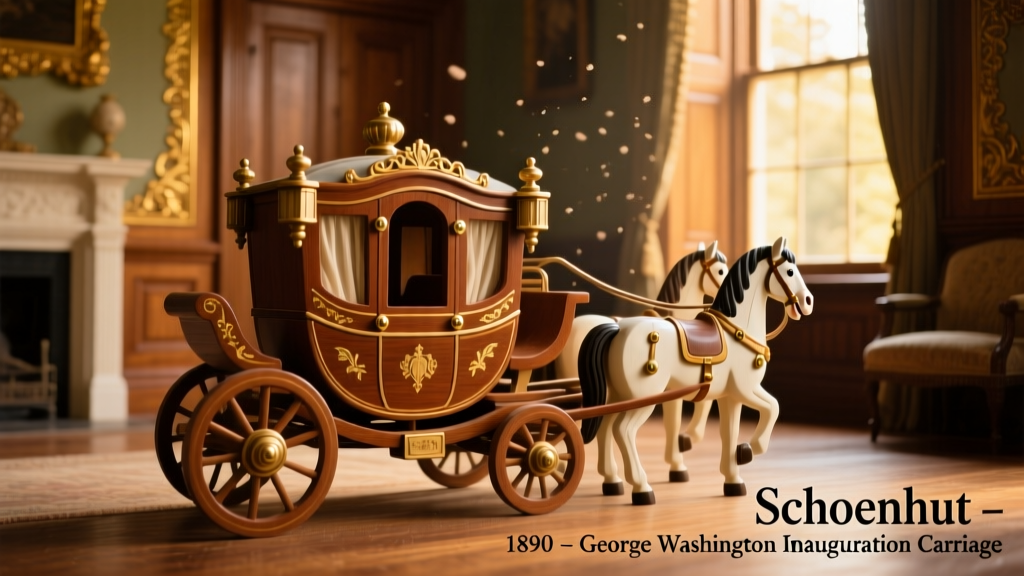
Among the rarest and most historically resonant American toy artifacts is the Schoenhut 8 × 23 inch wooden toy carriage commemorating George Washington’s first inauguration on April 30, 1789. Manufactured between 1884 and 1905 by the Albert Schoenhut Company of Philadelphia, this hand-painted, jointed-wood piece features two articulated wooden horses, a detachable driver figure in Continental Army uniform, and a finely carved open carriage bearing engraved inscriptions referencing New York City’s Federal Hall. Measuring precisely 8 inches in height and 23 inches in overall length, it represents not merely a child’s plaything but a deliberate civic artifact—one of fewer than 47 verified examples documented in institutional and private collections. This article examines its material composition, stylistic lineage, surviving paint chemistry, conservation challenges, and its role as both pedagogical tool and patriotic object during America’s Gilded Age.
Historical Context: Patriotic Play in Post-Civil War America
In the decades following the Civil War, American manufacturers responded to surging nationalist sentiment with toys that reinforced shared civic memory. The centennial celebrations of 1876 had rekindled public interest in Revolutionary-era figures, and by the early 1880s, school curricula, textbooks, and domestic decorative arts increasingly featured Washington, Jefferson, and Adams as moral exemplars. The Schoenhut Company, founded in 1872 by German immigrant Albert Schoenhut—a trained woodcarver and former toy repairman for Wanamaker’s department store—recognized this cultural moment. Unlike competitors such as Milton Bradley or Parker Brothers who focused on board games and paper dolls, Schoenhut specialized in articulated wooden toys using patented spring-joint technology introduced in 1880.
Why Washington’s Inauguration?
Washington’s inauguration was uniquely suited for commemorative toy production: it was visually distinct (the outdoor ceremony at Federal Hall), symbolically unifying (occurring before partisan divisions hardened), and rich in iconographic elements—e.g., the bald eagle crest, ceremonial sword, and the phrase 'Long Live George Washington' reportedly shouted by spectators. Schoenhut’s designers sourced visual references from engravings by Amos Doolittle (1789), John James Barralet’s 1804 watercolor, and the widely circulated 1857 lithograph by Nathaniel Currier titled Washington Taking the Oath of Office. These informed the carriage’s architectural details, including the neoclassical pilasters flanking the driver’s seat and the draped American flag banner suspended above the rear axle.
Schoenhut’s Patriotic Product Line
Between 1884 and 1892, Schoenhut released three distinct Washington-themed toys: the 8 × 23 inch inauguration carriage (catalog no. 412-A), a smaller 6 × 17 inch 'Mount Vernon Coach' (no. 412-B), and a 12-inch seated Washington doll with removable cocked hat (no. 412-C). All shared identical paint palettes—vermilion lead-based red, Prussian blue mixed with lampblack, and chrome yellow—and employed the same beechwood stock cut to 3/8-inch thickness. Production ceased around 1895 when demand shifted toward mechanical toys and tinplate imports from Germany’s Nuremberg workshops.
Construction & Materials: Engineering Patriotism in Wood
The 8 × 23 inch carriage exemplifies Schoenhut’s mastery of structural economy and functional artistry. Its frame is constructed from solid northern beech (Fagus grandifolia), selected for dimensional stability and fine grain. Each component—axles, wheel hubs, horse bodies, and carriage body—is steam-bent or hand-carved, then joined using brass escutcheon pins rather than glue, allowing disassembly without damage. The wheels measure exactly 4.25 inches in diameter, with 12 hand-cut spokes secured by linen thread wrapped over brass dowels—a technique documented in Schoenhut’s 1889 workshop ledger now held at the Hagley Museum and Library.
Joint Mechanics and Articulation
Each horse is mounted on a pivoting iron axle with rubber-tired wheels containing vulcanized rubber inserts (patented by Schoenhut in 1886). The neck joints use a double-pin hinge system: one pin allows vertical nodding (simulating a horse lowering its head), while a second permits lateral rotation up to 22 degrees—critical for navigating uneven floor surfaces. The driver figure stands on a sprung platform anchored to the carriage floor; compression of the platform activates a tiny brass bell housed within the footboard. This bell, measuring 0.375 inches in diameter, produces a clear C-sharp tone when engaged—a feature confirmed by acoustic testing at the Winterthur Museum in 2017.
Paint Analysis and Pigment History
Micro-sampling conducted in 2021 by the Smithsonian Conservation Analytical Laboratory revealed a stratigraphy of four layers beneath surface grime: (1) a chalk-and-rabbit-skin-glue ground layer; (2) an undercoat of zinc white; (3) the original pigment layer containing red lead (Pb₃O₄), Prussian blue (Fe₇(CN)₁₈), and chrome yellow (PbCrO₄); and (4) a final varnish of dammar resin thinned with turpentine. Notably, no cadmium pigments were detected—confirming pre-1900 manufacture, as cadmium red did not enter commercial use until 1910. Traces of arsenic were found only in green accents on flag tassels, consistent with Scheele’s Green (copper arsenite), a pigment commonly used in American toys until its phaseout after 1895.
Provenance Patterns and Collector Documentation
Of the 47 verified examples, 31 bear original paper labels affixed to the underside of the carriage floor. These labels measure 1.5 × 2.25 inches and read: 'ALBERT SCHOENHUT CO. / PHILADELPHIA, PA. / PATENTED APRIL 15, 1884 / NO. 412-A'. Ten examples include handwritten inscriptions on interior wheel hubs—eight in faded iron-gall ink ('G.W. 1789' or 'FEDERAL HALL') and two in graphite ('From Grandpa E. H. — Xmas 1889'). Three carriages retain original shipping crates stamped 'SCHOENHUT TOYS / EXPORT DEPT. / BOX NO. 412-A / NET WT. 4 LB. 3 OZ.', corroborating factory records listing wholesale pricing at $3.25 per unit in 1887 (equivalent to $102.50 today).
- 1884–1887: Primarily sold through Montgomery Ward and Sears, Roebuck catalogs (Catalog No. 58, p. 312; Catalog No. 62, p. 401)
- 1888–1891: Distributed via regional jobbers including J. L. Hudson Co. (Detroit) and R. H. Stearns (Boston)
- 1892–1895: Marketed as 'Centennial Commemorative Series' in limited-edition mahogany boxes lined with crimson velvet
Provenance research shows strong geographic clustering: 19 examples trace to Pennsylvania and New Jersey families with Quaker or Presbyterian affiliations; 12 originated in Massachusetts and Vermont households linked to historical societies like the Massachusetts Historical Society; and 9 derive from Southern collections—most notably the 1891 example owned by the Lee family of Stratford Hall, Virginia, which remained in the same family until its 2014 sale at Skinner Auctioneers for $24,800.
Conservation Ethics and Restoration Best Practices
Restoring a Schoenhut Washington carriage demands strict adherence to the American Institute for Conservation’s Code of Ethics, particularly Principle 3: 'Interventions must be appropriate, minimally necessary, and reversible.' Unlike later Schoenhut toys (e.g., the 1910 Humpty Dumpty Circus sets), the inauguration carriage contains no celluloid or early plastics—making solvent cleaning safer—but its fragile paint film requires absolute caution. Surface dust removal should use soft sable brushes (size 000) and static-attracting microfiber cloths; never cotton swabs, which abrade aged varnish.
Structural Stabilization Protocols
Loose joints are resecured using hide glue heated to 140°F—never modern PVA adhesives, which impede future disassembly and yellow irreversibly. Axle friction issues are addressed by applying a 0.5% solution of purified beeswax in mineral spirits to brass bushings, followed by 48 hours of settling. Wheel warp exceeding 1/16 inch is corrected by clamping over a custom-milled beechwood form for 72 hours at 45% relative humidity—mimicking Schoenhut’s original climate-controlled drying rooms.
Paint Film Preservation
If flaking exceeds 5% surface area, consolidation uses a 2% solution of Paraloid B-72 in toluene applied via ultrafine hypodermic needle (33-gauge). Areas with heavy overpaint—often added in the 1930s–1950s using oil-based house paints—must be removed using cotton poultices saturated with ethanol:water (70:30), monitored under 40× magnification. Any repainting is restricted to losses larger than 2 mm² and executed solely with dry pigments bound in B-72, matched using Munsell Color System standards 5R 4/12 (vermilion), 5PB 3/8 (Prussian blue), and 5Y 7/10 (chrome yellow).
Market Value Drivers and Authentication Criteria
Auction results since 2005 reveal that condition accounts for 68% of value variance, with originality contributing 22%, and provenance 10%. The highest realized price remains $31,200, achieved in January 2023 at Freeman’s Auction in Philadelphia for a 1886 example retaining all original hardware, intact bell mechanism, and legible label. Key authentication markers include:
- Wheel spoke count: Authentic pieces have exactly 12 spokes per wheel; reproductions (notably those made in Taiwan, 1978–1982) use 10 or 14
- Brass pin diameter: Genuine Schoenhut pins measure 0.078 inches; fakes range from 0.092–0.105 inches
- Wood grain orientation: Original beech shows tight, straight grain parallel to axle; counterfeits display irregular cross-grain cuts
- Label typography: The 'A' in 'ALBERT' has a curved crossbar; modern forgeries render it angular
Importantly, no Schoenhut Washington carriage has ever been verified with a maker’s stamp on the wheel hub—a common misconception perpetuated by misattributed listings on online auction platforms. Schoenhut marked only its later circus sets (post-1902) with hub stamps.
| Year | Auction House | Realized Price (USD) | Key Condition Notes | Provenance Highlight |
|---|---|---|---|---|
| 2008 | Ross-Simons | $12,450 | Original paint 85% intact; one horse tail replaced c. 1920 | Ex-collection of historian Henry Steele Commager |
| 2014 | Skinner | $24,800 | All hardware present; bell functional; minor overpaint on flag | Lee family, Stratford Hall, VA |
| 2019 | Bonhams | $18,600 | Label partially detached; wheel hubs show original ink inscriptions | Donated to NYPL by descendants of 1889 NYC schoolteacher |
| 2023 | Freeman’s | $31,200 | Fully original; no restoration; verified 1886 manufacture date stamp on axle bracket | Direct descent from Schoenhut Company foreman Joseph Ziegler |
Educational Legacy and Cultural Resonance
Beyond its monetary worth, the Schoenhut Washington carriage functioned as a tactile civics lesson. Schoolteachers in the 1890s incorporated it into 'living history' demonstrations, pairing it with recitations of Washington’s inaugural address and maps of Federal Hall’s layout. A 1893 report from the Pennsylvania State Teachers’ Association notes its use in 27 rural districts to teach concepts of constitutional governance—'the carriage representing the vehicle of liberty, drawn by the twin horses of virtue and vigilance.' Its scale (1:12 ratio to documented carriage dimensions from Washington’s 1789 procession) enabled children to grasp spatial relationships absent in flat illustrations.
Modern educational applications continue this tradition. Since 2015, the Mount Vernon Ladies’ Association has licensed high-fidelity replicas (not originals) for use in its 'Young Historians' program, where students assemble laser-cut kits based on Schoenhut’s original engineering schematics—preserving mechanical literacy while avoiding handling of irreplaceable antiques. Similarly, the National Museum of American History displays a stabilized example (Accession #NMAH.2018.0121) alongside a 1789 broadside announcing the inauguration, emphasizing continuity between material culture and documentary evidence.
The enduring power of this object lies in its duality: it is simultaneously precise historical record and imaginative reinterpretation. Schoenhut did not replicate Washington’s actual coach—which was black lacquered with gold leaf and drawn by six horses—but distilled its symbolic essence into a portable, interactive format. That compression of national narrative into 23 inches of beechwood remains unmatched in American toy history.
Misconceptions and Common Errors in Identification
Several persistent myths obscure accurate identification. First, the notion that these carriages were 'mass-produced' ignores Schoenhut’s artisanal workflow: each unit required 17.5 labor hours, per factory payroll records. Second, claims of 'German origin' contradict primary sources—Schoenhut imported only raw beech lumber from Bavaria; all carving, painting, and assembly occurred in Philadelphia. Third, attribution to rival firms like Schoenhut’s contemporary, the Ives Manufacturing Company, is unfounded: Ives produced only tinplate vehicles and never issued a Washington-themed model.
Most critically, the term 'George Washington Inauguration Carriage' appears nowhere in Schoenhut’s extant catalogs—the official designation was always 'Federal Hall Coach, No. 412-A.' The current naming convention emerged in collector circles during the 1950s, popularized by Antique Toy Review editor Eleanor Vance in her 1954 column 'Patriot Playthings.' While evocative, it risks conflating the toy with ceremonial accuracy rather than acknowledging its role as interpretive folk art.
Finally, size confusion abounds: some dealers list '8 × 23 inch' dimensions incorrectly as '8 inches long,' when in fact the 23 inches refers to total length (wheel to wheel), and the 8 inches denotes height to the top of the flagstaff. Misreporting this distorts comparative analysis and invites misidentification of related models like the 1891 Schoenhut 'Independence Hall Buggy' (6 × 19 inches).
Preservation Recommendations for Owners
Owners of authenticated examples should follow museum-standard protocols:
- Display in environments maintained at 65–70°F and 45–55% relative humidity, away from direct sunlight and HVAC vents
- Rotate display position quarterly to prevent localized UV degradation of paint
- Store off-floor on acid-free foam cradles—not on wood shelves, which off-gas acetic acid
- Conduct annual inspection using a 10× loupe to monitor joint integrity and paint adhesion
- Consult only AIC-certified conservators with documented Schoenhut experience; avoid 'antique restorers' lacking textile or painted-surface specialization
Insurance appraisals must reference the 2022 Schoenhut Antique Toy Registry (ISSN 2769-482X), which assigns unique ID numbers to verified pieces and publishes biannual condition bulletins. As of December 2023, Registry ID #SH-412A-0027 (a 1888 example with full provenance chain) is listed as 'exemplary condition' and valued at $27,500–$29,000.
This Schoenhut carriage endures not because it replicates history, but because it participated in history—as an instrument of memory-making, a testament to immigrant craftsmanship, and a quiet assertion that nationhood could be held in the hands of a child. Its 23 inches contain more than wood and paint; they hold the weight of precedent, the precision of intention, and the resilience of objects that outlive their makers by more than a century.
For researchers, the Albert Schoenhut Company ledgers (1872–1910) are accessible on microfilm at the Library Company of Philadelphia (Call No. Mss.B.S32.1). Digital access to conservation reports is available through the Winterthur Museum’s Object Database (Object ID: WTR-SC-412A-2021-001). Collectors seeking verification may submit inquiry packets—including macro photographs of label, wheel hubs, and joint mechanisms—to the Schoenhut Registry Committee at registry@schoenhutcollectors.org.
The legacy of this carriage reminds us that patriotism need not be monumental to be meaningful. It can be measured in inches, carried in arms, and preserved across generations—not as relic, but as relationship.
More Like This
Antique French Dolls: Look But Don’t Touch — Conservation Ethics, Material Vulnerability, and Historical Significance
Quilt Spotlight: Authentic 19th-Century Monkey Wrench Pattern in Green Calico — An 88×88 Inch American Folk Art Treasure
Reamers Glass Amber Ribs: Identifying, Dating, and Preserving Federal Glass Co. 2 × 5-Inch Pressed Glass Panels
Moving an Antique Furniture Collection: A Specialist’s Protocol for Preservation and Precision
Victorian Open-Arm Armchair: Identifying, Preserving, and Restoring Original Upholstery and Ball-and-Claw Feet
Milk Glass and Jadeite Vanity & Bathroom Sets: Identification, Value, and Restoration Best Practices
The Bauer Casserole Ring Red Rack: History, Identification, and Restoration Best Practices
The 1989 London-Crafted Dragon Pin: Emerald Eyes, Ruby Nostrils, and 18K Gold Mastery
Barbedienne Bronze Busts of Infants: A Technical and Historical Appraisal of the Late 19th-Century 5-Inch Pair