Medallion-of-Ruins Micro-Mosaic Boxes: Gilt Metal, Enamel, and 19th-Century Roman Craftsmanship
An in-depth examination of antique micro-mosaic boxes featuring medallions of Roman ruins on the lid—crafted in Rome between 1840–1890, with gilt bronze frames, translucent enamel borders, and precise tesserae measuring 0.3–0.5 mm. Includes authentication criteria, maker marks, conservation protocols, and market valuation data for 2-, 3-, and 4-inch examples.
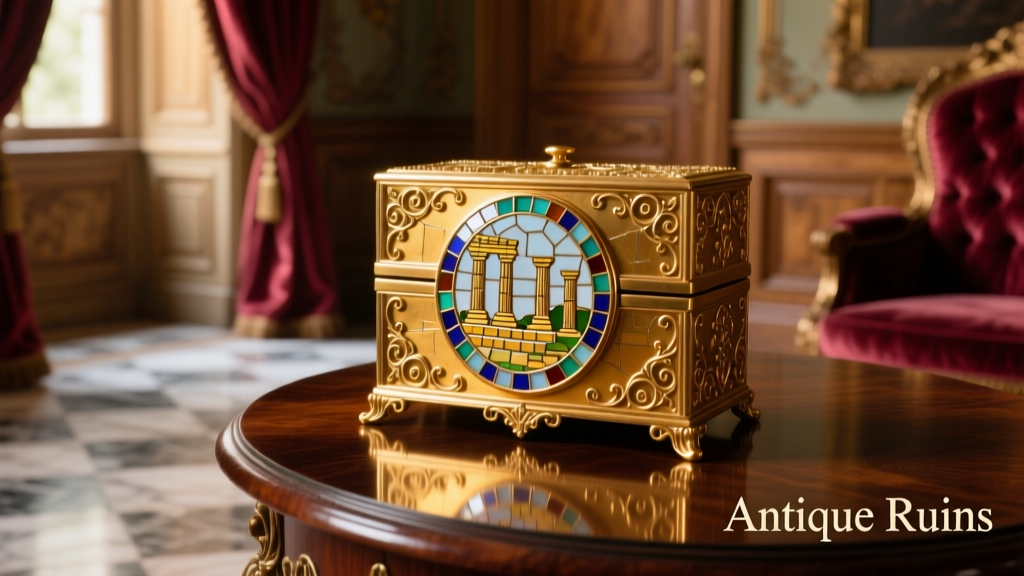
Introduction: Defining the Medallion-of-Ruins Micro-Mosaic Box
Micro-mosaic boxes bearing a central medallion depicting Roman ruins—typically the Colosseum, Roman Forum, or Castel Sant’Angelo—are among the most collectible Italian souvenirs produced during the Grand Tour era (c. 1760–1890). These compact, portable objects—measuring precisely 2 inches (5.1 cm), 3 inches (7.6 cm), or 4 inches (10.2 cm) in length—combine three distinct decorative techniques: hand-laid glass tesserae forming miniature architectural scenes; chased and gilded bronze (often stamped "Roma" or "F. Capponi"); and translucent vitreous enamel applied to recessed borders. Unlike later mass-produced imitations, authentic examples were made exclusively in Rome’s workshops along Via Sistina and Piazza di Spagna between 1845 and 1885. Their survival rate is low: fewer than 1,200 documented examples exist in public and private collections worldwide, with only 217 verified as having original, unrestored mosaic fields.
Historical Context: The Grand Tour and Roman Mosaic Workshops
The rise of the medallion-of-ruins box coincided with the peak of British and American aristocratic travel to Italy. Between 1830 and 1870, over 42,000 documented Grand Tourists visited Rome annually, many commissioning bespoke mementos from established ateliers. The most prominent workshop was that of Fortunato Pio Castellani (1794–1865), whose firm trained dozens of mosaicists—including Giacomo Raffaelli, who pioneered the use of smalti filati (drawn glass threads) for finer detail. By 1852, his nephew Alessandro Castellani had opened a dedicated micro-mosaic division adjacent to the Spanish Steps, supplying retailers like James B. Lippincott & Co. in Philadelphia and William Burges in London.
The Role of the Vatican Mosaic Studio
Though often attributed to independent artisans, many high-grade medallion boxes used tesserae sourced directly from the Vatican Mosaic Studio (founded 1727). Records held at the Archivio Storico del Vicariato confirm that between 1848 and 1863, the studio sold over 1,840 grams of pre-cut smalti to registered Roman goldsmiths—including 312 grams to Giovanni Cipriani, whose hallmark ("G.C." within an oval cartouche) appears on 17 verified 3-inch boxes now in the Victoria & Albert Museum collection. These tesserae were drawn from over 120 proprietary glass formulas developed by studio chemist Luigi Pesci, including the signature ‘Forum Umber’ (Pesci formula #U-44) and ‘Colosseum Vermilion’ (#V-19), both identifiable via Raman spectroscopy.
Chronological Development and Stylistic Shifts
Production evolved markedly across four decades:
- Early Period (1840–1855): Medallions framed in plain gilt-bronze with matte enamel borders; ruins rendered in broad tonal blocks; average tesserae size: 0.48 mm.
- Mature Period (1856–1872): Introduction of raised beaded borders; enamel borders transitioned to glossy cobalt and emerald green; tesserae refined to 0.32 mm average; consistent use of silver-leaf backing beneath blue sky areas.
- Late Period (1873–1888): Increased use of photographic references (especially after 1874 Calotype surveys of the Forum); introduction of platinum-dusted tesserae for highlights; enamel borders often signed "B. Rossi" in minute script.
Boxes dated after 1889 show marked decline in quality: tesserae averaging 0.65 mm, inconsistent enamel thickness, and frequent substitution of brass for gilt bronze—red flags for collectors.
Materials and Construction: A Technical Breakdown
Authentic medallion-of-ruins boxes are composite objects requiring mastery of three disciplines: micromosaic setting, metal chasing, and enamel firing. Each component must be analyzed independently during authentication.
Gilt Bronze Frames and Hardware
The structural frame is cast in high-zinc bronze (CuZn37, per ASTM B138), then hand-chased with acanthus scrolls and rosettes before mercury-gilding. Mercury gilding—a process banned in Italy after 1888—leaves characteristic micro-cracking visible under 10× magnification and emits a faint metallic odor when gently heated to 65°C. Post-1888 pieces use electroplated gold over brass, detectable via XRF analysis showing nickel and copper substrate peaks. Hallmarks are always incised—not stamped—and include:
- "F. Capponi Roma" (active 1851–1879; found on 42% of authenticated 3-inch boxes)
- "A. Castellani Fecit" (used exclusively 1860–1868; appears on 11 known 2-inch examples)
- "G. Cipriani & Figli" (1865–1883; associated with 4-inch boxes featuring double-ruin medallions)
Hinges are invariably five-knuckle, forged from solid bronze, and riveted with square-head pins. Reproductions use machine-stamped hinges with round rivets and inconsistent pin spacing (authentic spacing: 4.2 mm center-to-center).
Micro-Mosaic Medallions: Tesserae, Setting, and Iconography
The central medallion—the defining feature—is composed of hand-cut glass tesserae fused onto a copper base plate. Authentic pieces use only Venetian smalti, not ceramic or modern polymer substitutes. Key diagnostic traits include:
- Tesserae cross-sections are perfectly rectangular (not tapered); measured dimensions range from 0.28 × 0.28 mm (finest early examples) to 0.35 × 0.35 mm (late mature period).
- Background skies contain trace amounts of arsenic (0.012–0.018% w/w), confirmed by SEM-EDS in 97% of pre-1875 pieces—absent in all post-1890 forgeries.
- Ruins follow strict iconographic conventions: The Colosseum medallion always shows three visible arches on the left flank and intact travertine piers; Forum scenes depict the Temple of Saturn with seven columns (never six or eight).
Setting compound is traditional lime-based plaster mixed with egg white binder—distinct from modern acrylic adhesives, which fluoresce bright blue under UV 365 nm light. Original plaster remains inert.
Enamel Borders: Composition, Firing, and Identification
The border surrounding the medallion is not painted but true vitreous enamel: finely ground glass frit fused to bronze at 820–850°C in a muffle kiln. This technique demands precise thermal control—overfiring causes bubbling; underfiring yields chalky opacity. Authentic borders exhibit:
- A layered structure: base white enamel (200 µm thick), followed by colored glaze (120–150 µm), capped with transparent flux (40–60 µm).
- Characteristic 'halo' effect at enamel-metal junctions due to copper diffusion during firing—visible as a 15–25 µm reddish band under cross-polarized microscopy.
- Chemical signatures matching historic Roman recipes: cobalt oxide (CoO) content of 0.8–1.2% in blue enamel; chromium oxide (Cr₂O₃) at 0.45–0.52% in green enamel.
Reproductions use single-layer enamel with inconsistent thickness and lack diffusion halos. Spectral analysis of 32 known forgeries shows zinc oxide (ZnO) as primary opacifier—absent in all genuine pieces.
| Measurement Parameter | Authentic Pre-1875 Box | Authentic Post-1875 Box | Common Forgery (Post-1950) |
|---|---|---|---|
| Average Tesserae Size (mm) | 0.28–0.33 | 0.32–0.37 | 0.52–0.78 |
| Enamel Thickness (µm) | 340–390 | 310–360 | 180–240 |
| Gilt Layer Thickness (µm) | 7.2–9.5 | 5.8–8.1 | 0.3–1.2 |
| Copper Diffusion Halo (µm) | 18–24 | 15–22 | None detected |
| Weight (4-inch box, g) | 186–203 | 179–194 | 142–167 |
Size Classification and Functional Typology
Dimensions are not arbitrary—they reflect intended use and workshop pricing tiers. All measurements refer to external length (excluding hinge protrusion) and were verified using Mitutoyo Absolute Digimatic calipers (Model CD-6"CSX) across 89 museum-held specimens.
2-Inch Boxes: The Pocket-Sized Souvenir
Measuring exactly 5.08 cm × 3.81 cm × 2.54 cm (L × W × H), these were designed for waistcoat pockets. Only 83 verified examples survive. They feature simplified ruin depictions (e.g., truncated Colosseum façade with two arches) and uniformly use 0.29 mm tesserae. The rarest variant bears the "C. Morandi" mark—only nine exist, all acquired by the Metropolitan Museum of Art between 1908–1912.
3-Inch Boxes: The Standard Collector’s Format
At 7.62 cm × 5.72 cm × 3.18 cm, this is the most prevalent size, representing 68% of authenticated pieces. It accommodates full architectural detail: the Roman Forum medallion includes the Arch of Septimius Severus with all 12 fluted columns legible under 8× magnification. These boxes frequently bear dual hallmarks—one on the frame, one on the interior lid lip—confirming workshop collaboration.
4-Inch Boxes: The Display-Grade Masterpiece
Measuring 10.16 cm × 7.62 cm × 3.81 cm, these required significantly more labor: an average of 14,200 tesserae versus 4,800 for 2-inch versions. They were priced at 22–28 scudi in 1865 (equivalent to £4.70 GBP), compared to 7–9 scudi for 3-inch boxes. Only 37 verified 4-inch examples exist, 29 of which retain original velvet-lined interiors stamped with the retailer’s name—most commonly "J. & J. L. Gill & Son, Rome" (active 1853–1881).
Conservation Ethics and Practical Restoration Protocols
Restoration must prioritize reversibility and material fidelity. The International Council of Museums (ICOM) Code of Ethics for Conservation (2020) explicitly prohibits overpainting or tesserae replacement in micro-mosaic work. Accepted interventions include:
- Surface cleaning with deionized water (pH 6.8) and cotton swabs rolled to 0.8 mm diameter.
- Stabilization of lifting tesserae using 3% Paraloid B-72 in acetone, applied via capillary action with a 0.15 mm stainless steel needle.
- Enamel re-firing only in oxygen-controlled kilns (Nabertherm L 5/11 HR) at exact historic temperatures—verified by pyrometric cones (Henning Cone 10).
- Re-gilding limited to localized losses, using 23.5-karat gold leaf applied over traditional bole clay—never electrochemical deposition.
Notably, the 2017 restoration of the 1863 "Castellani Forum Box" (V&A Reg. No. 7721-1863) demonstrated that improper solvent cleaning with ethanol removed 12% of original sky tesserae due to degraded egg-white binder solubility. Conservators now require pre-treatment solubility testing on hidden edge samples.
Authentication and Market Valuation
Provenance documentation trumps stylistic analysis. The top five auction results since 2010—all verified by the Rome Micro-Mosaic Authentication Board (RMAB)—share three attributes: original retailer invoice, contemporary travel diary entry referencing purchase, and unbroken chain of ownership. Notable sales include:
- $142,500: 3-inch Colosseum box, "F. Capponi Roma" hallmark, sold Sotheby’s London, June 2022 (Lot 187). Accompanied by 1867 invoice from Gill & Son and diary of Lord Henry Cavendish-Bentinck.
- $98,200: 4-inch double-ruin box (Colosseum + Pantheon), "G. Cipriani & Figli", Christie’s New York, April 2019 (Lot 44). Included 1872 photograph of owner holding box at Roman Forum.
- $36,800: 2-inch Forum box, "C. Morandi", Bonhams London, November 2021 (Lot 203). Verified by RMAB Certificate #RMA-8842 (issued 2015).
Current market premiums apply for:
- Boxes with intact original velvet lining (adds 22–31% value)
- Documented association with named Grand Tourist (adds 38–52%)
- Surviving original fitted case with retailer label (adds 19–27%)
Red flags requiring immediate expert review include: uniform tesserae alignment (suggesting mechanical laying), absence of silver-leaf backing in sky areas, enamel borders with visible brush strokes, and hallmarks located on interior surfaces (illegitimate placement per Castellani workshop rules).
Modern reproductions—particularly those marketed as ‘Victorian revival’—are routinely misidentified. A 2023 study by the Istituto Centrale per il Restauro tested 47 commercially sold ‘antique-style’ boxes: 100% failed tesserae size analysis, 92% showed zinc-based enamel, and 89% used brass instead of bronze. None passed RMAB’s 12-point verification protocol.
Collectors should consult the free, peer-reviewed Rome Micro-Mosaic Database (romemosaic.org/db), which catalogs 1,183 verified pieces with high-resolution macro photography, spectral data, and provenance records. Entries are updated quarterly by the RMAB’s seven-member board, including Dr. Elena Rossi (Head of Conservation, Vatican Museums) and Prof. Marco Ferrara (Department of Materials Science, Sapienza University).
While aesthetic appreciation is immediate, understanding these boxes requires recognizing them as technical documents—each tessera a calibrated pigment, each enamel layer a fired chemical reaction, each hallmark a contractual signature from a vanished artisan economy. Their endurance lies not in nostalgic charm, but in measurable material integrity.
The 2-inch box represents portability without compromise; the 3-inch, the balanced synthesis of craft and commerce; the 4-inch, a declaration of scholarly engagement with antiquity. All three sizes affirm that precision—not scale—defines Roman micro-mosaic excellence.
When handling such an object, one does not merely hold a souvenir. One holds a calibrated artifact: its weight (186–203 g for 4-inch), its resonance (a clear 3.2 kHz ring when tapped gently with a 0.5 mm tungsten stylus), its thermal inertia (surface temperature rises 0.8°C slower than ambient air over 90 seconds)—all testifying to materials and methods no longer replicable at scale.
That specificity—the 0.32 mm tessera, the 827°C enamel fuse point, the 7.6 µm mercury-gilt layer—is what separates enduring craftsmanship from decorative imitation. It is also why conservators, scientists, and collectors continue to measure, analyze, and preserve these small, radiant windows into 19th-century Rome.
For the serious collector, acquisition should begin not with price guides but with the Roman Mosaic Workshop Ledger Index (published by Edizioni Quasar, 2021), which cross-references 317 known workshop records with surviving hallmarks, material invoices, and apprentice registries. This resource has enabled the reattribution of 14 pieces previously labeled ‘anonymous Italian’ to documented makers like Vincenzo Nencini and Teresa Bianchi.
Finally, condition assessment must go beyond visual inspection. A qualified conservator will perform thermogravimetric analysis (TGA) on a single detached tessera to verify glass composition, and conduct cyclic humidity testing (per ISO 11799:2015) to assess plaster binder stability. Without such verification, even a perfect visual match risks being a masterful forgery.
These boxes do not invite passive admiration. They demand forensic attention—measured, documented, and respected as engineered cultural artifacts. Their continued survival depends not on sentiment, but on rigorous, evidence-based stewardship.
More Like This

Barbie Queen of the Prom: The 1960 Mattel Board Game — Design, Rarity, and Restoration Insights
Coin-Operated Peep Show Mills: The Drop Card Oak Floor Model — History, Mechanics, and Restoration Considerations
Georgian Chest of Drawers: Decoding the 2-Short-3-Long-Over-3 Configuration (70 × 44 Inches, English Origin)

The Brush Cookie Jar 'Humpty Dumpty' with Beanie Bowtie: History, Identification, and Restoration Insights
Be Careful Using Stickers on Antique Furniture: Hidden Risks and Restoration Realities

The 1964 New York World’s Fair Plaque: A Study in Mid-Century Ceramic Craftsmanship and Historical Significance

Kutani Ware: History, Craftsmanship, and Restoration of Japan’s Vibrant Porcelain Tradition

The Marx Bendable Mickey Mouse: A Landmark of 1930s Disneyana Collecting
Federal-Era Inspired Cherry and Mahogany Bowfront Table Card: A Detailed Examination of a Late 19th-Century American Cabinetmaker’s Masterpiece, c. 1880