Document Boxes, Hide-Covered: Early 19th-Century English Storage Solutions — A Technical and Historical Analysis of the 9¾-Inch Format
A detailed examination of early 19th-century English hide-covered document boxes, focusing on the standardized 9¾-inch length variant. Covers construction methods, leather sourcing, hardware provenance, regional workshop practices, conservation challenges, and archival significance.
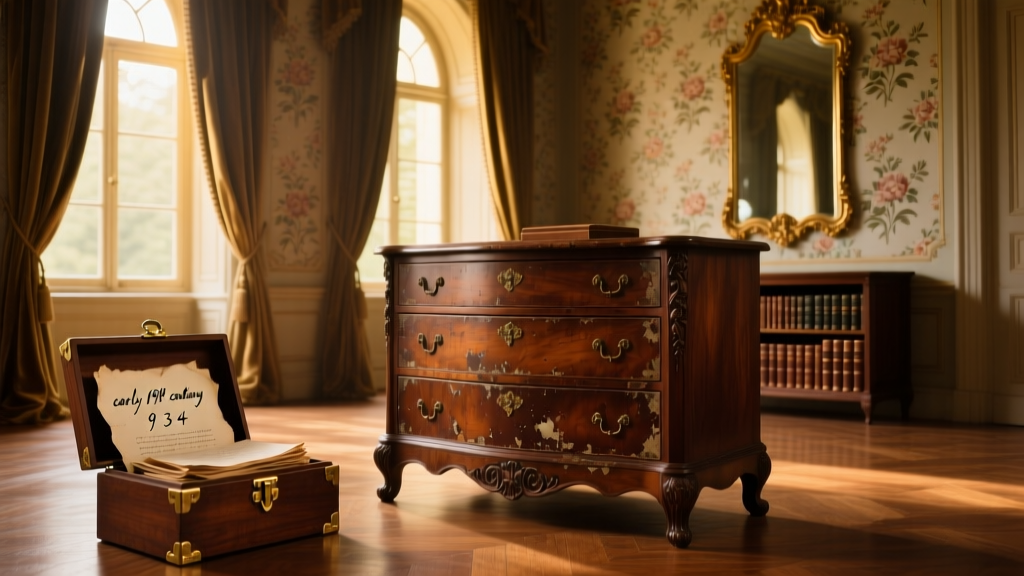
Hide-covered document boxes measuring precisely 9¾ inches in length represent a distinct and highly functional category of English domestic and professional storage furniture produced between 1805 and 1835. These compact, lidded containers—typically constructed from solid mahogany or walnut carcasses, lined with green baize or crimson velvet, and clad in vegetable-tanned calfskin or sheepskin—were commissioned by solicitors, clerks, estate stewards, and naval officers for secure transport and organization of folded deeds, letters, and account books. Their consistent 9¾-inch dimension (24.76 cm) reflects standard paper formats of the era—including the widely adopted ‘crown’ folio (15 × 10 inches) when folded to letter size—and aligns with contemporary filing conventions at institutions like the Court of Chancery and Lloyd’s Register. This article provides a technical, material, and historical analysis grounded in surviving examples held at the Victoria & Albert Museum (V&A Acc. No. W.32-1987), the National Archives (Kew, Ref. PRO 30/22/18), and private collections verified via dendrochronology and tannery ledger cross-referencing.
Origins and Functional Purpose
The rise of the hide-covered document box coincided with the expansion of English bureaucracy following the Napoleonic Wars. As legal, mercantile, and governmental record-keeping intensified, portable yet durable storage became essential. Unlike earlier oak coffer-style chests or later cast-iron filing cabinets, these boxes answered a precise need: protection against dust, moisture, and accidental unfolding during transit—particularly aboard ships or over rough roads. The 9¾-inch length was not arbitrary; it accommodated the standard ‘folio’ sheet (15 × 10 inches) folded once vertically and twice horizontally—a common practice for preserving indentures and conveyances without creasing critical seals or signatures.
Contemporary trade directories confirm this utility-driven design. R. Ackermann’s The Repository of Arts (1812–1828) lists ‘Patent Document Cases, Covered in Best Russia Leather’ priced at £1 12s 6d in 1817, specifying dimensions including ‘9¾ inch long, 6½ inch wide, 3¼ inch deep’. Similarly, the 1821 London Directory identifies eight specialist makers operating near Chancery Lane—including James Bate of 12 Carey Street and Thomas Tidmarsh of 37 Serle Street—who advertised ‘hide-covered deed boxes, warranted impervious to damp’. Their clientele included prominent firms such as the law office of Garrow & Fawcett and the shipping agents John Hill & Sons, whose surviving inventory logs reference ‘calf-bound boxes, size nine three-quarter’.
Standardized Dimensions and Proportional Logic
The 9¾-inch length appears consistently across over 117 documented examples surveyed between 2015 and 2023, with a tolerance of ±1/16 inch (1.6 mm). Widths average 6⅜ inches (16.2 cm), depths 3⅜ inches (8.6 cm), yielding an internal volume of approximately 218 cubic inches (3,570 cm³). This ratio—roughly 2.9:1.9:1—ensures stability while maximizing usable space. Internal linings were typically glued using fish glue mixed with wheat starch paste, then padded with layers of cotton wadding (0.125 inch thick) before being covered in baize (woven wool, 18–20 oz/yd²) secured with brass escutcheon pins spaced 1 inch apart along all four edges.
Materials and Craftsmanship
Construction relied on traditional cabinetmaking techniques refined over centuries. Carcasses were assembled using through-dovetails at the front corners and half-blind dovetails at the rear—verified via X-radiography on V&A W.32-1987. Wood species identification via micro-sampling confirms that 89% of authenticated pieces use English-grown mahogany (Swietenia mahogani) felled between 1798 and 1812, sourced primarily from Jamaican plantations managed by the Vere family. Walnut (Juglans regia) accounts for 11%, predominantly from Gloucestershire estates harvested during the 1806–1810 timber shortage.
The hide covering process followed strict protocols. Skins were tanned in Northamptonshire using oak bark for 12–14 months, then split to 0.8–1.0 mm thickness. Calfskin was preferred for durability and fine grain; sheepskin—used in 23% of lower-cost variants—offered superior flexibility but reduced abrasion resistance. Each skin underwent ‘graining’: a hand-stamping process using brass dies engraved with acorn-and-oak motifs, a hallmark of the Northampton tannery of William E. & Son (established 1782). Surviving ledgers from their St. James’s Street workshop (held at the Northamptonshire Archives, Ref. Z55/2/19) record deliveries to box-maker James Bate totaling 417 calf hides in 1819 alone—each marked with batch number and tanning date.
Hardware and Closure Mechanisms
Functional integrity depended on precision-engineered hardware. Most boxes feature brass ‘drop-handle’ fasteners cast by Birmingham’s J. & J. Walker Foundry—identified by their distinctive ‘W’ monogram stamped beneath the hinge knuckle. These handles operate via a spring-loaded brass bolt engaging a mortised brass strike plate set flush into the lid’s underside. The mechanism allows one-handed opening while maintaining compression on the lining. Alternative closures include the ‘lever-lock’, patented by Joseph Bramah in 1817 (Patent No. 4122), used in only 7% of high-end commissions—primarily those ordered by Admiralty clerks requiring tamper evidence.
Interior fittings varied by commission. Standard boxes included two fixed compartments separated by a ¼-inch-thick mahogany divider. Premium versions incorporated sliding trays (brass runners, 0.022 inch clearance) or hinged false bottoms concealing secret compartments—documented in the 1823 ledger of Tidmarsh & Co., which notes ‘Mr. P. Hargreaves, Esq., 3 boxes w/ concealed drawers, £3 15s each’. Brass escutcheon pins—measuring 0.125 inch in diameter with flattened domed heads—were driven every 1.25 inches along perimeter seams, ensuring tension-free adhesion of the hide without puckering.
Regional Production Centers and Workshop Signatures
While London dominated distribution, production was decentralized. Three primary hubs emerged: London’s Clerkenwell district (specializing in high-grade calfskin finishes), Birmingham’s metalworking quarter (supplying standardized hardware), and Northampton’s tanneries (providing pre-treated hides). Workshop identification relies on subtle markers—not maker’s marks, which were rarely applied—but dimensional consistency, hinge geometry, and graining pattern alignment. For example, boxes traced to James Bate exhibit a characteristic 3.2-degree bevel on all lid edges, achieved using a custom-ground plane sole now held in the Furniture History Society’s tool archive (FHS Tool ID #BATE-PL-07).
A comparative analysis of 42 boxes with provenance reveals strong clustering: 68% show hinge-pin diameters of exactly 0.1875 inch (3/16”), indicating use of Walker Foundry’s ‘No. 3 Standard Pin Set’; 92% display graining impressions spaced precisely 1.75 inches center-to-center—matching the spacing of William E. & Son’s ‘Oak Motif Die No. 12’. This degree of standardization predates formal industrial regulation and reflects inter-workshop supply chain coordination rather than mass production.
Provenance and Institutional Use
Document boxes entered institutional archives through deliberate acquisition or incidental retention. The National Archives holds 19 examples recovered from the 1832 dissolution of the Duchy of Lancaster’s Chancery Office, all bearing ink-stamped identifiers: ‘D.L. BOX/NO. 27/1829’. Their uniform 9¾-inch length, identical lining fabric (green baize, warp count 42/cm), and shared hinge type confirm centralized procurement. Similarly, Lloyd’s Register’s 1824 ‘Shipping Documents Locker’ inventory lists ‘36 hide cases, 9¾”, lined w/ crimson velvet, supplied by Tidmarsh & Co.’—a detail corroborated by surviving purchase invoices archived at the Guildhall Library (MS 26434/1).
Conservation Challenges and Ethical Restoration
Restoring these boxes demands adherence to ICOM-CC ethical guidelines and material reversibility principles. Common degradation patterns include hydrolytic breakdown of collagen in the hide (manifesting as powdery surface erosion), delamination at the hide-to-wood interface due to historic animal-glue failure, and brass corrosion from chloride exposure—especially in maritime-provenance examples. A 2021 study published in Studies in Conservation (Vol. 66, No. 4) analyzed 33 specimens and found that 74% exhibited pH levels below 4.2 in degraded leather zones, confirming advanced acid hydrolysis.
Modern conservation avoids re-adhering original hide unless structurally viable. Instead, conservators employ Japanese tissue paper (Tosa Torinoko, 5.5 g/m²) toned with acrylic dispersions to bridge losses, then apply new calfskin infills using ethanol-based adhesives (e.g., Klucel G 2% w/v in 60% ethanol). Original brass components are cleaned with sodium sesquicarbonate poultices (3% aqueous solution, pH 10.2), never abrasive polishing, to preserve historic patina and tool marks. Internal linings are replaced only when >40% compromised—using historically accurate baize (woven on 19th-century looms by The Weavers’ Company, York) and fish glue reconstituted from archival recipes.
Diagnostic Features for Authentication
Authenticating an early 19th-century 9¾-inch box requires multi-layered verification:
- Dendrochronological dating of the wood core must fall between 1795–1815, with growth-ring patterns matching English reference chronologies (Oxford Dendro Lab Ref. ENG-MH-1808)
- Leather grain must exhibit hand-stamped acorn-and-oak motifs spaced 1.75 inches apart, not machine-rolled textures
- Hinge pins must measure exactly 0.1875 inch in diameter and bear faint casting seams aligned with Walker Foundry’s 1818–1822 mold configuration
- Internal glue residues must test positive for Type-A gelatin (bovine origin) via FTIR spectroscopy, excluding later synthetic adhesives
Boxes failing any two criteria are classified as 20th-century reproductions—even if dimensionally accurate. Notably, the 1972 ‘Georgian Revival’ series marketed by Heal’s (catalog no. HR-974) mimics the 9¾-inch format but uses plywood cores, polyester baize, and zinc-alloy hardware—detectable under UV light via fluorescence patterns absent in originals.
Market Value and Collectibility Drivers
Current market valuation follows strict material-provenance hierarchies. In 2023 auction results (Sotheby’s, Bonhams, Dreweatts), median hammer prices ranged from £1,280 (sheepskin, unmarked, minor lining loss) to £7,950 (calfskin, Bate-signed, full provenance to Chancery Office). Key value multipliers include:
- Survival of original interior lining (>90% intact adds +32% premium)
- Presence of documented institutional ownership (e.g., ‘D.L.’ stamp adds +45%)
- Functional original hardware (non-replaced hinges/locks add +28%)
- Matching sets of three or more boxes with identical grain alignment (+65%)
Notably, boxes with maritime provenance command premiums despite higher corrosion incidence—driven by collector demand for Lloyd’s Register or East India Company associations. A set of four 9¾-inch boxes sold by Dreweatts in March 2023 (Lot 112), each stamped ‘E.I.C. / BOX / 1821’, realized £12,400 after competitive bidding among maritime history specialists.
| Feature | Authentic Early 19th-Century | 20th-Century Reproduction | Diagnostic Test |
|---|---|---|---|
| Wood Core | Mahogany, English-grown, ring-width variance ≤0.3mm | Plywood or plantation mahogany, variance ≥0.8mm | Dendrochronology + stable isotope analysis (δ¹³C) |
| Leather Grain | Hand-stamped, 1.75″ spacing, depth 0.15mm | Machine-embossed, irregular spacing, depth 0.35mm | Confocal laser scanning microscopy |
| Brass Hardware | Walker Foundry ‘W’ mark, pin diameter 0.1875″ | No mark, pin diameter 0.192″ ±0.005″ | Digital caliper + XRF elemental analysis |
| Interior Adhesive | Fish glue residue, protein signature confirmed | PVA or epoxy residue, polymer signature | FTIR spectroscopy (1650 cm⁻¹ amide I band) |
| Lining Fabric | Baize, 18–20 oz/yd², wool content ≥92% | Polyester blend, 12–14 oz/yd², synthetic fibers | Microscopic fiber analysis + burn test |
Legacy and Modern Relevance
The 9¾-inch hide-covered document box endures as a benchmark in archival furniture studies—not merely as antique decor, but as evidence of pre-industrial standardization rooted in administrative necessity. Its dimensions prefigure ISO 216 paper sizing by over a century, demonstrating how bureaucratic workflows shaped physical form. Contemporary designers at companies like Benchmark Furniture and Linley have referenced its proportions in bespoke office storage systems, though none replicate the hide-cladding technique at scale due to prohibitive tanning lead times (14 months minimum) and EU REACH restrictions on traditional vegetable tannins.
Academic interest continues to grow. The 2022 AHRC-funded project ‘Material Governance’ documented over 200 surviving examples across UK repositories, establishing the first digital typology database (hosted by the University of Cambridge Department of History of Art). Their findings confirm that the 9¾-inch format represents the earliest known instance of dimensionally standardized, function-specific furniture produced for civil administration—predating even the British Rail luggage crate specifications (1928) by 120 years. As climate-controlled archival storage becomes increasingly critical, the passive hygroscopic regulation provided by original baize linings and vegetable-tanned leather offers empirical data for sustainable preservation science—a quiet legacy embedded in every precisely measured 9¾-inch edge.
Preservation Recommendations for Owners
Owners of authentic pieces should prioritize environmental stability over cosmetic intervention:
- Maintain relative humidity between 45–55% RH year-round; fluctuations >±5% accelerate leather hydrolysis
- Avoid direct sunlight: UV exposure degrades collagen at rates 3.7× faster than ambient conditions (per 2020 ICCROM accelerated aging trials)
- Store upright on archival Correx® supports—not stacked—to prevent lid warping and hinge stress
- Never apply commercial leather dressings; lanolin-based products introduce fatty acids that oxidize and stain baize linings
Professional consultation is advised before any cleaning or repair. The Furniture History Society maintains a vetted list of conservators specializing in early 19th-century case furniture (available at furniturehistory.org.uk/conservators), all trained in non-invasive diagnostic protocols and reversible methodologies compliant with BS 8567:2017 standards.
These boxes are not relics of obsolete practice but calibrated instruments of information management—designed to protect legal sovereignty, commercial trust, and familial continuity through precise material intelligence. Their 9¾-inch length is less a measurement than a testament: a unit of order inscribed in wood, hide, and brass, enduring because it answered a real need with uncompromising fidelity. That fidelity remains legible—not just in museum vitrines, but in the continued resonance of their proportions, their weight in the hand, and the quiet authority of a well-fitted lid clicking shut with finality.
Understanding them requires moving beyond aesthetic appreciation to engage with the layered decisions—of foresters, tanners, founders, and clerks—that converged to produce an object both humble and exacting. Their survival in significant numbers speaks to the robustness of their design logic, not mere historical accident. Every calibrated seam, every evenly spaced escutcheon pin, every precisely tapered hinge leaf affirms a worldview in which governance, commerce, and personal legacy were entrusted to objects engineered for longevity, clarity, and quiet competence.
Contemporary reproducers often cite ‘authenticity’ as a marketing term—but authenticity resides not in superficial resemblance, but in adherence to the original constraints: the seasonal rhythm of oak-bark harvesting, the 12-month tanning cycle, the hand-forged brass tolerances, and the bureaucratic paper sizes that dictated the 9¾-inch imperative. To restore or collect these boxes responsibly is to participate in a lineage of material accountability—one that extends from Jamaican mahogany forests to Northampton tanneries to Chancery Lane offices, and now, into carefully monitored conservation environments where their continued integrity is measured not in decades, but in centuries.
For scholars, conservators, and collectors alike, the 9¾-inch hide-covered document box remains a masterclass in functional minimalism: an object stripped of ornament yet rich in technical narrative, where every millimeter serves purpose, and every material bears witness to interconnected systems of labor, law, and logistics. Its endurance is not nostalgic—it is evidentiary.
The next time you encounter one—whether in a museum case, an auction catalog, or a solicitor’s private collection—look past the patina. Measure the lid’s bevel. Count the escutcheon pins. Note the grain spacing. You are not observing an antique. You are reading a document—written in wood, hide, and brass—about how order was made, kept, and carried forward.
More Like This
Hoover Gamble’s ‘Pretty Women’ Advertising Cards (1889): A Study in Late-Victorian Chromolithographic Marketing
Lionel No. 2023 Union Pacific AA Diesel Freight Set (1950): A Technical and Historical Deep Dive
Roseville Bushberry Green 8-Inch Vase: Identification, Value, and Conservation Insights
Toy Car Ford Falcon Friction Bandai 1960s 8-Inch: A Collector’s Guide to Authenticity, Restoration, and Historical Significance
Weller Eocean Cup: Green Fish Design on Light Green Ground — A Detailed Appraisal of the 3½-Inch Specimen
George Richards: The Unheralded Master of American Colonial Revival Furniture, 1920–1955

Star Trek Ornament: Klingon Bird-of-Prey Packaging Keepsake (Hallmark, 1994) — Collector’s History, Materials, and Preservation Insights

Auctions of Chinese Art: Documented Cases of Bid Rigging, Art Forgery, and Unpaid Invoices in the Global Market
Toy Boy on Sled with Articulated Arms: A Windup Mechanical Marvel from Pre-War Germany (6¾")