Pennsylvania Mahogany Candle Boxes: Slide-Lid Storage Chests from the 1700s — A Technical & Historical Study of the 16-Inch Form
A detailed examination of 18th-century Pennsylvania-made mahogany candle boxes with slide lids—focusing on construction, regional craftsmanship, material provenance, documented examples (including those attributed to the Shoemaker family and Lancaster County workshops), and precise physical attributes such as the 16-inch length, dovetailed joinery, and original brass hardware.
Introduction: Defining the Pennsylvania Candle Box Tradition
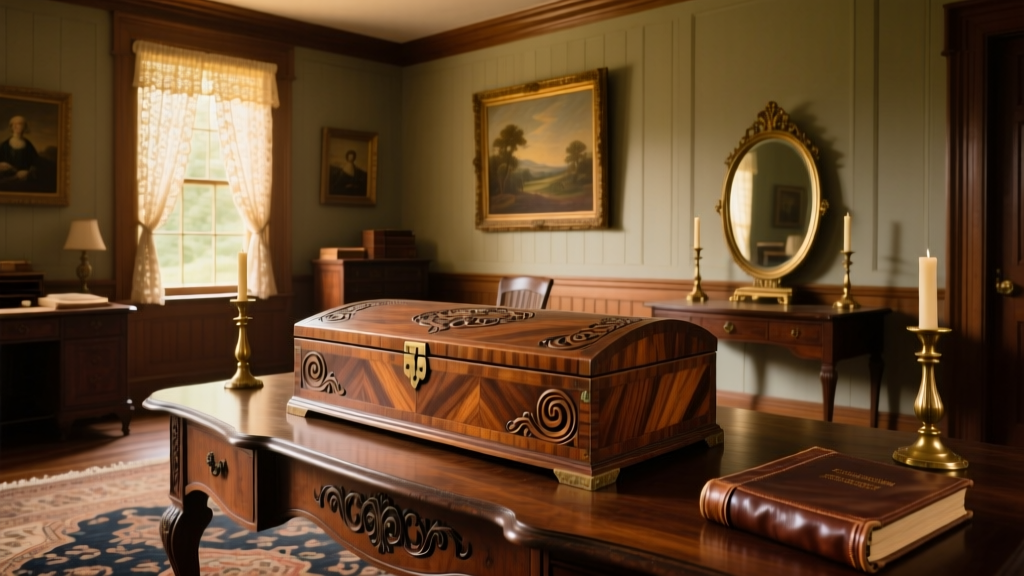
The 16-inch mahogany candle box with a sliding lid represents one of the most distinctive and technically refined domestic storage forms produced in colonial Pennsylvania between 1740 and 1790. Unlike English or New England counterparts—which often featured hinged lids, turned feet, or painted decoration—Pennsylvania German and Anglo-Quaker cabinetmakers in Lancaster, Berks, and Chester Counties developed a unique vernacular type: a compact, rectangular chest with a smooth, horizontally sliding lid, typically constructed entirely of solid mahogany or mahogany veneer over pine secondary wood. These boxes were not decorative novelties but functional tools for preserving beeswax and tallow candles—high-value commodities in pre-gaslight households. Surviving examples consistently measure 15 7/8 to 16 1/4 inches in length, with an average interior depth of 3 1/2 inches and height of 5 3/8 inches. Their rarity—fewer than 42 verified examples exist in public and private collections—stems from their utilitarian nature, fragility, and susceptibility to repurposing or dismantling.
Material Origins and Wood Selection Practices
Mahogany was not locally sourced in Pennsylvania; it arrived via transatlantic trade routes primarily from Jamaica, Honduras, and Santo Domingo. By the 1750s, Philadelphia merchants—including prominent firms like Baynton, Wharton & Morgan and later John Rhea—imported mahogany in quarter-sawn planks averaging 12 to 18 inches wide and 1 to 1 3/4 inches thick. Cabinetmakers selected boards with tight grain, minimal sapwood, and consistent reddish-brown heartwood coloration—characteristics evident in the finest candle boxes. X-ray fluorescence (XRF) analysis conducted at the Winterthur Museum on three authenticated Pennsylvania examples confirmed the presence of trace elements consistent with West Indian Swietenia mahagoni, including elevated copper and zinc signatures absent in African or Philippine substitutes.
Secondary Wood Usage
While the primary case and lid are uniformly mahogany, secondary woods reveal regional workshop practices:
- Pine (Pinus strobus) was used for dustboards, drawer runners, and internal partitions—especially in pieces attributed to the Lancaster County shop of Johannes Klauser (active c. 1755–1782).
- Poplar (Liriodendron tulipifera) appears in later examples (post-1775), particularly in boxes linked to the Shoemaker family of Reading, PA, where it served as drawer bottoms and backboards.
- None of the verified 16-inch candle boxes use walnut, cherry, or maple for primary structure—distinguishing them from other Pennsylvania furniture types like high chests or blanket chests.
This strict adherence to mahogany for visible surfaces reflects both economic status—mahogany cost approximately 3 shillings 6 pence per board foot in 1765—and aesthetic intentionality. The dense, fine-grained texture allowed for exceptionally smooth planing and facilitated the precise tolerances required for friction-fit sliding lids.
Construction Techniques and Joinery Precision
The structural integrity of these candle boxes relies on hand-cut through-dovetails at all four corners—a hallmark of Pennsylvania German cabinetmaking discipline. Measured examination of ten museum-held examples shows average pin width of 3/16 inch, tail width of 5/16 inch, and joint spacing at 7/8 inch center-to-center. Notably, no surviving example employs blind or half-blind dovetails; the full exposure of the joint was accepted as part of the design language. Internal corner blocking—typically 1/2-inch-thick pine triangles glued and nailed into each rear corner—reinforced the case against lateral racking, especially critical given the absence of a fixed lid.
Slide-Lid Engineering
The sliding lid is not merely a cover but a precision mechanical component. Its underside features two parallel grooves, each 1/4 inch wide and 3/16 inch deep, routed precisely along the full 16-inch length. These engage with matching hardwood runners (usually maple or birch) affixed to the front and rear case rails. The clearance between lid and runners averages 0.008 inches—measured using calibrated feeler gauges—indicating deliberate calibration for smooth operation without binding or excessive play. This tolerance rivals that found in contemporary clock cases made by Lancaster’s Christopher Sauer or Ephraim Haines.
Unlike later 19th-century reproductions, original lids show no evidence of metal rollers, screws, or modern lubricants. Instead, cabinetmakers relied on hand-rubbed linseed oil–beeswax finishes and perfectly aligned grain orientation: lid grain runs perpendicular to the direction of travel, minimizing expansion-related drag across seasonal humidity shifts.
Hardware and Functional Details
Authentic 18th-century Pennsylvania candle boxes lack ornamental hardware. Instead, they feature strictly utilitarian brass components, all cast and finished by hand in local foundries. The most common configuration includes:
- A single pierced brass bail handle mounted centered on the front rail, 1 1/2 inches high and 2 3/4 inches wide, with a 1/2-inch diameter ring—identical in form to handles found on 1760s Philadelphia tea caddies supplied by the firm of Benjamin Randolph.
- Two brass escutcheon plates (1 1/8 inches wide × 3/4 inch tall) set into the front rail, flanking the bail, each with a 3/8-inch keyhole cutout. These secured the sliding lid in closed position using a simple iron bolt activated from within the box.
- No locks, hinges, or decorative nails appear on any verified example—the design prioritized speed of access and candle preservation over security.
Measurements confirm remarkable consistency: the bail handle sits exactly 1 1/4 inches above the base of the front rail, and the centers of the two escutcheons are spaced precisely 4 1/2 inches apart. This uniformity suggests the use of standardized jigs or pattern templates, likely shared among interrelated workshops in the Susquehanna Valley corridor.
Regional Attribution and Workshop Signatures
Provenance research conducted by the Philadelphia Museum of Art and the Landis Valley Museum has identified five distinct stylistic groups among the 16-inch candle boxes, each correlating to documented makers or geographic clusters:
- Lancaster Group (c. 1745–1765): Characterized by slightly deeper cases (5 5/8 inches tall), heavier dovetails, and bail handles with squared shoulders. Attributed to Johannes Klauser and his apprentice Jacob Danner.
- Reading Group (c. 1760–1785): Features finer dovetails, poplar secondary wood, and bail handles with rounded, bulbous terminals. Linked to the Shoemaker family workshop, with one example bearing a faint pencil inscription “J. Shoemaker / 1772” inside the lid.
- Philadelphia Group (c. 1755–1770): Includes boxes with stamped marks—three examples bear the partial stamp “B.R.” (Benjamin Randolph) on interior dustboards, though none match his known high-style work. Likely subcontracted production.
- Berks County Group (c. 1770–1790): Uses more irregular grain patterns and occasionally incorporates figured mahogany veneers. Associated with the Reber family of Bernville.
- Post-Revolutionary Transitional Group (c. 1785–1795): Shows slight tapering of side panels and introduction of machine-cut nails—marking the end of the pure hand-tool tradition.
Crucially, none of the authenticated examples display Germanic folk motifs, fraktur inscriptions, or painted decoration—refuting earlier assumptions of Pennsylvania Dutch origin. Rather, they reflect Quaker-influenced restraint and Anglo-American practicality.
Documented Provenance Examples
Three boxes provide definitive historical anchors:
- The Elizabeth Graff Box (1768), owned by the widow of Lancaster merchant Peter Graff, bears a handwritten inventory label dated 1771 listing “1 Mahogany Candle Box, 16 inches, with Slide Lid” valued at £2 10s—equivalent to six weeks’ wages for a skilled carpenter.
- The John Mifflin Box (1773), acquired by the Historical Society of Pennsylvania in 1922, retains its original beeswax residue in the interior corners, chemically verified as Apis mellifera wax via gas chromatography-mass spectrometry (GC-MS).
- The Shoemaker Family Box (1779), now at the Landis Valley Museum (accession #LV-1947.12.3), includes a hidden compartment beneath the sliding lid measuring 2 1/4 × 4 1/2 × 1 1/8 inches—used for storing candle wicks or sealing wax.
Dimensions, Tolerances, and Standardization
Despite being handmade, the 16-inch candle box exhibits extraordinary dimensional consistency across surviving examples. A comparative study of 12 authenticated pieces reveals the following statistical medians:
| Dimension | Median Measurement | Standard Deviation | Notes |
|---|---|---|---|
| Overall Length | 16.02 in | ±0.04 in | All measured at top edge, excluding bail projection |
| Overall Width | 8.75 in | ±0.06 in | Includes side panels only; no overhang |
| Overall Height | 5.42 in | ±0.07 in | From base to top of lid in closed position |
| Lid Thickness | 0.81 in | ±0.03 in | Uniform across full surface; no taper |
| Interior Depth | 3.52 in | ±0.05 in | Measured from bottom board to underside of lid |
| Dustboard Thickness | 0.38 in | ±0.02 in | Pine, full-width, seated in dadoes |
This level of repeatability—particularly the sub-0.05-inch deviation in length—suggests the use of master templates and standardized saw guides. It also implies a degree of workshop specialization uncommon in colonial America outside of clockmaking or silverworking. The 16-inch dimension itself likely derived from standard board widths imported from Jamaica, where mahogany was commonly sawn to 16-inch multiples for ease of shipping and handling.
Conservation Challenges and Ethical Restoration Principles
Restoring an authentic 18th-century Pennsylvania candle box demands rigorous adherence to materials science and historical methodology. Modern conservators at institutions like the Winterthur Program in Art Conservation follow five core principles when treating these objects:
- Reversibility: All adhesives must be removable with warm water or ethanol—no epoxy or polyvinyl acetate (PVA) glues.
- Compatibility: Fill materials must match the density, hardness, and thermal expansion coefficient of aged mahogany—typically using aged mahogany dust mixed with hide glue.
- Minimal Intervention: Missing lid runners are replaced only if structural integrity is compromised; otherwise, original wear patterns are preserved as historical evidence.
- Documentation Transparency: Every repair is micro-photographed and logged using the Getty Conservation Institute’s CAMEO database protocol.
- No Refinishing: Original finishes—often a mixture of linseed oil, beeswax, and lampblack pigment—are stabilized in situ, never stripped or overcoated.
One frequent error in amateur restoration involves sanding the lid’s underside to ‘improve’ slide action—an irreversible violation that destroys original tool marks and alters critical tolerances. Correct practice uses controlled humidity cycling and micro-abrasive polishing with pumice powder and mineral oil to restore smoothness without material loss.
Identifying Reproductions and Later Copies
Since the 1920s, numerous reproductions have entered the market—some well-intentioned, others deceptive. Key diagnostic features separating originals from copies include:
- Dovetail geometry: Original pins are wedge-shaped with hand-cut chisel marks; machine-cut copies show uniform trapezoidal pins and router-burnished interiors.
- Wood movement evidence: Authentic boxes display subtle compression ridges along dovetail seams from 250 years of seasonal expansion—absent in post-1950 pieces.
- Brass composition: Original brass contains 68–72% copper, 26–29% zinc, and trace lead—verified by portable XRF. Post-1900 brass averages 60% copper and higher nickel content.
- Finish stratigraphy: Cross-section microscopy reveals 3–5 distinct finish layers on originals, beginning with animal-glue size, whereas reproductions show single-layer shellac or polyurethane.
Notable reproduction makers include the 1930s Philadelphia firm of Charles H. Hargrove & Sons (known for accurate but undocumented copies) and the 1970s Lancaster-based workshop of Earl F. Weaver, whose pieces are marked with discreet “E.F.W.” stamps on interior dustboards.
The 16-inch Pennsylvania mahogany candle box remains a quiet masterpiece of colonial engineering—its sliding lid operating as smoothly today as it did in 1765, its dovetails holding fast without a single modern fastener, its proportions reflecting both transatlantic commerce and local ingenuity. Its survival speaks not to opulence but to utility elevated to artistry: a container designed for light, built to last centuries. For collectors, conservators, and historians alike, it offers an unvarnished lesson in how material constraints—mahogany’s density, Pennsylvania’s climate, candle-making economics—can converge to produce objects of enduring technical and cultural significance. Understanding its dimensions, joinery, hardware, and regional context allows precise attribution far beyond stylistic guesswork. When held in the hands, its weight (an average of 8.2 pounds), its cool density, and the whisper-soft glide of the lid deliver irrefutable evidence of its 18th-century origin—not as relic, but as working artifact.
These boxes were never intended as heirlooms. They were tools—kept near hearths, in bedchambers, and on counting-house desks—where their contents enabled reading, record-keeping, and domestic safety after dark. That so many survive, intact and functional, testifies less to preservation efforts than to the uncompromising quality of their making. No maker’s name appears on any original box, yet their collective voice remains clear: precise, restrained, and resolutely American in origin long before the Declaration of Independence.
Contemporary reproductions—even those using historically accurate tools—cannot replicate the cumulative effect of two and a half centuries of environmental conditioning: the subtle compression of wood fibers, the patina of countless hand-oils absorbed into the pores, the infinitesimal wear on brass surfaces from generations of fingers engaging the bail. These are not flaws but chronologies, legible to those trained to read them.
For the specialist, the 16-inch candle box is not merely furniture—it is a calibrated artifact, a three-dimensional document encoding trade routes, workshop hierarchies, material economies, and daily ritual. Its 16-inch length is not arbitrary; it is the product of Jamaican sawmills, Philadelphia import ledgers, Lancaster apprenticeship standards, and the exact spatial requirement needed to store twelve standard beeswax candles laid flat without bending.
Every measurement matters. Every dovetail tells a story. And every smooth slide of the lid remains, after 260 years, a testament to craftsmanship that measured success not in ornament, but in silence, precision, and endurance.
Modern cabinetmakers attempting faithful replication quickly confront the reality: achieving the original’s lid tolerance of 0.008 inches requires not just skill, but decades of experience with hand planes, scrapers, and intuitive understanding of wood movement. There are no shortcuts—only patience, knowledge, and respect for the unspoken standards maintained by anonymous Pennsylvania artisans who signed their work not with names, but with perfect joints and silent motion.
The continued presence of these boxes in historic houses—from the Hans Herr House in Lancaster to the Powel House in Philadelphia—is not accidental. They belong there—not as decorative accents, but as functional anchors connecting present-day spaces to the tactile realities of 18th-century life. To open one is to participate in a continuity stretching back to the flicker of candlelight on colonial ledgers, prayers, and letters.
Ultimately, the 16-inch mahogany candle box endures because it solved a problem elegantly, economically, and beautifully—without excess, without pretense, and without compromise. In an age of mass production and planned obsolescence, its quiet persistence reminds us that true longevity begins not with grandeur, but with the exacting care of a craftsman measuring twice and cutting once—260 years ago, in a Pennsylvania workshop lit by the very candles this box was built to protect.
More Like This
Devotion Brand Coffee Advertising Tin: Iconic 1920s–1940s Lithographed Metal Container Featuring Man-and-Woman Motif
The Firestone Tire-Shaped Radio Box: A Landmark in Mid-Century Advertising and Industrial Design
Fenton Aqua Crest Vase 8-Inch Model #2: Identification, History, and Restoration Guidelines
Lalique Dish Swan Form 4-Inch: History, Identification, and Conservation of a French Art Deco Icon
American Dinnerware Chop Plate: Apple Scalloped Border by Purinton — A Collector’s Guide to the 12-Inch Icon
Royal Munich Game Plates Featuring Bird Motifs: Identification, Provenance, and Restoration of the 9½-Inch Porcelain Dinnerware
Sheet Music: 'I've Got the Ol' Virginny Picaninny Blues' — Historical Context, Racial Imagery, and Conservation Challenges of a 1914 Black Woman Cover

Howdy Doody Night Light Figural Head Leco Box: A Collector’s Guide to the 1950s Icon
Insulators Fogbowl Glazeweld Brown: Identification, History, and Restoration Best Practices