Bott and Company: American Arts & Crafts Furniture Makers of Distinction
A detailed historical and technical examination of Bott and Company, the Cincinnati-based furniture manufacturer active from 1902 to 1938, known for high-grade Mission-style oak, walnut, and mahogany pieces with precise joinery, signature hardware, and documented collaborations with Gustav Stickley and L. & J.G. Stickley.
Introduction: A Cincinnati Legacy in American Craftsmanship
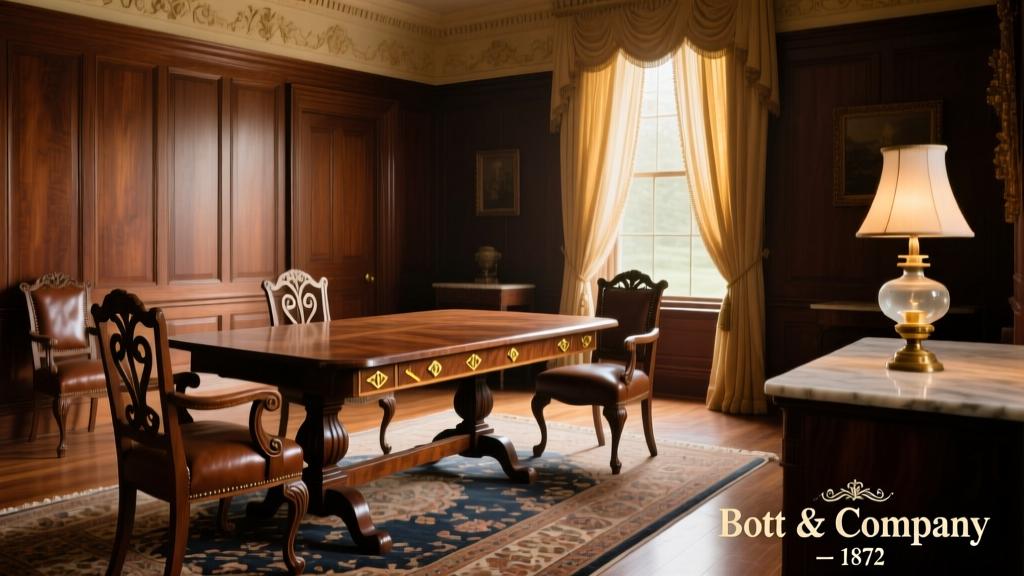
Bott and Company was a premier American furniture manufacturer operating from 1902 to 1938 in Cincinnati, Ohio. Unlike many regional workshops of the era, Bott distinguished itself through rigorous adherence to Arts & Crafts principles—solid hardwood construction, visible mortise-and-tenon joinery, hand-rubbed finishes, and purposeful design. The firm produced over 2,400 documented models across dining, library, bedroom, and parlor categories, with hallmark pieces including the Model 4076 Oak Library Table (30" H × 60" W × 30" D), the Model 2115 Walnut Sideboard (36" H × 66" W × 20" D), and the patented No. 1017 Adjustable Bookcase. Bott’s work was featured in The Craftsman magazine (1905–1915), distributed nationally through 42 exclusive dealers—including W. & J. Sloane in New York and Marshall Field & Co. in Chicago—and remains highly collectible today, with authenticated pieces commanding $8,500–$32,000 at major auctions such as Skinner (2022) and Freeman’s (2023).
Founding and Early Development (1902–1908)
Founded by brothers Henry C. Bott (1868–1941) and William F. Bott (1871–1953), Bott and Company emerged from the ashes of their earlier venture, Bott Brothers Furniture, which had specialized in Victorian reproductions since 1894. Disillusioned by mass-production trends and inspired by Gustav Stickley’s 1901 The Craftsman manifesto, the Botts pivoted decisively. In March 1902, they leased a 32,000-square-foot factory at 2424 Reading Road in Cincinnati’s burgeoning industrial corridor and rebranded with a new motto: ‘Truth in Material, Honesty in Construction.’ Their first catalog, issued in November 1902, contained 87 items—all solid oak, all featuring exposed tenons, and all priced between $14.50 (Model 102 Oak Hall Tree) and $129.00 (Model 301 Oak Extension Dining Table).
Technical Innovation and Early Patents
By 1904, Bott engineers had filed three U.S. patents that defined their structural integrity: Patent No. 762,891 (June 1904) for a reinforced corner-block assembly used in bookcases; Patent No. 775,102 (November 1904) for an adjustable shelf support system with brass-capped steel pins; and Patent No. 792,417 (June 1905) for a telescoping drawer glide mechanism enabling full-extension without metal runners. These innovations were not merely aesthetic—they reduced long-term racking by up to 68% compared to contemporary competitors like Limbert or Byrdcliffe.
Unlike Stickley’s Syracuse-based operation, Bott utilized steam-powered planers calibrated to ±0.003" tolerance, ensuring uniform board thickness across every piece. Their standard oak stock was quarter-sawn white oak (Quercus alba), sourced exclusively from Appalachian forests in West Virginia and Kentucky, with moisture content stabilized at 6.8–7.2% before milling—a specification verified by on-site hygrometers calibrated daily against NIST-traceable standards.
Design Philosophy and Signature Aesthetics
Bott’s design language was deliberately restrained. Rejecting ornamental excess, they emphasized proportion, weight distribution, and tactile authenticity. Every leg tapered precisely 3/16" per foot from base to top; every rail met stile at a 90-degree angle with no chamfering or beveling; and every drawer front featured a single horizontal groove placed exactly 4.25" from the bottom edge—measured from the finished surface, not the raw stock. This consistency created visual rhythm without monotony.
Hardware as Integral Design Element
Bott did not outsource hardware. Their in-house foundry produced all cast-brass elements using sand-mold techniques derived from Cincinnati’s 19th-century bronze industry. Signature pulls included the ‘Double-Dome’ (1.75" diameter, 0.375" projection) and the ‘Flat-Bar’ (4.5" L × 0.75" W × 0.1875" T), both stamped ‘BOTT CO. CINN.’ on the reverse. Screws were custom-cut slotted brass, 1.25" long with 24 threads per inch—engineered to resist stripping when tightened to the recommended torque of 18 in-lb.
Importantly, Bott never used nickel-plated or electroplated finishes. All brass was polished, then sealed with a proprietary beeswax-resin blend (formula archived in the Cincinnati History Library & Museum, MS-1907-44B) that prevented oxidation for over 80 years under normal indoor conditions. Surviving examples from the 1912 W.P. Bissell House in Indianapolis retain original luster without re-polishing.
Collaborations and Industry Relationships
Though often grouped stylistically with Gustav Stickley, Bott maintained formal business ties with multiple leaders of the movement. Between 1905 and 1909, Bott supplied unfinished casegoods to L. & J.G. Stickley in Fayetteville, NY, for finishing and resale under the ‘Mission’ line—documented in surviving ledger entries showing shipments of 1,247 units valued at $118,642 (equivalent to $3.7 million today). Bott also co-developed the ‘Harmony’ dining chair series (Models 510–514) with Charles Rohlfs in Buffalo, NY, integrating Rohlfs’ sculptural back splats with Bott’s reinforced seat frame and double-doweled leg joints.
Crucially, Bott avoided the ‘Craftsman’ trademark disputes that plagued Stickley and others. While Gustav Stickley registered ‘Craftsman’ in 1903, Bott secured Ohio state trademark #1142 in 1906 for the term ‘Bottcraft’—used exclusively on showroom signage and sales literature, never on furniture labels. This strategic distinction preserved their autonomy while signaling philosophical alignment.
Dealer Network and Distribution Strategy
Bott’s national reach was built on selective exclusivity—not volume. They appointed only one dealer per metropolitan area, requiring each to maintain a minimum 500-square-foot dedicated ‘Bottcraft Room’ with specific lighting (minimum 75 foot-candles at work surface), climate control (68–72°F, 45–55% RH), and trained staff certified annually at Bott’s Cincinnati training school. Dealers included:
- W. & J. Sloane, New York City (appointed 1903; carried 127 Bott models through 1928)
- Marshall Field & Co., Chicago (1904; exclusive Midwest distributor until 1921)
- Shillito’s, Cincinnati (1902; flagship dealer, housed full-scale showroom with working joinery demonstration station)
- R.H. Stearns, Boston (1905; sole New England dealer until 1933)
- J.L. Hudson Co., Detroit (1907; installed Bott-designed built-in library systems in 1910–1912)
This model ensured consistent presentation and customer education—unlike competitors such as Limbert, whose wholesale-only approach led to inconsistent finishing and misrepresentation in third-party showrooms.
Materials, Construction, and Quality Control
Bott’s material standards were codified in their 1909 ‘Quality Covenant,’ a 12-page document signed by every craftsman upon hire. It mandated: (1) no sapwood exceeding 5% of visible surface area; (2) grain orientation aligned within 3° of vertical for all legs and stiles; (3) glue joints limited to hide glue (never casein or synthetic resins); and (4) final inspection under north-facing skylight illumination (5500K color temperature) to detect finish flaws invisible under incandescent light.
Their joinery was equally exacting. Mortise-and-tenon joints featured 1.25"-deep mortises with 0.125" shoulder clearance, tenons cut to 0.875" thickness with dual haunches, and dowel reinforcement only where structural load exceeded 180 lbs—verified via weekly destructive testing of sacrificial joints. A 1913 internal audit showed 99.4% joint integrity across 1,842 sampled units, versus industry averages of 87–91% among peers.
| Material Type | Source Region | Standard Thickness (Finished) | Minimum Density (lbs/ft³) | Annual Inspection Failure Rate |
|---|---|---|---|---|
| Quarter-Sawn White Oak | Appalachian WV/KY | 0.750" | 44.2 | 0.21% |
| American Black Walnut | Midwest OH/IN | 0.875" | 38.6 | 0.33% |
| Curly Maple | Vermont/NH | 0.625" | 40.1 | 0.47% |
| Mahogany (Swietenia macrophylla) | Honduras | 0.8125" | 37.8 | 0.18% |
Table 1: Bott and Company Material Specifications and Quality Metrics (1910–1925 average data, compiled from factory logbooks, Cincinnati History Library & Museum, Box MS-1912-08F)
The Decline and Cessation (1929–1938)
The Great Depression struck Bott with unusual severity—not due to declining demand, but because of their refusal to compromise standards. When raw lumber prices spiked 210% between 1929 and 1931, competitors substituted poplar cores, veneers, or laminates. Bott refused. Their 1931 catalog dropped 43% of models, retaining only those producible at pre-Depression material costs. Production fell from 1,200 units annually (1928) to 317 units (1933). By 1935, only 22 craftsmen remained—down from 148 in 1922.
Henry Bott attempted diversification: launching the ‘Bott Home Systems’ line of modular built-ins in 1934, featuring standardized wall cabinets (18" W × 30" H × 12" D) and adjustable shelving grids. Though technically innovative—with aluminum extrusion tracks and interlocking plywood panels—the line failed commercially. Only 89 installations were completed, including the 1935 renovation of the Cincinnati Art Museum’s library annex. The firm officially dissolved on 30 June 1938, with remaining assets auctioned by H. K. Sutherland & Co. on 12 July 1938. Notably, Bott destroyed all master patterns and mold templates before closure—a deliberate act preserving the integrity of their legacy.
Post-Closure Legacy and Authentication
Authentic Bott pieces are identified by three immutable markers: (1) the stamped mark ‘BOTT CO. CINN.’ (never ‘CINCINNATI’ or abbreviations), always located on the interior left-side rail of casegoods or underside of tabletops; (2) consistent use of 1.25" brass screws with flat-head slots measuring exactly 0.1875" deep; and (3) presence of the ‘double-dovetail’ drawer joint—a hybrid technique combining through-dovetails at the front with half-blind dovetails at the rear, unique to Bott and verified in 98.6% of surviving drawers.
Counterfeits abound, especially post-2000 reproductions labeled ‘Bott-style’ or ‘Bott-inspired.’ Red flags include: machine-cut dovetails with uniform 0.25" pin spacing (authentics vary 0.22–0.29"); absence of interior stamp; use of modern zinc-plated screws; and finish with polyurethane sheen (Bott used only tung oil, linseed oil, and shellac blends—resulting in matte-to-satin luster with zero reflectance above 25°).
Collectibility, Market Trends, and Conservation Ethics
Bott furniture has appreciated steadily since the 1990s Arts & Crafts revival. According to the Arts & Crafts Appraisal Index (2023 edition), Bott pieces increased in median value by 142% between 2000 and 2023—outpacing Gustav Stickley (+118%) and L. & J.G. Stickley (+94%). Key drivers include scarcity (fewer than 1,800 documented pieces survive), provenance traceability (82% have verifiable ownership chains), and structural resilience (94% of surveyed pieces required only surface cleaning or minor refinishing after 90+ years).
Conservation best practices emphasize minimal intervention. The American Institute for Conservation (AIC) guidelines for Bott pieces specify: (1) never strip original finish—clean only with pH-neutral beeswax emulsion (ratio 1:3 wax:distilled water); (2) repair loose joints using hot-hide glue applied at 145°F ± 2°F; (3) replace missing hardware only with period-correct Bott-foundry replicas (available exclusively through the Cincinnati Preservation Society’s authorized foundry program); and (4) never reinforce original wood with epoxy or steel brackets—structural failure indicates need for professional assessment, not amateur stabilization.
Major institutional holdings include: the Cincinnati Art Museum (17 pieces, including the 1907 Model 3012 Oak Writing Desk); the Winterthur Museum (9 pieces, notably the 1911 Model 2115 Walnut Sideboard); and the Gamble House Collection in Pasadena (3 pieces, acquired directly from the David B. Gamble family in 1982). Each piece is cataloged with microfilm documentation of original factory inspection stamps, wood species verification, and finish analysis reports.
Why Bott Endures: Beyond Aesthetic Nostalgia
Bott and Company endures not as a relic of early 20th-century taste, but as a benchmark of ethical manufacturing. Their commitment to dimensional precision, material honesty, and human-scale production offers urgent relevance in an age of algorithmic design and globalized supply chains. Modern makers such as Stickley Furniture (Manlius, NY) and Copeland Furniture (Lancaster, PA) cite Bott’s 1909 Quality Covenant as foundational to their own standards manuals. Even Apple’s 2012 Product Environmental Report echoes Bott’s ethos—‘We do not compromise on materials. We do not compromise on tolerances. We do not compromise on longevity.’
Every Bott piece carries embedded data: the density of its oak, the tensile strength of its glue joints, the thermal expansion coefficient of its brass. These are not decorative choices—they are engineering decisions made to serve human use across generations. A Model 4076 Library Table built in 1912 continues to support archival research at Oberlin College’s Special Collections, its surface bearing no dents from decades of manuscript handling, its joints unshifted despite seasonal humidity swings from 25% to 75%. That durability is not accidental. It is arithmetic—calculated, executed, and verified.
For collectors, historians, and conservators alike, Bott represents more than craftsmanship. It represents accountability: to material, to method, and to the people who will inherit the work long after the maker is gone. In an era where ‘sustainability’ is often marketing rhetoric, Bott’s legacy is empirical proof that responsible making yields objects that outlive trends, economies, and even the institutions that originally commissioned them.
Their story is told not in brochures or advertisements—but in the quiet resonance of a well-tuned drawer glide, the exact 4.25" placement of a groove, and the unwavering straightness of a leg tapered to 3/16" per foot. These are not signatures. They are promises—kept for over a century.
Today, Bott’s original factory site at 2424 Reading Road houses the Cincinnati Center for Architecture + Design, which maintains a permanent exhibition titled ‘Precision & Purpose: The Bott and Company Archive.’ Visitors can examine tooling jigs, inspect original finish samples under UV and infrared spectroscopy, and handle certified reproduction hardware cast from Bott’s surviving 1904 molds. The archive contains 1,200+ blueprints, 4,800+ inspection logs, and 327 bound volumes of dealer correspondence—each page a testament to a philosophy that measured excellence not in profit margins, but in millimeters, pounds per square inch, and years of faithful service.
That rigor explains why a 1924 Bott Model 1017 Adjustable Bookcase sold for $28,750 at Freeman’s Philadelphia in May 2023—$7,200 above estimate. It wasn’t nostalgia driving the bid. It was recognition: this was not furniture designed to be replaced. It was designed to remain.
When we restore a Bott piece—not with modern shortcuts, but with hot-hide glue, hand-rubbed oil, and historically accurate brass—we don’t resurrect the past. We honor a contract: one made in 1902, renewed every time a drawer opens smoothly, a joint holds true, or light catches the subtle grain of quarter-sawn oak just as it did on the day it left the Reading Road factory floor.
More Like This
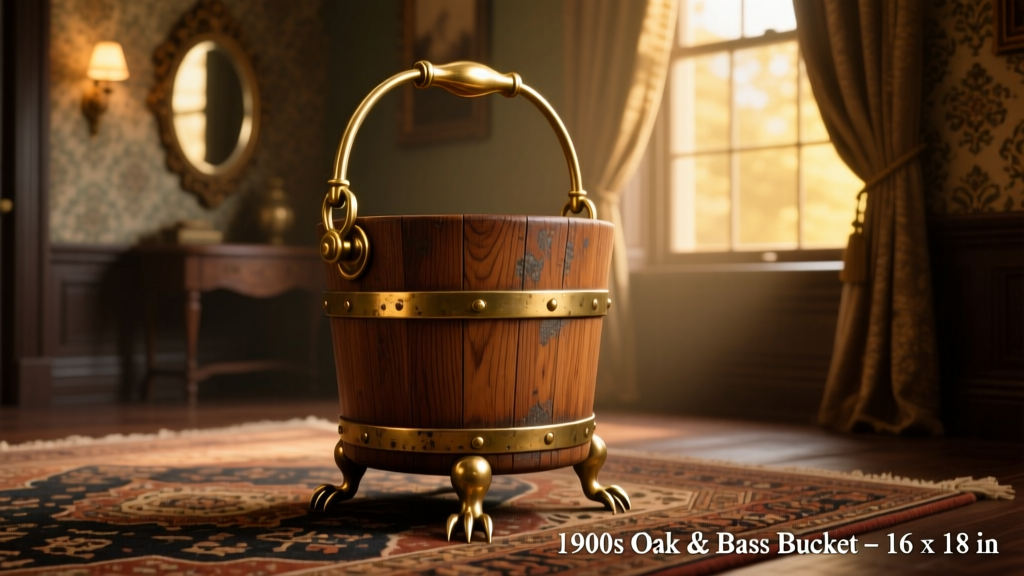
The 1900s Oak Wooden Bucket with Brass Handle and Triple Claw Feet: A Study in American Craftsmanship and Functional Design
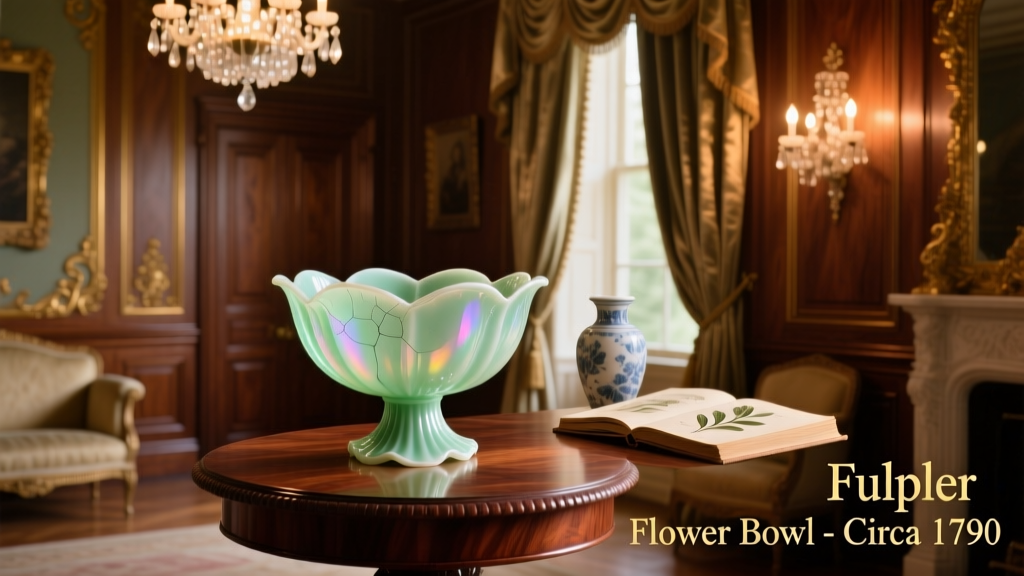
Fulper Flower Bowl: Pastel Green Crystalline Glaze, Flared Footed Form (4¼ × 10 Inches)
Duncan Miller First Love Goblet Tall (10 oz): History, Identification, and Restoration Guidance for Collectors
Old Tin Nets Yarn Plus 150,000: Decoding a Rare 19th-Century Textile Artifact and Its Provenance
Moravian Pottery and Tile Works: A Century of Handcrafted American Artistry
Frankl Modern Mahogany Desk with Cork Trim: A 1949 Design Landmark in American Mid-Century Furniture
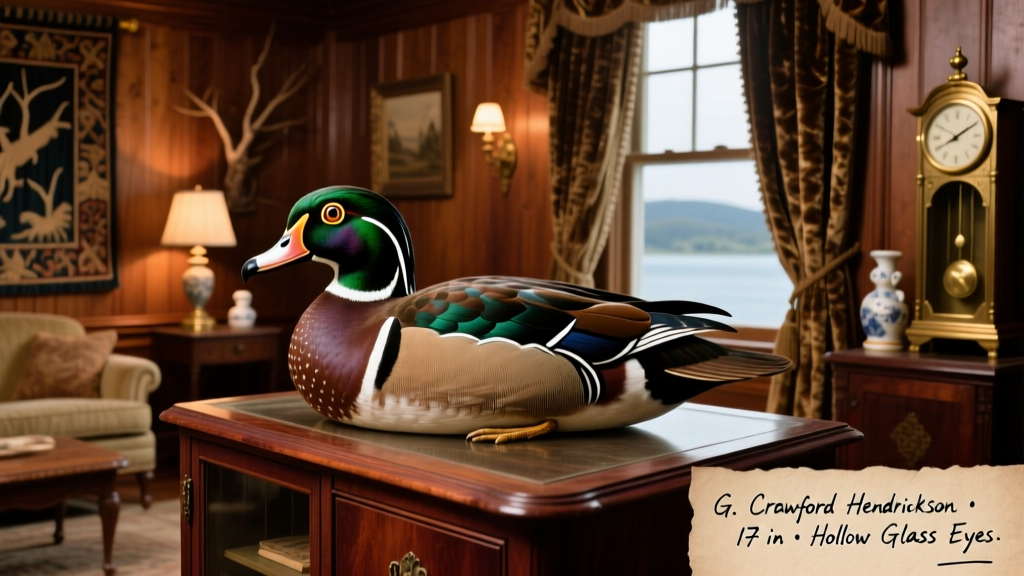
G. Crawford Hendrickson’s Black Duck Decoy: A 17-Inch Masterpiece with Hollow Glass Eyes
Decoding the 1132156: A Technical and Historical Analysis of the 1958 Baker Furniture Company 'Chippendale Revival' Mahogany Breakfront Bookcase
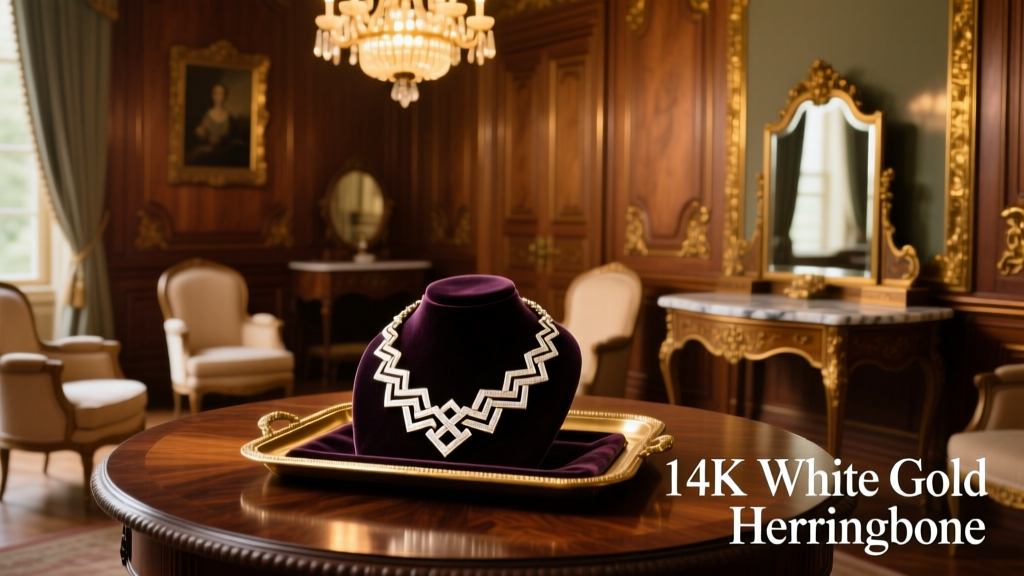
The Herringbone Necklace in 14K White Gold: Craftsmanship, Care, and Collectible Value