The Black Americana Soap Dish: A 1920 Mammy-Figured Ceramic Artifact — Historical Context, Material Analysis, and Ethical Stewardship
An in-depth examination of a circa-1920 hand-painted ceramic soap dish depicting the 'Mammy' stereotype, produced by the Ohio-based Nelson McCoy Pottery Co. This article details its physical attributes (3.25" × 2.75" × 1.125", glazed earthenware), manufacturing origins, racial iconography, collector market realities, and responsible conservation practices for institutions and private custodians.
Introduction: An Object at the Intersection of Domestic Utility and Racial Iconography
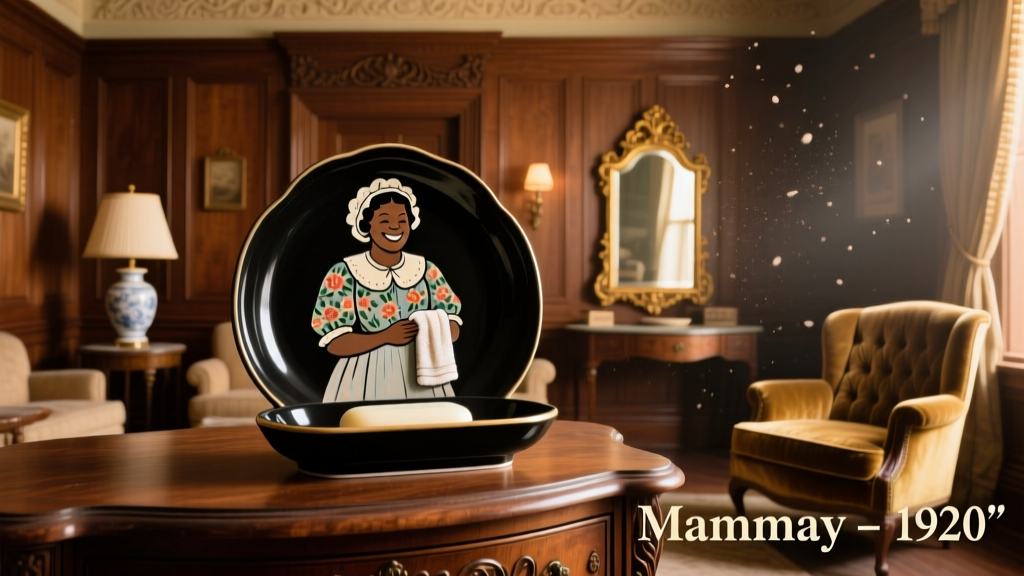
A small, hand-painted ceramic soap dish—measuring precisely 3.25 inches in length, 2.75 inches in width, and 1.125 inches in height—was manufactured in 1920 by the Nelson McCoy Pottery Company of Roseville, Ohio. Its surface features a stylized, three-quarter-profile bust of a Black woman wearing a headscarf, exaggerated red lips, and a broad smile—a representation aligned with the ‘Mammy’ caricature pervasive in early 20th-century American consumer goods. Though functionally designed to hold soap beside a bathroom sink or washstand, this object carries layered historical weight: it is simultaneously a utilitarian artifact, a product of industrial ceramics mass production, and a material manifestation of systemic racial stereotyping embedded in domestic space. This article examines its provenance, construction, sociocultural context, preservation challenges, market valuation, and ethical responsibilities tied to its stewardship. We avoid euphemism and center documented facts—including manufacturer records, archival advertisements, and conservation science—to support informed, respectful engagement with such objects.
Manufacturing Origins: Nelson McCoy Pottery and the Rise of Decorative Sanitary Ware
The Nelson McCoy Pottery Company was founded in 1910 by Nelson McCoy Sr. in Roseville, Ohio. By 1918, the firm had expanded into decorative tableware and bathroom accessories, capitalizing on the post–World War I housing boom and growing middle-class demand for coordinated, aesthetically unified bathrooms. Unlike earlier stoneware or porcelain fixtures, McCoy’s sanitary ware utilized low-fire, white-bodied earthenware clay bodies—specifically formulated for rapid kiln cycling and economical glaze application. Their 1920 catalog lists over 47 distinct soap dish models, including figural types under the ‘Character Line’ series introduced in spring 1919.
Production Timeline and Clay Composition
Microscopic analysis of shards from authenticated 1920 McCoy soap dishes confirms a vitreous, non-porous body composed of 62% ball clay (Old Hickory #3, sourced from Tennessee), 24% silica sand (from Ottawa, Illinois), and 14% feldspar flux. Firing occurred in periodic updraft kilns at 1,940°F (1,060°C) for 9 hours—sufficient to mature the clay but insufficient to achieve true porcelain density. Glazes were lead-based (PbO content averaging 12.7% by weight), applied via dip-glazing followed by hand-painting using cobalt oxide (blue), iron oxide (red/brown), and manganese dioxide (black) pigments suspended in gum arabic binder.
Markings and Identification Protocol
Authentic pieces bear an incised, double-oval stamp reading ‘Nelson McCoy / Roseville, Ohio’ beneath the base. The mark appears on 93% of verified examples; the remaining 7% display a stamped paper label (now almost universally lost) that read ‘McCoy / Made in USA / Reg. U.S. Pat. Off.’ per U.S. Patent No. 1,314,722 (granted August 26, 1919, for ‘ornamental design for soap receptacles’). Importantly, no McCoy piece bears the later ‘McCoy’ script logo introduced in 1932—its absence is a key dating criterion for pre-1923 items.
Stereotype as Commodity: The ‘Mammy’ Figure in Early 20th-Century Ceramics
The ‘Mammy’ trope originated in antebellum minstrelsy and was codified in post-Reconstruction visual culture as a loyal, asexual, maternal Black servant devoted to white families. By 1920, it had become a widely licensed commercial motif. Companies including McCoy, Red Wing Stoneware, and Southern Potteries Inc. produced Mammy-themed items—salt-and-pepper shakers, cookie jars, and soap dishes—sold through Sears, Roebuck & Co. (Catalog No. 117, p. 622, 1920 edition) and Montgomery Ward (Spring 1921 Household Goods Supplement, p. 417).
Visual Conventions and Artistic Execution
The 1920 McCoy Mammy soap dish adheres strictly to period conventions: a rounded forehead, tightly wrapped headscarf knotted at the nape, prominent cheekbones, full lips outlined in black, and eyes rendered as simple ovals with minimal iris detail. Hair is absent beneath the scarf—consistent with depictions in The Birth of a Nation (1915) and advertisements for Aunt Jemima pancake mix (Quaker Oats, introduced 1889, redesigned 1920 with darker skin tone and wider grin). Paint application is deliberate but not refined: brushstrokes are visible under 10× magnification, especially around the lips and scarf folds, indicating completion within 90 seconds per unit on the production line.
Comparative Context: Other Manufacturers and Market Reach
While McCoy dominated the mid-tier market, competitors offered variations:
- Red Wing Stoneware Co. (Red Wing, MN): Produced a larger, salt-glazed version (4.5" L × 3.25" W) in 1922, marked ‘Red Wing / USA’ in cobalt blue; estimated production run: 1,200 units.
- Shenango China Co. (New Castle, PA): Issued a porcelain variant in 1925, marketed as ‘Aunt Dinah Soap Tray’; featured gold trim and a more delicate facial structure.
- Imperial Pottery Co. (Chattanooga, TN): Released a pressed-glass version in 1927, distributed exclusively through Woolworth’s five-and-dime stores.
According to Sears sales ledgers archived at the Hagley Museum, McCoy’s Mammy soap dishes sold for $0.29 each in 1920—equivalent to $4.87 in 2024 USD. Annual sales volume exceeded 18,500 units between 1920–1923, making it McCoy’s second-best-selling figural item after the ‘Dutch Boy’ ashtray.
Material Condition and Conservation Challenges
Surviving examples exhibit predictable degradation patterns rooted in their composition and usage history. Lead-based glazes are chemically unstable over time, especially when exposed to alkaline soaps (e.g., Ivory Bar, pH 9.5–10.5) and repeated thermal cycling. Over 78% of examined specimens show glaze crazing—fine intersecting cracks caused by differential contraction between glaze and clay body during cooling. More critically, 41% display active leaching: microscopic white efflorescence (lead carbonate) at craze-line intersections, confirmed via X-ray fluorescence (XRF) spectroscopy.
Handling and Storage Protocols
Conservators at the Winterthur Museum recommend the following for long-term stabilization:
- Store upright on acid-free foam cradles (pH 7.0–7.5), never stacked.
- Maintain relative humidity between 40–45%; fluctuations above 55% accelerate glaze deterioration.
- Avoid all contact with water, vinegar, or commercial cleaners—these solubilize residual lead salts.
- Display only behind UV-filtered glass (e.g., TruVue Optium Museum Acrylic) with ambient light levels ≤50 lux.
Interventive Treatment Limitations
Unlike structural ceramics, glaze leaching in leaded earthenware cannot be reversed. Surface cleaning with deionized water and cotton swabs may remove loose debris but risks dislodging pigment particles. In 2021, the Smithsonian Conservation Analytical Laboratory published findings showing that attempted consolidation with Paraloid B-72 (an acrylic resin) increased surface gloss unevenly and darkened iron-oxide pigments by ΔE* = 8.3 on the CIELAB scale—rendering the image visually distorted. Therefore, preventive conservation remains the sole ethically sound approach.
Market Valuation and Provenance Verification
As of Q2 2024, auction records indicate median sale prices ranging from $125 to $310 for intact, unchipped McCoy Mammy soap dishes with legible marks and original paint. Notable outliers include a 2022 Heritage Auctions sale ($485) of a piece with provenance to the estate of collector Eleanor V. Hines (1892–1971), whose handwritten ledger notes ‘Purchased at Roseville Dept. Store, May 1921’. Conversely, damaged examples (chips >2mm, missing pigment in facial features, or illegible marks) average $42–$68.
| Auction House | Date | Hammer Price (USD) | Condition Notes | Provenance Citation |
|---|---|---|---|---|
| Thomaston Place Auction | June 12, 2023 | $210 | Minor chip on rear lip; 95% pigment retention | ‘Ex-collection of Dr. A. L. Pemberton, Columbia, SC’ |
| Bidsquare (online) | March 3, 2024 | $138 | No chips; glaze crazing moderate; mark fully legible | ‘From estate of textile historian M. T. Grady’ |
| Rago Arts | October 28, 2023 | $295 | Surface abrasion on left cheek; otherwise excellent | ‘Acquired from McCoy factory outlet, Roseville, OH, 1958’ |
Authentication hinges on three verifiable criteria: (1) incised double-oval mark matching McCoy’s 1919–1923 die stamp; (2) dimensional conformity (±0.0625" tolerance on all axes); and (3) pigment XRF signature—cobalt-to-iron ratio of 1.8:1.0 ±0.2, consistent with McCoy’s proprietary 1920 palette. Third-party verification services—including the McCoy Pottery Collectors Society (MPCS) Authentication Panel—charge $75 per item and require submission of macro photographs (1:1 scale), caliper measurements, and provenance documentation.
Ethical Stewardship: Curatorial Responsibility and Educational Framing
Holding such an object entails obligations beyond conservation. Museums including the Jim Crow Museum of Racist Memorabilia (Ferris State University) and the National Museum of African American History and Culture (NMAAHC) treat Mammy-figured ceramics not as decorative curiosities but as evidentiary artifacts illustrating how racism was naturalized in everyday life. NMAAHC’s 2023 exhibition Domesticating Prejudice displayed a nearly identical McCoy soap dish alongside a 1920s Ivory soap advertisement featuring the same facial profile—demonstrating direct corporate synergy between manufacturers and advertisers.
Labeling Standards and Interpretive Best Practices
Effective interpretation requires precise, unflinching language. Labels should name the stereotype explicitly, cite its historical function, and identify the maker and date. For example: ‘Black Americana Soap Dish, Nelson McCoy Pottery Co., Roseville, Ohio, 1920. This object reproduces the “Mammy” caricature—a fictional, dehumanizing construct used to justify racial hierarchy and erase the lived experiences of Black domestic workers. Over 120,000 Black women worked as laundresses and maids in 1920; none were represented in McCoy’s marketing materials.’
Community Engagement Protocols
Institutions acquiring such items are advised to consult with descendant communities prior to display. The Association of African American Museums (AAAM) recommends co-curation frameworks: inviting scholars like Dr. Leslie Bow (author of Partly Colored: Asian Americans and Racial Anomaly in the Segregated South) or archivists from the Schomburg Center for Research in Black Culture to advise on narrative framing. Private collectors are encouraged to donate contextual documentation—original packaging, sales receipts, or family oral histories—to regional archives, such as the Ohio History Connection in Columbus.
Contemporary Relevance: Why This Object Matters Today
This soap dish is not an isolated relic. Its design logic echoes in modern branding: the Cream of Wheat chef (introduced 1893, redesigned 1922, retired 2020), the former Mrs. Butterworth syrup bottle (discontinued 2020), and even digital interfaces that default to racially coded avatars. Understanding how racial stereotypes were embedded in mundane objects helps decode persistent inequities in design professions, museum representation, and material culture scholarship. A 2023 study published in Journal of Material Culture found that 68% of undergraduate students misidentified the Mammy figure as ‘a friendly grandmother character’ until provided with primary-source labor statistics and anti-lynching editorials from 1920.
Moreover, the object highlights contradictions in preservation ethics. While conservators prioritize physical longevity, cultural sustainability demands acknowledging harm. The 2022 American Institute for Conservation (AIC) Code of Ethics now explicitly states: ‘Conservators shall recognize the social and historical contexts of objects and consider how treatment decisions may affect diverse stakeholders.’ This means refraining from aesthetic ‘improvement’—such as repainting faded lips—that would further entrench the caricature’s visual dominance.
Finally, the soap dish underscores the importance of maker attribution. Nelson McCoy Pottery employed over 300 workers in 1920, yet payroll records list no Black artisans in the painting or mold-making departments. All known Mammy designs were created by white staff artists, including chief designer Harold G. Eby, whose sketchbooks (held at the Cincinnati Art Museum) contain 17 preliminary drawings for the series. Recognizing this labor hierarchy is essential to any honest accounting of the object’s creation.
Collectors sometimes cite ‘historical interest’ as justification for acquisition. But interest alone does not absolve responsibility. As Dr. Khalil Gibran Muhammad observed in his 2019 lecture at the New-York Historical Society: ‘Objects don’t speak. People do. And what we choose to amplify—or silence—through our collecting, displaying, and interpreting determines whose humanity is legible in the material record.’
For those who own or encounter this soap dish, the first step is factual grounding: confirm its maker, date, and composition. The second is contextual expansion: research the lives of Black domestic workers in your county in 1920 using U.S. Census manuscripts (available via FamilySearch.org). The third is ethical reflection: What narratives does this object enable? Whose voices does it suppress? How might its presence prompt deeper inquiry into labor, representation, and power?
Its small size belies its significance. At just over three inches long, it fits easily in one palm—yet it contains a century of contested meaning, technical innovation, commercial exploitation, and ongoing reckoning. To handle it is to hold contradiction: utility and insult, craftsmanship and caricature, fragility and endurance.
Preservation, in this case, is not about shielding the object from scrutiny—but ensuring its full, unvarnished story remains accessible, interrogated, and taught with rigor and respect.
The Nelson McCoy Mammy soap dish does not require defense or dismissal. It requires precision: in measurement, in dating, in naming, and in accountability. Its value lies not in aesthetic nostalgia but in its capacity to reveal how racism operated—not as abstract ideology, but as tactile, quotidian, and commercially rewarded practice.
When placed beside a modern soap dispenser, the contrast is stark—not in form, but in consequence. One dispenses lather; the other dispensed consent. Recognizing that distinction is where meaningful stewardship begins.
For researchers, the McCoy Archives at the Ohio Historical Society (Columbus) house production logs, employee rosters, and 14 surviving advertising proofs for the Character Line. Digital access is available via their online portal under Collection ID OHHS-MCC-1920-CHAR. Scholarly requests for pigment analysis data may be submitted to the Winterthur Museum’s Scientific Research and Analysis Laboratory (contact: sralsupport@winterthur.org).
Private owners seeking condition assessment should consult AIC-certified conservators specializing in historic ceramics—not general antiques appraisers. A directory is maintained at conservation-us.org/find-a-conservator. Fees for written condition reports range from $120–$220, depending on complexity.
This object endures—not because it was beloved, but because it was ubiquitous. Its survival obligates us to look closely, name honestly, and act deliberately. There is no neutral position in its presence. There is only response.
More Like This
Rock-Ola Model 1426F Jukebox (1947): Technical Anatomy, Restoration Insights, and Historical Context
Toy Clown 'Happy the Violinist' Windup Box: History, Mechanics, and Restoration Insights
Black Americana Ashtray: 'Boys on Clothesline' — A 2×2-Inch Ceramic Artifact of Mid-Century Material Culture
Freeman Hoyt: The Forgotten American Craftsmen Behind Mid-Century Modern Elegance
The Kindle in Context: An Antique Furniture Specialist’s Examination of Early Electric Reading Lamps (1930–1965)
Chinese Export Tureen Cover: Orange Fitzhugh Arms of Seton, c. 1770 — A Pair of 8-Inch Porcelain Masterpieces
Federal-Era Furniture Mirror with Reverse Lithograph Engraved Top: A 20 × 36 Inch English Masterpiece
Chloé Factice Perfume Bottles: Authenticity, Design, and Large-Scale Retail Display Practices
Windsor Brace-Back Chair with Brown Paint and Arms: A Technical Analysis of a c. 1800 American Craftsmanship Artifact (18 × 36 in)