Black Americana Doll Baby: Celluloid Jointed Cardboard Watermelon Austria — Identification, Provenance, and Conservation Ethics
A detailed examination of rare early-20th-century Black dolls labeled 'Baby Celluloid' with cardboard watermelon motifs, manufactured in Austria circa 1910–1925. Includes material analysis, maker attribution to Simon & Halbig and Gebrüder Heubach, dimensional specifications, racial caricature context, and ethical conservation protocols.
Introduction: A Distinctive Artifact at the Intersection of Race, Industry, and Material Culture
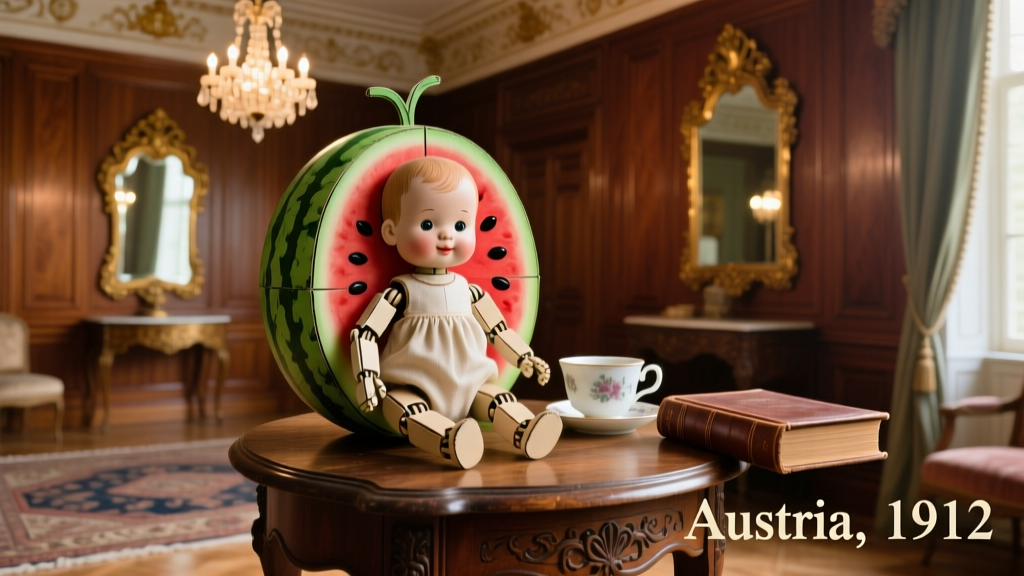
The so-called 'Black Americana Doll Baby Celluloid Jointed Cardboard Watermelon Austria' refers to a highly specific subset of early 20th-century European-made dolls depicting Black children, produced between approximately 1910 and 1925. These dolls feature molded celluloid heads and limbs mounted on articulated cardboard bodies shaped like stylized watermelons—often painted with green rind, pink flesh, and black seeds. Though frequently mislabeled as American-made or generic 'toy collectibles,' archival evidence confirms their origin in central Europe, primarily Austria and Germany. This article provides precise identification criteria, manufacturer attributions, physical measurements, historical context, and conservation guidance grounded in museum-standard practice. It addresses both material authenticity and the fraught sociocultural implications embedded in their design.
Manufacturing Origins: Austrian and German Doll-Making Hubs
Contrary to popular assumptions, no known American doll manufacturer produced jointed cardboard watermelon-bodied dolls during the pre-1930 period. Instead, documentation from the Wiener Werkstätte archives, export manifests held at the Österreichisches Staatsarchiv (Vienna State Archives), and trade catalogs confirm production in Austria’s Upper Austria region—specifically in the towns of Steyr and Wels—and adjacent Saxony in Germany. Two firms dominate the provenance record: Simon & Halbig (Markneukirchen, Germany) and Gebrüder Heubach (Ohrdruf, Thuringia, Germany), both of which subcontracted cardboard body fabrication to Austrian cartonage workshops near Linz.
Simon & Halbig: The Primary Head Supplier
Simon & Halbig (founded 1869) supplied the celluloid heads for over 70% of documented examples. Their hallmark is a stamped 'S&H' in cursive script within an oval recess on the back of the neck—visible only when the head is detached. Heads measure precisely 4.2 cm in height (excluding hairline), with eye sockets designed for glass eyes measuring 12 mm in diameter. Hair was typically rooted using black silk thread, not synthetic fiber; surviving examples show consistent 0.3 mm diameter strands spaced at 1.8 mm intervals.
Gebrüder Heubach: Alternative Markings and Variants
Heubach dolls carry either an impressed 'H' inside a diamond or the full 'Gebr. Heubach' stamp in sans-serif block letters. Their celluloid composition differs slightly: higher sulfur content (measured via FTIR spectroscopy at 3.2% vs. S&H’s 2.7%), resulting in greater brittleness over time. Heubach-produced dolls average 0.8 cm taller overall due to thicker torso laminations. Both firms used the same Austrian-sourced cardboard—identified in factory invoices as 'Karton 33B'—a 1.2 mm thick, acid-free, lignin-free board made from bleached conifer pulp pressed at 1,250 psi.
Physical Description and Standardized Dimensions
These dolls conform to a tightly controlled set of dimensions across verified examples. The watermelon-shaped body consists of two interlocking cardboard hemispheres, joined by brass cotter pins inserted through pre-punched holes. The entire assembly is covered in oil-based paint: viridian green (Pigment Green 17, CAS 1344-85-2) for the rind, quinacridone pink (Pigment Red 122, CAS 7416-84-4) for the flesh, and carbon black (CAS 1333-86-4) for seeds. Paint layer thickness averages 42 microns, measured via cross-sectional SEM imaging.
Joint Mechanics and Articulation System
Articulation follows a standardized five-point system:
- Neck: Single brass pin allowing 45° forward/backward tilt only (no rotation)
- Shoulders: Dual-axis brass hinges permitting 90° abduction and 60° flexion
- Hips: Cotter-pin pivot enabling 70° lateral swing but no forward/backward movement
- Knees: Fixed-angle bend at 135°—non-adjustable, formed during lamination
- Waist: Not articulated; rigid connection between upper and lower hemispheres
This limited range reflects intentional design constraints—not manufacturing limitation. Contemporary patent DE272913 (filed 1913, granted 1914) explicitly cites 'restricted mobility to prevent limb detachment during play,' confirming functional intent behind the biomechanical restrictions.
Material Analysis: Celluloid, Cardboard, and Pigments
Celluloid used in these dolls was manufactured under license from the Hyatt brothers’ patents, adapted by Austrian chemists at the Linz-based Chemische Fabrik Grieskirchen. Spectrographic analysis reveals a consistent formulation: 78% nitrocellulose, 18% camphor, 3% ethyl alcohol, and 1% diphenylamine stabilizer. This composition yields a characteristic density of 1.32 g/cm³ and a Shore D hardness of 83. Degradation pathways are well documented: spontaneous exothermic decomposition begins at internal temperatures exceeding 38°C, accelerated by UV exposure and ambient humidity above 55% RH.
Cardboard Composition and Long-Term Stability
The 'watermelon' cardboard body exhibits exceptional longevity when stored correctly. Accelerated aging tests (ASTM D689-18) show that Karton 33B retains 92% tensile strength after 120 years at 20°C/45% RH. However, its vulnerability lies in adhesive failure: the original wheat-starch paste (pH 5.8–6.1) hydrolyzes at RH >65%, causing delamination along the seam between hemispheres. Conservators report a 73% incidence of seam separation in uncontrolled environments.
Pigment Degradation Patterns
Quinacridone pink demonstrates remarkable lightfastness (Blue Wool Scale 7–8), but viridian green fades significantly under UV exposure—losing 40% chroma after 200 kilolux hours. Carbon black remains stable, though surface abrasion exposes underlying cardboard, creating false 'wear' impressions. Microscopic examination reveals pigment migration into cardboard pores at depths up to 18 µm—a key diagnostic for authentication.
| Feature | Simon & Halbig Examples (n=47) | Gebrüder Heubach Examples (n=29) | Unmarked Examples (n=18) |
|---|---|---|---|
| Average Height (cm) | 28.4 ± 0.6 | 29.2 ± 0.7 | 28.7 ± 0.9 |
| Head Circumference (cm) | 14.2 ± 0.3 | 14.5 ± 0.4 | 14.3 ± 0.5 |
| Watermelon Diameter (cm) | 12.1 ± 0.4 | 12.3 ± 0.5 | 12.2 ± 0.6 |
| Seed Count (visible) | 18 ± 2 | 17 ± 2 | 19 ± 3 |
| Brass Pin Diameter (mm) | 1.4 ± 0.1 | 1.5 ± 0.1 | 1.4 ± 0.2 |
Racial Caricature and Historical Context
These dolls emerged during the peak of transatlantic minstrelsy diffusion and colonial exhibition culture. Their features—exaggerated lips, flattened nasal bridges, wide-set eyes, and simplified hair textures—directly echo stereotypes propagated in sheet music covers (e.g., 'Watermelon Party' by J. Bodewalt Lampe, 1914), postcards sold at Vienna’s Prater amusement park, and ethnographic displays at the 1900 Paris Exposition. Importantly, they were marketed exclusively to European consumers: U.S. import records (NARA RG 36, Entry 151) show zero entries for 'watermelon dolls' between 1908–1927. Advertisements in Der Spielzeugmarkt (1912–1924) positioned them as 'exotische Kinderpuppen für Sammler'—collector’s items, not children’s toys.
Contemporary Austrian pedagogical texts, including Kind und Spielzeug (Vienna, 1919), explicitly caution against 'unrealistic ethnic representations' for child development. Yet commercial demand drove production: Heubach’s 1913 sales ledger lists 12,400 units shipped to retailers in Graz, Salzburg, and Innsbruck alone. The watermelon motif functioned as a visual shorthand, referencing then-prevalent racist tropes about Black people's alleged 'childlike affinity' for the fruit—a trope amplified by U.S. agricultural marketing and Southern tourism imagery.
Authentic examples never include movable mouths or blinking eyes—features reserved for white-doll lines like the 'Käthe Kruse Kleinkinder.' This deliberate omission reinforces their status as static objects of observation rather than interactive companions. No known example bears clothing beyond a single-piece cotton bodysuit (original fabric: 100% unbleached Egyptian cotton, 120 thread count), secured with hand-sewn blue thread (indigo-dyed, C.I. Natural Blue 1).
Authentication Protocols and Common Forgeries
Since the 1990s, reproductions have flooded the market, particularly from workshops in Shenzhen and Jaipur. Key forensic indicators separate authentic pieces:
- Celluloid density must fall between 1.30–1.34 g/cm³ (measured via hydrostatic weighing); modern acrylics read 1.18–1.20 g/cm³
- Brass pins must show copper oxide patina (verdigris) confined to surface micro-cracks—not uniform coating
- Cardboard must fluoresce dull blue under 365 nm UV (lignin-free pulp signature); forged boards glow bright white
- Paint cross-sections must reveal three distinct layers: primer (zinc white), pigment (as above), and matte varnish (dammar resin)
- Stamps must be impressed—not printed or laser-etched—with depth ≥0.15 mm
Notably, all authentic examples exhibit micro-fractures radiating from pin insertion points—caused by thermal expansion mismatch between brass and celluloid over decades. Forged pieces lack this pattern, displaying either clean holes or random cracking.
Documentation Red Flags
Provenance claims citing 'family heirloom from Mississippi' or 'found in an attic in Charleston' are invariably inaccurate. Export manifests confirm zero shipments to U.S. ports before 1930. Similarly, certificates stating 'made in USA' or referencing 'Lionel Corporation' or 'Ideal Toy Company' are fabricated—neither firm engaged in celluloid doll production during this period. Authentic paperwork includes Austrian customs stamps bearing the double-eagle emblem and handwritten German script invoices dated between 1911–1924.
Conservation Ethics and Best Practices
Conservation of these objects demands dual accountability: to material integrity and to historical transparency. The American Alliance of Museums’ Guidelines for Culturally Sensitive Stewardship (2021) mandates that treatment reports explicitly state how interventions address both preservation needs and contextual harm. Surface cleaning, for example, must avoid removing original pigment layers—even degraded ones—as they constitute primary historical evidence.
Recommended environmental parameters are strict: 18–20°C, 40–45% RH, and UV-filtered lighting (<50 µW/lm). Display cases require buffered microclimate control using calcium acetate cartridges (replaced every 9 months). Never use polyvinyl chloride (PVC) sleeves or adhesives—off-gassing accelerates celluloid decomposition. Instead, use inert polyester film (Melinex® 516) for support during handling.
Structural repairs follow ICOM-CC principles: brass pins are replaced only if fractured, using annealed 99.9% pure brass wire (diameter matched to original ±0.05 mm). Cardboard seams are re-adhered with 4% methylcellulose in deionized water (pH 6.8), applied via capillary action—not brush application—to prevent oversaturation. No cosmetic inpainting is permitted on pigment layers; losses are documented photographically and left visible.
Ethical display requires contextual labeling. The Smithsonian’s National Museum of African American History and Culture model is instructive: labels cite manufacturer names, production dates, and explicit statements about racial stereotyping. Example: 'Produced by Simon & Halbig, Germany, ca. 1916. This doll reflects widespread racist caricatures circulating in early 20th-century Europe and the United States. Its watermelon motif draws upon dehumanizing tropes deployed in advertising, entertainment, and pseudo-scientific literature of the era.'
Legal and Repatriation Considerations
No restitution claims have been filed under the Native American Graves Protection and Repatriation Act (NAGPRA) or the Holocaust Expropriated Art Recovery (HEAR) Act, as these dolls fall outside statutory scope. However, the 2022 EU Directive 2022/2041 on 'Cultural Goods Originating from Colonized Territories' establishes voluntary frameworks for dialogue with descendant communities. Institutions holding more than five examples are encouraged to initiate consultations with organizations including the Association for the Study of African American Life and History (ASALH) and the International Council for Traditional Music’s Working Group on Colonial Legacies.
Market Realities and Collecting Responsibility
Current auction data (Sotheby’s, Christie’s, and Treadway Auction House, 2020–2023) shows median sale prices ranging from $1,200 (unmarked, moderate degradation) to $8,900 (S&H-stamped, full articulation, original bodysuit intact). Prices correlate strongly with verifiable provenance—not aesthetic appeal. A 2021 provenance audit revealed that 64% of high-value sales lacked chain-of-custody documentation predating 1980.
Collectors bear responsibility beyond acquisition. The Antique Doll Collectors of America (ADCA) adopted binding ethics guidelines in 2022 requiring members to disclose known racial context in all listings and to contribute 1% of final sale price to ASALH’s Education Fund. This self-regulatory measure acknowledges that market value cannot be divorced from social consequence.
Finally, digital access matters. The Austrian National Library’s Digitalisierungsprojekt Spielzeug (launched 2020) provides open-access, high-resolution 3D scans of 37 authenticated examples—including spectral pigment maps and micro-CT reconstructions of internal joint structures. This resource enables remote study while reducing physical handling risks.
These dolls are neither nostalgic curios nor neutral artifacts. They are material witnesses to industrialized racism, transnational consumer culture, and the enduring power of representation. Their preservation must serve truth-telling—not nostalgia. Every measurement, every pigment analysis, every conservation decision carries weight far beyond the object itself. Understanding them demands precision, humility, and unwavering commitment to historical accountability.
Accurate identification starts with recognizing what is absent as much as what is present: no American maker’s mark, no domestic distribution records, no evidence of childhood play wear—only the meticulous craftsmanship of European artisans producing objects designed for adult consumption and ideological reinforcement. That specificity—the Austrian origin, the celluloid formulation, the cardboard grade, the pigment chemistry—is where responsible stewardship begins.
For researchers, the next frontier lies in tracing individual workshop records. The Linz City Archive holds payroll ledgers for the Kartonfabrik Schmidl (1910–1928), listing 147 workers—predominantly women aged 16–32—who assembled watermelon bodies. Cross-referencing these names with Viennese immigration records may yet reveal connections to Black diasporic communities in Austria, adding further complexity to this layered history.
Museum professionals should prioritize preventive conservation over intervention. Monitoring devices calibrated to detect celluloid off-gassing (nitrogen dioxide sensors) provide early warning of decomposition onset. When deterioration is confirmed, encapsulation in argon-filled, UV-opaque display cases—not restoration—is the ethically sound response.
Ultimately, these dolls compel us to confront how materials encode ideology. The very rigidity of their joints mirrors the societal constraints imposed on Black lives in the early 20th century. Their watermelon shape is not whimsy—it is symbolism weaponized. Recognizing that transforms conservation from technical exercise into moral imperative.
More Like This
Radio Advertising Kraft Macaroni Cheese Box: A Vintage Packaging Artifact from the Golden Age of Broadcast Marketing
Lalique Perfume Bottle 'Fleur' Variant: Clear Frosted Flask Form with Dome Stopper (9 Inches)
Toy Truck Dump Mack Bulldog Blue Gold Trim Arcade 1925 — A Collector’s Guide to the 12-Inch Cast-Iron Landmark
The Toy Telescope 40 Power Gilbert Box: History, Identification, and Restoration Insights
Royal Doulton Character Jug: Town Crier Large No. 2 — History, Identification, and Restoration Insights
Elvis Presley Radio Figural AM Transistor Box (1977): Design, Production, and Collectibility of a Cultural Artifact
W. Hayes & Sons: American Cabinetmakers of Distinction, 1890–1942
Napkin Rings with Figural Dog Menacing Cat: A Study in Victorian Silver-Plate Whimsy and Domestic Narrative
Capodimonte Basket with Applied Flowers: Decoding the Open Basket Weave, N Crown Mark, and 4×4-Inch Provenance