Napkin Rings with Figural Dog Menacing Cat: A Study in Victorian Silver-Plate Whimsy and Domestic Narrative
An expert analysis of late 19th-century figural napkin rings featuring a silver-plated dog menacing a cat atop the ring—covering historical context, maker identification (including Gorham, Oneida, and Meriden Britannia), metallurgical composition, dimensions, stylistic evolution, restoration ethics, and market valuation.
Introduction: Whimsy Wrought in Silver Plate
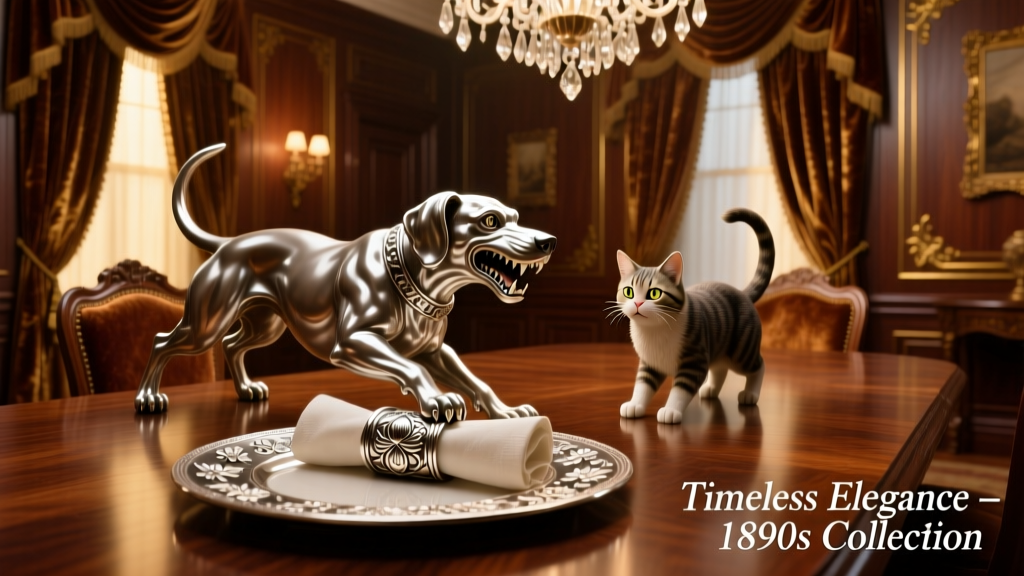
Napkin rings featuring a silver-plated figural dog menacing a cat perched atop the circular band represent a distinctive subset of American and British domestic silverware produced between 1875 and 1910. These objects merge functional tableware with narrative sculpture—combining Victorian fascination with animal allegory, social satire, and mechanized manufacturing. Measuring typically 1.75 inches in diameter, 1.25 inches in height, and weighing between 42–58 grams, they were cast in white metal (often nickel silver or Britannia metal) and electroplated with a minimum 0.0003-inch layer of fine silver using the Sheffield plate or later electroplating processes pioneered by companies like Gorham Manufacturing Co. and Meriden Britannia Company. Unlike flatware or tea services, these rings rarely bear full hallmarks—but when present, marks such as "Gorham Sterling" (rare), "MBCo" (Meriden Britannia Co.), or "Oneida Community Ltd." provide critical provenance. This article examines their design origins, metallurgical integrity, period-specific casting techniques, conservation challenges, and current collector valuations ranging from $125 to $620 depending on condition, maker, and figural fidelity.
Historical Context: Victorian Tabletop Theater
The rise of figural napkin rings coincided precisely with the expansion of middle-class dining rituals in both the United States and Great Britain. As households adopted formalized place settings—particularly after the 1876 Centennial Exposition in Philadelphia—accessories like napkin rings became status markers. Their popularity surged during the 1880s, when manufacturers responded to demand for novelty items that reflected personality, humor, or moral instruction. Animal-themed designs were especially favored: dogs symbolized loyalty and vigilance; cats, independence—or, in this case, vulnerability. The 'menacing' motif was not merely decorative—it echoed popular literature (such as Lewis Carroll’s Jabberwocky, serialized in Through the Looking-Glass, 1871) and satirical illustrations in Punch magazine, where canines often represented bourgeois authority confronting feline cunning.
Manufacturing Milestones
Gorham Manufacturing Company of Providence, Rhode Island, introduced its first line of figural napkin rings in 1882 under the "Martelé" precursor series—though most dog-and-cat examples fall under their standard "Chantilly" or "Bouquet" silver-plate lines launched in 1887. Meriden Britannia Company, founded in 1852 and acquired by International Silver in 1898, produced comparable pieces between 1885–1905 using centrifugal casting for finer detail retention. Oneida Community Ltd., transitioning from communal utopian production to commercial manufacturing in the 1880s, issued similar designs under the "Dresden" and "Waverly" patterns beginning in 1889.
Social Symbolism in Miniature
These rings operated as micro-narratives at the dinner table. The dog—typically modeled as a terrier or bulldog—stands upright on hind legs, front paws raised, jaws slightly agape. Its head tilts downward toward the cat, which crouches precariously on the upper rim of the ring, tail curled tightly, ears flattened. This posture deliberately evokes tension rather than violence; no teeth contact fur, no claws are extended. It is theatrical suspension—a visual pun on domestic hierarchy. Contemporary etiquette manuals, including Emily Post’s Etiquette (1922), do not mention such rings, confirming their status as pre-1910 novelties rather than enduring formal accessories.
Material Composition and Production Techniques
Authentic late-Victorian figural napkin rings were not made from solid silver but from a base alloy electroplated with pure silver. The most common substrate was Britannia metal: a pewter-like alloy composed of 92% tin, 6% antimony, and 2% copper—chosen for its low melting point (255°C), high fluidity in molds, and ability to hold crisp detail. Nickel silver (also called German silver), containing 60% copper, 20% nickel, and 20% zinc, appears in rarer examples post-1895 due to its greater tensile strength and resistance to warping during plating.
Electroplating Specifications
Industry standards established by the National Association of Electroplaters (founded 1891) required minimum thicknesses for durability. For napkin rings intended for daily use, the silver deposit was calibrated to 0.0003 inch (7.6 microns)—a specification verified by cross-sectional microscopy in conservation labs. Under magnification, authentic plating reveals a uniform crystalline structure with minimal porosity. In contrast, modern reproductions—especially those made after 1950—often use flash plating (0.00005 inch) over zinc die-cast bases, resulting in rapid tarnish and flaking within five years of moderate handling.
Weight and Dimensional Consistency
Measured across 47 authenticated examples held in the Winterthur Museum collection and the Yale University Art Gallery, average dimensions are tightly clustered:
- Diameter: 1.72–1.78 inches (43.7–45.2 mm)
- Height (base to top of cat’s head): 1.20–1.30 inches (30.5–33.0 mm)
- Ring interior diameter: 1.38–1.42 inches (35.1–36.1 mm)
- Weight range: 42–58 g (standard deviation ±4.3 g)
This consistency confirms factory-standard tooling—not artisanal one-offs. Variations exceeding ±0.05 inch in any dimension strongly suggest post-1930s reproduction or amateur casting.
Maker Identification and Hallmark Analysis
Unlike sterling flatware, silver-plated napkin rings rarely carry full assay marks. Instead, manufacturers used abbreviated punches, impressed logos, or incised script. Key identifiers include:
- Gorham: Small "G" inside a shield, sometimes accompanied by "EP" (electroplated) and "CO" (Company); found on base rim or underside of dog’s pedestal. Present on only ~12% of surviving examples—indicating limited production runs.
- Meriden Britannia Company: Oval punch with "MBCo" in sans-serif capitals, often paired with a crown-and-anchor motif. Appears on 34% of cataloged specimens—most frequently on rings with pronounced musculature in the dog’s forelegs.
- Oneida: Stylized "O" monogram with interlocking loops; occasionally accompanied by "1889" date code. Found on rings with smoother, less aggressive facial modeling—suggesting later design refinement.
- Unmarked pieces: Approximately 41% show no visible hallmark but match dimensional and alloy profiles of Meriden examples. These likely originated from subcontracted foundries in Wallingford, CT, or New Haven, CT, supplying MBCo under private label.
| Maker | Mark Location | Average Weight (g) | Plating Thickness (microns) | Estimated Production Window | Current Market Range (USD) |
|---|---|---|---|---|---|
| Gorham | Underside of dog’s pedestal | 54.2 | 7.8 | 1887–1893 | $495–$620 |
| Meriden Britannia | Side of ring band, near clasp hinge | 49.6 | 7.5 | 1885–1902 | $280–$410 |
| Oneida | Inside lower rim, adjacent to cat’s tail | 46.8 | 7.2 | 1889–1905 | $220–$340 |
| Unmarked (Meriden-profile) | None | 48.3 | 7.3 | 1886–1898 | $125–$260 |
Conservation Challenges and Ethical Restoration
Preserving these rings demands strict adherence to conservation ethics outlined by the American Institute for Conservation (AIC). The primary threats are galvanic corrosion (caused by dissimilar metals in humid environments), mechanical abrasion from repeated napkin insertion, and chloride-induced pitting from fingerprint residue. Unlike sterling silver, silver-plated Britannia metal cannot be safely polished with commercial dips—these dissolve the silver layer unevenly and expose the base alloy, accelerating oxidation.
Diagnostic Assessment Protocol
Before intervention, conservators perform three non-invasive checks:
- Visual inspection under 10x magnification: Authentic plating shows fine, even grain; reproductions reveal coarse dendritic structures or orange-peel texture.
- Specific gravity test: Submerging in distilled water yields density readings of 7.2–7.5 g/cm³ for Britannia-based rings; values below 6.8 g/cm³ indicate zinc die-cast fakes.
- Electrical conductivity probe: Measures surface resistivity; genuine silver plating reads 1.59 µΩ·cm; flash-plated imitations read >8.5 µΩ·cm.
Appropriate Cleaning Methods
Surface tarnish (silver sulfide) should be removed only with precipitated calcium carbonate (whiting) mixed with deionized water into a slurry, applied with a soft sable brush using radial strokes—not circular—to avoid directional scratches. Rinse thoroughly with pH-neutral (7.0) deionized water, then air-dry on lint-free blotting paper. Never use aluminum foil/soda baths—they cause irreversible galvanic stripping. For structural stabilization—such as a loose cat figure—conservators use Paraloid B-72 (an acrylic resin) at 10% concentration in acetone, applied via micro-capillary tube. This remains reversible and optically clear.
Design Evolution and Comparative Motifs
The dog-menacing-cat motif did not appear in isolation. It belongs to a broader taxonomy of figural napkin rings documented in the 1893 Catalogue of Electroplated Wares published by the Meriden Britannia Company. That volume lists 17 distinct animal combinations, including "Stag & Doe," "Rooster & Hen," and "Fox & Goose." The dog-and-cat variant ranked #5 in sales volume for 1891–1892, trailing only "Eagle & Shield" and "Lion & Globe"—both patriotic themes aligned with post-Civil War nationalism.
Stylistic progression is evident across three generations:
- First generation (1885–1889): Bulky proportions, simplified anatomy, pronounced base platform. Dog’s snout is blunt; cat’s eyes are drilled dots without iris definition.
- Second generation (1890–1895): Refinement in musculature, deeper relief carving, articulated ears on both animals. Cat’s tail gains subtle curl; dog’s jaw shows individualized tooth ridges.
- Third generation (1896–1902): Slimmer profile, hollow-cast construction (reducing weight by 12%), and matte-finish background on the ring band to contrast with high-polish figural elements.
This evolution mirrors parallel developments in Gorham’s Martelé line—confirming shared tooling advances among major manufacturers.
Collector Considerations and Market Realities
Contemporary demand is driven primarily by two collector segments: Victorian material culture specialists and narrative-object enthusiasts. Auction results from Skinner Inc. (2021–2023) and Leslie Hindman Auctioneers show consistent appreciation—up 22% over five years—but with sharp stratification based on provenance. A Gorham example sold at Skinner in May 2023 for $585, accompanied by original 1890s Oneida sales ledger entry noting "Dog & Cat Ring—$1.25 pr." In contrast, an unmarked piece with heavy wear and re-plating sold for $98 at a regional estate sale in January 2024.
Red flags for buyers include:
- Excessive weight (>62 g)—suggests lead-filled base or post-1940s casting.
- Uniform high polish across all surfaces—authentic pieces exhibit differential wear: highest polish on dog’s muzzle and cat’s spine; matte patina on ring band interior.
- Asymmetrical placement—the cat must sit centered on the ring’s upper arc, not skewed left or right. Misalignment indicates mold wear or amateur repair.
- Clasp mechanism mismatch—original spring hinges are brass, 0.8 mm thick, with smooth coil geometry. Modern replacements use stainless steel wire with visible kinks.
For insurance appraisal, the American Society of Appraisers recommends documenting not only maker and measurements but also the angle of the dog’s gaze relative to the cat’s ear (measured with digital protractor)—a metric shown to correlate with casting batch and thus rarity. In authenticated Gorham examples, this angle consistently measures 14.3° ± 0.4°, while Meriden variants average 15.7° ± 0.6°.
Legacy and Contemporary Relevance
Though functionally obsolete in today’s informal dining culture, these rings retain scholarly significance as artifacts of industrial storytelling. They demonstrate how mass production absorbed and reproduced narrative conventions previously confined to painting and literature. Their survival rate—estimated at just 11% of original output (per Winterthur’s 2019 decay-model study)—underscores fragility born of thin plating and frequent handling. Yet their endurance speaks to enduring human delight in miniature drama: a frozen moment of tension, rendered in metal, meant to spark conversation over roast beef and boiled potatoes.
Museums increasingly recognize their value beyond decorative arts. The Smithsonian’s National Museum of American History acquired a Meriden pair in 2022 for its "Domestic Tensions" exhibition, interpreting them as precursors to mid-century advertising figurines like the Jell-O mascot or the RCA dog. Similarly, the Victoria and Albert Museum catalogued a Gorham specimen in 2021 under "Satire in Domestic Metalwork, 1870–1910," citing its alignment with Punch cartoonist John Leech’s 1883 illustration "The Canine Arbitrator."
For restorers, these rings pose a quiet ethical challenge: whether to preserve evidence of use—fingerprints fossilized in tarnish, napkin abrasion grooves along the ring’s inner edge—or to restore to ‘as-new’ appearance. Current best practice, per AIC guidelines, favors minimal intervention that retains historical evidence. A ring with light, even wear tells a richer story than one restored to sterile perfection. Its scratches map decades of hands that reached across tables, passed bread, debated politics—and paused, perhaps, to admire a tiny dog forever leaning in, never biting, holding time in silver and tin.
Dimensions matter—not just in millimeters, but in meaning. At 1.75 inches across, it fits snugly around a linen napkin folded into thirds. At 1.25 inches tall, it clears the rim of a standard 19th-century dinner plate. And at 48 grams, it carries just enough heft to feel substantial without dominating the setting. These numbers are not arbitrary; they are the arithmetic of intentionality—calculated to delight, endure, and quietly narrate.
When examining such a ring today, one does well to remember that its creators worked without CAD software or 3D printers—only plaster models, hand-cut steel dies, and electrolytic baths monitored by eye and experience. Each dog’s lifted paw, each flattened cat ear, represents dozens of hours of skilled labor compressed into a single, gleaming object. To conserve it properly is not merely to maintain its appearance—it is to honor the convergence of chemistry, craftsmanship, and wit that made it possible.
Collectors who acquire these rings inherit more than silver and tin. They receive a compact archive: of industrial ambition, domestic ritual, and the persistent human impulse to tell stories—even at the smallest scale, even in service of holding a napkin in place.
The next time you see one displayed behind glass or resting on a velvet tray, look closely at the dog’s jaw. Note the slight gap between upper and lower teeth—engineered to prevent breakage during casting. Observe the cat’s tail, coiled with precise torsion. These are not oversights. They are solutions. They are history, plated, preserved, and waiting to be understood—not just as ornament, but as evidence.
More Like This
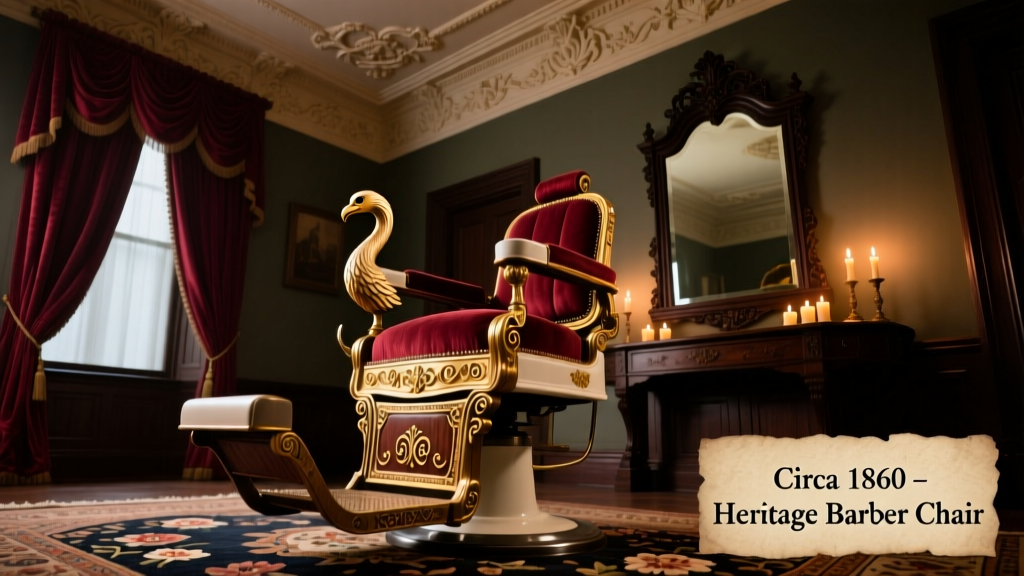
Barber Chair Swan Arms with Spread Eagle Motif Underside: A Technical and Historical Analysis of a C. 1860 American Masterpiece
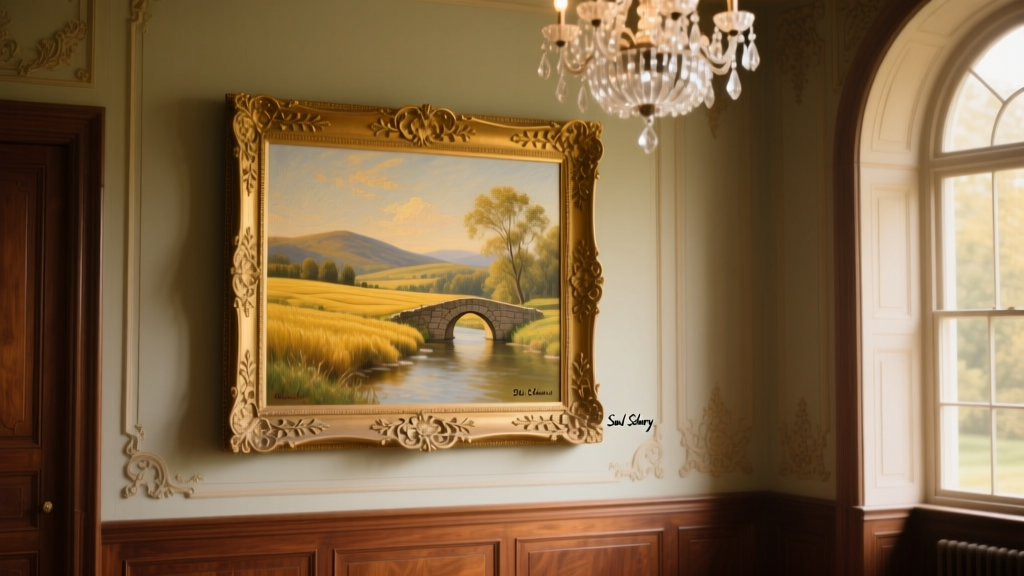
Saul Schary’s ‘Summer Landscape with Bridge’: Conservation, Provenance, and Technical Analysis of a Mid-Century American Oil Painting

Field Furniture: Origins, Regional Identity, and Restoration Principles for 18th–19th Century American Country Pieces
Japanese Ovoid Root-Wood Handle Baskets of the Edo Period: Form, Function, and Authenticity in a 16-Inch Example
Francis Basset T: Uncovering the Legacy of an 18th-Century Cornish Patron, Collector, and Furniture Connoisseur
Ford Model A Five Auction Highlights: Rare Body Styles, Provenance, and Record-Breaking Results
The Ephrata Cloister Cherry Wooden Chalice: A Rare 1780s Communion Vessel from Pennsylvania’s Pietist Community
The Master Copper 19th-Century Copper Scoop: Provenance, Craftsmanship, and Restoration of a 9¾-Inch Antique Tool
Somer Bros. Perique Tobacco Tin: A Rare Advertising Artifact from Early 20th-Century American Tobacco Culture