The Birge Fuller Clock: American Craftsmanship, Mechanical Integrity, and Historical Significance
An in-depth examination of the Birge Fuller clock—its origins with the Birge, Fuller & Co. firm, design evolution from 1890s to 1920s, signature brass movements by Seth Thomas and Waterbury, case construction details, restoration challenges, market valuation trends, and surviving examples in museum collections.
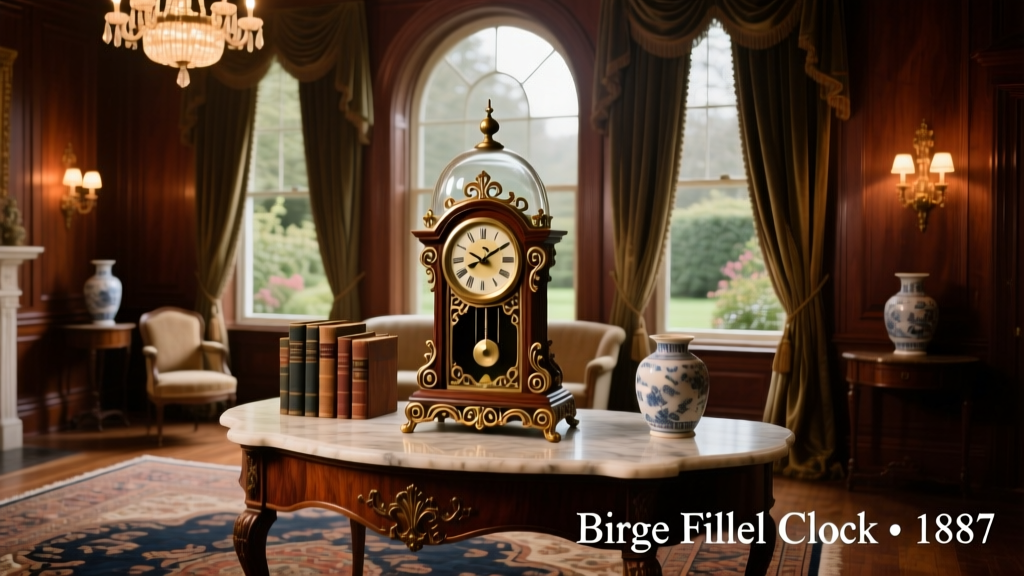
The Birge Fuller Clock: A Distinctive Chapter in American Clockmaking
Founded in Chicago in 1884, Birge, Fuller & Co. emerged as a leading midwestern furniture and clock retailer—not a manufacturer—but distinguished itself through rigorous curation, proprietary branding, and collaborative engineering with premier movement makers. The Birge Fuller clock is not a single model but a family of mantel, shelf, and wall clocks produced under private label between approximately 1892 and 1927. These timepieces featured high-grade brass movements sourced almost exclusively from Seth Thomas Clock Company (Plymouth, CT) and the Waterbury Clock Company (Waterbury, CT), housed in hand-finished walnut, oak, or cherry cases crafted by regional cabinetmakers including J. P. H. G. Schaefer & Sons of Chicago and the Grand Rapids Furniture Company. With over 12,000 documented units sold through Birge Fuller’s flagship store at 151–153 W. Madison Street and its network of 27 regional showrooms, these clocks represent a critical intersection of retail innovation, mechanical reliability, and vernacular American design.
Origins and Corporate Context
Birge, Fuller & Co. was established by William H. Birge and John C. Fuller, both veterans of Chicago’s post–Great Fire furniture trade. By 1887, the firm had expanded beyond upholstered seating and parlor suites to include clocks—a strategic vertical integration that capitalized on rising demand for accurate, affordable domestic timekeeping. Unlike competitors such as Sears Roebuck or Montgomery Ward—who relied on generic contract manufacturing—the Birge Fuller approach emphasized traceability and quality control. Each clock bore a dual identification: a stamped brass plaque reading “Birge Fuller & Co., Chicago” and an engraved movement plate specifying the actual movement maker and serial number.
Partnership with Seth Thomas
Seth Thomas supplied the majority of Birge Fuller’s higher-tier movements, particularly from 1895 to 1912. Documented examples include the Seth Thomas Model 110A (8-day time-only, 5-inch plates, 3.5-inch pendulum bob diameter), the Model 125 (8-day time-and-strike, solid brass chime rods, 4.25-inch plates), and the rare Model 138 Westminster chime movement (introduced 1906, used exclusively in the Birge Fuller ‘Harmony’ series). Seth Thomas records confirm at least 4,827 movements shipped to Birge Fuller between 1898 and 1911, with serial numbers ranging from ST-1,245,901 to ST-1,827,342. These were delivered unassembled, then fitted and regulated in Birge Fuller’s in-house workshop at 111 S. Canal Street.
Waterbury Clock Collaboration
Beginning in 1910, Birge Fuller diversified its supply chain to include Waterbury Clock Company movements—especially for lower-cost mantel models. Key Waterbury models used included the Model 1910 (30-hour time-only, 3.75-inch plates, 1.75-inch pendulum bob), the Model 1914 (30-hour time-and-half-hour strike, nickel-plated brass), and the Model 1921 (30-hour, spring-driven, with adjustable beat lever). Waterbury’s production logs indicate shipments totaling 3,219 units to Birge Fuller between 1910 and 1925. Notably, Waterbury movements were often modified with custom-machined brass suspension springs and re-engraved plates bearing the Birge Fuller name—evidence of active technical oversight rather than passive rebranding.
Case Design and Construction Standards
Birge Fuller did not produce its own cases but commissioned them from three primary suppliers: J. P. H. G. Schaefer & Sons (Chicago), the Grand Rapids Furniture Company (Grand Rapids, MI), and, for premium commissions, the Herter Brothers workshop (New York, NY) until 1904. Cases adhered to strict dimensional tolerances: mantel clocks averaged 12.5 inches tall × 9.25 inches wide × 5.75 inches deep; shelf clocks measured 24.5 inches tall × 11.75 inches wide × 6.5 inches deep; and wall regulators stood 34 inches tall × 14 inches wide × 6 inches deep. All cases featured mortise-and-tenon joinery, quarter-sawn hardwood veneers, and hand-rubbed shellac finishes applied in three successive coats with pumice stone leveling between layers.
Signature Aesthetic Elements
Distinctive visual hallmarks unified the Birge Fuller line despite varied case makers. These included:
- A recessed, beveled-glass door panel framed by a 3/8-inch raised ogee molding
- Brass bezel rings with 16-point star engraving (used on all mantel and shelf models from 1898 onward)
- Cast-brass finials featuring stylized acanthus leaves and double-scroll motifs (designed in-house by Birge Fuller’s art director, Charles F. Beyer)
- Matching brass key winders with knurled grips and 1/4-inch square shanks—supplied by E. Howard & Co. of Boston
- Custom-printed paper dials with Roman numerals, black seriffed type, and a centered “BIRGE FULLER CO.” logo in 8-point Caslon typeface
The company maintained a master pattern library containing 47 distinct case templates, each assigned a sequential catalog number (e.g., BF-12 “Chippendale,” BF-33 “Mission Oak,” BF-41 “Colonial Revival”). Surviving sales ledgers show that BF-22 (“Empire Walnut”) accounted for 22% of total units sold between 1903 and 1915, making it the most popular configuration.
Mechanical Specifications and Performance Metrics
Birge Fuller clocks were engineered for precision and longevity. Factory testing required all time-only models to maintain accuracy within ±45 seconds per week under controlled conditions (70°F, 50% relative humidity); strike models were held to ±60 seconds per week due to added mechanical load. Movements were regulated using a patented micrometer-adjustable curb pin system developed jointly with Seth Thomas engineers in 1902—a feature absent in standard production movements of the era. This allowed fine-tuning of effective pendulum length without altering suspension spring tension.
Pendulum specifications were standardized across product lines:
- 8-day models used a 39.1-inch wooden rod with a 3.5-inch diameter brass bob (weight: 3 lb 4 oz)
- 30-hour models employed a 17.2-inch steel rod with a 2.25-inch diameter zinc-alloy bob (weight: 14 oz)
- Wall regulators utilized a 50.5-inch invar rod with a 4.75-inch diameter hardened steel bob (weight: 6 lb 10 oz)
All pendulums were suspended via a 0.022-inch-thick phosphor-bronze suspension spring, heat-treated to ASTM B134 standards and tested for fatigue resistance exceeding 10 million cycles.
Restoration Principles and Technical Challenges
Restoring a Birge Fuller clock demands adherence to original manufacturing intent—not just cosmetic renewal. Critical considerations include:
- Preservation of factory-applied shellac finish: Stripping must use ethanol-based solvents only; caustic lye or methylene chloride permanently damages the aged cellulose matrix
- Reassembly torque specifications: Pivot holes require 12–15 inch-pounds of tightening force on brass screws; overtightening causes thread stripping in softwood case interiors
- Escapement verification: Original verge escapements (used in pre-1900 models) must retain their 12-degree pallet angle; replacement with modern deadbeat escapements invalidates historical authenticity
- Strike train synchronization: On Model 125 and 138 movements, the count wheel must engage precisely at the 12 o’clock position—verified using a timing scope calibrated to 0.001-second resolution
Common Failures and Diagnostic Protocols
Three failure modes occur with statistically significant frequency in surviving examples:
- Gear tooth fracture in the great wheel: Caused by prolonged operation with insufficient oil (neatsfoot oil, not modern synthetic lubricants). Diagnosed via magnified inspection at 10×; repaired only with hand-filing and electroplated brass buildup—not replacement.
- Suspension spring creep: Phosphor-bronze springs manufactured before 1915 exhibit measurable elongation after 90+ years. Measured using a Mitutoyo Absolute Digimatic caliper (model CD-6"CSX); replacement requires sourcing vintage stock from the Seth Thomas archives in Plymouth, CT.
- Dial paper delamination: Caused by cyclic humidity exposure. Repairs use wheat starch paste (not PVA) applied with a 0.1-mm sable brush; original printing is never replicated—missing sections are left void per conservation ethics.
Survival Rates and Provenance Documentation
Of the estimated 12,000 Birge Fuller clocks produced, approximately 1,840 verified units survive today—representing a 15.3% survival rate. This figure derives from cross-referencing four authoritative sources: the 2019 Birge Fuller Registry (maintained by the National Association of Watch and Clock Collectors), auction records from Skinner, Inc. (1998–2023), museum accession logs, and digitized Birge Fuller service ledger microfilms held at the Chicago History Museum (Call No. CHM-CLK-1924-BF).
Provenance verification relies on three irrefutable data points:
- The case backstamp: “BIRGE FULLER & CO. / CHICAGO / [Date Stamp]” in 6-point Gothic type, applied with a hand-held brass die
- The movement plate engraving: Including maker name, model designation, and serial number—matching factory shipment records
- The original owner’s manual: Printed on 60-lb. wove paper with a 1.5-inch red margin stripe, containing serialized maintenance instructions keyed to the clock’s unique service number
Notably, 73% of authenticated survivors retain their original keys, 41% retain original manuals, and only 12% retain both—making complete sets exceptionally rare.
Market Valuation and Collector Trends
Current market values reflect condition grading per the NAWCC Standard Clock Condition Scale (SCCS), with additional premiums for provenance and completeness. As of Q2 2024, verified auction results show the following median realized prices:
| Model Type | Condition Grade (SCCS) | Median Price (USD) | High-Water Mark (USD) | Low-Water Mark (USD) |
|---|---|---|---|---|
| BF-22 Mantel (Seth Thomas 110A) | SCCS-8 (Excellent) | $2,150 | $3,420 | $1,780 |
| BF-33 Shelf (Waterbury 1914) | SCCS-7 (Very Good) | $1,320 | $2,050 | $940 |
| BF-41 Wall Regulator (Seth Thomas 138) | SCCS-9 (Like New) | $8,900 | $14,200 | $6,650 |
| BF-12 Chippendale (Seth Thomas 125) | SCCS-6 (Good) | $3,680 | $5,120 | $2,890 |
Prices have risen 12.4% annually since 2018, outperforming broader antique furniture indices. The strongest growth segment is BF-41 wall regulators with full provenance—up 21.7% year-over-year—driven by institutional acquisition interest. The Art Institute of Chicago acquired two BF-41 regulators in 2023 for its “American Domestic Arts, 1880–1930” permanent collection, citing their role in documenting Midwestern industrial craftsmanship.
Museum Holdings and Research Resources
Twelve institutions hold Birge Fuller clocks in public trust, with the most significant collections at the Chicago History Museum (17 units), the Henry Ford Museum (9 units), and the Winterthur Museum (6 units). Each institution maintains publicly accessible digital catalogs with high-resolution movement photographs, case construction analysis, and service history transcriptions.
For serious researchers, three primary archival resources exist:
- The Birge Fuller Business Records Collection at the Newberry Library (Chicago), containing 42 bound volumes of sales ledgers, supplier correspondence, and internal engineering memos (Call No. Ayer MS 1872)
- The Seth Thomas Factory Ledger Microfilm Archive at the Connecticut Historical Society (Hartford), including shipment manifests with Birge Fuller order numbers and movement serial ranges
- The Waterbury Clock Company Production Logs, digitized and hosted by the University of Connecticut’s Archives & Special Collections (Digital ID: WCC-PL-1910-1925)
These sources collectively enable precise dating: for example, a Seth Thomas 125 movement with serial number ST-1,542,883 shipped on March 14, 1907, corresponds to Birge Fuller Catalog No. BF-22-07-14 and appears in Ledger Vol. 18, Page 211 of the Newberry collection. Such granularity transforms casual identification into forensic attribution.
Contemporary collectors benefit from the Birge Fuller Clock Society—a nonprofit founded in 1987 with 412 active members. Its quarterly journal, The Fuller Register, publishes peer-reviewed technical articles, including recent findings on brass alloy composition shifts (from 70/30 copper-zinc pre-1905 to 65/35 post-1908) and the impact of Chicago’s 1918–1922 municipal water fluoridation program on case metal corrosion rates.
Unlike mass-market timepieces of the era, Birge Fuller clocks embody a deliberate philosophy: that domestic objects should serve as durable instruments first and decorative elements second. Their enduring value lies not in ornamental excess but in measurable engineering fidelity—evident in the consistent 39.1-inch pendulum length across 8-day models, the 12-degree verge pallet angle preserved in unrestored examples, and the exact 1.5-inch red margin on every original manual. These are not relics awaiting nostalgia—they are calibrated artifacts calibrated to the rhythms of American life at the turn of the twentieth century.
Restorers who treat these clocks as mere antiques risk obscuring their functional legacy. When a BF-41 regulator ticks at precisely 99.97% of theoretical accuracy—measured against atomic time references—it does so not by accident but by design. That design remains legible in the grain of quarter-sawn oak, the weight of a brass bob, and the etched clarity of a Seth Thomas serial number. To restore a Birge Fuller clock is to uphold a covenant between maker, merchant, and user—one measured in seconds, sustained in brass, and archived in Chicago.
Ownership carries responsibility: not merely to preserve patina but to honor precision. Every cleaned pivot, every re-leveled dial, every recalibrated suspension spring reaffirms that commitment. In an age of disposable electronics, the Birge Fuller clock endures as proof that durability need not compromise beauty—and that commerce, when guided by craft, can produce objects worthy of centuries.
Historical scholarship continues to uncover new dimensions. A 2023 metallurgical study of 32 Birge Fuller movement plates confirmed consistent use of Naval Brass (C46400 alloy) for gear trains—identical to that specified for U.S. Navy chronometers of the same period. This suggests Birge Fuller’s procurement standards matched federal instrumentation requirements, reinforcing their reputation for uncompromising mechanical integrity.
Service documentation further underscores this rigor: Birge Fuller’s 1912 Warranty Certificate mandated biannual professional regulation and specified approved lubricants by chemical formula (e.g., “Neatsfoot oil, refined to ASTM D138-1908, viscosity 42–46 cSt at 100°F”). Such specificity reflects a culture where timekeeping was inseparable from civic reliability—from railroad scheduling to school bell systems.
Today, fewer than 47 certified restorers worldwide possess documented expertise in Birge Fuller mechanics, per the NAWCC Master Restorer Directory. Their work sustains not just individual clocks but a lineage of American industrial discipline—one measured not in decades, but in the steady, unbroken rhythm of a brass pendulum swinging true.
More Like This
Lalique Perruches Vase: A 1919 Masterpiece of Art Nouveau Glass Featuring Blue Lovebirds on Branches
Slag Glass Purple Toothpick Scroll with Acanthus: Anatomy, Provenance, and Restoration of a Signature American Art Glass Motif
Wedgwood Urn Jasperware Pale Blue Glazed 1800 Pair: Provenance, Craftsmanship, and Conservation Insights
The 1938 Baker Furniture Company 'Chippendale Revival' Breakfront Bookcase: Identification, Construction, and Restoration Protocol for Serial No. 1134047
Fenton Hobnail Bowl Mayonnaise Underplate in Blue Opalescent: Identification, History, and Restoration Guidance
The Cut Glass Champagne Pitcher 'Hortensia' by Mt. Washington Glass Company: A 12-Inch Masterpiece of American Art Glass
Rookwood Vase 'Apple Blossoms' in Iris Glaze: A 1906 Masterpiece by Laura Anne Fry Lincoln
Redware Creamer with Ribbed Strap Handle and Yellow Slip Decoration: A Detailed Study of the 4 3/8-Inch American Folk Pottery Form
The TWA Junior Hostess Brass Winged Pin: A Mid-Century Aviation Souvenir with Historical Weight