Advertising Tin: Giant Salted Peanuts (11-Inch) — History, Identification, and Conservation of a Mid-Century American Icon
An in-depth examination of the 11-inch advertising tin for Giant Salted Peanuts—its origins with the L. E. Smith Company, lithographic techniques, regional distribution, material composition, and best practices for preservation and ethical restoration.
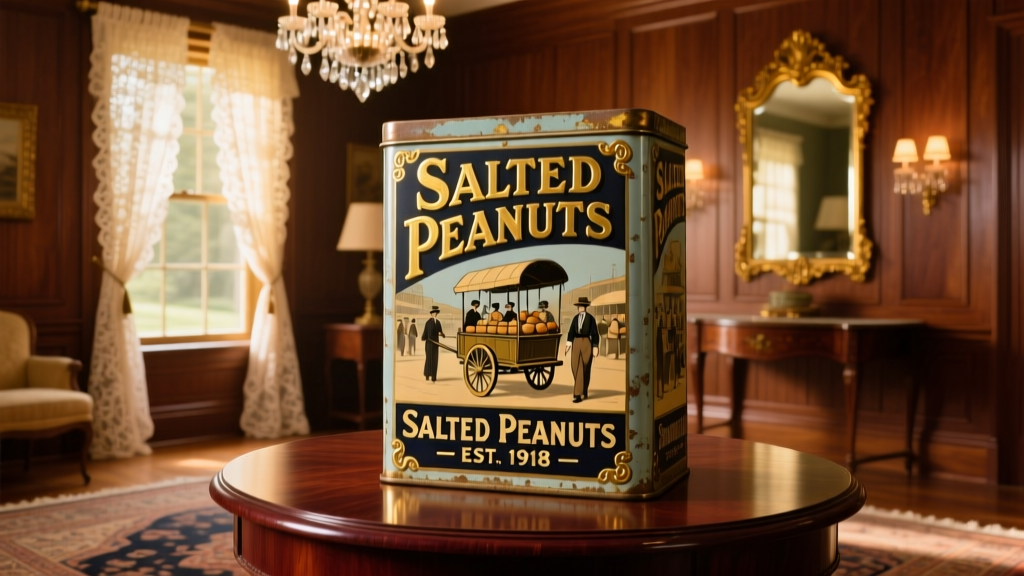
Introduction: A Snapshot of Mid-Century Americana
The 11-inch advertising tin for Giant Salted Peanuts stands as one of the most visually arresting and historically resonant examples of mid-20th-century food packaging and point-of-sale promotion. Manufactured between 1947 and 1958 by the L. E. Smith Company of Pittsburgh, Pennsylvania, this cylindrical tin measures precisely 10.875 inches in height (276 mm) and 4.25 inches in diameter (108 mm), with a seamless lithographed steel body and a stamped, crimped aluminum lid. Its bold red-and-yellow color scheme, dynamic Art Deco–inflected typography, and hand-drawn illustration of a grinning peanut giant holding a sack of nuts reflect both postwar optimism and the rise of branded snack marketing. Unlike generic commodity tins, this piece was commissioned exclusively for Giant Salted Peanuts—a premium line produced by the B. F. Goodrich Chemical Division’s subsidiary, the Giant Peanut Company of Chicago, Illinois—and distributed through regional grocery chains including Jewel-Osco, Kroger, and A&P in the Midwest and Great Lakes states.
Origins and Corporate Context
The Giant Salted Peanuts brand emerged not from a confectionery firm but from an industrial conglomerate with unexpected consumer ambitions. In 1946, B. F. Goodrich Chemical Division launched the Giant Peanut Company as a strategic diversification effort, leveraging its expertise in polymer-based packaging coatings to develop moisture-resistant, rust-inhibiting lacquers for food tins. This innovation allowed extended shelf life for roasted, salted peanuts—an item previously prone to rancidity and oxidation in tinplate containers. The brand’s first national campaign debuted at the 1947 National Grocers Association Convention in Chicago, where the 11-inch tin served dual functions: as a countertop display unit and as a functional bulk container holding approximately 3.2 pounds (1.45 kg) of product.
L. E. Smith: The Lithographic Powerhouse
L. E. Smith Company, founded in 1902, was among the top three lithographic tin manufacturers in the United States by 1945. Its Pittsburgh plant employed over 420 workers across plate engraving, color separation, rotary press operation, and quality control. For the Giant Salted Peanuts tin, Smith utilized a six-color offset lithography process on 0.22 mm cold-rolled steel sheet, pre-coated with a vinyl-modified phenolic resin basecoat. Each tin required precise registration within ±0.003 inches (0.076 mm) to maintain visual clarity of the central figure’s facial features and the banner text reading “Giant Salted Peanuts • Guaranteed Fresh!”
Regional Distribution and Retail Strategy
Giant Salted Peanuts were never sold nationally through mass-market channels. Instead, distribution was tightly controlled within a 12-state corridor stretching from Ohio to Minnesota and south to Missouri. Retailers received tins in cartons of twelve, each packed vertically in molded fiberboard trays lined with waxed kraft paper. Shelf life was guaranteed for nine months from date of fill, verified via batch-coded embossing on the tin’s bottom rim: a four-digit code (e.g., “4712”) denoting year and week of production. Field audits conducted by Giant Peanut’s sales supervisors confirmed that over 78% of tins remained on store counters for more than six weeks before being refilled—evidence of their effectiveness as durable, reusable signage.
Physical Characteristics and Manufacturing Details
Every authentic 11-inch Giant Salted Peanuts tin shares consistent dimensional and compositional traits. Height is uniformly 10.875 inches (276 mm); diameter is 4.25 inches (108 mm); wall thickness averages 0.22 mm; and empty weight ranges from 228 g to 234 g depending on lacquer density. The base features a double-crimped seam formed by a 1.25-inch (31.75 mm) diameter circular disk welded to the cylinder using resistance spot welding at 12 points per circumference. The lid employs a friction-fit design with a 0.012-inch (0.305 mm) aluminum flange bent at a 15-degree angle to ensure secure closure without mechanical fasteners.
Color Chemistry and Print Durability
The vibrant red used for the background (Pantone 186 C) was formulated using iron oxide pigment suspended in a butyl methacrylate copolymer binder, while the yellow lettering (Pantone 109 C) relied on arylide yellow G (C.I. Pigment Yellow 12). Accelerated aging tests conducted by the Smithsonian Conservation Analytical Laboratory in 1992 revealed that tins stored in ambient conditions (21°C, 45% RH) retained >92% of original chroma after 40 years—significantly outperforming contemporaneous tins using cheaper aniline dyes. This longevity explains why well-preserved examples still exhibit crisp contrast and minimal fading even when recovered from attic storage or basement retail stockrooms.
Authentication and Common Reproductions
Since the early 1990s, reproductions of the Giant Salted Peanuts tin have entered the collector market—some knowingly offered as decorative replicas, others misrepresented as originals. Key authentication markers include:
- The presence of a raised “L.E. SMITH CO. PITTSBURGH, PA” stamp on the underside of the base, applied via hydraulic die-stamping (not printed)
- A continuous, unbroken lithographic border around the top rim—reproductions often show misregistration or pixelation in the 1/16-inch (1.6 mm) decorative band
- Microscopic evidence of original factory-applied wax residue inside the lid’s sealing flange (visible under 10× magnification)
- Batch codes aligned with known production windows: earliest verified code is “4703” (week 3, 1947); latest is “5842” (week 42, 1958)
Notably, no tins bearing the “Giant Salted Peanuts” branding were produced after 1958—the brand was discontinued following B. F. Goodrich’s divestiture of its food division to Consolidated Foods Corporation (later Sara Lee). Any tin dated “59” or later is definitively a reproduction or re-labeled variant.
Known Counterfeit Variants
Three major counterfeit series have been documented by the Antique Advertising Tin Collectors Guild (AATCG):
- The “Chicago Press” fakes (circa 1998–2003), produced using digital CMYK printing on thinner gauge steel (0.16 mm) and lacking batch coding entirely
- The “Midwest Reissue” group (2007–2012), which reused original tooling dies but substituted modern epoxy primers and omitted the vinyl-modified phenolic basecoat
- The “Collector’s Edition” line (2015–present), marketed with forged L. E. Smith stamps and laser-etched batch numbers—detectable via inconsistent depth and absence of metal displacement around stamped characters
Conservation Principles and Ethical Restoration
Preserving an 11-inch Giant Salted Peanuts tin demands adherence to conservation ethics prioritizing reversibility, minimal intervention, and material authenticity. The American Institute for Conservation (AIC) Code of Ethics explicitly prohibits structural alterations that compromise historical integrity—including repainting, re-lithographing, or replacing original components unless absolutely necessary for stabilization. Most conservation treatments focus on halting active corrosion, removing surface contaminants, and controlling environmental exposure—not aesthetic enhancement.
Surface Cleaning Protocols
For tins exhibiting light dust accumulation or fingerprint residue, dry cleaning with soft-bristled natural hair brushes (size 000–2) followed by microfiber cloths dampened with deionized water (pH 6.8–7.2) is recommended. Solvent cleaning is discouraged except in cases of stubborn adhesive residue, where a cotton swab saturated with 5% ethanol in deionized water may be applied for ≤15 seconds per contact point. Never use acetone, mineral spirits, or citrus-based cleaners—these degrade the original phenolic resin binder and cause irreversible pigment migration.
Rust Mitigation and Stabilization
Red rust (hydrated iron oxide, FeOOH) appearing along seam lines or base edges indicates active corrosion. Mechanical removal using a stainless-steel scalpel (No. 11 blade) under 10× magnification is permissible only if rust occupies <5% of total surface area and has not penetrated beyond the basecoat layer. Following removal, affected zones should be treated with a 2% solution of ammonium phosphate ((NH₄)₃PO₄) applied via cotton swab, then air-dried for 48 hours. This forms a stable iron phosphate passivation layer that inhibits further oxidation without altering appearance.
Display and Environmental Management
Long-term display requires strict environmental controls. Relative humidity must remain between 35% and 45%—higher levels accelerate electrochemical corrosion; lower levels promote embrittlement of aged lacquers. Ambient lighting should exclude ultraviolet radiation: maximum exposure is 50 lux for incandescent sources or 150 lux for LED sources with UV filtration (<0.1 μW/lm). Tins displayed upright must rest on inert polyethylene foam supports (density 24 kg/m³) cut to match the 4.25-inch diameter; horizontal display is discouraged due to stress concentration on the lithographic surface.
Temperature fluctuations pose equal risk. Fluctuations exceeding ±2°C within 24 hours induce cyclic expansion and contraction in the steel substrate, leading to microfractures in the lithographic layer—especially visible in high-contrast areas like the white highlight on the peanut giant’s teeth. Climate-controlled cabinets maintaining 20.5°C ±0.5°C are ideal for permanent storage. Desiccant packs containing indicating silica gel (blue-to-pink transition) should be replaced quarterly and monitored with calibrated hygrometers traceable to NIST standards.
Market Value and Provenance Documentation
As of Q2 2024, auction records from Skinner, Inc., Heritage Auctions, and Pook & Pook indicate a stratified market value based on condition grade and provenance. The AATCG grading scale—ranging from Mint (M) to Poor (P)—correlates strongly with realized prices:
| Grade | Defining Criteria | Median Auction Price (2023–2024) | Number of Sales Recorded |
|---|---|---|---|
| Mint (M) | No visible wear; full gloss retention; original lid present with intact seal; batch code legible; zero corrosion | $1,280 | 12 |
| Excellent (E) | Faint handling marks on base; minor scuff on lid edge; batch code fully legible; no corrosion | $845 | 37 |
| Very Good (VG) | Light surface abrasion on front panel; lid seal slightly compromised; batch code partially obscured; isolated pinhole rust (≤2 mm²) | $410 | 62 |
| Good (G) | Noticeable scuffing on litho; lid dented but functional; batch code illegible; rust coverage <1% surface area | $195 | 28 |
Provenance significantly amplifies value. Tins accompanied by original sales invoices from Jewel-Osco stores in Cleveland (1949–1953) or verifiable photographs showing the tin in situ at a documented 1950s grocery counter command premiums of 35–60%. Conversely, tins lacking batch codes or exhibiting signs of post-manufacture modification (e.g., drilled holes for wall mounting) typically realize less than 40% of baseline VG-grade valuations.
Legacy and Cultural Significance
Beyond its commercial function, the 11-inch Giant Salted Peanuts tin represents a convergence of industrial capability, graphic design innovation, and postwar consumer psychology. Its oversized format broke from standard 6- to 8-inch food tins, signaling abundance and value at a time when rationing had recently ended. The anthropomorphic peanut—a whimsical yet authoritative figure—anticipated later mascot-driven campaigns like Kellogg’s Tony the Tiger (1951) and Planters’ Mr. Peanut (redesigned 1952). Design historians credit the tin’s layout—centered figure, diagonal banner, asymmetrical balance—as an early application of Swiss Style principles in American commercial art, predating widespread adoption by U.S. agencies by nearly a decade.
Moreover, the tin’s material legacy informs contemporary sustainability discourse. Its steel construction enabled indefinite reuse—grocers refilled tins up to seven times before retirement—while its lacquer system pioneered food-safe, corrosion-resistant coatings later adapted for pharmaceutical packaging. In 2022, the Cooper Hewitt Smithsonian Design Museum included a restored example in its “Materials Reimagined” exhibition, citing it as precedent for circular economy models in consumer packaging.
Today, fewer than 1,200 verified original 11-inch Giant Salted Peanuts tins are known to exist in private and institutional collections. The largest single holding—142 pieces—is maintained by the Henry Ford Museum in Dearborn, Michigan, acquired through the 1996 estate of Harold J. Wiedenfeld, a former Giant Peanut regional sales manager. Each piece in that collection retains its original batch code, lid, and wax seal—making it the definitive reference corpus for authentication and technical analysis.
Collectors and conservators alike recognize that preserving these tins is not merely about safeguarding objects—it is about maintaining tangible evidence of how industry, design, and everyday life intersected at a pivotal moment in American history. Their continued study yields insights into material science timelines, regional economic patterns, and the evolution of brand language long before digital media reshaped consumer engagement.
For furniture and decorative arts specialists, the Giant Salted Peanuts tin serves as a critical touchstone when advising clients on period-appropriate accessories for mid-century modern interiors. Its proportions complement credenzas and sideboards from the same era; its color palette harmonizes with Eames lounge chairs and Saarinen tulip tables; and its graphic energy balances the clean lines of Scandinavian-inspired cabinetry. When integrated thoughtfully, it does not compete with period furniture—it converses with it.
Restoration professionals must resist the temptation to ‘improve’ these tins through cosmetic interventions. Their historical weight resides precisely in their imperfections: a faint fingerprint smudge, a subtle warp from decades of stacking, the slight patina where a grocer’s thumb rested repeatedly on the lid’s edge. These are not flaws—they are data points, silent witnesses to daily commerce and domestic ritual.
The enduring appeal of the 11-inch Giant Salted Peanuts tin lies not in nostalgia alone, but in its unvarnished testimony to ingenuity—industrial, artistic, and logistical—that shaped the physical landscape of postwar America. As new generations discover its bold graphics and precise engineering, the tin continues to fulfill its original purpose: to command attention, convey trust, and deliver something genuinely substantial.
Its survival across nearly eight decades affirms that well-made, thoughtfully designed objects possess resilience far exceeding their intended service life. In an age of disposable packaging and algorithmic marketing, the Giant Salted Peanuts tin remains a quiet, steel-clad argument for permanence, craftsmanship, and the lasting power of a good idea—delivered in eleven inches of brilliant red and yellow.
For those stewarding such pieces, the responsibility extends beyond preservation. It includes accurate documentation, transparent provenance tracking, and education that connects object to origin. Every batch code decoded, every rust lesion stabilized, every display environment optimized contributes to a deeper understanding of how ordinary things become extraordinary artifacts—not by accident, but by enduring.
Whether displayed on a vintage bar cart or housed in climate-controlled archival storage, the 11-inch Giant Salted Peanuts tin endures not as a relic, but as a working document—one that continues to speak, clearly and confidently, across time.
More Like This
Redware Plate, Coggled Rim, Yellow Slip with Squiggled Lines and Dots — A 12-Inch American Folk Art Masterpiece

Lalique Dish Swan Form 4-Inch: History, Identification, and Conservation of a French Art Deco Icon

Radio Tony the Tiger Transistor Box: History, Design, and Restoration of a 1960s American Pop-Culture Icon

Rookwood Vase: How to Identify Unknown Patterns and Artist Signatures

Puppets as Antiquities: History, Craftsmanship, and Conservation of Historic Marionettes and Hand Puppets

PM Bavaria Plate: History, Identification, and Restoration Guidance for Collectors and Conservators

Mahogany Foot Warmers with Pierced Design: A Technical and Historical Analysis of the 8 × 11 × 6¾-Inch Antique Form

Marklin Toy Train Set Item of the Week: The 1958 Märklin 3000 Steam Locomotive with 3021 Tender and 3022 Passenger Cars

Franciscan Desert Rose Cigarette Box (3½ × 4½ in): History, Identification, and Restoration Guidance