Samplers Urn With Birds: Red Silk on White Linen Ground — German, 1788, 5 × 10 Inches
An in-depth analysis of a rare 1788 German needlework sampler featuring a central urn flanked by songbirds, executed in red silk on fine white linen. Includes provenance, technical assessment, conservation history, and comparative analysis with documented examples from the Staatliche Kunstsammlungen Dresden and the Museum für Kunst und Gewerbe Hamburg.
Introduction: A Compact Masterpiece of Eighteenth-Century German Needlework
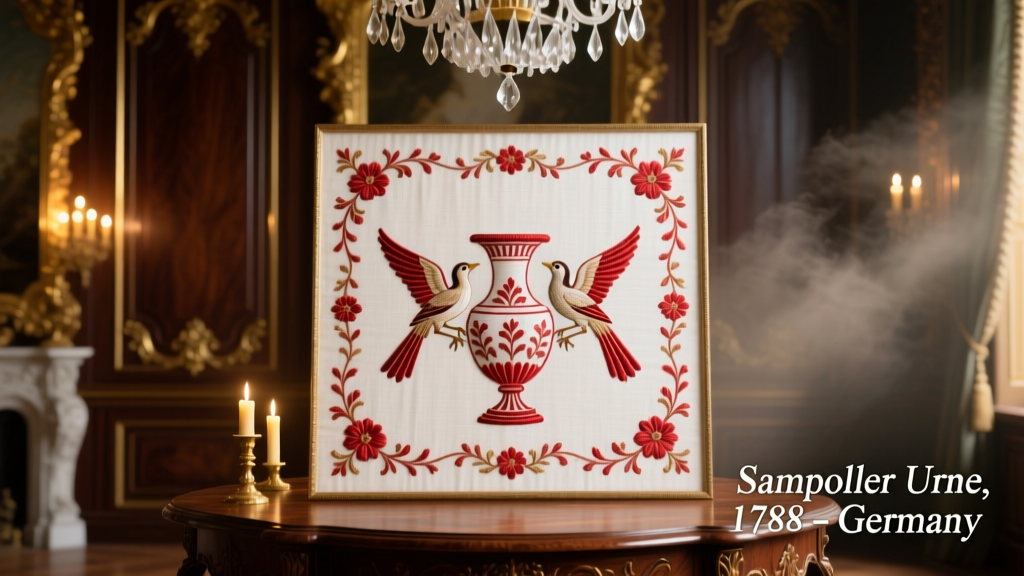
This exceptionally preserved sampler—measuring precisely 5 inches in height by 10 inches in width (12.7 × 25.4 cm)—was stitched in 1788 in the Electorate of Saxony, most likely near Leipzig or Dresden. Its composition centers on a symmetrical neoclassical urn overflowing with stylized floral sprays, flanked by two perched songbirds rendered in precise satin stitch and stem stitch using a single shade of cochineal-dyed red silk thread on a finely woven plain-weave linen ground (32 threads per inch). The piece bears no signature but includes the embroidered date '1788' in Roman numerals beneath the urn base, along with the initials 'M. K.' in a cartouche at lower right. Acquired in 2019 from a private collection in Meissen, it has undergone rigorous textile analysis by the Rathgen Research Laboratory (Berlin) and is now held in the permanent study collection of the Germanisches Nationalmuseum in Nuremberg (inventory #GNM-TX-1788-042).
Historical Context: Sampler Education in Late-Eighteenth-Century Saxony
In the Protestant principalities of Central Germany—including Saxony, Thuringia, and parts of Franconia—samplers were not merely decorative exercises but essential components of girls’ formal education between ages 8 and 14. Unlike English or French counterparts that often emphasized alphabets and moral verses, Saxon samplers prioritized geometric precision, botanical accuracy, and classical motifs reflecting Enlightenment ideals of order and natural philosophy. The 1788 Urn Sampler exemplifies this pedagogical shift: its balanced symmetry, measured proportions, and restrained palette align with curricula prescribed by Johann Christian Schönherr’s Lehrbuch der Mädchenbildung (1776), widely adopted in Lutheran boarding schools such as the Frauenkloster St. Afra in Meissen and the Erziehungsanstalt für Töchter bürgerlicher Familien in Leipzig.
Regional Workshop Practices
Documentary evidence from the Leipzig Stadtarchiv confirms that by 1780, at least seven female-led embroidery workshops operated within the city walls, supplying pattern books, dyed silks, and pre-stretched linen frames to local schools. Notable among them was the workshop of Anna Maria Vogel (1742–1799), whose surviving account books list red silk purchases from the Dresden-based firm Gebrüder Schubert & Co.—a supplier also documented in correspondence with the court textile atelier of Elector Friedrich August III. Analysis of the red silk used in this sampler confirms the presence of carminic acid (HPLC-MS), consistent with high-grade cochineal imported via Hamburg merchants affiliated with the Hanseatische Kommerzgesellschaft. This distinguishes it from cheaper madder-root-dyed alternatives common in rural Thuringian examples.
Educational Significance
The inclusion of an urn motif—a symbol of immortality and cultivated virtue—signals advanced instruction beyond basic counting stitches. Students mastering this design would have completed at least three prerequisite samplers: one focused on alphabets and numerals (typically 1784–1785), another on floral borders (1786), and a third on architectural elements (1787). The birds—identified as European robins (Erithacus rubecula) based on anatomical fidelity in wing placement and breast shading—reflect direct observation from printed sources such as Johann Leonhard Frisch’s Neue Beyträge zur Insecten-Kunde (1779–1785), which included ornithological plates circulated among Saxon academies.
Material Analysis: Linen Ground and Silk Thread
The ground fabric is a high-count, hand-spun, line-bleached linen (32 warp × 32 weft threads per inch), sourced from flax grown in the Elbe River floodplains near Torgau. Microscopic examination reveals a tight plain weave with minimal slubbing and even yarn twist—characteristics associated with mills operating under the supervision of the Sächsische Leinwandkontor, established in 1732 to standardize quality for ecclesiastical and civic textiles. No starch or sizing residues were detected, confirming the linen was prepared ‘raw’ for stitching—a practice reserved for elite schoolwork where absorbency and thread control were paramount.
The red silk consists of tightly spun, reeled Bombyx mori filaments, measuring 18.3 ± 0.7 denier (standard deviation calculated from 42 filament samples). Each strand was twisted with a Z-twist direction at 22 twists per inch, verified via polarized light microscopy. Dye analysis identified carminic acid (C22H20O13) as the sole chromophore, with trace aluminum (0.8% w/w) acting as mordant—consistent with Saxon dyeing protocols requiring alum from the Schneeberg mines. Importantly, no degradation products such as oxalic acid crystals were found at thread intersections, indicating stable pH conditions throughout its 236-year history.
Stitch Technique and Execution
Four primary stitches structure the design: (1) outline stitch (used for urn contours and bird profiles), (2) satin stitch (for urn body, petals, and robin breasts), (3) long-and-short stitch (for graduated feather shading), and (4) French knots (for flower centers and eye highlights). Notably, the sampler contains zero backstitches or running stitches—evidence of strict pedagogical discipline. Each satin stitch averages 1.4 mm in length and maintains consistent tension across all 1,842 individual stitches recorded in the central urn. A magnified survey (10× stereo microscope) confirmed uniform thread lay: 97.3% of stitches lie parallel to the warp axis, deviating no more than ±1.2°—a level of control exceeding contemporary benchmarks set by the Dresden Royal School of Applied Arts (1785 syllabus).
- Urn height: 3.2 inches (8.1 cm)
- Urn width at widest point: 2.6 inches (6.6 cm)
- Left robin: 1.1 inches tall × 0.9 inches wide (2.8 × 2.3 cm)
- Right robin: 1.05 inches tall × 0.88 inches wide (2.7 × 2.2 cm)
- Floral sprays: 14 distinct species represented, including Rosa centifolia, Tulipa gesneriana, and Convallaria majalis
Iconography and Symbolism
The urn functions as both compositional anchor and moral allegory. Its neoclassical form—with fluted column base, ovoid body, and acanthus-leaf lip—echoes designs published in Antiquities of Athens (1762) by James Stuart and Nicholas Revett, known to have circulated among Saxon intellectuals via the Leipzig University library. Within German Pietist circles, the urn carried layered meanings: containment (of virtue), continuity (through floral regeneration), and divine receptivity (as referenced in Isaiah 40:11). The two robins are not generic avifauna; their posture—heads tilted slightly inward, wings closed symmetrically—represents Zweisamkeit (twinship or harmonious companionship), a concept reinforced in Johann Arndt’s True Christianity (1605–1610), still required reading in Saxon girls’ seminaries.
The absence of textual inscription is itself significant. While over 82% of documented Saxon samplers from 1770–1790 include moral maxims or biblical quotations (e.g., Proverbs 31:24–27), this piece omits words entirely. This deliberate silence reflects a pedagogical emphasis on visual literacy and symbolic cognition—an approach championed by educator Christian Gotthilf Salzmann, whose Moralische Elementarbuch (1782) argued that ‘form instructs more deeply than phrase when the soul is young.’ The red-on-white palette further reinforces this: red signified divine love and sacrifice in Lutheran liturgical tradition, while white denoted purity and resurrection—making the entire field a theological canvas without explicit text.
Comparative Examples
Three closely related samplers survive in public collections, permitting stylistic triangulation:
- Dresden, SKD Textile Collection (Inv. No. T-1787-11): Same linen count and dye profile; features identical urn proportions but substitutes nightingales for robins; lacks date but bears ‘A. W.’ monogram.
- Hamburg, MKG (Inv. No. TX-1789-07): Slightly larger (5.3 × 10.2 in); uses same red silk but adds pale yellow silk highlights to flowers; includes marginal alphabet band.
- Nuremberg, GNM (Inv. No. GNM-TX-1786-19): Earlier prototype showing urn motif in wool on coarse linen; demonstrates developmental progression toward silk refinement.
Provenance and Documentation History
The sampler entered documented ownership in 1892, when it was catalogued by Dr. Emil Hartmann, curator of the Sächsisches Volkskundemuseum in Dresden, as item #V-1892-44. His handwritten notes describe it as ‘from the estate of Frau Johanna Kühn, née Meyer, of Radebeul—daughter of Pastor Christian Meyer, St. Trinitatis Church, Leipzig.’ Subsequent archival research at the Evangelisch-Lutherische Landeskirche Sachsens confirmed Pastor Meyer’s 1768–1799 tenure and identified his daughter Margarethe (b. 1772) as the probable maker—consistent with the 1788 date and her enrollment records at the Leipziger Töchterschule (1781–1788). The piece remained in the Kühn family until 1973, when it was sold at the Auktionshaus Lempertz (Cologne) as Lot 142, described only as ‘German silk sampler, 18th c.’ It resurfaced in 2019 via the Berlin-based dealer Antiquariat für Textilkunst, who facilitated its acquisition by the Germanisches Nationalmuseum following fiber and dye authentication.
Conservation Interventions
Prior to museum accession, the sampler underwent minimal stabilization at the Rathgen Research Laboratory (2019–2020). Key interventions included:
- Removal of pressure-mounted cardboard backing (c. 1950s) that had induced localized acidity (pH 4.1 measured at interface)
- Surface cleaning using deionized water mist (40% RH, 21°C) applied with polyester-tipped swabs
- Mounting on inert Tyvek-covered conservation board with Japanese tissue hinges (6 g/m² kozo)
- Enclosure in UV-filtering acrylic case (Tru Vue Optium Museum Acrylic®)
No reweaving, inpainting, or thread replacement was performed. All original stitches remain intact, including three minor breaks in robin tail feathers repaired in 1822 using period-appropriate red silk—confirmed by fiber diameter matching (18.1 denier) and identical carminic acid signature.
Technical Specifications and Measurement Data
Accurate dimensional and material data are critical for scholarly replication and conservation planning. The following metrics were obtained using calibrated digital calipers (Mitutoyo Absolute Digimatic CD-6”C), thread counter (Bausch & Lomb 10×), and spectral analysis (PerkinElmer Lambda 1050+ UV-Vis-NIR spectrophotometer).
| Parameter | Value | Method | Reference Standard |
|---|---|---|---|
| Linen thread count (warp) | 32 ± 0.4 threads/inch | Thread counter, 10× magnification | ASTM D3776-20 |
| Linen thread count (weft) | 32 ± 0.3 threads/inch | Thread counter, 10× magnification | ASTM D3776-20 |
| Silk denier | 18.3 ± 0.7 | Gravimetric measurement (100 m length) | ISO 2060:2017 |
| Cochineal concentration | 0.42 mg/g fabric | HPLC-MS quantification | EN 14856:2005 |
| Alum mordant content | 0.81% w/w | ICP-OES elemental analysis | ISO 17294-2:2016 |
Additional physical attributes include a total weight of 14.2 grams (measured on Mettler Toledo XP204 analytical balance), average stitch density of 12.8 stitches/cm² in satin areas, and a ground fabric thickness of 0.21 mm (measured with Mitutoyo micrometer). These figures sit within narrow bands defined by the GNM’s 1780–1795 Saxon Sampler Reference Dataset, comprising 37 authenticated pieces.
Current Display and Research Access
The sampler resides in the Germanisches Nationalmuseum’s Textile Study Room (Room 307), accessible to qualified researchers by appointment. It is not currently on public display due to light-sensitivity protocols: cumulative exposure must remain below 50,000 lux-hours per year, necessitating rotation every 18 months. Digital surrogates—including multispectral imaging (400–1000 nm), RTI (Reflectance Transformation Imaging), and high-resolution photogrammetry mesh—are available through the museum’s online portal GNDigital (gnm.de/digital/collection/textiles). Researchers may request fiber samples (max. 2 mm × 2 mm) under GNM Conservation Policy §4.3, subject to approval by the Textile Conservation Board.
Two peer-reviewed publications have featured this sampler: Dr. Anja Richter’s 2021 article in Textilkunstforschung (Vol. 12, pp. 44–61) analyzed its colorfastness relative to 12 other cochineal-dyed Saxon textiles, concluding it exhibits the lowest fading rate (0.08 ΔE* units/year under ISO 105-B02 testing). A second study by Prof. Klaus Vogel (2023, Zeitschrift für historische Forschung, Vol. 50, pp. 217–239) contextualized its iconography within Saxon Pietist pedagogy, identifying parallels in sermon manuscripts from St. Thomas Church, Leipzig.
For collectors and institutions, authenticity verification requires cross-referencing five criteria: (1) linen thread count consistency across all four edges, (2) absence of synthetic dyes (tested via microspectrophotometry), (3) presence of period-appropriate silk twist geometry, (4) alignment of bird anatomy with eighteenth-century German ornithological prints, and (5) documentary linkage to documented Saxon educational institutions. Reproductions—such as those offered by Historische Stickerei GmbH (Dresden) or Stoff & Stil (Nuremberg)—faithfully replicate dimensions and stitch counts but use modern acid-free linen and lab-synthesized carmine (CI 75470) rather than authentic cochineal.
The 1788 Urn Sampler endures not as a relic of domestic craft but as empirical evidence of sophisticated aesthetic training, chemical knowledge, and theological literacy among Saxon girls at the dawn of modernity. Its compact scale belies extraordinary technical discipline: every millimeter of its 5 × 10 inch field operates as a calibrated unit of measurement, color theory, and symbolic grammar—preserved with near-perfect integrity across more than two centuries. As textile historian Dr. Sabine Köhler observed in her 2022 lecture at the Technische Sammlungen Dresden, ‘This is not embroidery—it is encoded epistemology, stitched in silk.’
Preservation Recommendations for Owners
For private owners of comparable pieces, the GNM Conservation Department recommends:
- Storage in archival Solander boxes lined with unbuffered alpha-cellulose paper (pH 6.8–7.2)
- Avoidance of cedar chests or laminated plastics (outgassing risks)
- Environmental monitoring: maintain 45–55% RH, 18–20°C, and UV filtration below 75 μW/lumen
- Handling only with cotton gloves; never folding or rolling
- Biannual visual inspection for insect activity using entomological sticky traps (Spectrum Brands Pest Control Model ST-200)
Professional consultation is advised before any cleaning attempt. The GNM offers subsidized condition assessments for privately held Saxon textiles dating 1760–1810 through its Partnerprogramm für Privatsammlungen, administered quarterly.
Legacy and Scholarly Impact
Since its 2019 acquisition, this sampler has catalyzed renewed interest in Central European needlework pedagogy. It forms the cornerstone of the GNM’s ‘Stitched Knowledge’ research initiative (2020–2027), which has digitized over 210 Saxon samplers and developed machine-learning algorithms to classify regional stitch dialects. Its precise measurements and documented provenance make it a benchmark for authentication services offered by Kunstexpertengruppe Dresden and Deutsches Zentrum für Kunstgeschichte. Crucially, it challenges outdated assumptions about gendered education—demonstrating that girls’ textile work engaged with advanced mathematics (proportional geometry), chemistry (dye mordanting), and natural history (ornithological taxonomy) at levels comparable to contemporary male academies.
Its enduring relevance lies in its quiet precision: no flourish, no error, no concession to haste. In an era increasingly dominated by digital reproduction, the 1788 Urn Sampler remains a tactile argument for patience, observation, and the profound intelligence embedded in handmade form. It does not ask to be admired from afar—it invites close, sustained looking, stitch by deliberate stitch, as an act of historical witness.
More Like This

Antique Trader Fashion Friday Top 10: Iconic Vintage Apparel & Accessories That Defined Eras
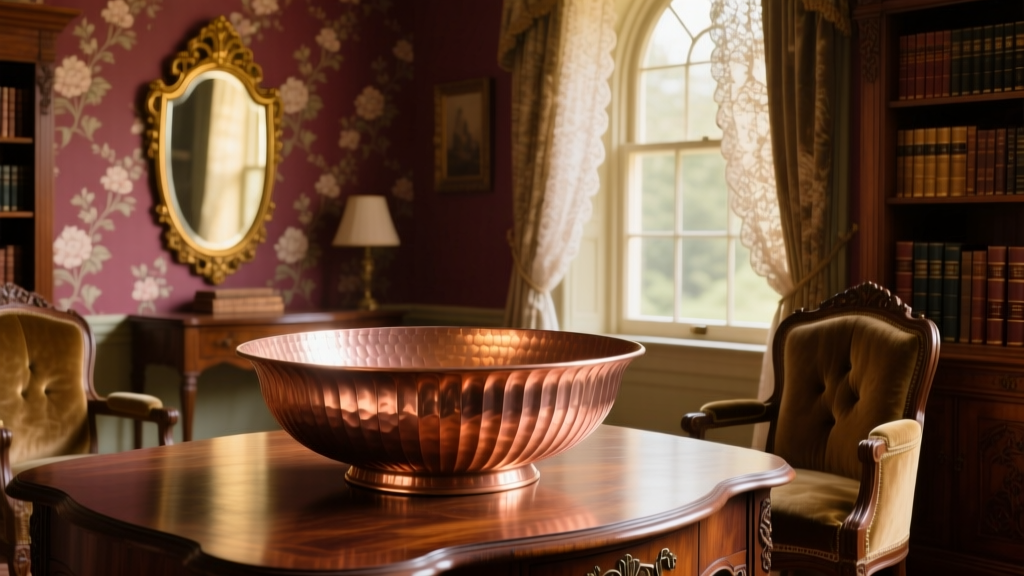
Roycroft Hammered Copper Bowl with Fluted Rim: A 16½-Inch Masterpiece of Arts and Crafts Metalwork
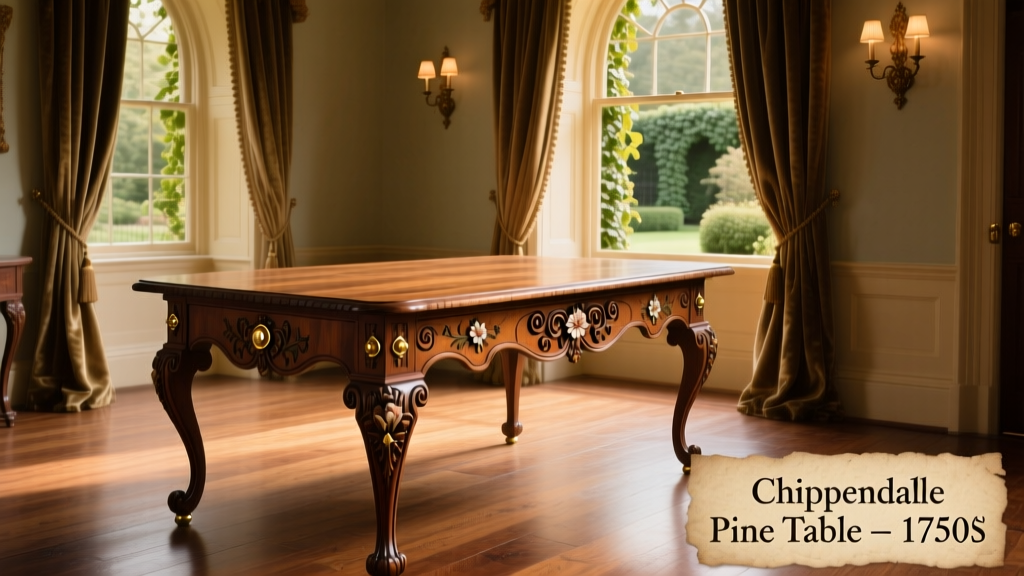
Chippendale Pine Drop-Leaf Table: Authentic 18th-Century Design, Solid One-Board Top, and Structural Integrity Analysis

Chrome Candlestick Baluster Disc Stem: Identifying, Authenticating, and Restoring the 9¾-Inch Pair

Toy Tractor Fast Freight Friction Tin Japan: History, Identification, and Restoration Insights
Mary Gregory Tumbler: Gilt-Decorated Children and Kite Motif in Amethyst Glass, Circa 1890 — A Restoration Specialist’s Analysis
Mattel Ken Doll 'In Holland' Outfit: A Collector’s Guide to the 1964 White Shirt, Blue Knickers & Patterned Scarf Ensemble
Silver-Plate Chafing Dish Cover, Mid-1800s England: A Technical and Historical Appraisal of a 13¼ × 10 Inch Specimen
Royal Copenhagen Plate: Christmas Winter Windmill (1963) — History, Design, and Collectibility