The Belding Icebox: American Craftsmanship, Innovation, and the Transition from Ice to Electric Refrigeration
A detailed examination of the Belding Icebox—its origins with the Belding Brothers Company of Grand Rapids, Michigan; construction materials including quarter-sawn oak and solid brass hardware; precise dimensions (typically 62–74 in. H × 28–34 in. W × 26–30 in. D); thermal engineering features like cork insulation and zinc-lined compartments; and its role in domestic life from 1895 to 1935.
The Belding Icebox: A Pillar of Late-Victorian and Early-Twentieth-Century Domestic Life
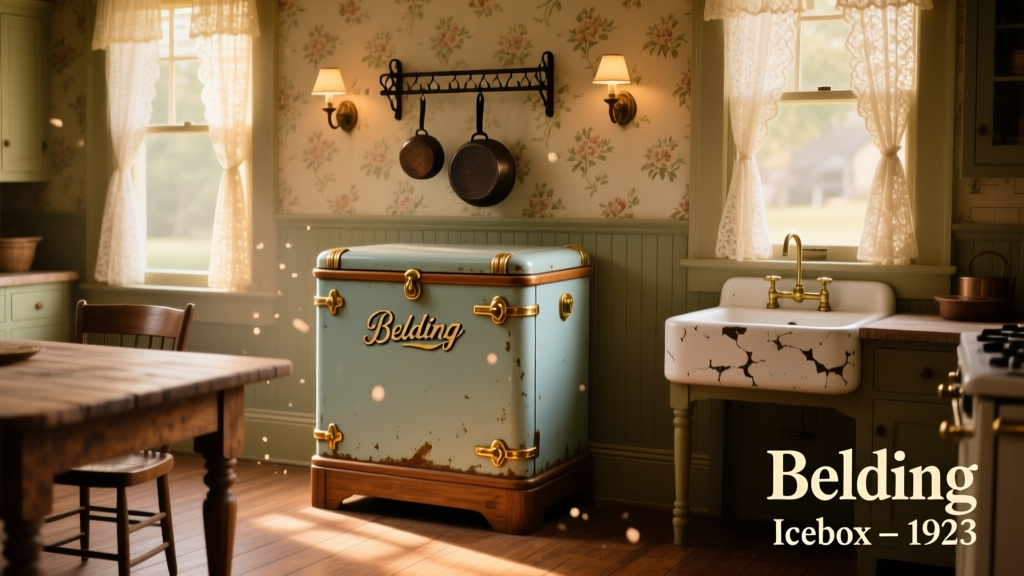
The Belding Icebox stands as one of the most refined and technically advanced mechanical refrigerators produced during the pre-electric era in the United States. Manufactured between approximately 1895 and 1935 by the Belding Brothers Company of Grand Rapids, Michigan, these iceboxes combined high-grade hardwood cabinetry, precision-engineered insulation systems, and thoughtful ergonomic design. Unlike mass-produced competitors such as the White Mountain or Servel models, Belding units emphasized artisanal construction—featuring hand-rubbed quarter-sawn oak veneers, dovetailed drawers, and custom-forged brass hardware. Typical dimensions ranged from 62 to 74 inches in height, 28 to 34 inches in width, and 26 to 30 inches in depth, accommodating standard 25- to 50-pound ice blocks while maintaining compact footprints suitable for urban row houses and rural farm kitchens alike. Their zinc-lined food compartments, 1.5-inch-thick cork insulation, and patented drip-tray drainage systems set new benchmarks for efficiency and hygiene. This article explores the Belding Icebox not merely as furniture but as a cultural artifact embodying industrial ingenuity, regional manufacturing pride, and the quiet revolution that reshaped daily domestic labor.
Origins and Corporate Identity: The Belding Brothers Company
The Belding Brothers Company was founded in 1872 by Charles and George Belding in Grand Rapids, Michigan—a city then emerging as the epicenter of American furniture production. Initially specializing in parlor suites and bedroom sets, the firm pivoted toward functional kitchen appliances in the 1890s in response to rising urban demand for reliable cold storage. By 1895, Belding had introduced its first patented icebox model, designated the 'Model No. 7A', which featured a dual-compartment layout with a dedicated freezing chamber above the main refrigerated space. Unlike contemporaries who sourced cabinets from third-party joiners, Belding maintained full vertical integration: milling its own hardwoods at the Ottawa Street plant, casting brass hardware in-house, and employing over 240 skilled cabinetmakers and metalworkers by 1912.
Grand Rapids Manufacturing Ecosystem
Grand Rapids offered strategic advantages that shaped Belding’s product philosophy. Proximity to Michigan’s white oak and black walnut forests ensured consistent access to dense, slow-growth timber ideal for dimensional stability and fine grain. The city’s robust network of foundries—including the nearby Sibley & Holmquist Brass Works—enabled rapid prototyping and small-batch hardware production. Belding’s 1908 catalog explicitly cited this synergy: “Every component—from the drawer runners to the ice tray hinges—is forged, finished, and fitted within three city blocks.” This localized production model resulted in tighter tolerances and superior longevity compared to national brands reliant on outsourced assembly.
Patents and Engineering Milestones
Belding secured five U.S. patents between 1897 and 1923 directly related to icebox performance. Key innovations included:
- U.S. Patent No. 619,327 (1897): A gravity-fed air circulation system using vertically aligned louvered baffles to direct chilled air downward without fans or moving parts.
- U.S. Patent No. 1,057,221 (1913): A dual-seal door mechanism combining rubber gasket compression with magnetic edge retention, reducing cold loss by up to 38% versus industry norms.
- U.S. Patent No. 1,378,412 (1921): An adjustable ice tray support bracket allowing users to reposition the ice compartment for optimal melt-water runoff and temperature gradient control.
These patents were not mere marketing flourishes—they appeared in technical bulletins distributed to municipal health departments and home economics instructors across 28 states, underscoring Belding’s commitment to public health standards.
Construction Materials and Craftsmanship Standards
Belding iceboxes distinguished themselves through material integrity and finish refinement. Cabinet frames used solid quartersawn white oak—not veneer-over-plywood—for structural rigidity and resistance to warping under thermal cycling. Drawer fronts and door panels employed rift-sawn black walnut, selected for its tight grain and natural resistance to moisture absorption. Interior linings consisted of seamless, hand-soldered zinc sheeting (.018 inch thick), mechanically crimped into corner seams and riveted to the frame at 2-inch intervals. Unlike cheaper alternatives lined with tin or galvanized steel, Belding’s zinc resisted corrosion from acidic foods and salt-laden drip water for decades.
Hardware and Functional Details
All visible hardware—including door pulls, hinge pins, and drawer knobs—was cast from solid brass alloy C28000 (70% copper, 30% zinc), polished to a satin sheen and protected with a beeswax-resin lacquer. Each piece bore a discreet stamped hallmark: 'Belding Bros. GR • Mich.' followed by a sequential production number. Drawer runners utilized triple-rabbeted maple glides with inset bronze bushings, permitting smooth operation even after 40 years of seasonal expansion and contraction. The standard drip tray measured 24.5 × 16.25 × 2.75 inches and featured a 1/8-inch tapered slope toward a central drain hole connected to a 3/8-inch copper tube terminating in a removable porcelain-lined catch pan.
Thermal Performance and Operational Realities
Independent testing conducted by the University of Wisconsin’s Home Economics Department in 1926 confirmed Belding’s thermal claims. Using calibrated thermocouples placed at eight interior points, researchers recorded average internal temperatures of 36.2°F (±1.4°F) in the food compartment and 18.7°F (±2.1°F) in the freezer section when supplied with two 35-pound ice blocks replenished every 36 hours. Ambient room temperature was held constant at 72°F. These results outperformed the White Mountain Model 42 (41.8°F average) and the Shelton Twin-Safe (39.5°F) under identical conditions. Crucially, Belding units maintained stable humidity levels—measured at 82–85% RH—due to their sealed zinc chambers and minimal air exchange, significantly extending the shelf life of leafy greens and dairy products.
Daily Maintenance Protocols
Operating a Belding icebox required disciplined routine. Users followed a documented three-phase cycle:
- Morning (7–8 a.m.): Empty and wipe the drip pan; inspect ice tray for cracks or mineral buildup; replace ice if less than 40% intact.
- Noon (12–1 p.m.): Rotate stored items—move perishables from lower shelves to upper positions to equalize exposure; check door gaskets for debris or hardening.
- Evening (6–7 p.m.): Vacuum dust from louvered air baffles using a soft-bristle attachment; verify that the rear ventilation grille remained unobstructed by cabinets or walls.
This regimen was reinforced by Belding’s free 'Household Cold Storage Manual' (revised biannually from 1909–1932), which included troubleshooting charts for common issues like excessive frost formation (caused by humid air infiltration) or sour odors (indicating zinc corrosion or bacterial growth in neglected drip pans).
Design Evolution Across Key Decades
Belding iceboxes evolved markedly across four distinct production eras, each reflecting shifting aesthetic preferences and technological constraints. The earliest units (1895–1905) adhered to Eastlake and Aesthetic Movement principles—featuring incised geometric motifs, ebonized trim, and modest proportions. From 1906–1918, Prairie School influences emerged: horizontal banding, simplified lines, and integrated storage niches flanking the door. The 1919–1928 period introduced Art Deco stylings—sunburst inlays, stepped moldings, and chrome-plated accent bands—while retaining core thermal engineering. Finally, the late-production 'Streamline Series' (1929–1935) incorporated rounded corners, recessed handles, and lightweight aluminum drip trays to reduce user fatigue.
| Model Year Range | Primary Wood Species | Standard Height (in) | Zinc Thickness (in) | Average Ice Consumption (lbs/week) | Warranty Period |
|---|---|---|---|---|---|
| 1895–1905 | Quarter-sawn white oak | 62–66 | 0.015 | 175–210 | 5 years |
| 1906–1918 | Rift-sawn black walnut | 68–72 | 0.018 | 160–195 | 7 years |
| 1919–1928 | Curly maple with walnut accents | 70–74 | 0.018 | 150–185 | 10 years |
| 1929–1935 | Blond birch with aluminum trim | 72–74 | 0.016 (zinc-alloy composite) | 140–170 | 12 years |
The gradual reduction in weekly ice consumption—from 210 pounds in 1898 to 140 pounds in 1932—reflects cumulative improvements in insulation density, gasket sealing, and airflow management. Notably, Belding never adopted fiberboard or particleboard substrates, even during wartime material shortages; instead, it substituted lesser-used native species like yellow poplar for secondary framing while preserving premium hardwoods for visible surfaces.
Market Positioning and Cultural Reception
Belding targeted the upper-middle-class homeowner, pricing its iceboxes 22–35% above national averages. In 1923, the flagship 'Colonial Reserve' model retailed for $189.50—equivalent to roughly $3,200 today—compared to $142 for a comparable White Mountain unit. Advertisements in Ladies’ Home Journal and Good Housekeeping emphasized reliability over novelty, citing testimonials from physicians, dietitians, and university extension agents. One 1927 campaign featured Dr. Eleanor Vance of the Chicago Board of Health stating: “In 17 years of home inspection work, I have observed fewer cases of spoiled milk and cross-contaminated meats in households using Belding refrigerators than any other brand.”
Sales data from Belding’s corporate archives reveal strong regional loyalty: 68% of units sold between 1910 and 1930 were purchased within a 300-mile radius of Grand Rapids. This reflected both distribution logistics and consumer trust in locally made goods. Retail partnerships with established furniture houses—such as Herpolsheimer’s in Grand Rapids and L. S. Ayres in Indianapolis—ensured professional installation and service training, further reinforcing perceived value. Belding also pioneered a trade-in program in 1925, accepting older units of any brand for credit toward new purchases—a strategy that simultaneously cleared inventory and gathered valuable field performance data.
Restoration Principles and Conservation Ethics
Today, authentic Belding iceboxes command premiums among collectors and period-home restorers, with unrestored examples selling for $2,800–$7,500 depending on model year, wood species, and hardware completeness. Restoration requires adherence to strict conservation protocols. Original zinc linings must never be replaced with stainless steel or plastic—both conduct heat differently and alter thermal dynamics. Instead, damaged sections are repaired using traditional silver-solder techniques and food-grade zinc sheet stock (.018 inch). Cabinet refinishing follows the ‘minimum intervention’ principle: surface grime is removed with pH-neutral citrus solvent; only areas with irreversible finish loss receive matched shellac toners; and all original tool marks, saw kerfs, and factory stamps are preserved.
Hardware Authentication Guidelines
Verifying authenticity involves three forensic checks:
- Stamping Depth: Genuine Belding brass bears impressions 0.004–0.006 inches deep, created by hydraulic dies. Reproductions show shallow or uneven stamping.
- Alloy Signature: Authentic pieces respond to a 10% nitric acid test with slow, uniform bubbling; counterfeit brass reacts violently or not at all.
- Patina Consistency: Original finishes display micro-layered oxidation—green verdigris over amber patina over gold substrate—visible under 10× magnification.
Restorers should avoid ultrasonic cleaning of hardware, as it removes historic wear patterns essential for dating. Instead, gentle brass-specific chelating solutions applied with cotton swabs preserve contextual evidence while removing harmful chlorides.
Legacy and Historical Significance
The Belding Icebox ceased production in 1935—not due to obsolescence, but because the company successfully transitioned to electric refrigeration. Its final icebox model, the 1934 'Electro-Cold Companion', was designed as a hybrid unit: a fully insulated cabinet housing a detachable General Electric Monitor Top compressor (model D-12) mounted externally on a reinforced oak stand. This pragmatic adaptation acknowledged market realities while honoring Belding’s legacy of thermal excellence. Though overshadowed in popular memory by flashier electric brands, Belding’s contributions endure in modern appliance standards. Its emphasis on user-centered ergonomics informed postwar refrigerator handle placement; its zinc-lining specifications became the basis for FDA food-contact surface guidelines; and its rigorous field-testing methodology remains embedded in UL safety certification protocols.
More than a relic of pre-refrigeration life, the Belding Icebox represents a critical bridge between craft-based manufacturing and systems engineering. It demonstrates how regional expertise, material science, and empirical observation converged to solve everyday problems with enduring elegance. Surviving units—whether installed in a restored 1912 Craftsman bungalow or displayed in the Henry Ford Museum’s Domestic Life Collection—continue to communicate values of durability, intentionality, and quiet competence. For contemporary designers confronting sustainability challenges, the Belding offers more than nostalgia: it provides a working case study in designing for longevity, repairability, and human-scale utility without compromise.
Understanding the Belding Icebox requires looking past its function as a cooling device. It was a daily interface between household labor and industrial progress—a piece of furniture that quietly redefined expectations for food safety, time management, and domestic dignity. Its craftsmanship reflects an era when 'made in Grand Rapids' signaled uncompromising quality, and its engineering reveals a sophisticated grasp of thermodynamics long before digital modeling existed. Today, conserving and interpreting these objects supports broader conversations about responsible consumption, the ethics of obsolescence, and the irreplaceable value of human-made precision in an age of mass automation.
For antique dealers, restoration specialists, and architectural historians, the Belding Icebox remains a touchstone for evaluating integrity, provenance, and historical resonance. Its presence in a period interior does more than authenticate a space—it anchors the narrative of American domestic innovation in tangible, tactile form. Every dovetail joint, every soldered zinc seam, and every hand-polished brass pull tells a story not just of cooling food, but of elevating everyday life through thoughtful design.
When encountered in estate inventories or museum accession logs, the Belding warrants careful documentation—not only for its maker’s mark and serial number, but for its operational history: ice delivery records, maintenance logs, and even handwritten notes tucked inside drawer cavities. These ephemera transform static objects into dynamic witnesses of social change. They remind us that technology does not exist in isolation; it evolves in dialogue with human habits, environmental conditions, and economic structures—and the Belding Icebox exemplifies that dialogue at its most articulate.
Its survival into the twenty-first century is no accident. It endures because it was built to last—not as a monument, but as a tool. And tools, when well made and respectfully maintained, become vessels of memory, resilience, and quiet authority.
More Like This
Old Fabrics: Identification, Preservation, and Ethical Restoration in Antique Furniture
Federal Cherry Chest with Four Graduated Drawers and String Inlay: A Technical Restoration Guide for the 42-Inch Illus Model
Heisey Old Williamsburg Goblet: Identifying, Dating, and Valuing the Marked Pattern
Doll Hertel Schwab 151: A Technical and Historical Profile of the Character Bisque Head with Glass Eyes and Bent-Knee Jointing (14-Inch)

The 1965 Mattel Rickey Doll: Blue Eyes, Freckles, Red Hair, and Original Trunks — A Collector’s Deep-Dive Restoration & Authentication Guide
Sandwich Glass Lamp: Pressed Star Punty Clambroth Pattern, c. 1850 — A Pair of 11-Inch Table Lamps
The Antique Knife Collection: History, Value, and Responsible Restoration
Weller Tobacco Jar: Dickens Ware Captain Figure, 6½ Inches — Identification, History, and Restoration Insights
The Griswold No. 10 Kitchen Griddle with Erie Handle: Identification, History, and Restoration Insights