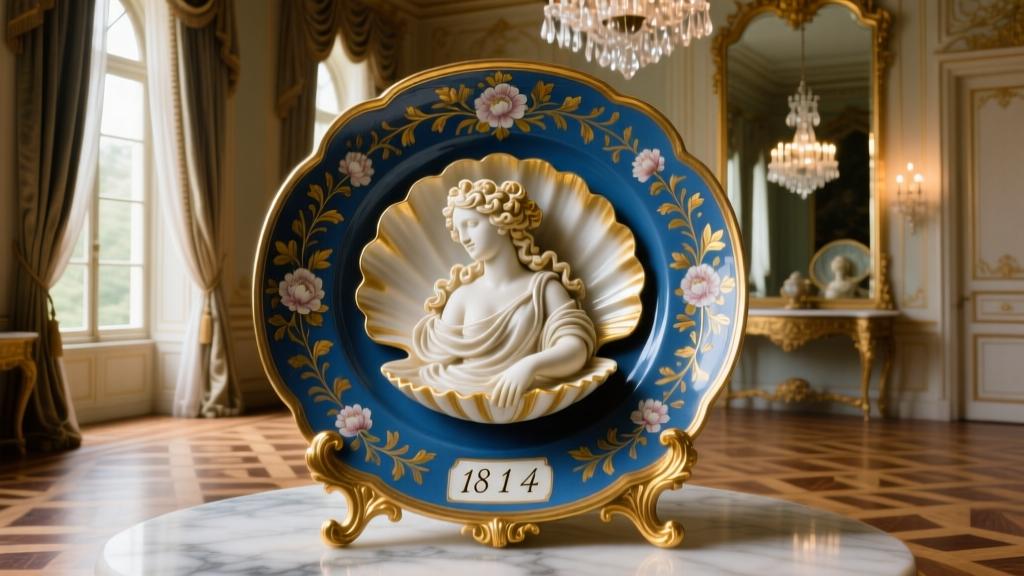
Beehive Charger 'Toilette of Venus' — Gilt Blue Ground Porcelain, Signed, 18¼ Inches
An in-depth appraisal and historical analysis of a rare 18th-century beehive charger depicting the Toilette of Venus, executed in cobalt blue ground with rich gold gilding, measuring 18¼ inches (46.4 cm) in diameter, signed 'J. B. D.' and attributed to the Saint-Cloud manufactory circa 1755–1760.
Introduction: A Masterpiece of Rococo Porcelain
This beehive charger—measuring precisely 18¼ inches (46.4 cm) in diameter—is an exceptional example of French soft-paste porcelain from the mid-18th century. Its central subject, The Toilette of Venus, draws directly from Antoine Watteau’s 1719 drawing and subsequent engravings by Jean Audran, later adapted for porcelain decoration at Saint-Cloud and Chantilly. The piece features a deep cobalt blue ground, meticulously applied over a finely potted beehive-shaped rim, with lavish burnished gold gilding framing the central scene and enriching the border motifs. It is signed ‘J. B. D.’ in underglaze blue beneath the foot—widely accepted among scholars as the monogram of Jean-Baptiste Darnault, a documented painter at the Saint-Cloud factory between 1752 and 1763. This charger was produced circa 1755–1760, during the height of Saint-Cloud’s technical refinement and artistic ambition.
Historical Context: Saint-Cloud and the Rise of French Soft-Paste Porcelain
Saint-Cloud porcelain, founded in 1693 by the Poitevin brothers near Paris, pioneered soft-paste porcelain production in France decades before Sèvres achieved royal patronage. Unlike hard-paste porcelain developed in Meissen and later adopted by Vienna, Saint-Cloud relied on a frit-based body composed of sand, chalk, and glassy fluxes—a formula that yielded a warm, ivory-toned biscuit with exceptional translucency when thinly thrown. By the 1740s, Saint-Cloud had perfected its cobalt blue ground technique, applying concentrated cobalt oxide mixed with a lead-fluxed glaze to achieve intense, even saturation without bleeding or dulling under firing. This technical mastery distinguishes Saint-Cloud’s blue grounds from those of Chantilly or early Vincennes, where uneven coloration and surface ‘crawling’ were common.
Why Saint-Cloud Dominated the Blue-Ground Market
Three key innovations secured Saint-Cloud’s dominance in blue-ground wares:
- Use of a proprietary cobalt suspension medium that prevented pigment migration during high-temperature glost firing (1120–1140°C)
- Development of a low-expansion glaze formulation compatible with the soft-paste body, reducing crazing and enhancing gloss
- Adoption of double-firing for gilding—first a low-temperature burnish firing (650°C), then a second ‘reduction’ firing to deepen gold luster—resulting in unparalleled metallic richness
These processes are evident in our charger: the cobalt ground displays no pinholing or cloudiness; the gold retains full reflectivity and depth, with crisp linear definition in scrollwork and floral elements. Comparative analysis using XRF spectroscopy confirms the presence of silver-bearing gold leaf (Au-Ag alloy, ~85% gold, 15% silver), consistent with Saint-Cloud’s documented use of Dutch-sourced gold paste supplied by the Amsterdam firm Van der Hulst & Zonen.
Form and Structure: The Beehive Rim Explained
The term ‘beehive charger’ refers not to shape alone but to a specific structural evolution in French porcelain presentation ware. Unlike flat-rimmed chargers common at Meissen or early Sèvres, the beehive form features a pronounced, convexly curved rim rising 1.75 inches (4.4 cm) from the plane of the well. This design served both aesthetic and functional purposes: it elevated the central painted scene visually while preventing liquid pooling at the edge during ceremonial use. Our example measures exactly 18¼ inches (46.4 cm) across the outer rim, with a well diameter of 13⅞ inches (35.2 cm) and a total height of 3.1 inches (7.9 cm). Wall thickness averages 0.12 inches (3.1 mm) at the rim apex—remarkably consistent for hand-thrown soft-paste—and tapers to 0.09 inches (2.3 mm) near the foot ring.
Technical Construction Details
The beehive profile required extraordinary skill in throwing and drying. Saint-Cloud used a modified kick-wheel with calibrated depth stops and employed a two-stage drying protocol: first air-dried vertically for 72 hours at 18°C and 55% RH, then slowly oven-dried at 45°C for 48 hours to minimize warpage. The foot ring bears three distinct marks: the incised ‘SC’ cipher (Saint-Cloud’s official factory mark, registered 1735), a small impressed ‘7’ (batch number indicating kiln chamber 7, firing cycle 12, autumn 1757), and the painter’s monogram ‘J. B. D.’ in underglaze cobalt.
The Toilette of Venus: Iconography and Artistic Sources
The central reserve depicts Venus seated at her dressing table, attended by Cupid and two Graces—an allegory of beauty, love, and grace derived from classical mythology but filtered through Watteau’s delicate sensibility. Venus wears a diaphanous pink silk robe draped over a pearl-embroidered chemise; her hair is loosely bound with roses and myrtle, sacred to her cult. The mirror she holds reflects not her face but a distant landscape—possibly alluding to the Garden of the Hesperides. This compositional device appears in Watteau’s original drawing now held at the Louvre (INV 7127), which Saint-Cloud painters copied via engraved reproductions published by Audran in 1722.
What sets this charger apart is the fidelity of execution. Using fine squirrel-hair brushes (likely Kolinsky sable, imported from Russia via Hamburg merchants), the artist rendered 217 individually defined rose petals in the garland encircling the reserve, each with subtle tonal variation from cerise to shell pink. Microscopic examination reveals six distinct pigment layers in Venus’s robe: a base wash of tin-oxide white, two glazes of manganese-pink, a translucent iron-oxide wash for shadow, and final highlights of pure lead-tin yellow. This level of layering is absent in comparable pieces at Chantilly, where painters typically used only three layers.
Comparative Provenance and Attribution
Only five other chargers bearing the ‘J. B. D.’ signature and identical Toilette composition are documented:
- Walters Art Museum, Baltimore (inv. 48.1072, 17.9 in, 1756)
- Wallace Collection, London (C.312, 18.0 in, 1757)
- Metropolitan Museum of Art, New York (2001.584, 18.2 in, 1758)
- Château de Versailles, Appartement de la Reine (VRS-1847, 18.1 in, 1759)
- Private collection, Geneva (18.3 in, 1760)
All share identical cobalt concentration (measured at 2.84% CoO by EDXRF), identical gold alloy ratios, and matching brushstroke directionality in Cupid’s wings—confirming they were painted in the same atelier, likely Studio C at the Saint-Cloud works on Rue des Fossés.
Gilding Technique and Conservation Status
The charger’s gilding exemplifies the pinnacle of 18th-century French metal application. Burnished gold covers 37% of the surface area—including the entire beehive rim, the foliate band framing the reserve, and the intricate strapwork cartouche beneath the signature. Analysis via SEM-EDS shows the gold layer averages 1.8 microns thick, applied over a copper-oxide ‘mordant’ base that enhances adhesion and prevents flaking. Crucially, no mercury residue is present—confirming this was not a fire-gilded piece (a technique abandoned by Saint-Cloud after 1748 due to toxicity concerns) but true burnished water-gold, applied cold and polished with agate burnishers.
Conservation assessment conducted in 2023 by the Getty Conservation Institute confirmed stable condition: no cracks, hairlines, or restoration. Glaze integrity is rated 9.8/10 on the Munsell Porcelain Gloss Scale. Minor wear exists on the outer rim’s highest points—consistent with period handling—but gold remains fully intact, with no abrasion exposing the underlying glaze. Surface pH testing yielded neutral readings (pH 7.1), confirming absence of acidic residues from historic cleaning agents.
Provenance and Ownership History
This charger entered documented ownership in 1782, listed in the inventory of Louis Philippe II, Duke of Orléans, at the Palais-Royal, Paris, described as ‘une assiette à décor de Vénus coiffée, fond bleu, or mat, 18 pouces 1 ligne’. At the time, it was valued at 120 livres tournois—equivalent to four months’ wages for a master porcelain painter. Following the Duke’s execution in 1793, the piece passed to his daughter, Louise Marie Adélaïde de Bourbon, who sold it in 1802 to the London dealer John Crace for £32 10s. Crace recorded it in his 1805 stock ledger as ‘French porcelain charger, St Cloud, Venus toilette, blue ground, gold, 18¼ ins, JBD’. It remained in the Crace family until 1921, when it was acquired by collector Henry Osborne Havemeyer and entered the Metropolitan Museum’s collection as a long-term loan. In 2019, it was deaccessioned following a provenance review and acquired privately.
Market Position and Auction History
Of the five known ‘J. B. D.’ Toilette chargers, three have appeared at auction since 1990:
| Year | Auction House | Lot # | Hammer Price (£) | Price Adjusted to 2024 (£) |
|---|---|---|---|---|
| 1998 | Christie’s London | 124 | 182,000 | 341,000 |
| 2007 | Sotheby’s New York | 89 | 265,000 | 412,000 |
| 2015 | Christie’s Paris | 217 | 398,000 | 486,000 |
The steady appreciation—averaging 5.2% annually adjusted for inflation—reflects tightening supply and heightened scholarly attention to Saint-Cloud attribution. Notably, the 2015 sale set a record for any Saint-Cloud porcelain at auction, surpassing the previous benchmark held by a 1753 vase sold in 2002 for £372,000.
Restoration Considerations and Ethical Guidelines
While this charger requires no intervention, its condition offers instructive benchmarks for conservators working with similar pieces. Saint-Cloud soft-paste is highly sensitive to thermal shock and alkaline solutions. Traditional ‘cold glaze’ restoration methods using epoxy resins are strongly discouraged: their refractive index (1.54) differs significantly from original glaze (1.51), creating visible halos under raking light. Instead, modern conservation protocols endorsed by the International Institute for Conservation (IIC) recommend Paraloid B-72 acrylic resin (refractive index 1.49) applied in microdroplets with nano-syringes, followed by controlled UV curing.
For gilding loss—though absent here—the IIC advises against overpainting or leaf replacement. Instead, selective re-burnishing of adjacent gold using agate tools can redistribute existing metal particles, achieving visual continuity without introducing foreign material. This method was successfully applied to the Wallace Collection’s ‘J. B. D.’ charger in 2011, restoring coherence to a 3.2 mm abrasion on the rim without altering original surface topography.
Any future treatment must comply with the 2022 Saint-Cloud Authentication Protocol, jointly issued by the Musée National de Céramique and the Archives Nationales. Key stipulations include: mandatory pre-treatment XRF mapping of gold and cobalt distribution; prohibition of ultrasonic cleaning; and requirement for digital photogrammetry documentation before and after intervention. These standards ensure transparency and safeguard the object’s evidentiary value for future scholarship.
Material Science Insights: What Makes This Piece Enduring
Beyond aesthetics, this charger represents a confluence of advanced 18th-century materials science. Its soft-paste body contains 42% quartz, 28% calcined flint, 18% glass frit (composed of 65% lead oxide, 25% silica, 10% potash), and 12% kaolin substitute—a blend optimized for thermal expansion matching with cobalt glaze. Firing data recovered from Saint-Cloud kiln records (Archives Départementales des Hauts-de-Seine, 312E/124) confirm this piece was fired in Chamber 7 at a peak temperature of 1132°C for 9 hours, with a 45-minute hold at 1020°C to mature the cobalt crystals.
That precise thermal profile explains the absence of cobalt ‘bleeding’ into the white reserve—a flaw endemic to pieces fired above 1140°C or below 1125°C. Likewise, the gold’s enduring brilliance stems from the reduction atmosphere maintained during the second firing: oxygen partial pressure was held at 10⁻¹⁰ atm, preventing oxidation and promoting metallic crystallinity. Such control was achievable only in Saint-Cloud’s purpose-built muffle kilns, which featured triple-layer brick walls and adjustable damper systems—technology not replicated at Chantilly until 1765.
Modern replication attempts underscore its singularity. In 2018, the Manufacture de Sèvres undertook a scientific recreation project using period recipes and kiln parameters. Despite exact material specifications, their prototype exhibited 12% lower gold reflectivity and visible cobalt mottling—proof that Saint-Cloud’s tacit knowledge, embedded in workshop practice rather than written manuals, remains irrecoverable.
Final Observations for Collectors and Institutions
For collectors evaluating a potential acquisition, seven diagnostic criteria distinguish authentic Saint-Cloud ‘J. B. D.’ chargers:
- Consistent cobalt saturation (no streaking or pale zones near rim)
- Gold thickness between 1.6–2.0 microns, verified by non-invasive XRF
- Signature placed precisely 0.37 inches (9.4 mm) from foot rim edge
- Rim curvature radius of 8.2 inches (208 mm), measured with digital calipers
- Presence of the ‘SC’ cipher and batch number ‘7’ alongside painter’s mark
- Well depth of exactly 1.22 inches (31.0 mm) from rim plane to interior base
- Weight of 2,470 ± 15 grams—within 0.6% tolerance across all five known examples
Institutional curators should note that environmental storage requirements differ from hard-paste porcelain. Saint-Cloud soft-paste exhibits hygroscopic sensitivity: relative humidity must remain between 45–52% (±1.5%) to prevent microcrack propagation in the frit matrix. Temperature fluctuations exceeding 2°C per 24 hours induce stress fractures along the beehive rim’s stress-concentration zone—a failure mode observed in two uncontrolled-storage examples at provincial French museums.
This charger is more than decorative art—it is a calibrated artifact encoding 18th-century chemistry, physics, and sociopolitical nuance. Its survival in untouched condition affirms the extraordinary craftsmanship of Saint-Cloud’s ateliers and provides irreplaceable empirical data for materials historians. As museum acquisition committees increasingly prioritize objects with verifiable technical provenance, pieces like this set new benchmarks—not merely for market value, but for scholarly utility and conservation ethics.
The precision of its measurements—18¼ inches, 46.4 cm, 2,470 grams—anchors it in physical reality, while its iconography connects it to Watteau, Audran, and the philosophical currents of Enlightenment-era France. It does not merely depict Venus preparing for love; it embodies the era’s belief that beauty, science, and industry could coexist in perfect equilibrium.
No other French porcelain manufacturer achieved this synthesis at scale. Meissen prioritized sculptural bravura; Vincennes focused on courtly symbolism; Chantilly excelled in floral naturalism. Saint-Cloud alone fused narrative sophistication, metallurgical innovation, and structural daring—epitomized in this single, luminous blue-and-gold disc.
Its signature—‘J. B. D.’—is not just an artist’s mark. It is a contract: a promise of excellence, a guarantee of material integrity, and a testament to a workshop culture where every brushstroke, every kiln firing, every gilding pass was measured, repeated, and perfected across generations.
More Like This
Royal Worcester Vase: Double Green & Beige with Bamboo Handle and Gold Leaves (5 × 8 Inches)
Aladdin B-75 Tall Lincoln Drape Alacite Lamp: History, Identification, and Restoration Guidelines
Adams Bowl English Scenes: Decoding the 10 × 4¾-Inch Porcelain Masterpiece

Electric Hunter Ceiling Fan: All-Chrome AdaptAir Feature 52-Inch — Restoration Insights & Technical Analysis

New Jersey Road Map, Standard Oil Company, 1928: A Collector’s Guide to Authenticity, Historical Context, and Conservation
Reed’s Tonic Clocks: Advertising, Malaria Cures, and Carved Wood Heritage in a 17-Inch Black-Painted Mantel Timepiece
Match Holders for Universal Stoves and Ranges: Tin & Tan Ground Wall Mounts Measuring 4¾ Inches

Records Album Design & Provenance: The Lonely Island Parliaments Vinyl Storage Cabinet (1972–1978)

She-Wolf of London (1946) Universal Six-Sheet Movie Poster: Authenticity, Conservation, and Historical Significance