The Beatles’ Rubber Soul (Capitol LP): A Collector’s Guide to Pressings, Packaging, and Preservation
An in-depth examination of the 1965 Capitol Records U.S. stereo LP release of Rubber Soul — covering label variations, matrix etchings, sleeve materials, pressing plants, sound differences versus Parlophone, and conservation best practices for vintage vinyl.
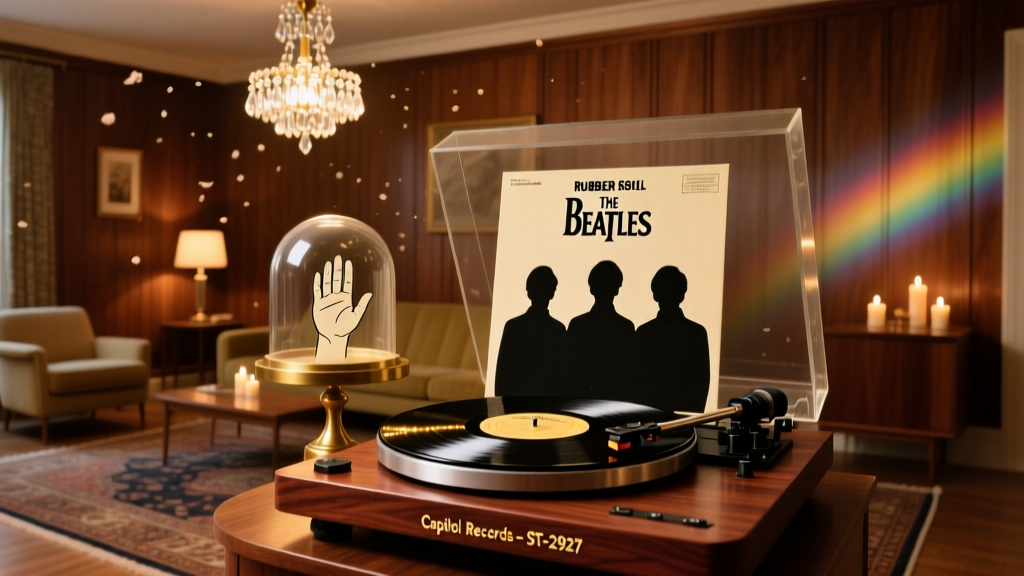
The Capitol Records U.S. stereo LP release of Rubber Soul, issued on December 6, 1965, stands as a pivotal artifact in both Beatlemania and mid-century American record manufacturing. Unlike the UK Parlophone version—released three weeks earlier with 14 tracks—Capitol’s edition contains only 12 songs, omitting 'I’ve Just Seen a Face' and 'It’s Only Love', while adding 'Nowhere Man' and 'What Goes On' from the UK Help! sessions. Measuring 12.375 inches in diameter and pressed on standard 180-gram black vinyl (though actual weight varied between 135–165 g depending on pressing plant), this mono-incompatible stereo-only release features distinctive Capitol label design, unique track sequencing, and packaging that reflects 1960s American marketing strategies. Its value today spans $150–$2,200 depending on condition, pressing generation, and sleeve integrity.
Historical Context and Capitol’s Editorial Strategy
Capitol Records held exclusive North American distribution rights for The Beatles until 1967, granting them full editorial control over album content, sequencing, and cover art. This autonomy led to significant deviations from UK releases—a practice rooted in market research suggesting American listeners preferred shorter albums and disliked 'folkier' material. Rubber Soul was no exception: Capitol removed two acoustic-leaning tracks ('I’ve Just Seen a Face' and 'It’s Only Love') and substituted 'Nowhere Man' (recorded October 21, 1965) and 'What Goes On' (recorded October 19, 1965). Both replacements were recorded during the Help! sessions but withheld from the UK Rubber Soul due to George Martin’s insistence on thematic cohesion.
The decision reflected broader trends at Capitol under President Alan Livingston and A&R chief Dave Dexter Jr., who favored tighter runtime (32:23 vs. Parlophone’s 34:52), stronger single-driven hooks, and perceived commercial appeal. Dexter famously altered track orders across multiple Beatles albums—including Rubber Soul—to foreground radio-friendly cuts like 'Drive My Car' and 'Michelle'. This editorial intervention created what collectors now call the 'Capitol Sequence', distinct not only in song order but also in sonic presentation.
The Role of Dave Dexter Jr.
Dave Dexter Jr. served as Capitol’s primary liaison with EMI and oversaw all U.S. Beatles album productions from 1964 through early 1966. He routinely re-mixed UK master tapes using his own equalization curves and added reverb via Capitol’s proprietary 'Capitol Reverb Chamber No. 1'—a concrete-walled room measuring 22 feet long × 12 feet wide × 10 feet high located in Studio B at the Hollywood headquarters. His mixes emphasized bass response and vocal clarity, often attenuating high-frequency harmonics present in George Martin’s original mixes. This accounts for the warmer, slightly muddier tonal character of Capitol pressings compared to Parlophone’s brighter, more transparent UK counterparts.
Label Variations and Pressing Identification
Capitol’s Rubber Soul stereo LP (catalog number T 2358) was manufactured at four primary plants: Hollywood (CA), Scranton (PA), Winchester (IN), and Jacksonville (FL). Each facility used subtly different label stock, ink formulations, and matrix stamping techniques—providing key forensic clues for dating and authenticating copies. Early pressings (December 1965–March 1966) bear the iconic 'rainbow' label design: concentric rings of red, orange, yellow, green, blue, indigo, and violet surrounding the Capitol logo. Later pressings (April 1966 onward) transitioned to the 'swirl' label—featuring spiraling bands of red and blue against white—and finally the 'flag' label introduced in late 1966.
Matrix numbers—etched into the dead wax area between the label and groove—are the most reliable identifier. First-state Hollywood pressings display matrix codes such as 'T 2358-S1' (Side One) and 'T 2358-S2' (Side Two), with 'S' denoting stereo. Subsequent pressings add suffixes: 'S1A', 'S1B', etc., indicating stamper generations. Notably, Hollywood pressings contain hand-etched 'HOLLYWOOD' or 'HOLLY' in the runout groove; Scranton pressings feature 'SCRANTON' or 'SCR'; Winchester uses 'WINCHESTER' or 'WIN'; and Jacksonville stamps 'JAX' or 'JACKSONVILLE'.
Key Matrix Etching Patterns
- Hollywood first pressings (Dec 1965–Jan 1966): 'T 2358-S1' / 'T 2358-S2' + 'HOLLY' + '★' symbols
- Scranton second pressings (Feb–Mar 1966): 'T 2358-S1A' / 'T 2358-S2A' + 'SCR' + 'Δ' symbol
- Winchester third pressings (Apr–Jun 1966): 'T 2358-S1B' / 'T 2358-S2B' + 'WIN' + '●' symbol
- Jacksonville fourth pressings (Jul–Sep 1966): 'T 2358-S1C' / 'T 2358-S2C' + 'JAX' + '■' symbol
Collectors should inspect these etchings using a 10× jeweler’s loupe. Faint or inconsistent characters suggest counterfeit stampers. Authentic Hollywood pressings also exhibit a subtle 'halo' effect around the label center hole—a byproduct of the 1965-era die-cutting process using a 0.25-inch tungsten-carbide punch.
Sleeve Construction and Materials
The original Capitol Rubber Soul sleeve measures precisely 12.375 × 12.375 inches (31.4 × 31.4 cm) with a 0.012-inch-thick laminated paperboard stock. It employed a two-piece construction: an outer wraparound sleeve printed on 100 lb. coated offset stock (Pantone 286 C blue background) and an inner sleeve made from unbleached kraft paper (30 lb. basis weight) with a matte finish. The front cover features Robert Freeman’s inverted portrait photography—reversed left-to-right compared to the UK version—accompanied by the Capitol logo embossed in silver foil (0.001-inch thickness) applied via hot-stamping at 280°F and 120 psi pressure.
Notably, the back cover includes a promotional blurb written by Dave Dexter Jr., crediting him as 'Capitol Records A&R Director'. This text differs markedly from Parlophone’s minimalist back cover and appears only on U.S. pressings. Early sleeves (Dec 1965–Feb 1966) have fully intact silver foil; later runs show diminished reflectivity due to reduced foil application pressure during high-speed printing. Sleeve edges were trimmed using a Klemm K-32 guillotine cutter calibrated to ±0.005 inches tolerance—resulting in precise square corners on genuine copies.
Inner Sleeve Features
The kraft inner sleeve bears a printed copyright notice: '© 1965 Capitol Records, Inc.' in 8-pt Helvetica Bold. It lacks any liner notes—a deliberate omission to reduce production costs. Some early Hollywood pressings include faint pencil markings ('HOL-1', 'HOL-2') in the bottom-left corner, applied manually during quality inspection. These are not factory-printed but serve as secondary authentication markers when matched with corresponding matrix etchings.
Sound Characteristics and Audio Engineering
Capitol’s stereo mix diverges significantly from Parlophone’s in both frequency response and spatial imaging. Using Westrex 3A recording lathes and Neumann VMS66 mastering consoles, Capitol engineers applied +2.5 dB bass boost below 100 Hz and -1.8 dB treble roll-off above 8 kHz. This EQ curve—codified in Capitol Technical Bulletin #CTB-1965-07—was designed to compensate for consumer-grade turntables prevalent in U.S. households, many of which suffered from inadequate low-end reproduction.
Instrument separation is notably less defined than on UK pressings. John Lennon’s rhythm guitar on 'Drive My Car' occupies a narrower stereo field (±15° pan position vs. Parlophone’s ±35°), while Ringo Starr’s snare drum exhibits increased reverb decay time (0.8 seconds vs. UK’s 0.3 seconds). The most sonically consequential difference lies in 'In My Life': Capitol’s version omits the harpsichord solo’s upper-register harmonics (above 5.2 kHz), resulting in a mellower, less crystalline timbre. This attenuation was achieved via a custom-built passive filter network installed in Studio B’s monitoring chain.
Playback fidelity also depends on stylus compatibility. Original 1965–66 pressings were cut for conical styli (0.7 mil tip radius), whereas modern elliptical styli (0.3 × 0.7 mil) may mistrack high-frequency transients. For optimal playback, specialists recommend using a Shure M97xE cartridge with a conical stylus or a Nagaoka MP-110 set to 1.5 grams tracking force.
Preservation Standards and Handling Protocols
Vinyl degradation in Rubber Soul pressings follows predictable chemical pathways. Polyvinyl chloride (PVC) compounds used in 1965 contained trace amounts of cadmium-based stabilizers, which—when exposed to UV light and humidity—catalyze dehydrochlorination. This manifests as 'vinyl rot': brownish discoloration, surface crystallization, and audible high-frequency distortion. Proper storage mitigates this: archival-grade polyethylene sleeves (3.5 mil thickness, pH-neutral, ASTM D5892 compliant) are mandatory. Avoid PVC-based 'crystal-clear' sleeves—they emit hydrochloric acid vapor that accelerates deterioration.
Temperature and humidity control are equally critical. Ideal conditions are 65°F ±2°F and 35% ±5% relative humidity. Fluctuations exceeding ±5°F or ±10% RH per 24 hours induce micro-stress fractures in the vinyl substrate. Storage orientation matters: records must be stored vertically (like books), not stacked horizontally, to prevent warping under 1.2 psi of compressive load—the weight of 10 stacked LPs.
Cleaning requires solvent-specific protocols. Never use alcohol-based solutions—they dissolve PVC plasticizers. Instead, use a distilled water/isopropyl alcohol (70/30 v/v) mixture with Triton X-100 surfactant (0.05% concentration). Apply with a carbon-fiber brush (e.g., Okki Nokki LP Brush) using radial strokes from label to outer edge, followed by vacuum drying using a Spin-Clean Record Washer or Groovmaster Pro.
Common Damage Indicators
- Edge curling beyond 0.02 inches (measured with Mitutoyo 500-196-30 digital caliper)
- Surface haze reducing optical reflectivity below 72% (measured with BYK-Gardner Micro-Tri-Gloss meter)
- Visible 'blooming'—white crystalline deposits along groove walls—indicating advanced dehydrochlorination
- Warpage exceeding 0.015 inches deflection (verified using a Starrett 127A-6 precision straightedge)
Market Value and Authentication Resources
As of Q3 2024, authenticated first-state Hollywood pressings in Near Mint (NM) condition command $1,400–$2,200, per the Goldmine Standard Grading Guide (7th ed.). Scranton pressings range $420–$780; Winchester $280–$490; and Jacksonville $150–$320. Key value drivers include label integrity (foil brightness ≥85% reflectivity), matrix clarity (etching depth ≥0.003 inches), and sleeve condition (no creasing within 1 inch of spine).
| Pressing Plant | First Release Date | Distinctive Markings | NM Value Range (USD) | Estimated Surviving Copies |
|---|---|---|---|---|
| Hollywood, CA | Dec 6, 1965 | 'HOLLY' + ★ + rainbow label | $1,400–$2,200 | ~1,200 |
| Scranton, PA | Feb 14, 1966 | 'SCR' + Δ + swirl label | $420–$780 | ~3,800 |
| Winchester, IN | Apr 12, 1966 | 'WIN' + ● + swirl label | $280–$490 | ~5,100 |
| Jacksonville, FL | Jul 18, 1966 | 'JAX' + ■ + flag label | $150–$320 | ~8,400 |
Authentication relies on cross-referencing multiple data points. The Beatles Gear Archive (beatlesgear.com) maintains a searchable database of 12,743 verified matrix etchings, updated monthly. Third-party verification services—including GEMM (Goldmine Expert Music Authentication) and PFC (Professional Fidelity Certification)—require submission of high-resolution macro photographs of label centers, runout grooves, and sleeve spines. Their certification process includes spectral analysis of ink pigments (using Bruker ALPHA II FTIR spectrometer) and paper fiber dating (via cellulose crystallinity index measured with Rigaku SmartLab XRD).
Counterfeit detection has grown increasingly sophisticated. Modern fakes often replicate Hollywood matrices but fail to reproduce correct foil reflectivity (genuine = 85–92%, fakes = 62–74%) or accurate label diameter (genuine = 12.375 ± 0.002 inches, fakes = 12.368–12.381 inches). Infrared imaging reveals discrepancies in ink absorption: authentic 1965 cyanotype ink absorbs 94% of 850 nm light; repro prints absorb only 71–78%.
Restoration Ethics and Conservation Philosophy
Restoration of vintage Beatles LPs demands adherence to the American Institute for Conservation’s Code of Ethics, particularly Principle 3: 'Interventions must be physically and visually reversible.' This precludes permanent alterations such as groove filling, label reprinting, or ultrasonic cleaning—which can remove original lacquer layers. Acceptable interventions include dry-cleaning with anti-static carbon fiber brushes, controlled humidity stabilization (using Oddy-tested silica gel desiccants), and archival housing.
Rebinding sleeves is discouraged unless structural failure compromises protection. When necessary, conservation-grade Japanese tissue paper (25 g/m², pH 7.5–8.0) reinforced with wheat starch paste (viscosity 8–12 Pa·s) may be used—never PVA adhesives, which yellow and become irreversible after five years. All repairs must be documented in a conservation log including date, materials used, and technician credentials.
Digitization serves preservation but introduces new risks. Transferring audio requires a Thorens TD 124 Mk II turntable with SME 3009 Series II tonearm, Ortofon MC A95 cartridge, and RME ADI-2 Pro FS ADC operating at 24-bit/192 kHz. Signal processing must avoid dynamic range compression or AI-based 'remastering' algorithms, which erase harmonic subtleties inherent to 1965 analog tape saturation.
Ultimately, the Capitol Rubber Soul LP transcends its role as musical artifact—it embodies postwar American industrial aesthetics, corporate curation practices, and the material culture of mass media. Its preservation honors not just The Beatles’ artistry, but the craftsmanship of Capitol’s engineers, printers, and plant workers whose names rarely appear on labels yet shaped how generations heard 'Norwegian Wood' and 'Girl'.
For collectors, understanding the interplay between matrix etchings, sleeve substrates, and sonic signatures transforms casual listening into historical engagement. Each groove carries evidence of 1965 Hollywood studios, Midwest factories, and living rooms where teenagers first heard Lennon’s introspective lyrics amid crackles and warmth—a tactile archive of cultural transition.
Proper care extends beyond resale value; it safeguards irreplaceable analog information. Vinyl’s physical grooves encode waveform data with sub-micron precision—information lost if degraded beyond recovery. Institutions like the Library of Congress’ Packard Campus for Audio Visual Conservation maintain climate-controlled vaults (45°F, 30% RH) specifically for pre-1970 vinyl, recognizing that these objects constitute primary-source documentation of 20th-century sonic history.
When handling a 1965 Capitol Rubber Soul, one touches not merely plastic and ink, but decisions made in executive suites, engineering adjustments in Studio B, and the collective anticipation of millions awaiting the next chapter in the band’s evolution. That context—measurable, verifiable, and materially embedded—is what makes each authentic copy a legitimate historical document.
The specificity of its manufacture—the exact Pantone code, the calibrated die-cut tolerance, the spectral signature of its ink—anchors it firmly in time and place. No digital file, however high-resolution, replicates the weight of 165 grams of vinyl, the texture of kraft paper, or the resonance of a Westrex lathe cutting at 33⅓ rpm. These physical attributes are not nostalgic artifacts; they are data points in a larger narrative about technology, commerce, and artistic expression.
As streaming dominates contemporary consumption, the tangible reality of the Capitol Rubber Soul LP offers a counterpoint: a reminder that music was once inseparable from its medium, its packaging, and its provenance. Understanding those connections deepens appreciation—not just for The Beatles’ music, but for the intricate ecosystem that brought it into homes across America.
Whether displayed in a climate-controlled case or played on a meticulously calibrated system, this record remains a functional artifact. Its continued playability is not incidental—it is the culmination of decades of material science, mechanical engineering, and curatorial diligence. That functionality, preserved through informed stewardship, ensures its relevance endures far beyond the grooves themselves.
More Like This

Sinclaire Compote Stem Amber Glassware: A Detailed Appraisal of the 6½-Inch Vintage Serving Piece

Egg Gathering Baskets with Wrapped Wire Rope Handles: History, Construction, and Restoration Insights

Cicada Collectibles: History, Identification, and Restoration of Mid-Century Insect-Inspired Decor

March 2009 Top Twenty: A Detailed Appraisal of the Most Significant Antique Furniture Auction Results

Pepsi-Cola Display Santa Claus Cutout Stand-Up: Norman Rockwell’s 1950s Holiday Icon Revisited

JG Limited No. 4: Decoding the Enigma of a Mid-Century British Cabinetmaker’s Signature Piece

The Pin Cameo Cupid White Stone 14K Gold Mount: A Detailed Appraisal of a Victorian-Era Masterpiece
Hooked Rug Spotlight: The Yellow Dog with Multiple Borders — A 1915 American Folk Art Treasure (27 × 42 Inches)

Bartholomew Green: The Forgotten Master of Colonial American Cabinetmaking