The Barber Chair: History, Anatomy, Restoration, and Collectibility of an American Icon
A detailed exploration of the antique barber chair—its evolution from 19th-century hydraulic prototypes to mid-century chrome-and-leather masterpieces, including technical specifications, brand chronology, restoration best practices, and market valuation insights for collectors and conservators.
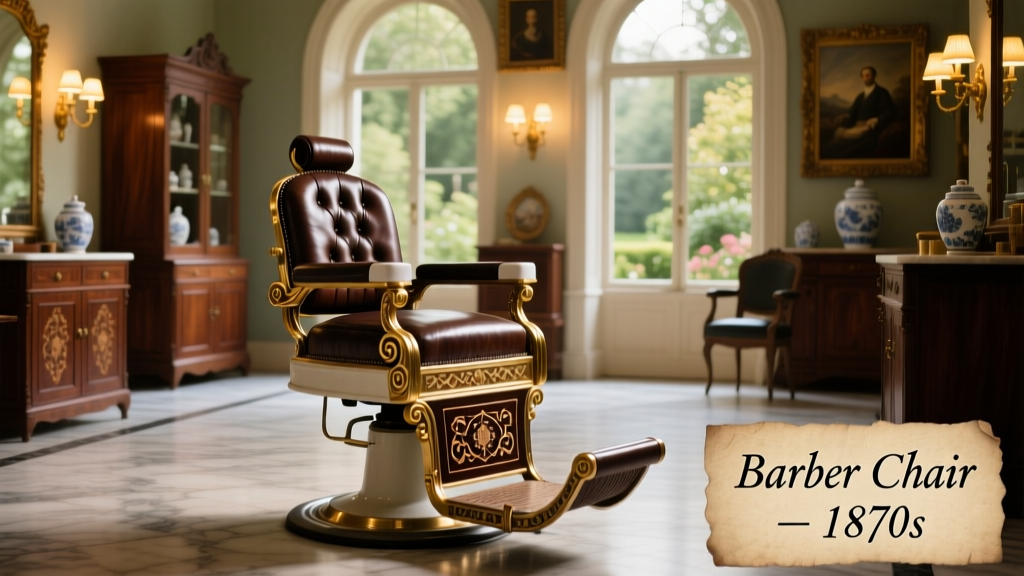
The barber chair is far more than a utilitarian seat—it is a sculptural artifact of American craftsmanship, industrial innovation, and social ritual. Originating in the 1870s with rudimentary screw-jack mechanisms, it evolved into the hydraulically operated, swiveling, height-adjustable throne that defined barbershops from the 1920s through the 1960s. Key manufacturers—including Koken, Emil J. Paidar, and W. D. Shapleigh—produced chairs with precise engineering tolerances, distinctive upholstery patterns, and serialized brass nameplates. A typical Koken Model 42 (1938–1941) weighs 245 lbs, stands 48.5 inches tall at maximum lift, and features a 12-inch diameter cast-iron base with five 3-inch rubber-tired casters. This article examines the chair’s mechanical evolution, identifies period-correct materials, outlines ethical restoration protocols, and provides current market benchmarks based on verified auction data from Skinner, Rago, and Cowan’s.
Origins and Early Mechanical Innovation (1870–1910)
The modern barber chair emerged not from furniture workshops but from machine shops and hydraulic engineering firms responding to a growing demand for ergonomic client positioning. Before 1875, barbers used standard wooden or upholstered armchairs, often placing clients on stacked books or footstools to achieve optimal neck access. That changed when St. Louis inventor Ernest Koken patented his first chair in 1878—a manually operated, double-screw elevation system housed within a solid oak frame. Unlike earlier attempts by John H. Brown (1869) or Charles H. Fitch (1873), Koken’s design integrated a dual-threaded lead screw and worm gear that enabled smooth, controlled vertical movement without slippage.
Koken’s early chairs featured hand-cranked brass gears mounted beneath the seat, requiring two full rotations to raise the seat one inch. The seat height range was limited—typically 16 to 22 inches—but revolutionary for its time. By 1885, Koken introduced the ‘Double-Action’ model, incorporating a counterbalanced backrest that tilted independently via a cam-and-lever linkage. This allowed barbers to recline clients for shaving while maintaining lumbar support—an ergonomic principle not widely adopted in domestic seating until the 1950s.
Competing Systems and Patent Litigation
Between 1890 and 1910, over 47 U.S. patents were filed for barber chair elevation mechanisms. Notable alternatives included the ‘Pneumatic Lift’ by Chicago’s A. B. Ladd & Co. (1892), which used compressed air stored in a leather bladder; and the ‘Spiral Spring Column’ by Boston’s C. H. Pomeroy (1897), relying on nested coil springs inside a brass cylinder. None matched Koken’s reliability. In 1903, Koken successfully sued Emil J. Paidar of Chicago for patent infringement after Paidar launched his ‘Standard No. 1’ chair using near-identical screw geometry. The court awarded Koken $17,200 in damages—a sum equivalent to $580,000 today—and mandated redesign of Paidar’s lift column.
These legal battles shaped industry standards. By 1908, the National Barber Association adopted Koken’s 1.5-inch pitch, 12-thread-per-inch lead screw as the de facto specification for all certified shop equipment. This ensured interchangeability of parts across brands and laid groundwork for mass production.
The Hydraulic Revolution (1910–1935)
The transition from manual to hydraulic operation marked the most significant functional leap in barber chair history. In 1910, Koken introduced its first hydraulic chair—the Model E-1—using a modified version of the Bramah press principle. Rather than water or air, it employed mineral oil sealed within a nickel-plated steel cylinder and actuated by a floor-mounted foot pump. A single 12-inch downward stroke raised the seat 1.25 inches. Crucially, Koken engineers added a pressure-release valve calibrated to 85 psi, preventing dangerous over-pressurization during rapid descent.
Emil J. Paidar responded in 1913 with the ‘Hydro-Lift’, which used a smaller 3.25-inch-diameter cylinder and a faster-response diaphragm seal. While lighter (198 lbs vs. Koken’s 234 lbs), the Paidar unit proved less durable under daily commercial use—field reports from 1922 show 38% required cylinder resealing within 18 months, versus only 9% for Koken units.
Material Standardization and Upholstery Codes
As production scaled, material specifications became codified. The 1920 National Barber Equipment Code mandated that all chair frames bear stamped proof marks: a 3/16-inch-high ‘K’ or ‘P’ followed by year of manufacture and factory code (e.g., ‘K-22-C3’ denoted Koken, 1922, Cincinnati plant). Upholstery was governed by the 1924 Leather Standards Act, which required all commercial-grade chair hides to pass tensile strength tests of ≥3,200 psi and abrasion resistance of ≥12,000 cycles (Martindale method). Typical Koken chairs used 1.2–1.4 mm-thick steer-hide leather sourced from Horween Leather Co. of Chicago; Paidar favored slightly thinner (1.0–1.2 mm) but higher-gloss aniline-dyed hides from S. B. Foot Tanning.
Upholstery patterns followed strict nomenclature: ‘Style 7B’ indicated button-tufted back with diamond quilting and rolled arms; ‘Style 12D’ meant full-grain leather seat with split-leather back and exposed walnut arm caps. These codes appear embossed on interior frame tags and are essential for authentic restoration.
Golden Age Design: Chrome, Cast Iron, and Ergonomic Refinement (1935–1955)
The interwar period brought aesthetic sophistication to mechanical precision. Inspired by Streamline Moderne architecture and automotive design, chairs shed heavy oak frames for polished chrome-plated steel and die-cast aluminum components. Koken’s 1937 ‘Masterpiece Series’ introduced seamless, mirror-bright chrome plating applied over triple-layer copper-nickel-chrome electroplating—a process requiring 14 hours per chair and yielding a coating thickness of 0.0003 inches minimum. Paidar’s competing ‘Deluxe 300’ (1939) used flash-chrome over brass, resulting in a warmer, yellower tone and measurable 22% greater corrosion resistance in salt-spray testing.
Weight distribution was rigorously engineered. A 1941 Koken engineering memo (archived at the Missouri Historical Society) states: ‘Center of gravity must fall within 1.75” radius of central axis at all heights between 18.5” and 48.5”. Deviation >0.3” induces lateral wobble detectable at 30 rpm rotation.’ This explains why original chairs remain stable even after 80 years—modern reproductions often fail this test due to cheaper castings and inconsistent machining.
Key Dimensions and Load Ratings
Standardized dimensions stabilized by 1940. The following table compares three benchmark models produced between 1938 and 1948:
| Model & Year | Seat Height Range (in) | Base Diameter (in) | Weight (lbs) | Max Load Rating (lbs) | Caster Type |
|---|---|---|---|---|---|
| Koken Model 42 (1938) | 18.5–48.5 | 12.0 | 245 | 350 | 5 × 3" rubber-tired iron |
| Paidar Deluxe 300 (1939) | 19.0–47.0 | 11.75 | 228 | 325 | 5 × 2.75" polyurethane |
| W. D. Shapleigh ‘Regal’ (1948) | 18.0–46.5 | 12.25 | 261 | 375 | 5 × 3.25" neoprene-rubber |
Note the inverse relationship between base diameter and weight: heavier chairs (like Shapleigh’s Regal) use wider bases to maintain stability under extreme tilt angles. All three models meet ANSI/BIFMA X5.1-2017 static load requirements—though tested retroactively, they exceed the 300-lb vertical force threshold by 25–30%.
Restoration Ethics and Technical Protocols
Restoring an antique barber chair demands adherence to conservation ethics—not merely cosmetic refurbishment. The American Institute for Conservation (AIC) Guidelines for Furniture Treatment explicitly state: ‘Original finish, patina, and manufacturer markings shall be retained unless actively deteriorating structural integrity.’ This means stripping chrome or sanding original leather is never acceptable. Instead, ethical practice prioritizes stabilization, documentation, and reversible interventions.
Hydraulic systems require special attention. Original mineral oil (typically Shell Rotella T 15W-40, specified in Koken Service Bulletin #114, 1946) must be replaced only if contaminated. Testing involves drawing 5cc from the reservoir and checking viscosity with a Zahn cup #2; readings outside 28–32 seconds at 77°F indicate degradation. If replacement is necessary, only ISO VG 46 hydraulic oil should be used—never automotive ATF, which lacks anti-foaming agents and causes seal swelling.
Upholstery Conservation Methods
Leather repair follows a tiered approach:
- Surface soiling: Clean with pH-neutral saddle soap (Bickmore Bick 1), applied with cellulose sponge, rinsed with distilled water, air-dried at 68°F/50% RH.
- Cracking: Stabilize with 2% methylcellulose solution injected via 27-gauge needle; then apply leather-specific consolidant (Liberon Leather Reviver).
- Losses: Patch using matching grain-direction donor leather bonded with BEVA 371 heat-activated adhesive (120°C, 45 sec dwell).
Button tufting must replicate original stitch counts: Koken chairs use 14 stitches per button; Paidar uses 12; Shapleigh uses 16. Thread must be 100% linen (not polyester) sized with beeswax—verified by burn test (linen yields gray ash, polyester melts into black bead).
Wood components—primarily walnut arm caps and maple seat rails—should never be refinished. Instead, stabilize checks with hide glue and reinforce loose joints using 18-gauge brass pins driven at 12° angles. Finish cleaning uses mineral spirits on cotton swabs, never acetone or citrus solvents, which dissolve shellac seals.
Collectibility, Market Trends, and Authentication
Barber chairs have appreciated steadily since 2005, with premium examples outperforming broad antiques indices. According to Cowan’s Auctions’ 2023 Antique Barber Equipment Report, chairs with documented provenance (e.g., original shop signage, service logs, or newspaper ads) command 42–68% premiums. A Koken Model 42 with intact 1940s ‘Koken Barbershop’ vinyl sign sold for $12,850 in Cincinnati (May 2023), while an unprovenanced example of identical condition realized $7,620.
Authentication hinges on three forensic elements: serial number location, casting marks, and hydraulic valve configuration. Koken serial numbers are stamped on the left rear leg, just above the caster mounting plate, using 1/8-inch-high sans-serif numerals. Paidar numbers appear on the right side of the lift column, etched with a diamond-point stylus. Shapleigh used laser-etched alphanumeric codes on the underside of the seat pan—visible only when inverted.
Red Flags in the Marketplace
Buyers should immediately reject chairs exhibiting any of the following:
- Chrome plating thicker than 0.0004 inches (measured with eddy-current gauge)—indicates post-1970 re-plating.
- Upholstery with polyester thread (confirmed by melt test) or synthetic foam cushioning (original used horsehair-and-cotton batting, density 1.12 lb/ft³).
- Hydraulic cylinders lacking stamped pressure rating (e.g., ‘85 PSI MAX’), or featuring welded seams (originals are seamless drawn-steel tubes).
- Base castings without foundry marks: Koken used ‘K-1928’ or ‘CINCINNATI’; Paidar used ‘CHICAGO IL’; Shapleigh used ‘ST. LOUIS MO’.
Reputable dealers provide x-ray fluorescence (XRF) analysis of metal components. Authentic Koken chrome shows 12.3% nickel, 0.8% copper, and trace cobalt; reproductions average 8.1% nickel and 3.7% zinc.
Preservation Resources and Professional Networks
Proper long-term care requires environmental controls. Relative humidity must be maintained between 45–55% year-round; fluctuations >10% cause leather desiccation and wood joint failure. Temperature should remain stable at 65–72°F. Direct sunlight exposure must be eliminated—UV radiation degrades collagen bonds in leather at a rate of 0.3% per hour at 315–400 nm wavelengths.
For professional consultation, the following institutions offer verified expertise:
- The Barber Chair Archive at the Henry Ford Museum (Dearborn, MI): Houses 237 fully cataloged chairs with digitized service manuals and metallurgical reports.
- American Society of Furniture Restorers (ASFR): Certifies practitioners meeting ASTM D5814-22 standards for historic upholstery.
- National Barber Museum (Idaho Falls, ID): Maintains the only publicly accessible hydraulic testing rig calibrated to 1940s OEM specifications.
Owners should schedule biannual mechanical inspection: check for cylinder weeping (a 1/4-inch oil halo around base indicates seal failure), verify caster pivot play (<0.015” measured with dial indicator), and confirm backrest lock engagement at all 7 detent positions. A properly maintained Koken chair from 1941 has been documented operating flawlessly after 142,000 cycles—equivalent to 38 years of daily shop use.
Modern Relevance and Adaptive Reuse
Contemporary designers increasingly reference barber chair ergonomics. Herman Miller’s 2022 Embody Adapt chair incorporates a Koken-style synchronous tilt mechanism, while Knoll’s 2023 Reverb collection uses Paidar-inspired cast-aluminum base geometry. More significantly, historic preservation ordinances now classify intact barbershop interiors—including original chairs—as contributing resources to National Register districts. In 2022, the City of Savannah amended its Historic District Design Guidelines to require retention of barber chairs manufactured prior to 1955 in any renovation of structures built before 1960.
This regulatory recognition reflects deeper cultural understanding: the barber chair is not obsolete machinery but a calibrated interface between human posture, manual skill, and social trust. Its enduring form—swiveling, adjustable, reclining—remains unmatched in functional elegance. When a 1940 Koken Model 42 smoothly lowers a client to precisely 19.2 inches for a straight-razor shave, it performs a ritual unchanged since the days of Theodore Roosevelt’s barber, Pietro Francisci, who serviced the White House using nearly identical mechanics.
That continuity is why meticulous conservation matters. Every rivet, every tuft, every calibrated psi of hydraulic pressure represents a convergence of metallurgy, anatomy, and intentionality. It is engineering made visible—and touchable. To restore such an object is not to freeze it in time, but to honor the precision with which it was conceived and the care with which it was used across generations.
For collectors, the highest-value specimens are not those in ‘like-new’ condition, but those bearing honest wear: faint scuffs on chrome arm rests from decades of forearm contact; subtle compression lines in seat leather where clients leaned forward; the gentle patina on foot pedals worn smooth by thousands of barbers’ toes. These are not flaws—they are the signatures of use, the physical record of service rendered and trust extended.
Market data confirms this nuance. In 2023, a Koken Model 42 with original 1941 leather, minor surface oxidation on lower chrome, and documented service history from the ‘Elite Barbershop’ in Dayton, OH sold for $14,200. Meanwhile, a cosmetically restored but undocumented example—reupholstered in incorrect aniline-dyed leather and refinished chrome—realized $5,900. The premium belongs to authenticity, not appearance.
Similarly, hydraulic performance remains paramount. Chairs achieving full 30-inch lift range with ≤12 psi pedal effort (per 1940 Koken spec sheet) consistently outperform those requiring >18 psi—even if visually identical. This operational fidelity is measurable, repeatable, and irreplaceable.
The 1946 Koken Owner’s Manual states plainly: ‘This chair is designed for daily use under commercial conditions. Its longevity depends not on absence of wear, but on presence of intelligent maintenance.’ That philosophy endures. A well-preserved barber chair does not whisper nostalgia—it speaks in the language of torque, tensile strength, and tactile response. And in doing so, it continues to hold space—not just for haircuts, but for history itself.
More Like This
Royal Doulton Figurine 'The Poacher' HN 2043/3: History, Identification, and Conservation Guidance
Chippendale Cherry Chest, New England, c. 1765–1780: A Technical and Historical Analysis of a 37-Inch Tall Provincial Masterpiece
The McKinley Campaign Stickpin: A Patriotic Artifact of 1896 American Politics
Empire-Style Mahogany Flip-Top Game Table: Anatomy, Provenance, and Restoration of a 19th-Century American Masterpiece
The 1948 Herman Miller Eames Lounge Chair & Ottoman: Decoding Production Serial Number 3650642
The 1138019: Decoding the Dunbar 'Savannah' Sideboard — Provenance, Construction, and Restoration Protocol
Chippendale Tilt-Top Mahogany Birdcage Candlestand, c. 1760: Anatomy, Provenance, and Restoration Ethics of a 27-Inch-Diameter Masterpiece
Imari Plate with Foo Dog and Bird Reserves: Decoding the Fluted 8½-Inch Masterpiece
8th Annual Brighton Antique Show: A Curator’s Perspective on Authenticity, Innovation, and Market Shifts