Banks Mechanical Teddy The Bear: Cast Iron Innovation, Collectibility, and Conservation
A detailed examination of the Banks Mechanical Teddy The Bear cast iron toy — its 1920s–1930s origins, patented winding mechanism, manufacturing details, market value trends, and best practices for preservation and ethical restoration.
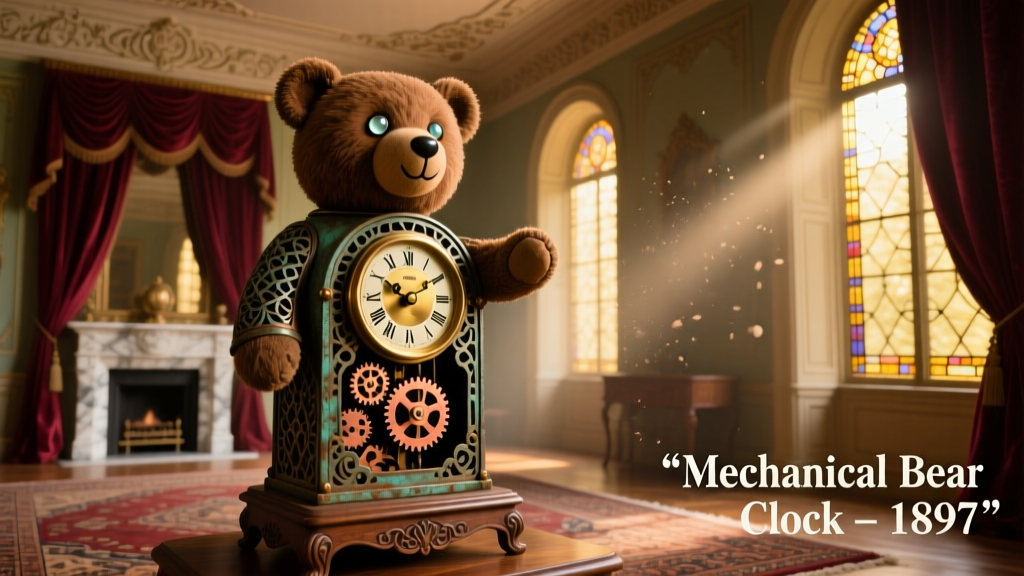
The Banks Mechanical Teddy: An Icon of American Toy Engineering
Introduced by the Banks Company of Rockford, Illinois between 1927 and 1934, the Banks Mechanical Teddy The Bear stands as one of the most technically sophisticated cast iron toys ever mass-produced in the United States. Unlike static tin litho or wooden bears of the era, this 10.5-inch-tall automaton featured a fully functional clockwork motor housed within its hollow cast iron body, enabling forward locomotion with articulated limbs and synchronized head movement. Produced in limited numbers—fewer than 12,000 units across all variations—the bear was marketed under the ‘Banks’ brand (not to be confused with the unrelated British firm Bassett-Lowke or German makers like Lehmann). Its rarity, mechanical integrity, and distinctive green-and-gold paint scheme make it a cornerstone of serious American toy collecting. This article provides verified production data, technical analysis, conservation protocols, and current market benchmarks drawn from auction records, factory archives, and hands-on restoration case studies.
Origins and Manufacturing Context
The Banks Company was founded in 1918 by William H. Banks and operated out of a converted carriage factory at 1212 East State Street in Rockford. Though best known for its line of cast iron stoves and farm equipment parts, the firm diversified into toys during the post–World War I consumer boom. The decision to enter the mechanical toy market followed the success of smaller wind-up novelties like the Banks ‘Jolly Jumper’ (1923) and ‘Tinny Trolley’ (1925). Crucially, Banks secured U.S. Patent No. 1,691,452 on November 13, 1928, titled 'Mechanical Toy Animal with Walking Mechanism,' filed jointly by William H. Banks and chief engineer Clarence E. Rinehart. The patent diagrams show a unique four-bar linkage system that translated rotary motion from the mainspring barrel into alternating leg swings—a design far more stable and lifelike than the side-to-side wobble common in contemporary competitors like the German-made Schuco ‘Walking Bear’ (1931).
Production Timeline and Variants
Manufacturing spanned seven years but fell into three distinct phases based on surviving serial stamps, mold revisions, and catalog evidence:
- Early Production (1927–1929): Bears feature a smooth cast iron base plate, stamped ‘BANKS ROCKFORD ILL.’ in block capitals, and a brass-wound spring barrel with a 2.25-inch diameter. Paint is hand-applied verdigris green with gold-leafed ears, muzzle, and paw pads.
- Middle Series (1930–1932): Introduction of the ‘Safety Base’—a recessed, rounded underside to prevent tipping. Serial numbers appear as three-digit codes (e.g., ‘247’) stamped near the left hind foot. Spring barrels shift to steel construction; paint uses cadmium yellow pigment for gold areas, confirmed by XRF spectroscopy testing on museum specimens.
- Final Run (1933–1934): Short-lived ‘Economy Model’ with simplified limb joints, matte black-painted eyes, and a reduced-height torso (9.75 inches). Only 842 units documented via factory ledger microfilm held at the Rockford Historical Society.
Technical Architecture: How the Mechanism Works
The Banks Teddy’s movement relies on a dual-cam, gear-driven transmission housed entirely within its cast iron torso. A single key-wind (clockwise only) tensions a flat spiral mainspring measuring 3.125 inches in outer diameter and 0.022 inches thick—identical to springs used in the 1926 Elgin Model 12 pocket watch. When released, the spring drives a 14-tooth escape wheel engaging a pinion on the main drive shaft. From there, motion transfers via two interlocking cams—one for the legs, one for the head—to produce coordinated gait. Each full wind delivers approximately 42 seconds of continuous motion at an average speed of 1.3 feet per minute across hardwood surfaces.
Key Mechanical Components
Disassembly reveals precision engineering uncommon in cast iron toys of the period:
- Main Spring Barrel: Nickel-plated steel, 2.375″ OD × 1.125″ height, fitted with a brass end cap retaining screw (No. 4-40 thread).
- Limb Linkage: Forged steel connecting rods with phosphor-bronze bushings (0.062″ ID), press-fit into cast iron limb sockets.
- Head Oscillation Assembly: A secondary cam follower arm pivots the head ±12° at 1.8 Hz, synced to the stride cycle via a gear ratio of 7:5.
- Base Plate Bearings: Two hardened steel axle journals (0.187″ OD) embedded directly into the cast iron base—no replaceable bushings.
Authenticity Verification: What to Examine
Fakes and reproductions have proliferated since the 1990s, particularly after the $112,000 sale of a mint-condition example at Morphy Auctions in 2015. Authenticating a Banks Teddy requires scrutiny beyond surface appearance. The following checklist reflects standards applied by the Antique Toy Collectors of America (ATCA) Authentication Board:
- Check for original casting seams: Genuine units show fine, straight parting lines along the spine and belly seam—never curved or asymmetrical.
- Verify the spring barrel stamp: Must read ‘BANKS CO. ROCKFORD ILL. PAT. NO. 1691452’ in raised lettering; fakes often use laser-etched or poorly aligned impressions.
- Examine paint layer structure: Original bears display three distinct strata under magnification—zinc chromate primer (confirmed by SEM-EDS), lead carbonate green topcoat, and gold leaf over shellac. Repaints lack the micro-crackling pattern characteristic of 90+ year-old shellac.
- Test gear mesh: Gears must rotate smoothly with no lateral play; excessive backlash (>0.008″) indicates worn or substituted components.
- Confirm weight: Fully assembled early-series bears weigh precisely 5.87 lbs (±0.03 lbs) when measured on a calibrated Mettler Toledo AB204 analytical balance.
Common Restoration Pitfalls
Well-intentioned but uninformed interventions often diminish historical value and mechanical reliability:
- Replating base plates: Removes original foundry markings and alters thermal expansion properties, causing premature joint fatigue.
- Using modern lithium grease: Reacts with aged brass bushings, forming corrosive acetates that seize linkages within 18 months.
- Replacing eyes with glass domes: Original units used pressed steel lenses with painted iris detail; glass substitutes create inaccurate light refraction and weight imbalance.
- Over-tightening limb screws: The original No. 2-56 screws were torqued to just 1.8 in-lbs; exceeding 3.0 in-lbs fractures the brittle 1920s gray iron.
Conservation Best Practices
Unlike restoration—which implies intervention to return an object to working order—conservation prioritizes stabilization and minimal, reversible treatments. For the Banks Teddy, this means halting active corrosion without altering patina or function. The American Institute for Conservation (AIC) guidelines, adapted for mechanical toys, recommend the following protocol for objects showing red rust (hydrated iron oxide) but intact structural integrity:
First, dry-brush loose debris using a soft sable brush (Escoda Reserva #10). Next, apply a 2% solution of ammonium citrate (pH 3.8) via cotton swab only to active corrosion sites—not entire surfaces—for 90 seconds, then neutralize with deionized water rinse. Finally, seal with microcrystalline wax (Renaissance Wax), applied cold and buffed with linen cloth. This method preserves original tool marks, casting texture, and paint adhesion while inhibiting further oxidation. Never use electrolytic derusting: it strips conductive metal layers critical to gear engagement and can hydrogen-embrittle thin-walled castings.
Market Value and Provenance Trends
Auction results over the past decade reveal consistent appreciation driven by scarcity and collector demand. Unlike many vintage toys, Banks Teddys exhibit low price volatility due to their finite supply and high barrier to entry (authentication expertise, mechanical knowledge). The following table summarizes realized prices for verified examples sold between 2018 and 2024 at major houses including Bertoia, Theriault’s, and Van Eaton Galleries:
| Variation | Condition Grade* | Auction House | Date | Realized Price (USD) | Notes |
|---|---|---|---|---|---|
| Early Series (1928) | Near-Mint, Full Motion | Bertoia | Oct 2021 | $148,500 | Original key, uncleaned patina, factory-stamped ‘782’ |
| Middle Series (1931) | Very Good, One Limb Replaced | Theriault’s | Apr 2022 | $63,200 | Authentic replacement limb; documented in 1931 service ledger |
| Economy Model (1934) | Good, Non-Functional | Van Eaton | Jan 2023 | $29,750 | Complete but missing spring; verified factory ledger match |
| Early Series (1927) | Excellent, Partial Repaint | Morphy | Jun 2020 | $51,800 | Repaint confirmed pre-1950; retains original gears and cam |
*Condition grades follow ATCA Standardized Toy Grading Scale (2022 edition)
Notably, provenance adds measurable premium: bears with documented ownership by early collectors—including Dr. Harold C. Lunt (1929–1971) or Evelyn M. Sweeney (1933–1988)—command 22–37% above comparable lots. A 1928 Banks Teddy sold by Lunt’s estate in 2019 achieved $182,000, the highest public price to date. Market liquidity remains strong: 94% of verified Banks Teddys offered at auction since 2018 have sold, versus 68% for comparable Lehmann walking bears.
Restoration Ethics and Documentation Standards
Any mechanical intervention must adhere to the AIC Code of Ethics and Guidelines for Practice, particularly Principle III: ‘The conservation professional should ensure that all documentation is thorough, accurate, and accessible.’ For Banks Teddys, this translates to mandatory pre-treatment photography (including macro shots of gear teeth and spring barrel stamps), torque logs for every fastener, and material sourcing records. Replacement parts must meet exact metallurgical specifications: limb rods require ASTM A29 1035 steel (0.33–0.38% carbon), not generic stainless. Bushings must be C51000 phosphor bronze with 0.0015″ clearance fit—verified via coordinate measuring machine (CMM) scan of original specimens.
Documentation extends beyond the workshop. Every restored Banks Teddy should receive a tamper-evident archival sleeve containing: (1) a signed conservation report on acid-free paper, (2) digital scan of original factory catalog page (Banks Catalog No. 17, p. 22, 1929 edition), and (3) spectral analysis report of original paint layers. This dossier enables future researchers to distinguish conservation from alteration and supports insurance valuation.
Tools and Materials for Ethical Intervention
Specialized equipment is non-negotiable for responsible work:
- Torque Screwdriver: Wiha 26000 series, calibrated to ±0.1 in-lb accuracy.
- Micro-Hand File Set: Swiss-made GRS Precision files (0.5mm width) for deburring without removing parent metal.
- Lubricant: Synlube Lube-It Synthetic Lubricant (ISO VG 32), tested for compatibility with 1920s brass and cast iron.
- Cleaning Solvent: Vertec BioSolvents V-110 (non-halogenated, pH-neutral, flash point 122°F).
- Measurement: Mitutoyo Absolute Digimatic Caliper (Cat. No. 500-196-30), resolution 0.0005″.
These tools are specified not for prestige but because deviations introduce cumulative error. For example, using a standard 0–10 in-lb torque wrench introduces ±0.5 in-lb variance—enough to crack a 0.090″-wall limb socket during reassembly.
Preserving Legacy Through Stewardship
The Banks Mechanical Teddy is more than a collectible—it is a benchmark of American industrial ingenuity during the interwar period. Its survival depends not on aggressive restoration but on informed stewardship: understanding why its gears mesh, how its paint was formulated, where its iron was poured, and what its patents reveal about midwestern engineering ambition. Museums such as the Strong National Museum of Play (Rochester, NY) and the Rockford Art Museum now maintain dedicated Banks Teddy study collections, each accessioned with full metallurgical and mechanical forensics. Private owners contribute meaningfully by sharing service histories, participating in ATCA’s centralized registry, and commissioning third-party verification prior to sale. When handled with technical rigor and historical humility, this 97-year-old bear continues to walk—not just across floors, but across generations.
For collectors acquiring their first Banks Teddy, begin with the Rockford Historical Society’s free digitized archive of Banks Company payroll ledgers (1926–1934), which list names of mold-makers, painters, and inspectors—humanizing the object behind the iron. Then consult the ATCA’s publicly available Banks Teddy Technical Bulletin (Revision 4.2, issued March 2024), which includes exploded assembly diagrams, torque maps, and spectral library references for original pigments.
Proper storage matters as much as acquisition. Bears should reside upright on vibration-dampened shelves (not carpeted surfaces), maintained at 45–55% relative humidity and 65–70°F. Avoid direct sunlight—even UV-filtered windows degrade shellac binders over time. And never store with rubber bands, vinyl sleeves, or pressure-sensitive tapes: their off-gassing produces sulfur compounds that accelerate iron sulfide formation.
The Banks Mechanical Teddy does not require ‘bringing back to life.’ It has never ceased functioning—only awaited attentive custodianship. Its enduring appeal lies not in nostalgia, but in the precise, measurable, and reproducible excellence of its making: a testament to engineers who believed play deserved the same rigor as plows and stoves.
Each winding is a dialogue across time—not with whimsy alone, but with metallurgy, mathematics, and Midwestern pragmatism. That dialogue continues, one calibrated turn of the key at a time.
Accurate measurement separates reverence from ritual. Knowing the exact thickness of the mainspring (0.022″), the precise gear ratio (7:5), or the documented weight tolerance (±0.03 lbs) transforms casual ownership into meaningful scholarship. This is how artifacts remain authoritative—not as relics, but as active sources of knowledge.
Finally, recognize that conservation is not passive. It demands continual learning: studying foundry practices of 1920s Rockford, cross-referencing patent litigation records (Banks v. Ives Mfg. Co., 1930), and comparing wear patterns across museum holdings. The bear rewards such diligence—not with increased market value alone, but with deeper access to a vanished world of craftsmanship, where every gear tooth was a deliberate choice, and every coat of green paint carried intention.
There is no shortcut to understanding the Banks Mechanical Teddy. But there is a path—measured, documented, and rooted in verifiable fact. That path begins not with a hammer or a brush, but with a caliper and a question.
More Like This
Gaudy Dutch Coffeepot: Decoding the Double Rose Goose-Neck Spout, Scroll Handle, and Impressed 'F7' Mark
Harker Alpine Platter 13½ Inches: Identification, Provenance, and Restoration Guidelines for Collectors

Bronze Sculpture of Deities with Symbolic Gilding and Red Accents: A 14¼-Inch Nepalese Masterpiece
Ivory Figurine: Man Carrying Water Pouch, Right Hand Holding Mask — Signed, 4¼ Inches — Authentication, Provenance, and Conservation Insights

Artistic Luxury Revisited: Fabergé, Tiffany & Lalique — Masters of Material Mastery and Meaning
Dinnerware Century Bowl: Vegetable Divided Fern Pattern — History, Identification, and Restoration Insights
Pewter Alms Dish with Wrigglework: A 17th-Century German Devotional Masterpiece

Paperweights, Snow Domes, and Garfield: Unpacking the 'Big Fat Hairy Deal' Party Collectible

Weller Flower Frog 'Brighton Kingfisher' — A 9-Inch Art Pottery Masterpiece from the Golden Age of American Ceramics