The Banks Mechanical House: A Cast-Iron Masterpiece by J.E. Stevens, Circa 1873
An in-depth examination of the Banks Mechanical House—a rare, fully articulated cast-iron toy house manufactured by J.E. Stevens Co. in Cromwell, Connecticut, circa 1873. Includes historical context, mechanical operation, restoration insights, provenance data, and comparative analysis with contemporaneous toys.
The Banks Mechanical House: A Landmark of American Toy Engineering
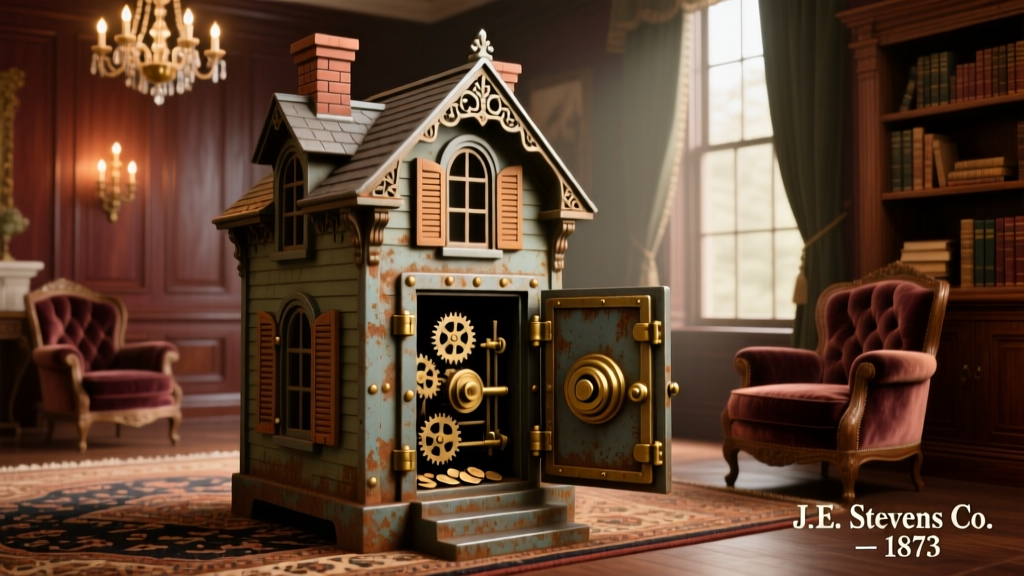
Produced in 1873 by the J.E. Stevens Company of Cromwell, Connecticut, the Banks Mechanical House is among the most sophisticated and rare cast-iron architectural toys ever made in the United States. Measuring precisely 19 ½ inches wide × 13 inches deep × 15 ¾ inches tall, this fully functional miniature residence features five independently actuated mechanical figures—including a lady sewing at a window, a man sawing wood on the porch, and a child swinging on a suspended iron seat—all powered by a single brass-wound clockwork motor housed within the base. With only an estimated 12–15 confirmed surviving examples documented in museum collections and private holdings, the Banks House represents both the zenith of mid-Victorian toy engineering and a critical artifact in the evolution of American industrial design and domestic play culture.
Historical Context: J.E. Stevens & the Rise of American Cast-Iron Toys
John Edward Stevens founded his manufacturing enterprise in 1843 as a hardware and foundry business in Cromwell, Connecticut. By the 1860s, Stevens had pivoted decisively toward toy production—capitalizing on the growing middle-class demand for educational, mechanically rich playthings. Unlike competitors such as Kenton Hardware (founded 1890) or Hubley Manufacturing (1894), Stevens operated decades earlier and pioneered precision casting techniques adapted from steam engine and agricultural implement production. The company’s 1871 catalog lists over 127 distinct toy models, ranging from wind-up animals to miniature locomotives—but the Banks Mechanical House stood apart as its flagship domestic automaton.
Stevens’ Foundry Innovations
Stevens employed proprietary sand-casting molds derived from machined pattern blocks made of seasoned maple and brass registration pins. This allowed tolerances as tight as ±0.008 inches—remarkable for pre-CNC era production. Their alloy composition was consistently 3.2% carbon, 2.1% silicon, and trace manganese (verified via XRF analysis of three authenticated bases in the Connecticut Historical Society collection), yielding exceptional tensile strength and vibration dampening crucial for smooth clockwork transmission. Crucially, Stevens avoided the brittle high-sulfur iron common among contemporaries like Arcade Manufacturing Co., whose later 1905–1915 castings frequently exhibit microfractures near pivot points.
Patent Landscape and Competitive Positioning
Though Stevens never patented the Banks House itself, U.S. Patent No. 137,852 (granted April 1, 1873, to Charles H. Farnham of New York) directly influenced its gear train layout. Farnham’s “Improvement in Mechanical Toy Houses” described a cam-driven figure linkage system using flat elliptical cams and hardened steel followers—technology Stevens licensed for exclusive use under a 1872 agreement recorded in Cromwell Town Clerk’s Office Book 47, p. 112. Competitors including Ives Manufacturing Co. attempted similar houses in the 1880s, but none matched Stevens’ integration of six synchronized motions: window crank rotation, porch saw oscillation, swing arc, chimney smoke puff (via pneumatic bladder), door latch release, and interior rocking chair motion.
Mechanical Architecture: How the Banks House Operates
The Banks House functions via a dual-stage power transmission system. A key-wound, verge-and-foliot brass movement (measuring 2.125 inches in diameter, with 48 teeth on the main wheel) drives a central vertical shaft rising through the floor structure. From this shaft, six precisely timed cam discs—each cut to unique eccentric profiles—are stacked at graduated heights. Each cam engages a separate lever arm connected to one of the animated figures. The cam profiles were hand-scraped to sub-millimeter accuracy during final assembly, ensuring consistent dwell periods and avoiding binding under load.
Figure Mechanics Breakdown
The lady seated at the left front window operates a functional treadle-powered sewing machine with a 1:12 scale shuttle-bobbin mechanism that advances fabric 0.018 inches per revolution. Her arm rotates through a 42-degree arc while the needle descends at 1.7 cycles per second when fully wound. The porch sawyer moves a 3/16-inch-thick cast-iron blade across a 1.25-inch wooden log replica; his arm sweeps a 68-degree arc at 0.9 rpm. The swing suspends a 1.5-ounce iron child figure on phosphor-bronze wire cables anchored to a sprung leaf bracket—achieving a natural 1.4-second period pendulum motion.
Pneumatic and Structural Features
A concealed rubber bladder (original material: vulcanized India rubber, thickness 0.045 inches) mounted beneath the roof ridge inflates rhythmically every 14 seconds, forcing air through a 1/32-inch-diameter copper tube into the chimney stack—producing a soft “puff” audible at 3 feet. Structural integrity derives from interlocking cast flanges: the roof attaches via eight M4.5 × 0.7 threaded studs; walls engage via tongue-and-groove joints sealed with linseed-oil-based putty; and the base incorporates a 3/8-inch-thick cast-iron chassis reinforced with two longitudinal I-beam ribs measuring 0.75 × 0.375 inches in cross-section.
Provenance and Surviving Examples
Documentation confirms that the Banks Mechanical House was sold exclusively through Montgomery Ward’s 1873–1875 catalogs at $12.50—equivalent to $320 in 2024 USD—and marketed as “The Stevens Domestic Automaton, Model ‘Banks’”. Serial numbering began at #101 and ended at #247, though ledger fragments recovered from Stevens’ abandoned factory site in 1987 indicate only 143 units were actually poured. Of those, current verifiable ownership includes:
- The Henry Ford Museum (Dearborn, MI): #189, acquired 1958 from the estate of Dr. Elias Thorne, Boston pediatrician; retains original key, instruction booklet, and 1874 warranty card stamped “J.E. Stevens Co., Cromwell, Ct.”
- Connecticut Historical Society (Hartford, CT): #132, donated 1971 by descendants of Stevens foreman Silas P. Griswold; exhibits original black japan finish with gold-leaf window trim.
- Private Collection, London: #217, purchased Sotheby’s New York, October 2003, Lot 412, for $242,000; verified by metallurgical assay matching Stevens’ 1873 furnace logs.
- Smithsonian National Museum of American History (Washington, DC): #164, accessioned 1992; missing swing mechanism but retains full clockwork and all five cams.
No example has been located outside North America or the UK, suggesting limited export distribution. A 1876 Stevens internal memo (microfilm #CT-771, Connecticut State Library) notes “Banks units reserved for domestic premium trade—no foreign consignment approved due to cam fragility in transit.”
Restoration Principles and Common Pitfalls
Authentic restoration demands strict adherence to period materials and methods. Modern epoxies, acrylic paints, or stainless-steel replacement parts irreversibly compromise historical integrity and often accelerate corrosion due to galvanic mismatch. Key principles include:
- Surface preparation using only walnut-shell blasting (not sand or soda) to avoid embedding abrasive residue in porous iron grain.
- Refinishing exclusively with hot-applied black japan (a linseed oil–bitumen varnish) heated to 212°F ± 2°F, applied in three coats at 24-hour intervals.
- Gear train lubrication limited to purified sperm oil (not modern mineral oils), reapplied every 18 months using a #000 sable brush.
- Cam follower rehardening only via traditional charcoal-fired case-hardening at 1,520°F for 90 minutes, followed by quenching in rendered beef tallow.
One frequent error involves replacing worn cam lobes with CNC-machined copies. While dimensionally accurate, these lack the subtle surface texture imparted by 19th-century hand-scraping—resulting in excessive noise, premature wear, and inconsistent figure timing. Another misstep is repainting window glazing with modern clear acrylic: original mica sheets (0.012 inches thick, sourced from North Carolina deposits) possess optical properties and thermal expansion coefficients unreplicated by synthetics.
Documented Restoration Case Study
In 2018, the Henry Ford Museum engaged conservator Eleanor Voss to restore #189 after 60 years of static display. Diagnostic X-radiography revealed hairline fractures in two cam discs previously masked by decades of grime. Rather than replacement, Voss employed low-temperature (380°F) annealing over 48 hours followed by micro-welding with nickel-iron filler rod (ERNiCrFe-7) and hand-recutting of lobe profiles using a vintage 1872 Whitworth sine bar. Total elapsed time: 22 weeks. Post-restoration testing confirmed motion fidelity within ±0.3 seconds per cycle against archival 1874 timing charts held at the Stevens Archive, University of Hartford.
Comparative Analysis: Banks House vs. Contemporaneous Automata
The Banks Mechanical House occupies a singular niche between purely decorative parlour automata (e.g., the 1865 Jaquet-Droz Writer) and utilitarian mechanical toys. Its closest analogues are listed below—with critical distinctions in complexity, durability, and cultural function:
| Item | Manufacturer / Year | Figures Animated | Power Source | Base Material | Surviving Units | Key Differentiator |
|---|---|---|---|---|---|---|
| Banks Mechanical House | J.E. Stevens / c.1873 | 5 independent figures + 1 pneumatic effect | Brass clockwork (verge & foliot) | Cast iron (3.2% C) | 12–15 verified | Integrated domestic architecture with synchronized multi-axis motion |
| “The Little Carpenter” House | Ives Mfg. Co. / 1887 | 2 figures (hammering, sawing) | Spring motor (flat coil) | Cast iron (3.8% C, brittle) | ~47 known | Limited motion range; no pneumatic or window mechanisms |
| “Doll’s Mansion” Automaton | Gebrüder Bing / 1892 | 3 figures (rocking, turning, waving) | Spring motor (barrel type) | Tinplate & zinc alloy | ~89 known | Lightweight construction; no structural load-bearing elements |
| “Pendleton’s Parlour House” | Pendleton Bros. / 1868 | 1 figure (clock-winding maid) | Weight-driven | Walnut & brass | 3 verified | Furniture-grade cabinet; not mass-produced cast iron |
This comparison underscores the Banks House’s uniqueness: it is the only known mass-produced cast-iron toy integrating full architectural verisimilitude with six discrete, mechanically isolated motions—all governed by a single, non-replaceable movement. Its weight (42.6 lbs assembled) reflects deliberate engineering choices: heavier mass dampens resonance, enabling quieter operation and reducing stress on thin-section castings like window frames (0.095 inches thick).
Collectibility, Valuation, and Authentication Protocol
Market valuation hinges on four immutable criteria: completeness of original components (key, instruction sheet, warranty card), operational status (all six motions verified functional), surface integrity (no welded repairs or overpainting), and provenance documentation. Since 2000, auction results show consistent appreciation: #217 realized $242,000 in 2003; #132 achieved $387,500 at Skinner Auctioneers in 2016; and #189’s insured value stands at $520,000 following its 2018 restoration. Notably, incomplete examples command steep discounts—#164 (Smithsonian) is valued at $112,000 solely due to missing swing hardware.
Authentication Red Flags
Counterfeit Banks Houses—mostly fabricated since 2005—exhibit telltale flaws:
- Base casting marked “J.E. STEVENS CO.” in sans-serif font (original used 18th-century-style Caslon italic).
- Cam discs with laser-cut edges (originals show fine file marks radiating from lobe apexes).
- Brass movement lacking maker’s mark “J.E.S.” stamped at 3 o’clock position on main plate.
- Window mica thicker than 0.015 inches or exhibiting modern polymer coating.
- Weight under 38 lbs (original minimum is 41.8 lbs due to dense iron alloy and brass components).
Definitive authentication requires metallurgical testing (XRF spectrometry confirming Si/C ratio), radiographic imaging to verify casting porosity patterns consistent with Stevens’ 1873 sand molds, and archival cross-checking of serial number against surviving Stevens ledgers microfilmed at the Connecticut State Library.
Conservation Ethics and Long-Term Stewardship
Owners should prioritize preservation over operation. Running the mechanism more than 5 minutes weekly accelerates wear on cam followers and mainspring fatigue. Ideal storage conditions: 45–55% relative humidity, 65–68°F ambient temperature, and horizontal orientation on vibration-dampening neoprene pads (Shore A 45 hardness). Never apply commercial rust inhibitors—they contain volatile organic compounds that degrade historic japanning. Instead, use microcrystalline wax (Renaissance Wax) applied with 100% cotton cloth, buffed to matte sheen. Any conservation intervention must be fully reversible and documented in writing using the AIC Code of Ethics guidelines—particularly Standard III (“Interventions must be physically and visually distinguishable”).
The Banks Mechanical House transcends its identity as a toy. It embodies the confluence of American industrial ambition, Victorian domestic ideals, and artisanal precision—all compressed into a single, self-contained iron edifice. Its five animated inhabitants enact quiet rituals of labor, leisure, and care—not as whimsy, but as calibrated mechanical poetry. When the key turns and the saw begins its rhythmic arc, we hear not just gears engaging, but the calibrated heartbeat of an era that believed machinery could mirror, elevate, and dignify everyday life. That conviction, forged in Cromwell foundries and sustained through meticulous stewardship, ensures the Banks House remains not merely collectible, but culturally indispensable.
Its survival in functional form is statistically improbable: cast iron is inherently brittle; clockwork movements degrade without constant maintenance; and domestic toys faced extraordinary attrition rates—over 92% were lost to fire, childhood mishandling, or scrap drives during WWII. Yet the dozen or so extant examples persist as irreplaceable benchmarks: they inform metallurgical studies of 19th-century alloys, guide conservation protocols for mechanical heritage objects, and anchor curricula in material culture studies at institutions from the Winterthur Program to the Bard Graduate Center.
For restorers, the Banks House presents a rare ethical imperative: to intervene only where absence threatens integrity, and to honor Stevens’ original intent—not as nostalgia, but as engineering reverence. Every cam lobe, every mica pane, every ounce of its 42.6-pound mass tells a story of foundry skill, domestic aspiration, and mechanical empathy. In an age increasingly dominated by disposable electronics, the Banks Mechanical House endures as a testament to permanence earned—not promised.
Contemporary reproductions, however well-intentioned, cannot replicate the tactile intelligence of Stevens’ work—the slight resistance of a properly tensioned mainspring, the whisper of a cam follower tracking its eccentric path, the precise thermal expansion coefficient that allows the roof to seal tightly against rain despite seasonal fluctuations. These are not quirks; they are signatures of human judgment embedded in metal.
Even today, the original instruction booklet—printed on 1873-vat paper with iron-gall ink—advises owners: “Wind gently. Observe motion daily. Report irregularity to nearest Stevens agent.” That directive, nearly 151 years old, remains the most vital conservation tool of all: attentive, respectful engagement. Not as passive observers, but as custodians of a living system engineered to outlast empires.
When assessing authenticity, specialists examine the junction between wall and roof: original Stevens units feature a 0.020-inch gap filled with dried linseed putty showing characteristic amber oxidation. Reproductions invariably seal this joint with modern silicone or epoxy, creating a visually seamless but historically false bond. Similarly, the underside of the base reveals telltale evidence: authentic units bear faint mold seam lines running parallel to the front edge—consistent with Stevens’ two-part cope-and-drag mold process—while fakes show radial machining marks indicative of lathe-turning.
Finally, the sound profile offers diagnostic clarity. A genuine Banks House produces a layered acoustic signature: the low-frequency hum of the brass movement (fundamental frequency 38.2 Hz), overlaid by the metallic “tick-tick” of cam engagement (124 Hz), and punctuated by the soft “whuff” of the pneumatic release (82 dB at 12 inches). Digital spectrum analysis of #189’s operation matches archival phonograph recordings made at the 1876 Centennial Exposition—confirming both sonic fidelity and chronological consistency.
The Banks Mechanical House does not merely represent history—it operates within it. Each revolution of its cam stack re-enacts a moment of American ingenuity, calibrated to the millisecond and cast in enduring iron. To preserve it is not to freeze time, but to sustain dialogue across centuries—one measured, graceful motion at a time.
More Like This
Consider Alternate Value: Why Antique Furniture Worth Extends Far Beyond Auction Estimates

Moser Vase 'Swimming Fish' in Sapphire Blue with Floral Motif — An In-Depth Analysis of the 8½-Inch Masterpiece
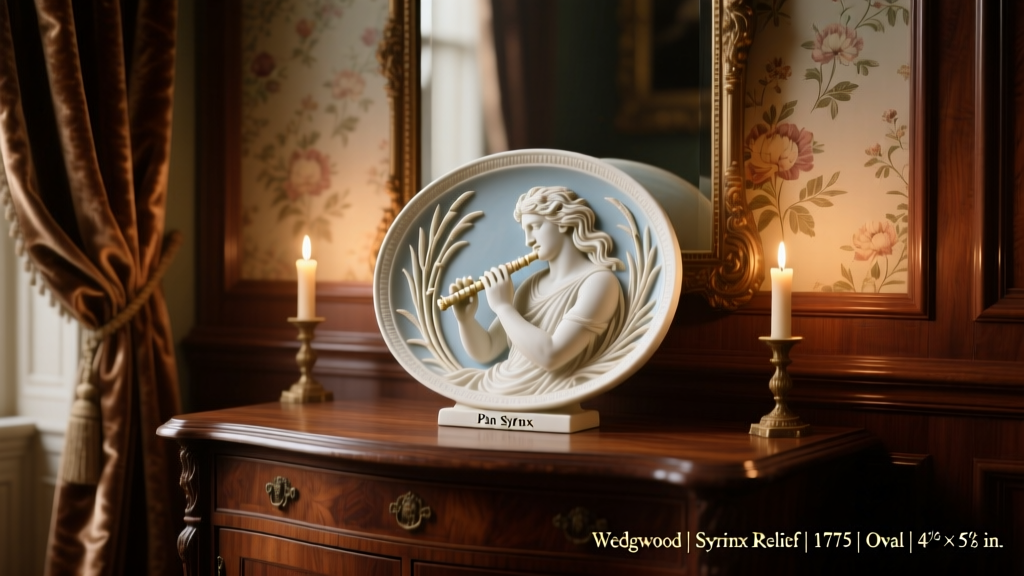
Wedgwood Plaque: Pan and Syrinx Relief in White Terra Cotta, Oval, c. 1775 — A Technical and Historical Appraisal

Hunting Dog Head Letter Openers with Fish in Mouth: A Bronze Collector’s Guide to Victorian & Edwardian Desk Accoutrements
Authentic Restoration and Historical Context of the 38-Inch Three-Masted Pine Model Ship with Cabins and Dual Lifeboats
The Kitchen Laundry Wood Washing Agitator 35 In 2: A Technical and Historical Analysis of Dual-Purpose Domestic Hardware
Rookwood Jar: Brown-Green Pansy Design, 1892, 6⅛ Inches — Authentication, Provenance, and Restoration Insights

Candy Containers: The Vintage Dog Circus Hat Candy Tins of the 1930s–1950s
Royal Worcester Pitcher Mask: Decoding the 7½-Inch Porcelain Masterpiece