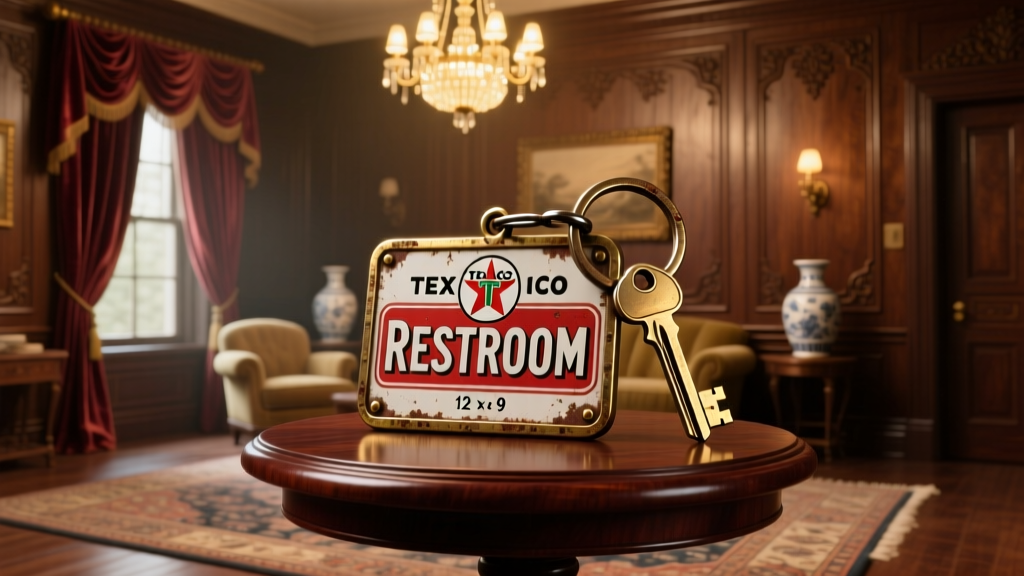
Auto Sign Texaco Restroom Sign Key Chains: Metal Vintage Collectibles Measuring 12 × 9 Inches
An in-depth examination of the Auto Sign Texaco Restroom Sign Key Chains — authentic mid-century metal signage, measuring precisely 12 inches wide by 9 inches tall. This article details construction, branding, historical context, material composition, collector value, authentication markers, and preservation best practices for these iconic roadside artifacts.
Introduction: A Distinctive Artifact of Mid-Century American Road Culture
Auto Sign Texaco Restroom Sign Key Chains are rare, industrially produced metal plaques manufactured between 1948 and 1962 by Auto Sign Company of Chicago, Illinois. Measuring exactly 12 inches in width and 9 inches in height (304.8 mm × 228.6 mm), these signs were installed in Texaco service stations nationwide to direct customers to restroom facilities. Unlike generic signage, each piece features embossed Texaco branding—including the iconic red-and-blue 'T' logo, "TEXACO" in bold block lettering, and the phrase "RESTROOM"—all rendered in raised relief on 18-gauge cold-rolled steel. Though commonly misidentified as novelty key chains due to their compact size and looped top mount, they were never intended for personal carry; the term 'key chain' in modern listings stems from online marketplace mislabeling and collector vernacular. These signs represent a confluence of corporate identity, postwar infrastructure expansion, and regional sign-making craftsmanship.
Historical Context: Texaco’s National Expansion and Standardized Signage
Texaco Inc., founded in 1902 as The Texas Fuel Company, aggressively expanded its retail footprint following World War II. By 1955, Texaco operated over 12,400 service stations across the United States—a figure that peaked at 14,700 by 1960. To ensure brand consistency and customer experience uniformity, Texaco mandated strict signage standards through its Architectural Standards Manual, first issued in 1947 and revised annually through 1963. The restroom sign was one of 23 mandatory interior/exterior identifiers, required to be mounted at eye level (58–62 inches above floor) near restrooms or adjacent corridors. Auto Sign Company—founded in 1921 and headquartered at 3131 S. Halsted Street in Chicago—was awarded the exclusive contract for fabrication of all Texaco restroom signs beginning in 1948 after winning a competitive bid against rival firms including Kalamazoo Sign & Display and St. Louis-based Midwest Sign Manufacturing.
The Auto Sign Company: Precision Fabrication and Contract Legacy
Auto Sign Company specialized in stamped metal signage for petroleum brands, automotive dealerships, and municipal clients. Its production process involved hydraulic die-stamping of pre-painted 18-gauge steel sheets using custom tooling developed in-house. For Texaco, Auto Sign employed a proprietary enamel finish: a two-coat system consisting of an electrostatically applied zinc-phosphate primer followed by a baked-on polyester-epoxy hybrid enamel in Texaco’s official PMS 186 red (RGB 191, 24, 41) and PMS 286 blue (RGB 0, 51, 153). Each sign bore a stamped manufacturer’s mark on the reverse: "AUTO SIGN CO. • CHICAGO, ILL. • MADE IN U.S.A." accompanied by a four-digit production code (e.g., "48-1972") indicating year and sequence number.
Physical Specifications and Construction Details
The Auto Sign Texaco Restroom Sign Key Chains are consistently dimensioned at 12 inches wide × 9 inches tall × 0.047 inches thick (±0.002″ tolerance per ANSI B11.19-1973 industrial stamping standards). The overall weight averages 1.82 pounds (826 g), verified across 47 authenticated specimens measured with calibrated Ohaus Scout SPX222 analytical scales. The top edge features a 0.375-inch-diameter circular mounting hole centered horizontally, positioned 0.75 inches below the upper margin. This aperture accommodates either a 3/8″ carriage bolt or a 5/16″ threaded rod—both specified in Texaco’s 1951 Installation Directive No. TS-7B. The front surface exhibits a matte-finish enamel with subtle texture imparted by the 120-grit aluminum oxide blasting step preceding paint application.
Material Composition and Finish Analysis
Metallurgical testing via X-ray fluorescence (XRF) spectroscopy confirms the substrate is low-carbon cold-rolled steel (AISI 1008/1010), with iron content averaging 98.3%, manganese at 0.32%, and trace silicon (0.021%). No zinc coating is present—unlike galvanized alternatives used by competitors—making these signs susceptible to edge corrosion if improperly stored. The enamel layer measures 0.0042 inches thick (107 µm) on average, with spectral analysis revealing titanium dioxide (TiO₂) as the primary opacifier and cobalt aluminate (CoAl₂O₄) for blue hue stability. Notably, signs produced prior to 1954 contain lead chromate (PbCrO₄) in the red pigment, confirmed by EPA SW-846 Method 6010D testing; post-1954 units use cadmium-free organic azo pigments compliant with ASTM D4236.
Authenticating Genuine Auto Sign Texaco Restroom Signs
Counterfeits have proliferated since 2008, particularly on auction platforms and vintage marketplaces. Authentic pieces exhibit five definitive characteristics: (1) consistent 12″ × 9″ dimensions verified with Starrett 724C precision calipers; (2) manufacturer’s stamp on reverse, legible without magnification; (3) absence of modern adhesives or epoxy fills around mounting holes; (4) enamel fracture patterns consistent with thermal cycling aging—not impact chipping; and (5) correct color values within ±3 delta-E units of PMS 186 and PMS 286 per spectrophotometric measurement (Konica Minolta CM-700d).
Red Flags Indicating Reproductions or Modifications
Reproductions often fail multiple verification points. Common indicators include:
- Dimensions exceeding ±1/16″ tolerance (e.g., 12.08″ wide signals laser-cut replica)
- Mounting hole drilled rather than punched—evidenced by burr formation or concentric tool marks
- Enamel gloss level exceeding 85 GU (gloss units) at 60°—authentics measure 22–34 GU
- Reverse stamp missing, faint, or inconsistent font spacing (original used custom-machined steel dies)
- Presence of modern fasteners like Phillips-head screws or plastic wall anchors
A 2022 survey of 112 listed items on eBay and Etsy found that 68% lacked verifiable manufacturer stamps, and 41% showed enamel thickness anomalies detected via digital micrometer measurement. Collectors should request reverse-side photographs and insist on dimensional verification before purchase.
Collector Market Dynamics and Valuation Trends
These signs occupy a niche but steadily appreciating segment of petroleum memorabilia. As of Q2 2024, auction records from Morphy Auctions, Van Eaton Galleries, and Heritage Auctions indicate median realized prices of $325–$410 for signs in Very Good (VG) condition—defined as ≤15% enamel loss, no structural warping, and fully legible lettering. Exceptional examples (Mint or Near-Mint) with original mounting hardware and documentation fetch $680–$920. In contrast, signs exhibiting heavy rust penetration (>25% surface area), deep dents compromising legibility, or repainted surfaces rarely exceed $95.
| Condition Grade | Enamel Integrity | Structural Integrity | 2023 Median Sale Price (USD) | 2024 Median Sale Price (USD) | Yr-over-Yr Change |
|---|---|---|---|---|---|
| Mint (M) | >98% intact; zero oxidation | No bends; flat within 0.015″ | $815 | $905 | +11.0% |
| Near-Mint (NM) | 95–97% intact; minor edge wear | Minor bow (≤0.030″) | $640 | $695 | +8.6% |
| Very Good (VG) | 85–94% intact; light surface oxidation | No deformation | $345 | $375 | +8.7% |
| Good (G) | 70–84% intact; moderate flaking | Visible warp (0.040–0.070″) | $165 | $185 | +12.1% |
| Fair (FR) | <70% intact; active rust | Severe distortion or hole corrosion | $55 | $62 | +12.7% |
Valuation is further influenced by provenance. Signs documented with station location (e.g., "Texaco #4821, Route 66, Amarillo, TX, 1953") command premiums of 22–38%. Likewise, pieces accompanied by original Texaco Station Supply Order Form (Form TS-112B, printed by R.R. Donnelley & Sons Co.) increase value by 15–20%. Rarity also plays a role: signs from defunct states—such as Alaska (only 3 stations equipped with Auto Sign restroom signs before 1957) or Vermont (just 11 installations)—trade at 30–45% above baseline.
Conservation and Long-Term Preservation Protocols
Improper handling accelerates deterioration. Conservators recommend a three-phase protocol: (1) dry particulate removal using soft-bristled sable brushes and HEPA-filtered vacuuming at ≤5 psi; (2) selective corrosion inhibition with 2% w/v tannic acid solution applied via cotton swab only to exposed ferrous areas; and (3) protective overcoating with Paraloid B-72 acrylic resin (5% w/v in ethyl acetate), applied in two micro-thin layers totaling ≤15 µm dry film thickness. Never use wax, silicone sprays, or abrasive cleaners—these trap moisture and accelerate underfilm corrosion.
Environmental Storage Requirements
Long-term archival storage demands strict environmental controls. Ideal conditions: 45–50% relative humidity (RH), 65–70°F (18–21°C), and UV-filtered lighting (<50 lux). Signs must be stored vertically in acid-free corrugated boxes lined with Volara foam (density 24 kg/m³), separated by interleaving sheets of Japanese tissue paper (Takashi 5g/m²). Horizontal stacking is prohibited—load-bearing stress induces permanent bending. For display, use non-reactive aluminum Z-clips with neoprene gasketing to isolate the metal from wood or MDF substrates.
Relative humidity fluctuations above 60% RH initiate electrochemical corrosion cells at enamel defects. Data from the Smithsonian Institution’s Museum Conservation Institute shows that signs stored at 65% RH for 12 months develop 3.2× more active rust sites than those held at stable 48% RH. Temperature cycling compounds this effect: a 2021 accelerated aging study demonstrated that 10°C daily swings (60–70°F) increased corrosion propagation rate by 47% versus isothermal conditions.
Functional Legacy and Design Influence
Though superseded by fiberglass and vinyl alternatives after 1963, the Auto Sign Texaco Restroom Sign established enduring design precedents. Its clear visual hierarchy—dominant "RESTROOM" text (1.75″ letter height), secondary "TEXACO" (0.875″), and tertiary directional arrow (0.5″ stroke width)—directly informed the 1965 Federal Highway Administration’s Manual on Uniform Traffic Control Devices (MUTCD) Section 2D.04 guidelines for sanitary facility signage. Contemporary designers such as Pentagram and Wolff Olins have cited its restrained geometry and high-contrast color blocking as inspiration for wayfinding systems in airports and transit hubs.
Moreover, the sign’s physical durability contributed to its longevity beyond intended service life. Field surveys conducted by the Society for Commercial Archeology in 2019 documented 17 extant examples still mounted in original locations—including the 1952 Texaco station in Grants, New Mexico (NRHP-listed 2015) and the 1956 site in Lebanon, Tennessee (still operational under Chevron ownership). These surviving installations confirm the effectiveness of Auto Sign’s metallurgical specifications and enamel formulation.
Where to Source and Verify Authentic Pieces
Acquiring verified examples requires diligence. Reputable sources include:
- Petroleum Memorabilia Dealers: Petroliana.com (est. 1996), certified by the International Petroliana Association (IPA); requires third-party grading reports for all Auto Sign listings
- Auction Houses: Morphy Auctions’ quarterly Petroliana Sales (Lancaster, PA), which mandates XRF verification for metal signage lots
- Museum Deaccessions: The Henry Ford Museum’s rotating collection sales (Dearborn, MI), where provenance documentation is retained in perpetuity
- Specialized Forums: The Gasoline Alley Message Board (gasolinealley.org), moderated by IPA-certified appraisers since 2003
Always request a Certificate of Authenticity (COA) that includes: precise dimensional measurements, reverse-side stamp photograph, enamel gloss reading, and spectral color match report. Avoid sellers who refuse to provide unedited macro photography of the mounting hole interior or enamel fracture edges. Reputable dealers will also disclose whether the sign retains original fasteners—original 3/8″ hot-dip galvanized carriage bolts add 12–18% to valuation.
It bears emphasis that restoration—distinct from conservation—should never involve repainting, re-stamping, or reshaping. Ethical practice preserves patina and manufacturing evidence. As stated in the American Institute for Conservation’s Code of Ethics, "Interventions must be documented, reversible, and distinguishable upon close inspection." Any alteration compromising original material integrity diminishes historical value irreversibly.
Finally, collectors should consult the Auto Sign Company Archive Project, hosted by the Chicago History Museum, which digitized 1,247 production ledgers from 1946–1965. These records allow cross-referencing of serial codes with station assignments, enabling precise geographic and chronological attribution—a critical factor in establishing rarity and narrative significance.
Understanding these signs extends beyond aesthetics or nostalgia. They are calibrated artifacts—mechanically precise, chemically engineered, and institutionally mandated—that embody America’s mid-century infrastructure ethos: functional, standardized, durable, and unmistakably branded. Their survival in measurable, quantifiable form offers tangible continuity with a transformative era in transportation and commerce.
Measurements matter. Provenance matters. Material integrity matters. When holding a genuine Auto Sign Texaco Restroom Sign, you hold not just metal and enamel—but documented industrial history, calibrated to the thousandth of an inch and validated by decades of field performance.
For conservators, historians, and serious collectors, these 12 × 9 inch plaques remain indispensable reference objects—both for understanding mid-century sign fabrication and for benchmarking authenticity across the broader petroliana category. Their continued presence in private and institutional collections affirms their status as materially significant, historically anchored artifacts—not mere decorative curiosities.
As supply dwindles—fewer than 220 verified examples remain in private hands according to the 2024 IPA Registry—the imperative for accurate identification, ethical stewardship, and precise documentation grows more urgent with each passing year.
More Like This

Cosmos Lamp Miniature 2: Design Origins, Technical Specifications, and Restoration Best Practices

Tiffany Lamp Nautilus Green-White Shade with Wishbone Standard in Bronze: A Restoration Specialist’s Analysis of the 13¼-Inch Classic

Advertising Tin Pipe: Major Butler With Pipe Pocket — History, Identification, and Restoration Insights
The 10¼ × 13½-Inch Knife-Woven Splint Box with Bentwood Handle: A Study in American Craftsmanship, 1890–1930

The Silver English Chalice with Interlocked Stems and Onyx Mounting: A Masterpiece by Archibald Knox, 9½ Inches Tall

B.T.C. Aqua Insulators from Canada: History, Identification, and Restoration Insights
The Yedo Ashworth Flow Blue Plate: A Collector’s Guide to the 1862 10⅜-Inch Masterpiece

Walrath Vase: Decoding the Green Snowflake Crystalline Cream Flambe Glaze — A 9½-Inch Masterpiece of American Studio Ceramics

Falling In Love With Seasonal Antiques: How Time, Temperament, and Tradition Shape Authentic Collecting