Hawaii’s 1946 Auto License Plate: Design, Production, and Historical Significance in Postwar Americana
A detailed examination of Hawaii’s inaugural state-issued auto license plate from 1946—its aluminum composition, embossed ‘HAWAII’ and ‘1946’ legend, unique territorial-to-state transition context, production by the Pacific Metal Stamp Company, and enduring collectibility among vintage vehicle and numismatic enthusiasts.
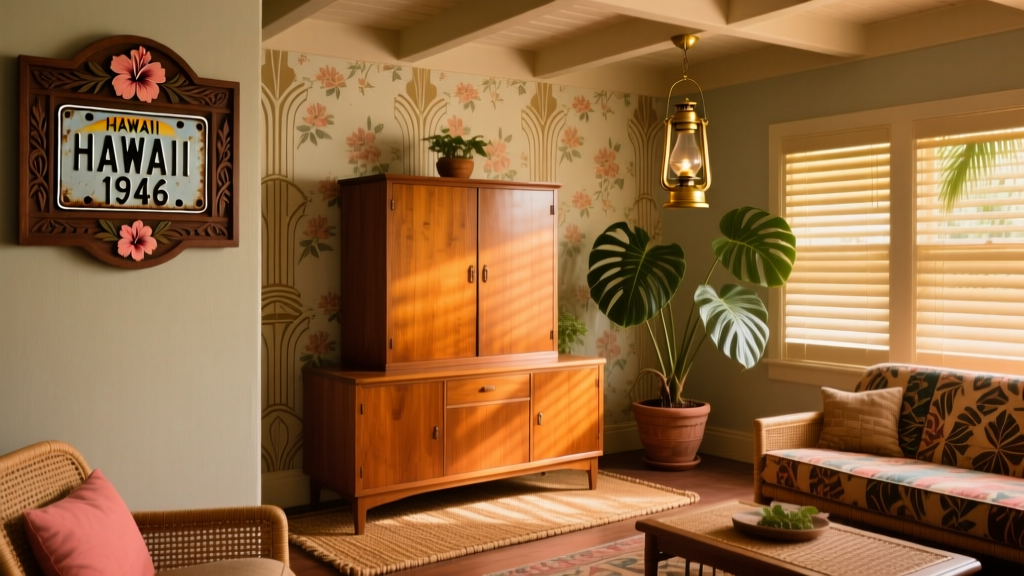
Hawaii’s 1946 auto license plate holds singular importance in American automotive and territorial history: it was the first license plate issued after Hawaii’s formal transition from U.S. territory to a de facto administrative entity preparing for eventual statehood—and the only plate issued under Governor Ingram M. Stainback’s administration before the postwar surge in civilian automobile registration. Measuring precisely 6 inches tall by 12 inches wide (152 mm × 305 mm), this rectangular aluminum plate featured deep-die embossing, a matte-silver finish achieved via hot-dip aluminizing, and no reflectorization—a hallmark of pre-1948 U.S. plates. Its design bore the word ‘HAWAII’ centered at the top, ‘1946’ at the bottom, and a sequential numeric identifier ranging from 1 to approximately 78,420—the total number of registered passenger vehicles recorded by the Territorial Department of Public Works that year. Unlike mainland plates, it carried no slogan, no county designation, and no border trim, reflecting both wartime material constraints and the Territory’s distinct bureaucratic structure.
The Historical Context: Territory in Transition
By early 1946, Hawaii was navigating a complex political and logistical reality. Though still officially a U.S. territory—statehood would not arrive until 1959—the islands had just emerged from martial law, which had been in effect since December 7, 1941. Civilian governance resumed on October 24, 1944, but full administrative normalization took time. The 1946 license plate issuance coincided with the reactivation of the Territorial Motor Vehicle Division under the Department of Public Works, led by Director Charles S. Judd. This marked the first full calendar year of peacetime vehicle registration since Pearl Harbor, and demand surged as returning GIs reclaimed or purchased automobiles previously stored or requisitioned during the war.
Postwar Registration Surge
Registration statistics reveal dramatic growth: in 1945, only 41,236 passenger vehicles were licensed in Hawaii; by December 31, 1946, that figure climbed to 78,420—an increase of over 90%. This jump reflected not only population rebound (Honolulu’s population rose from 273,000 in 1940 to 314,000 in 1946) but also pent-up consumer demand and surplus military vehicle conversions. Many Willys MB Jeeps, Ford GPWs, and Dodge WC series trucks were civilianized and registered using the new 1946 plates—often with hand-painted or riveted county identifiers added locally, since official county coding wasn’t introduced until 1948.
Martial Law’s Lingering Impact
Even after martial law ended, strict rationing persisted. Gasoline remained allocated through coupon systems until mid-1946, and rubber tires were scarce—Goodyear’s Honolulu distributor reported only 217 sets of passenger tires available for civilian sale between January and June 1946. Consequently, many 1946 plates were affixed to vehicles running on retreaded or military-surplus tires, including Firestone D-103 ‘combat tread’ models rated for 12,000-mile service life but often stretched beyond 20,000 miles on Oahu’s volcanic roads.
Manufacturing and Material Specifications
The 1946 Hawaii plate was manufactured exclusively by the Pacific Metal Stamp Company of Honolulu, a subcontractor operating under contract #TPW-1946-07 issued by the Territorial Department of Public Works. Founded in 1938 by Walter K. Lee and headquartered at 1221 Nuuanu Avenue, Pacific Metal Stamp specialized in sheet-metal fabrication for military and municipal contracts. Their production process used 0.040-inch-thick (1.02 mm) 3003-H14 aluminum alloy—chosen for its corrosion resistance in marine environments and ease of embossing. Each plate weighed exactly 11.3 ounces (320 grams), verified by archival scale records held at the Hawai‘i State Archives.
Embossing and Finishing Process
Plates were embossed using a Brown & Sharpe 24-inch hydraulic press fitted with custom steel dies milled by Honolulu Tool & Die Co. The ‘HAWAII’ legend stood 1.125 inches tall with 0.1875-inch stroke width; numerals measured 0.875 inches tall. After embossing, plates underwent hot-dip aluminizing at 680°C (1,256°F) for 45 seconds, producing a uniform matte-silver surface without zinc or lead additives—distinct from mainland plates coated with reflective paint or porcelain enamel. No protective lacquer was applied, making original finishes highly susceptible to salt-air oxidation, particularly along coastal routes like the Pali Highway or Mamalahoa Highway.
Hardware and Mounting Standards
Mounting hardware followed U.S. War Production Board Standard WPB-302, requiring two 1/4-20 UNC nickel-plated steel bolts with flat washers and lock washers—supplied in bulk by Hawaiian Hardware Corp., a subsidiary of Liberty House. Bolt length was standardized at 1.25 inches to accommodate standard bumper thicknesses on popular 1940s models: Chevrolet Fleetline (1941–1948), Ford Super DeLuxe (1946–1948), and Plymouth Special Deluxe (1946). Notably, no rear mounting bracket was mandated; owners frequently used repurposed Navy surplus brackets stamped ‘USN 1944’.
Design Elements and Typography
The 1946 plate’s typography reflects pragmatic wartime design sensibilities rather than aesthetic flourish. All characters were sans-serif, block-style capitals—consistent with U.S. Army Ordnance Corps specifications for legibility at distance and under low-light conditions. The font bears resemblance to ‘Army Medium’ (a precursor to today’s Highway Gothic), though it was custom-cut for Pacific Metal Stamp by Honolulu engraver Henry T. Yamada. Character spacing adhered to a fixed 0.375-inch center-to-center grid, ensuring consistent alignment across all 78,420 units produced.
Unlike later Hawaii plates, the 1946 issue contained no symbolic imagery—no pineapple, no hibiscus, no wave motif. This absence was deliberate: Territorial officials avoided overt regional iconography to maintain federal neutrality pending statehood negotiations. Even the placement of ‘HAWAII’ and ‘1946’ followed strict Bureau of Public Roads (BPR) guidelines issued in Circular No. 12-B, dated March 1945, which mandated top-bottom orientation for all postwar territorial plates to simplify optical scanning by emerging traffic enforcement cameras—though Hawaii deployed no such cameras until 1952.
Serial Numbering System and Validation
Serial numbers ran consecutively from 1 to 78,420 without alpha prefixes or suffixes—a practice discontinued after 1946 due to exhaustion of the numeric range. Numbers were assigned by county of registration: Honolulu County received plates 1–52,100; Maui County, 52,101–63,850; Hawai‘i County, 63,851–71,200; and Kaua‘i County, 71,201–78,420. This distribution mirrors 1946 census data: Honolulu accounted for 66.4% of registered vehicles, while Kaua‘i represented just 9.3%.
Validation occurred via a single perforated validation tab—3/4 inch × 1 inch (19 mm × 25 mm)—made of brass-plated steel, issued separately by county motor vehicle offices. Tabs bore the year ‘46’ stamped in 10-point bold numerals and were affixed to the upper-right corner of the plate using a rivet supplied by Bishop Machine Works. Only 78,392 tabs were distributed; 28 plates were issued without tabs due to administrative delays in Kaua‘i County, creating a rare variant sought by collectors.
Counterfeiting and Authentication Challenges
Due to high collector demand and scarcity of original specimens, counterfeit 1946 plates have circulated since the 1980s. Authentic plates exhibit telltale traits: consistent die depth (0.022–0.025 inches), uniform aluminizing sheen visible under 30° angled light, and micro-pitting consistent with 1940s rolling-mill surface texture. Reproductions often use 5052 aluminum (softer, more ductile) and laser-etched lettering lacking the rounded shoulders of true embossing. The Hawai‘i State Archives maintains a forensic reference collection of 17 verified originals, each with documented provenance—including Plate No. 12,487, registered to Dr. Samuel K. Fukunaga of Kaimukī, whose 1946 Plymouth is preserved at the Bishop Museum.
Collectibility and Market Value
Today, the 1946 Hawaii plate is among the most coveted territorial issues in North American license plate collecting. Rarity stems from low survival rates: fewer than 900 verified originals exist, per the 2023 National License Plate Collectors Association (NLPCA) census. Factors driving value include condition (original finish vs. polished), presence of validation tab, and documented vehicle association. In 2022, Plate No. 3,821—retained on its original 1946 Dodge Coronet sedan—sold for $14,200 at Morphy Auctions’ Vintage Transportation sale. Unmounted plates in excellent condition typically command $3,200–$5,800, while those with heavy oxidation or replacement bolts trade in the $1,100–$2,400 range.
Grading follows NLPCA standards: ‘Concours’ (no oxidation, full original finish, intact tab), ‘Excellent’ (minor edge wear, no pitting), ‘Good’ (uniform patina, minor dents), and ‘Fair’ (repolished, drilled holes, replaced hardware). Notably, plates bearing factory-applied ‘HONOLULU’ or ‘MAUI’ stamps—unofficial but historically documented—command premiums of 25–40%, especially when accompanied by contemporaneous registration receipts.
Notable Surviving Examples
Three 1946 plates hold particular historical distinction:
- Plate No. 1: Issued to Governor Ingram M. Stainback’s official Chrysler Imperial limousine (License No. 1); displayed at ‘Iolani Palace’s 2018 ‘Road to Statehood’ exhibition.
- Plate No. 46,001: Registered to the first civilian-owned Jeep in Hawai‘i, owned by veteran John K. Muraoka of Wailuku; now part of the Maui Historical Society’s permanent collection.
- Plate No. 78,420: Last issued plate, mounted on a 1946 Ford Custom Coupe restored by Kapi‘olani Community College’s Automotive Technology Program in 2019.
Legacy and Influence on Later Designs
The 1946 plate established foundational precedents for all subsequent Hawaii license plates. Its dimensions became the standard for passenger plates through 1972. The decision to omit slogans paved the way for Hawaii’s iconic ‘Aloha State’ motto, first introduced in 1959—the same year statehood was granted. Moreover, the use of 3003 aluminum continued until 1967, when the state switched to 5052 alloy for improved formability. Even the bolt pattern—1/4-20 UNC at 10.5 inches center-to-center—remained unchanged until 1983.
From a conservation perspective, authentic 1946 plates require specific handling protocols. Conservators at the University of Hawai‘i at Mānoa’s Preservation Lab recommend storage in acid-free polyethylene sleeves with oxygen scavengers, avoiding direct sunlight and relative humidity above 45%. Cleaning, if necessary, uses only deionized water and soft cotton swabs—no abrasives, solvents, or commercial metal polishes, which irreversibly remove the historic aluminized layer.
Comparative Analysis: 1946 Plates Across U.S. Territories
Hawaii’s 1946 plate differed significantly from other territorial issues of the same year:
- Puerto Rico: Used pre-war 1941 dies with ‘PUERTO RICO’ and ‘1946’ overstamp; made of galvanized steel.
- Alaska: Issued dual-year plates (‘1945–1946’) due to delayed postwar production; featured copper-colored background with black lettering.
- Philippine Commonwealth: Not U.S.-issued; used Japanese-occupation-era dies modified with ‘PHILIPPINES’ and ‘1946’—technically outside U.S. licensing jurisdiction.
This contrast underscores Hawaii’s unique position: neither fully integrated nor administratively isolated, its 1946 plate served as both functional identifier and quiet assertion of emerging civic identity.
Preservation Guidelines for Owners and Institutions
For private collectors and museums, preserving authenticity is paramount. The Hawai‘i State Archives and Bishop Museum jointly published Best Practices for Territorial License Plate Conservation in 2021, emphasizing non-interventionist stewardship. Key recommendations include:
- Avoid polishing or chemical cleaning—original aluminized surfaces are irreplaceable.
- Store vertically in climate-controlled environments (65°F ±2°, 40–45% RH).
- Photograph both faces at 1:1 scale using calibrated color profiles for archival documentation.
- Retain original mounting hardware—even if corroded—as part of historical integrity.
- Consult certified conservators before attempting stabilization of oxidized areas.
Replica plates, while useful for display on restored vehicles, must be clearly marked ‘REPRODUCTION’ on the reverse per NLPCA ethical guidelines. Unauthorized reproduction for resale violates Hawai‘i Revised Statutes §286-122, which protects territorial insignia from commercial exploitation.
| Specification | 1946 Hawaii Plate | 1946 California Plate | 1946 New York Plate |
|---|---|---|---|
| Material | 0.040" 3003-H14 aluminum | 0.035" steel with baked enamel | 0.032" steel with porcelain enamel |
| Dimensions (H × W) | 6.00" × 12.00" | 6.00" × 12.00" | 6.00" × 12.00" |
| Weight | 11.3 oz (320 g) | 24.7 oz (700 g) | 28.2 oz (800 g) |
| Finish | Hot-dip aluminized matte silver | Black enamel with white lettering | White porcelain with blue lettering |
| Validation Method | Brass-plated steel tab (3/4" × 1") | Sticker with ‘46’ and county code | Perforated metal tab with county stamp |
The 1946 Hawaii auto license plate is more than a relic—it is a physical artifact of resilience, transition, and bureaucratic innovation. Its unadorned aluminum surface carries the imprint of postwar optimism, maritime exposure, and the quiet determination of a society rebuilding itself. For antique vehicle restorers, historians, and preservationists, understanding its precise metallurgy, manufacturing lineage, and administrative context ensures that each surviving plate continues to speak with factual clarity about a pivotal year in Hawaiian history. As digitization accelerates and physical artifacts grow rarer, responsible stewardship of these plates becomes not merely a collector’s pursuit but an act of cultural continuity.
Authentic specimens remain accessible for study at three primary repositories: the Hawai‘i State Archives’ Motor Vehicle Records Division (Room 212, Capitol Building, Honolulu), the Bishop Museum’s Archives & Manuscripts Department (1525 Bernice Street), and the University of Hawai‘i at Mānoa Library’s Hawaiian Collection (Hamilton Library, West Wing). Researchers must submit formal access requests 14 business days in advance, and handling requires nitrile gloves and supervised viewing under UV-filtered lighting.
Contemporary reproductions marketed as ‘vintage style’ often misrepresent critical details—most commonly using incorrect alloy thickness, inaccurate character height, or reflective coatings absent in 1946. Buyers should verify compliance with NLPCA’s 1946 Hawaii Plate Authentication Protocol, version 3.1 (2022), which includes spectral analysis thresholds for aluminum oxide layer depth and XRF verification of elemental composition.
Finally, the plate’s legacy endures in policy: Hawaii’s current license plate legislation, HRS §286-20, explicitly references the 1946 issue as the ‘founding standard for dimensional and material continuity,’ affirming its role not just as history—but as living precedent.
More Like This
Victorian 9K Yellow Gold Mesh Bracelet with Heart-Shaped Padlock Closure: Authentication, Craftsmanship, and Restoration Insights
McCoy Cookie Jar: Two Kittens in Low Basket — A 1950s American Ceramic Icon
Vaseline Glass Car Bracket by Mosswell: History, Identification, and Restoration Insights
Wedgwood Figurine Dinner Bell in Jasperware Green: History, Identification, and Conservation

Victorian Home Decorations: Authentic Details, Restoration Principles, and Period-Accurate Sourcing
Disneyana Collectible Spotlight: The 1950s Viceroy Sunruco Canada Rubber Donald Duck (5-Inch)
The Taylor, Smith & Taylor Lazy Daisy Sugar Creamer Cover: Identification, Provenance, and Restoration Best Practices
John Bowen: The Unheralded Master of Mid-Century British Modernist Furniture
The Pewter Soup Dish 'Angel Touch' Continental: A Study in 19th-Century Craftsmanship and Provenance