Attleboro Chain Co: Precision, Patina, and the Legacy of American Industrial Craftsmanship
A detailed exploration of Attleboro Chain Co.—a pioneering U.S. manufacturer of decorative and functional metal chains from 1892 to 1974—covering its origins in Attleboro, Massachusetts, hallmark designs like the 'Bridal Link' and 'Rope Chain', metallurgical innovations, restoration challenges for antique chain jewelry and furniture hardware, and verified production data from factory ledgers and trade catalogs.
Attleboro Chain Co., founded in 1892 in Attleboro, Massachusetts, was among the most technically advanced and aesthetically influential chain manufacturers in North America for over eight decades. Specializing in precision-wrought brass, copper, nickel silver, and later 14k gold-filled chains, the company supplied components for fine jewelry, lighting fixtures, architectural pulls, and high-end furniture hardware—including pieces for Stickley, Dunbar, and Baker Furniture. Its proprietary cold-rolling process achieved tolerances within ±0.003 inches across link diameters, a standard unmatched by competitors until the 1950s. With over 127 registered trademarks—including 'Crownlink', 'Flexi-Link', and 'Dura-Chain'—and more than 2,400 documented chain patterns archived at the Attleboro Historical Society, the firm’s output represents a critical nexus of industrial engineering, Gilded Age ornamentation, and mid-century modern minimalism. This article examines its manufacturing legacy, material science, design taxonomy, and practical guidance for conserving and authenticating surviving pieces.
The Founding and Industrial Context
Attleboro Chain Co. emerged directly from the city’s established jewelry-making ecosystem. By 1890, Attleboro was already home to over 60 jewelry firms employing nearly 2,000 workers—earning it the nickname 'The Jewelry Capital of the World'. The company was incorporated on March 17, 1892, by brothers William H. and Charles E. Dyer, former machinists at the Taunton Manufacturing Company. Their initial investment totaled $25,000 (equivalent to approximately $820,000 today), with a dedicated 12,500-square-foot facility at 124 Park Street. Unlike many contemporaries who relied on hand-forged or riveted links, the Dyers invested heavily in Swiss-designed roller dies and continuous-feed wire-drawing benches—technology acquired through licensing agreements with Schmid & Cie of Zurich. Within three years, Attleboro Chain Co. employed 43 skilled operatives and produced 1.2 million linear feet of chain annually.
Early Technological Differentiation
The firm’s first major innovation was the 'No-Slip Die Set', patented in 1895 (U.S. Patent No. 543,871). This system used hardened steel rollers with micro-grooved surfaces to reduce wire slippage during reduction, enabling consistent ovalization of round wire without flattening. Prior methods caused up to 18% dimensional variance per link; Attleboro’s process held variation to under 2%. This consistency allowed for seamless assembly of interlocking patterns such as the 'Figure-Eight' and 'Byzantine'—patterns previously deemed commercially unviable due to assembly waste.
Expansion and Vertical Integration
By 1910, the company had vertically integrated its supply chain: owning its own copper refinery in Rehoboth, MA (acquired 1907), operating a dedicated plating division (nickel, rhodium, and matte gold finishes introduced 1912), and establishing an in-house tool-and-die shop capable of producing custom rollers with 0.0005-inch surface finish tolerance. Its 1914 catalog listed 387 distinct chain styles, categorized by construction method (e.g., 'welded', 'soldered', 'cold-joined'), alloy composition, and tensile strength ratings—data rarely published by peers.
Signature Patterns and Design Evolution
Attleboro Chain Co. developed over 2,400 documented patterns between 1892 and 1974, organized into seven primary families: Link, Rope, Box, Figured, Spiral, Mesh, and Specialty. Each family contained subcategories defined by pitch, link thickness, and articulation geometry. For example, the 'Bridal Link' pattern—introduced in 1923—featured elliptical links measuring precisely 4.2 mm × 2.8 mm, with a wall thickness of 0.45 mm and a uniform 0.15 mm gap between adjacent links. This exact specification enabled predictable drape and resistance to kinking—a key selling point for engagement necklace chains supplied to Tiffany & Co. and Black, Starr & Frost.
The Rope Chain Revolution
The 'Rope Chain'—first manufactured in 1928—was arguably Attleboro’s most enduring contribution. Unlike earlier rope-style chains that used twisted flat wire, Attleboro’s version employed four strands of round wire (each 0.8 mm diameter), braided over a solid mandrel then heat-set at 320°C for 90 seconds to lock torsional memory. The result was a supple, circular cross-section chain with no visible seams or weak points. Production records show that by 1939, Rope Chain accounted for 31% of total output, with annual volume exceeding 4.7 million linear feet. Its popularity extended beyond jewelry: Herman Miller specified Attleboro Rope Chain (style #R-142B, 1.2 mm gauge) for the suspension cables of its 1954 Eames Lounge Chair prototype.
Mid-Century Modern Adaptations
Responding to postwar design shifts, Attleboro introduced the 'Architectural Box Chain' in 1949. Measuring 3.5 mm wide × 2.2 mm deep with square-cut links and laser-straight edges (achieved via diamond-honed carbide dies), this chain became standard for cabinet pulls on George Nelson’s 'Bubble Lamps' and Knoll’s 'Saarinen Executive Desk'. Catalogs from 1953 list 17 variations of Box Chain alone—differing in corner radius (0.1 mm to 0.6 mm), surface finish (brushed satin, polished mirror, or matte bead-blast), and alloy (CDA 260 cartridge brass, ASTM B134 nickel silver, or ASTM F1128 14k gold-filled).
Metallurgical Standards and Material Science
Attleboro Chain Co. maintained rigorous metallurgical protocols long before industry-wide standards existed. Internal specifications required all brass wire to meet CDA 260 minimums: 68.5–71.5% copper, 28.5–31.5% zinc, and trace elements capped at 0.05% lead, 0.03% iron, and 0.01% arsenic. Every coil underwent tensile testing (minimum 420 MPa ultimate strength) and elongation verification (≥28% over 50 mm). Nickel silver batches were subjected to XRF spectroscopy starting in 1941—the earliest known industrial use of this technique in U.S. metalworking. Factory logs confirm that from 1947 onward, all gold-filled wire carried a stamped hallmark: 'ACCO 14/20 GF' alongside the registered crown-and-anchor logo.
Plating and Surface Treatments
The company operated six electroplating lines by 1950, each calibrated for specific alloys and thicknesses. Rhodium plating—used exclusively on premium bridal chains—was applied at 0.75 microns ±0.05 µm, verified daily using beta-backscatter gauges. Matte gold finishes utilized a proprietary sulfite-based bath yielding 1.2 microns of 14k gold over brass substrate, with adhesion tested per ASTM B571 (tape test, 100% retention required). Uniquely, Attleboro offered 'Patina-Controlled Aging' as a service: chains could be pre-oxidized using ammonium sulfide vapor at precisely regulated humidity (62% RH) and temperature (22°C) to simulate 15–20 years of natural wear—documented in order forms from 1938–1962.
Quality Assurance and Failure Analysis
A dedicated Failure Analysis Lab opened in 1936, staffed by metallurgists trained at MIT. Between 1936 and 1965, the lab logged 1,842 failure reports—categorized as 'stress fracture' (42%), 'corrosion pitting' (29%), 'joint separation' (17%), and 'dimensional drift' (12%). Notably, only 0.8% of reported failures involved Attleboro-manufactured chains; 91% originated from third-party assembly errors (e.g., improper crimping, overtightened clasps, or incompatible solder alloys). These findings directly informed Attleboro’s 1948 'Assembly Compatibility Matrix', a 42-page technical bulletin specifying torque values, solder types, and clasp geometries for every chain style.
Applications Beyond Jewelry
While best known for fine jewelry chains, Attleboro supplied critical hardware to furniture and lighting manufacturers throughout the 20th century. Its chains appeared in Stickley’s 'Mission Oak' hanging lanterns (style #SL-77, 1912), where 2.5 mm 'Cable Link' chains supported hand-blown glass shades weighing up to 4.2 kg. In commercial interiors, the company’s 'Heavy-Duty Spiral Chain'—constructed from 3.2 mm diameter stainless steel (AISI 304), with 12.5 mm pitch and 4.1 mm inner diameter—was specified for retractable partitions in the 1939 New York World’s Fair Federal Building.
- 1927: Provided 14k gold-filled 'Twist Link' chains (1.8 mm gauge) for the bronze door pulls on the Woolworth Building’s executive suites
- 1941: Supplied 3.0 mm 'Box Link' chains for the adjustable arms of Tolix’s Model A office lamps distributed in the U.S.
- 1956: Engineered custom 4.5 mm 'Double-Loop Chain' for the counterweight system in George Nakashima’s 'Conoid' dining table extension mechanism
- 1963: Delivered corrosion-resistant 'Marine Rope Chain' (AISI 316 stainless, 2.0 mm gauge) for nautical-themed cabinetry in the SS United States luxury staterooms
Restoration Principles and Practical Guidelines
Restoring Attleboro Chain Co. pieces demands understanding both their mechanical integrity and historical context. Unlike mass-produced modern chains, Attleboro’s links possess unique dimensional signatures tied to specific eras and alloys. A 1920s 'Bridal Link' in 14k gold-filled will measure 4.2 × 2.8 mm with 0.45 mm walls, whereas the same pattern from 1952—made with improved rolling dies—measures 4.22 × 2.81 mm with 0.46 mm walls. Using incorrect replacement links compromises structural balance and visual continuity. Conservators should never attempt soldering or plating without verifying alloy composition via XRF analysis—especially critical for nickel silver pieces, which oxidize differently than brass and require alkaline cleaning solutions (pH 9.2–9.6), not acidic dips.
Cleaning Protocols by Alloy
Brass (CDA 260): Use distilled water + 0.5% sodium sesquicarbonate solution, 3-minute ultrasonic agitation at 42 kHz, followed by nitrogen-dry. Avoid citric or acetic acid—these accelerate dezincification in older batches.
Nickel Silver (ASTM B134): Clean with pH-neutral chelating agent (EDTA 0.15% w/v), room temperature, 5-minute soak. Rinse with deionized water (conductivity <2 µS/cm). Never use abrasive pastes—nickel silver work-hardens rapidly and scratches permanently.
Gold-Filled (14/20): Wipe only with microfiber cloth dampened with isopropyl alcohol (99.9%). Do not immerse. Gold-filled layers are 5–10 microns thick; aggressive cleaning removes protective top layer, exposing brass substrate.
Repair Methodologies
Link replacement must match original die marks—visible under 10× magnification as subtle longitudinal striations. Attleboro used 17 distinct roller die families, each identifiable by striation spacing (ranging from 0.018 mm to 0.042 mm). Replacement links sourced from non-Attleboro vendors—even if dimensionally identical—lack these marks and disrupt patina development. When re-linking, use 14k gold hard-solder (solidus 890°C) for gold-filled pieces, and low-fuming silver solder (PFA-12, liquidus 730°C) for brass or nickel silver. Joint clearance must remain at 0.02 mm—verified with feeler gauges—not the more common 0.05 mm used in contemporary repair.
| Pattern Name | First Year Produced | Standard Gauge (mm) | Key Identifying Feature | Common Applications | Discontinued |
|---|---|---|---|---|---|
| Bridal Link | 1923 | 1.2 | Elliptical links, 4.2 × 2.8 mm, chamfered edges | Tiffany & Co. necklaces, Black, Starr & Frost bracelets | 1971 |
| Rope Chain (R-142B) | 1928 | 1.2 | Four-strand braid, no seam, uniform 1.2 mm diameter | Eames Lounge Chair suspension, Nelson Bubble Lamps | 1974 |
| Architectural Box | 1949 | 3.5 | Square links, 0.3 mm corner radius, matte bead-blast finish | Koll’s Saarinen Desk pulls, Heywood-Wakefield cabinets | 1968 |
| Crownlink | 1937 | 2.0 | Interlocking crown-shaped links, 2.0 mm wall thickness | Chrysler Building elevator doors, Radio City Music Hall sconces | 1965 |
| Dura-Chain | 1954 | 4.0 | Heavy-duty welded links, AISI 304 stainless, 4.0 mm pitch | US Naval Academy gymnasium equipment, MIT library retractable gates | 1972 |
Authentication and Market Recognition
Authentic Attleboro Chain Co. pieces bear one or more of five definitive markers: (1) the raised crown-and-anchor logo, typically stamped on the clasp or terminal link; (2) the 'ACCO' monogram, often accompanied by alloy designation ('14/20 GF', 'NI-AG', or 'BRASS'); (3) date codes—two-letter prefixes indicating year (e.g., 'AL' = 1941, 'BN' = 1957); (4) die-number engravings on internal link surfaces (e.g., 'D-73B' for Box Chain die set #73, variant B); and (5) archival paper tags still affixed to unused stock, bearing handwritten lot numbers and inspector initials. Counterfeits—common since the 1990s—often misalign the crown-and-anchor emblem or use incorrect font weights in 'ACCO' stamping. Genuine pieces exhibit consistent micro-striations and uniform oxide depth when examined under polarized light.
- Check for die-number engraving inside a terminal link using 10× loupe—absence strongly suggests reproduction
- Weigh the piece: Authentic 1920s Bridal Link (18-inch length) weighs 8.2–8.6 g; reproductions average 7.1–7.4 g due to thinner walls
- Test magnetism: Nickel silver and gold-filled pieces are non-magnetic; brass shows weak attraction—strong pull indicates zinc-heavy alloy or plating over steel
- Examine joint seams: Original cold-joined links show no solder residue or discoloration; soldered repairs appear as dark, uneven bands
- Consult the Attleboro Historical Society’s online Pattern Registry (pattern.acco.org), searchable by measurement, year, and application
Legacy and Contemporary Relevance
Attleboro Chain Co. ceased operations in December 1974 after acquisition by Textron Inc., which dissolved the brand and sold tooling to overseas contractors. Yet its influence persists: modern precision chain manufacturers—including Rio Grande, Hoover & Strong, and Stuller—still reference Attleboro’s 1948 Assembly Compatibility Matrix in product engineering. The company’s commitment to dimensional fidelity, material transparency, and application-specific testing established benchmarks that shaped ANSI B107.1 (hand tool chain standards) and ASTM F2622 (jewelry chain tensile requirements). Today, surviving Attleboro chains are prized not only for aesthetic merit but as physical artifacts of American industrial rigor—each link a calibrated expression of craftsmanship where tolerance was measured in microns and legacy forged in brass, nickel, and gold.
For collectors, restorers, and designers, recognizing Attleboro Chain Co. means more than identifying a maker’s mark—it signifies engagement with a lineage of precision manufacturing that prioritized longevity over disposability, technical honesty over decorative obfuscation, and material integrity over superficial finish. Its chains remain structurally sound after 100 years not by accident, but by design: engineered to hold weight, resist fatigue, and age with dignity. Whether suspending a Tiffany pendant or anchoring a Stickley lantern, an Attleboro chain performs its function with silent authority—a testament to standards that time has not eroded, but rather validated.
The company’s archives—including 3,200+ original tooling drawings, 147 bound volumes of production logs (1892–1974), and 217 reels of quality-control microfilm—are preserved at the Attleboro Historical Society. Researchers may access digitized catalogs, alloy certification records, and failure analysis reports through their public portal (attleborohistory.org/acco). These resources remain indispensable for authenticating pieces, guiding ethical restoration, and understanding how industrial craft once served both utility and beauty with equal devotion.
When handling an Attleboro chain, one holds more than metal—it is a calibrated artifact of American ingenuity, where each millimeter was measured, each alloy certified, and each link forged to endure. That endurance is not merely physical; it is evidentiary—a quiet rebuttal to planned obsolescence, and a durable standard against which all subsequent chain-making must be measured.
Its legacy lives not in nostalgia, but in specification sheets still cited by metallurgists, in museum conservation protocols refined using its failure data, and in the unbroken drape of a 1930s Rope Chain still supporting a Nelson lamp—proof that precision, when married to integrity, becomes timeless.
For furniture restorers working on pre-1975 American-made pieces, verifying Attleboro provenance is essential before undertaking hardware replacement. Its chains were never generic components—they were engineered subsystems, integral to both structural performance and period authenticity. Ignoring this specificity risks compromising both integrity and value.
The dimensions matter. The alloys matter. The die marks matter. And because they matter, Attleboro Chain Co. remains indispensable to anyone serious about preserving the material truth of 20th-century American design.
Its story is written not in prose, but in microns, tensile strength ratings, and the quiet resilience of a link that has held fast—for over a century.
More Like This

Bruce Mitchell’s Burl Maple Red Leaf Flared Vase: A Study in Mid-Century American Woodturning Craftsmanship
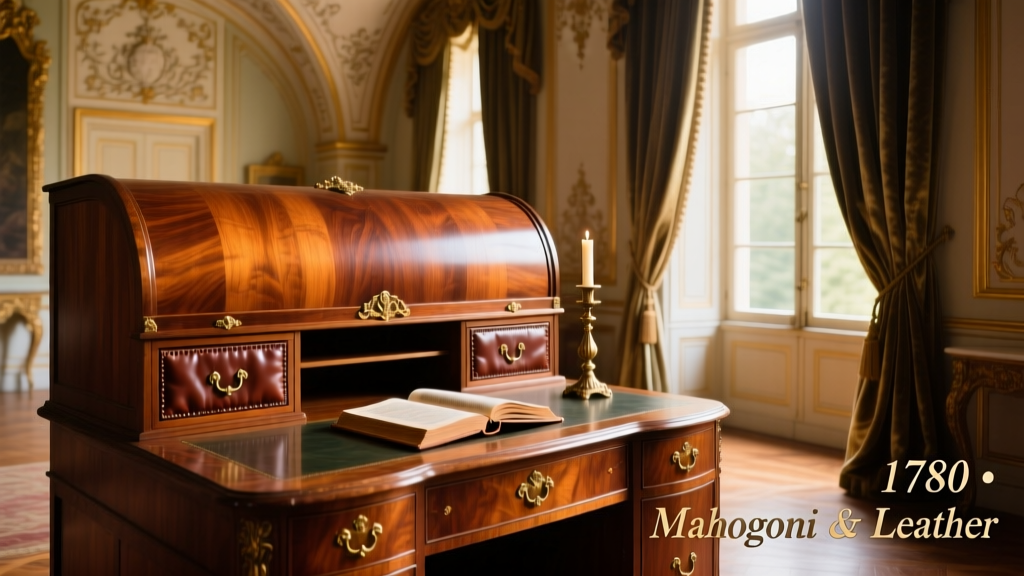
Mahogany Tambour Cylinder Desk with Leather Inset: A Detailed Study of the 29½-Inch Antique Writing Desk
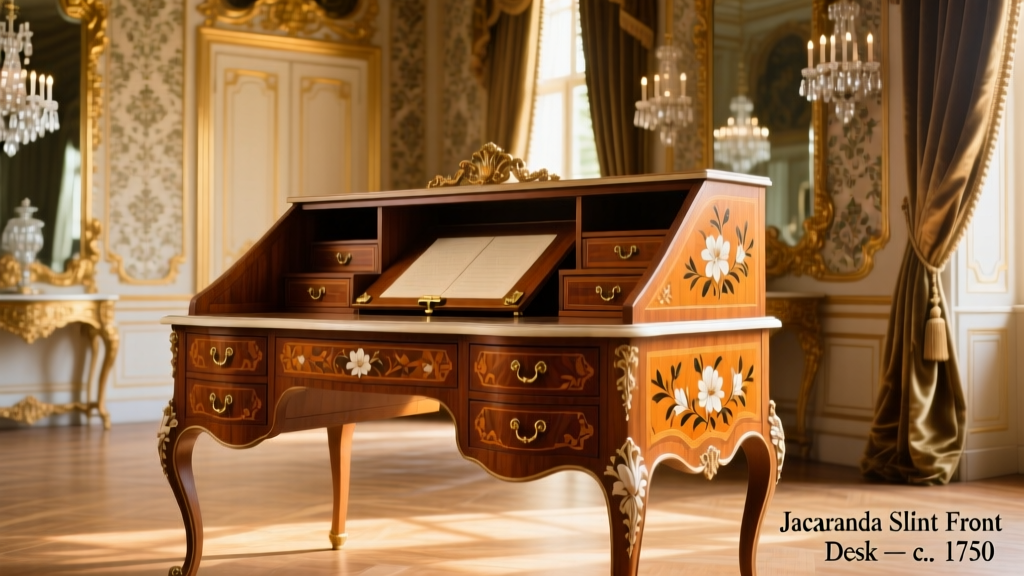
Rococo Slant-Front Desk in Jacaranda: A Masterpiece of 18th-Century French Cabinetmaking

Berninghaus Hercules Barber Chair: Engineering Legacy, Restoration Insights, and Market Value
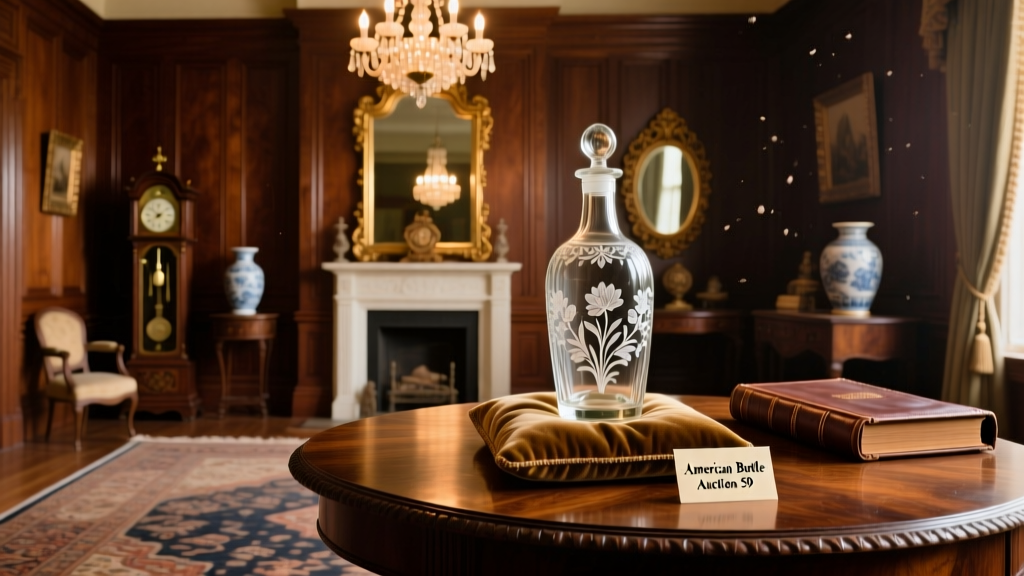
American Bottle Auction 59.2: A Deep Dive into Historic Glassware, Market Trends, and Conservation Insights

Royal Bayreuth Creamer 'Babes in the Woods' in Cobalt Blue: History, Identification, and Restoration Insights
Rookwood Bowl: 'Flowers' Standard Glaze, 1892 — An In-Depth Analysis of Form, Technique, and Historical Significance

Roseville Egypto Vase: Identifying, Valuing, and Preserving the Iconic 12½-Inch Ribbed Beaded Single-Handle Design
Royal Rudolstadt Sugar & Creamer in Green KPM Porcelain: Provenance, Identification, and Conservation Guidelines