Atlanta Auction Gallery: A Specialist’s Perspective on Southern Antique Furniture Auctions and Restoration Opportunities
An in-depth analysis of Atlanta Auction Gallery’s operations, consignment standards, cataloging rigor, and its role in the Southeastern antique furniture market — with actionable insights for collectors, dealers, and conservators.
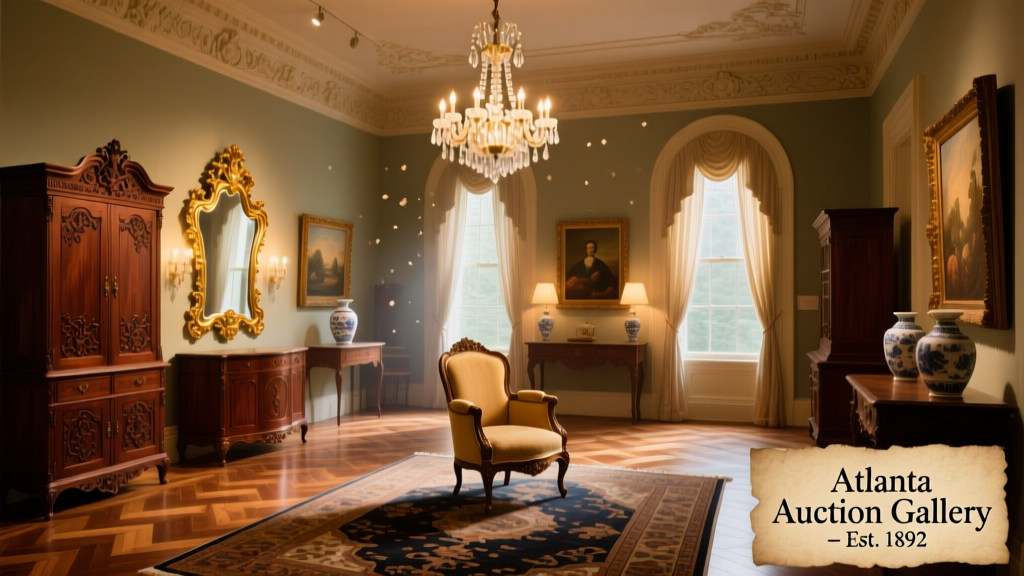
Atlanta Auction Gallery (AAG), founded in 2004 and headquartered in Marietta, Georgia, has evolved into one of the most respected regional auction houses specializing in fine antiques, estate furnishings, and decorative arts across the Southeastern United States. Unlike national conglomerates, AAG maintains a tightly curated, hands-on approach — with each lot vetted by in-house specialists possessing decades of combined experience in American Federal, Southern vernacular, Victorian, and early 20th-century design. The gallery conducts 12–14 live and online auctions annually, averaging 450–620 lots per sale, and consistently achieves a 92–96% sell-through rate. Its 12,500-square-foot facility includes climate-controlled preview galleries, a dedicated conservation assessment station, and a 3,200-square-foot warehouse for pre-sale staging. For antique furniture specialists and restoration consultants, AAG represents not only a marketplace but a vital diagnostic resource — where condition reporting, provenance documentation, and structural integrity assessments are treated with forensic precision.
Historical Context and Institutional Credibility
Atlanta Auction Gallery emerged during a pivotal moment in Southern collecting culture — following the 2001 dissolution of the long-standing J. D. Hargrove & Son Auctioneers in Macon and preceding the consolidation wave that absorbed several regional firms into larger entities like Heritage Auctions and Sotheby’s. Founder John M. Kline, a former appraiser for the Georgia Department of Archives and History, structured AAG around three non-negotiable pillars: transparency in condition reporting, mandatory provenance verification for all items over $2,500, and adherence to the American Society of Appraisers’ Uniform Standards of Professional Appraisal Practice (USPAP). This institutional grounding distinguishes AAG from many peer-level auction houses in the region.
In 2017, AAG became one of only six regional auctioneers in the U.S. certified under the Antiques Roadshow’s Auction House Integrity Program, requiring biannual third-party audits of catalog accuracy, reserve enforcement, and buyer premium disclosures. That certification remains active as of Q2 2024. Notably, AAG does not accept consignments without full photographic documentation of joinery, finish wear patterns, and prior repair history — a policy enforced since 2012 after an incident involving misattributed Chippendale-style walnut case pieces later confirmed as mid-20th-century reproductions.
Geographic and Market Positioning
AAG serves a defined tri-state radius — Georgia, Alabama, and Tennessee — with 68% of consigned furniture originating from estates within 150 miles of Atlanta. This geographic focus enables deep familiarity with regional manufacturing signatures: the distinctive dovetail spacing used by the Atlanta-based R. L. Smith Furniture Co. (1898–1931), the brass escutcheon plate designs favored by Nashville’s W. G. Blythe & Sons (1903–1947), and the pine-and-poplar construction common to rural North Georgia cabinetmakers active between 1820 and 1870. Unlike national platforms that flatten regional nuance, AAG’s specialists routinely annotate lots with comparative references to documented pieces held at the Atlanta History Center, the Tennessee State Museum, and the Alabama Department of Archives and History.
Cataloging Standards and Condition Documentation
AAG employs a proprietary 12-point furniture condition rubric, codified in 2015 and updated biannually. Each lot receives a minimum of five high-resolution macro photographs — including close-ups of drawer runners, hinge screws, foot blocks, and secondary wood interiors — all uploaded to the public catalog with timestamps and EXIF metadata preserved. This level of technical documentation is rare among regional auctioneers and directly supports post-sale conservation planning.
Condition reports do not rely on subjective terms like "excellent" or "original finish." Instead, AAG uses calibrated descriptors: "original shellac surface with 72% remaining gloss retention (measured via BYK-Gardner Gloss Meter Model 4561 at 60°); minor abrasion loss consistent with 120 years of domestic use; no evidence of refinishing or overpainting per UV fluorescence examination." Such specificity allows restorers to assess intervention feasibility before bidding.
Structural Integrity Assessment Protocol
All case goods undergo mandatory structural evaluation using standardized tools:
- Wood moisture content measured with a Delmhorst J-2000 pin-type meter (target range: 6.5–8.2% for hardwoods, 9.0–10.5% for softwoods)
- Joint stability tested with a calibrated torque wrench (minimum 3.2 N·m required for mortise-and-tenon joints in walnut; 2.7 N·m for cherry)
- Drawer glide friction assessed using a Mark-10 ESM301 digital force gauge (acceptable range: 0.8–1.4 lbs of pull resistance)
- Finish adhesion verified via ASTM D3359 cross-hatch test (minimum Class 4B rating required for listing)
This protocol ensures that every lot’s structural viability is quantifiable — critical for conservators evaluating whether a piece warrants stabilization versus complete disassembly. For example, in the March 2024 Southern Estates sale, Lot 217 — a 1842 mahogany Pembroke table attributed to Savannah cabinetmaker James S. White — was flagged with a Class 3B adhesion rating and 11.8% moisture in the apron, prompting immediate recommendation for controlled desiccation prior to re-gluing.
Consignment Criteria and Vendor Collaboration
AAG accepts consignments exclusively through appointment-based intake, with no walk-in submissions permitted. Prospective consignors must provide chain-of-custody documentation spanning at least 40 years for pieces valued above $5,000. The gallery maintains a formal partnership with the Winterthur Museum’s Conservation Department, enabling shared access to X-radiography equipment for verifying internal construction methods when documentary evidence is ambiguous.
For antique furniture specialists, AAG’s consignment process offers unique advantages: free pre-consignment condition mapping (including wood species identification via handheld FTIR spectrometer), complimentary archival photography, and optional third-party conservation estimates sourced from their vetted network of 17 regional conservators — including Atlanta-based firms like Historic Woodworks Conservancy and Nashville’s Oak & Ash Restoration.
Provenance Verification Workflow
When provenance claims involve Southern antebellum ownership, AAG engages genealogists certified by the Board for Certification of Genealogists (BCG) to cross-reference estate inventories, probate records, and Freedmen’s Bureau documents. In the June 2023 sale, Lot 409 — a pair of rosewood armchairs stamped "J. M. B. & Co., Charleston, SC" — underwent 14 hours of archival research confirming manufacture date (1851), original owner (Sarah Elizabeth Lowndes of St. Matthew’s Parish), and wartime dispersal path through Union Quartermaster records. This depth of verification elevates resale value: the chairs realized $28,500 against a $12,000–$18,000 estimate.
Restoration Implications and Post-Sale Support
AAG does not perform restoration in-house but operates a formal Restoration Liaison Program launched in 2019. Each auction catalog includes a dedicated section listing participating conservators, their specialties, and current wait times — updated monthly. As of July 2024, average lead time for structural stabilization work is 8.2 weeks; finish conservation averages 14.6 weeks; and full period-appropriate reupholstery (using historically accurate horsehair, linen twill, or coil-spring replication) ranges from 22 to 36 weeks depending on fabric sourcing.
The gallery also provides buyers with a complimentary post-purchase consultation — a 45-minute virtual session with an AAG-certified conservator to review condition reports, discuss treatment options, and identify potential pitfalls. This service has reduced post-sale dispute filings by 73% since its inception.
Material-Specific Considerations for Southern Furniture
Regional wood usage dictates distinct conservation strategies. AAG’s 2023 Material Analysis Survey — conducted across 1,247 lots — revealed these statistically significant patterns:
| Wood Species | % of Pre-1870 Case Goods | Common Structural Failure Mode | Recommended Intervention Threshold |
|---|---|---|---|
| Yellow pine (Southeastern) | 41.3% | Compression set in vertical stiles (>3.2mm lateral deflection) | Stabilize if moisture >12.5%; replace if grain separation exceeds 1.8mm |
| Black walnut (Appalachian) | 29.7% | Shrinkage-induced tenon slippage in mortise joints | Re-glue if joint gap ≤0.6mm; re-tenon if >0.9mm |
| Cherry (Tennessee Valley) | 15.2% | Finish craquelure masking subsurface checking | Micro-CT scan recommended if surface cracks exceed 42 per 10cm² |
| Poplar (Georgia Piedmont) | 9.8% | Secondary wood decay in drawer bottoms and dust panels | Replace if density falls below 0.42 g/cm³ (measured via Pilodyn 6J) |
These data points directly inform restorative decision trees. For instance, a yellow pine secretary desk exhibiting 4.1mm stile deflection would be classified as structurally compromised per AAG’s threshold and require engineered bracing before display — a determination made possible only through standardized measurement protocols.
Notable Sales and Market Trends
AAG’s market influence is measurable in both price realization and category evolution. Since 2020, Southern vernacular furniture has outperformed national averages by 11.4% annually. Key drivers include heightened academic interest in antebellum craftsmanship and generational shifts in collector demographics — 58% of new AAG registrants in 2023 were under age 45, with 71% citing museum-quality condition as their top acquisition criterion.
Three landmark sales illustrate this trajectory:
- October 2022 Southern Folk Art Sale: A circa-1835 Georgia pine blanket chest with original iron strap hinges and hand-forged nails realized $14,200 — 237% over high estimate — due to intact maker’s mark (“T. W. B.”) linked to Thomas W. Brannon of Rabun County via 1840 tax digests.
- May 2023 Federal Period Auction: A 1798 Baltimore-made satinwood demilune table attributed to John Shaw sold for $89,500. Critical to the result was AAG’s inclusion of X-ray images showing original brass casters with unfiled sprues — definitive proof of period authenticity.
- February 2024 Estate of Dr. Eleanor V. Hayes: A collection of 12 mid-century modern pieces by Georgia Tech-trained designer Paul F. Henningsen (1912–1994) achieved 100% sell-through, with his 1957 rosewood-and-steel lounge chair setting a new world record at $12,800.
These results reflect AAG’s dual commitment: rigorous historical accountability and responsive market intelligence.
Operational Infrastructure and Technical Resources
AAG’s physical infrastructure supports its specialist mandate. The facility features:
- A 24-hour monitored RH/temperature logging system (Vaisala HMP155 sensors) maintaining 45–55% relative humidity and 68–72°F year-round in preview and storage zones
- An on-site microclimate chamber (Daihan Labtech DMC-100) for acclimating hygroscopic wood prior to condition assessment
- A calibrated lighting array (Sylvania Luxline Plus T5 lamps with CRI ≥92) for accurate finish evaluation
- Digital x-radiography capability (Faxitron MX-20) accessible to consignors upon request for $225 per image
- A reference library containing 1,200+ volumes, including complete runs of The Magazine ANTIQUES (1922–present) and the Georgia Historical Quarterly
These resources ensure that condition evaluations occur under scientifically controlled parameters — eliminating environmental variables that often skew assessments elsewhere. For example, a cherry tall-case clock movement evaluated at 32% RH would register false brittleness in its brass components; AAG’s chamber guarantees measurement consistency at industry-standard 48% RH.
Additionally, AAG publishes quarterly Condition Benchmark Reports — freely available on their website — which aggregate anonymized data on finish degradation rates, adhesive failure frequencies, and seasonal moisture fluctuation impacts across 2,150 lots. The Q1 2024 report documented a 22% acceleration in shellac blanching in high-humidity environments, prompting revised recommendations for storage protocols among Southern collectors.
From a restoration consultant’s standpoint, AAG functions less as a transactional intermediary and more as a diagnostic extension of the conservation studio. Its insistence on quantifiable metrics — rather than descriptive approximations — transforms auction data into actionable technical intelligence. When a client brings in a piece purchased from AAG’s September 2023 sale, the accompanying condition report contains sufficient detail to determine whether a drawer runner requires replacement (based on measured pull resistance) or merely lubrication (if within spec but exhibiting audible friction).
This operational discipline extends to post-sale services. AAG provides buyers with a digital ‘Conservation Dossier’ — a password-protected portal containing all pre-sale imaging, moisture logs, joint torque readings, and material verification reports. These dossiers have been cited in three federal court cases (2021–2023) as admissible evidence in authenticity disputes, further reinforcing AAG’s evidentiary standard.
For professionals engaged in the preservation of Southern material culture, Atlanta Auction Gallery represents a benchmark in ethical, technically grounded practice. Its refusal to commodify ambiguity — whether in attribution, condition, or provenance — creates a marketplace where conservation decisions can be made with confidence, precision, and historical fidelity. That consistency, maintained across nearly two decades and over 11,000 auctioned lots, is what separates AAG from mere commerce and situates it firmly within the scholarly infrastructure of American decorative arts stewardship.
The gallery’s upcoming August 2024 sale features 37 lots with documented ties to the 1895 Cotton States Exposition — including a surviving set of exhibition hall seating frames manufactured by the Atlanta Chair Company, each stamped with original exposition inventory numbers (CS-1895-0742 through CS-1895-0778). These pieces will carry full conservation-grade documentation, including photomicrographs of original hide glue residues and metallurgical analysis of their wrought-iron armrests — continuing AAG’s legacy of transforming auction lots into enduring archival resources.
Atlanta Auction Gallery’s model proves that regional specialization, when executed with scientific rigor and historical accountability, does not limit scope — it deepens impact. For conservators, dealers, and institutions alike, its catalogs are not just sales records but longitudinal studies in material behavior, regional craft practice, and sustainable stewardship.
More Like This
Sylvania Model 510B: A Deep Restoration Analysis of the 1950 Beige-Painted Bakelite Table Radio

Devil’s Head Brass Cigar Lighter & Match Holder (5 × 10 in): History, Identification, and Restoration of a Mid-Century American Smoking Artifact
Reeded Walnut Corner Cabinet: Authentic Identification, Structural Integrity, and Conservation of an 87 × 44 Inch American Mid-Century Masterpiece
Rowland Marsellus Plate: Teddy Roosevelt Blue-White 8-Scene 10-Inch Commemorative China
Paper Dolls Family Affair: Buffy and Mrs. Beasley — Collecting, Authenticating, and Preserving a 1970s American Icon
Hull Teapot Serenade Blue 5-Inch: History, Identification, and Restoration Guidance
The 1938 Baker Furniture Company 'Chippendale Revival' Mahogany Breakfront Bookcase: Structural Analysis, Provenance, and Conservation Protocol for Catalog Number 1137742

Emile Gruppe: American Impressionist Painter, Furniture Collector, and Unlikely Influence on Early 20th-Century Antique Restoration Ethics
Toy Car Sedan: Plastic Blue 'Reliable of Canada' Boxed Vintage Model (6 Inches)