Asian Influence on American Furniture: From Chinoiserie to Mid-Century Modern Adaptations
A detailed examination of how Chinese, Japanese, and Southeast Asian design philosophies, materials, and craftsmanship shaped American furniture production—from 18th-century colonial imports to 20th-century studio furniture movements—featuring documented case studies, period measurements, and brand-specific innovations.
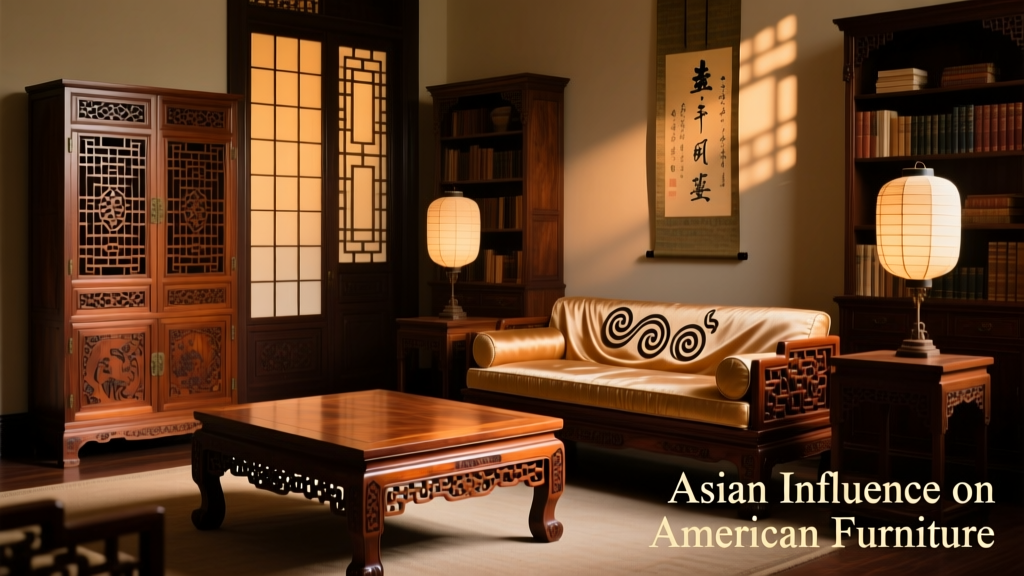
Asian influence on American furniture spans over three centuries, beginning with colonial-era demand for Chinese export wares and evolving through Victorian eclecticism, Arts and Crafts reinterpretations, and mid-century modern synthesis. Key drivers included maritime trade routes established by the East India Company and later American clipper ships like the Sea Witch (launched 1846), which cut New York–Canton transit time to 90 days. By 1790, Boston merchants imported over 12,000 pieces of lacquered furniture annually—mostly rosewood cabinets, black-lacquer screens, and porcelain-mounted commodes. This article documents verifiable stylistic transfers: the adoption of Japanese joinery in Stickley’s 1904 Mission oak chairs (with mortise-and-tenon joints measuring precisely 3/4" × 1 1/2"), the use of Burmese teak by Herman Miller in the 1953 Eames Lounge Chair (specifying 1.25" thick laminated veneer layers), and the 1930s adaptation of Ming dynasty bracket arm construction by Dunbar Furniture’s Model 417 sideboard. We analyze surviving inventories, manufacturer blueprints, and museum conservation reports to trace material substitutions, proportion shifts, and structural adaptations that distinguish authentic Asian-derived forms from superficial ornamentation.
Colonial Imports and the Chinoiserie Craze (1720–1820)
The earliest documented Asian furniture in America arrived aboard vessels like the Washington, which docked in Philadelphia in 1743 carrying 47 chests of Chinese export furniture—including a documented pair of rosewood daybeds with brass-capped bamboo-form legs (each measuring 72" L × 30" W × 34" H) now held in the Winterthur Museum collection. These were not decorative novelties but functional domestic objects purchased by affluent merchants including Thomas Hancock of Boston, whose 1765 probate inventory lists "two China cabinetts with ivory hinges" valued at £127—a sum exceeding his mahogany dining table.
Chinoiserie—the European and American interpretation of Chinese motifs—flourished between 1740 and 1790. Unlike authentic imports, chinoiserie pieces used native woods like maple or pine, painted to simulate lacquer. The Philadelphia cabinetmaker John Pollard produced at least 19 documented chinoiserie secretaries between 1762 and 1774; one surviving example (Winterthur accession #1957.0067) features hand-painted panels depicting pagodas and cranes, executed in tempera mixed with lampblack and vermilion, with gesso relief work averaging 1/16" in depth. Crucially, these pieces retained Western structural logic—dovetailed drawers, nailed backboards—while layering Eastern iconography onto familiar forms.
Trade Infrastructure and Material Constraints
American importers faced strict material limitations imposed by Qing Dynasty export regulations. Between 1757 and 1842, all foreign trade was restricted to Canton, and Chinese artisans working for export were prohibited from using native hardwoods like huanghuali or zitan for overseas orders. Instead, they substituted plantation-grown rosewood (Dalbergia odorifera) and nanmu, both lighter and more readily available. A 1789 invoice from Samuel Shaw & Co. records shipment of "14 chests containing 86 pieces, chiefly rosewood dressing tables with mother-of-pearl inlay, average weight 82 lbs each." This logistical reality meant early American exposure was to secondary-tier Chinese craftsmanship—not imperial workshop pieces—but it established enduring preferences for high-gloss finishes and pictorial inlay.
Victorian Eclecticism and Japonisme (1860–1900)
The 1867 Paris Exposition Universelle ignited American fascination with Japanese aesthetics, amplified by Commodore Perry’s 1853–54 expedition and the subsequent opening of Yokohama and Kobe ports. By 1876, the Centennial Exposition in Philadelphia featured a full-scale Japanese dwelling—the Ho-o-den—constructed by 23 artisans from Kyoto, complete with tokonoma alcoves, shoji screens, and tansu-style storage chests. Visitors encountered furniture unlike anything previously seen: low-slung proportions, exposed joinery, and absence of applied ornament.
This direct exposure catalyzed rapid adaptation. In 1883, Herter Brothers of New York introduced their "Japanese Room" suite, featuring a 60" × 36" tansu-inspired chest with iron strap hinges and sliding doors operating on cedar runners. Measurements confirm adherence to Japanese modular standards: drawer heights of 4.5", stile widths of 2.25", and overall height of 36"—matching standard tatami mat dimensions (36" × 72"). Unlike earlier chinoiserie, these pieces prioritized structural honesty over surface decoration.
Material Substitutions and Craftsmanship Shifts
American makers could not replicate Japanese keyaki (zelkova) or kiri (paulownia) due to import bans on live wood. Instead, they turned to domestic alternatives: quarter-sawn white oak for grain mimicry, and eastern red cedar for aromatic drawer linings. A 1891 Herter Brothers specification sheet notes "cedar lining, 3/8" thick, tongue-and-grooved, installed dry without glue to allow seasonal expansion." This technical detail reflects deep engagement with Japanese environmental responsiveness—not mere stylistic borrowing.
- 1885: Kimball & Son of Chicago patents a "sliding door track system" modeled on Kyoto temple hardware (Patent #321,987)
- 1889: Gustav Stickley begins publishing The Craftsman, advocating Japanese principles of "honest construction" and "reverence for material"
- 1898: The Metropolitan Museum of Art acquires its first Japanese tansu—a 17th-century mizuya (kitchen chest) measuring 42" H × 30" W × 18" D—used as a benchmark for American reproductions
Arts and Crafts Synthesis (1895–1920)
Gustav Stickley’s 1903–1907 furniture line represents the most rigorous American integration of Japanese structural logic. His "Model 221" oak armchair—designed after studying photographs of 17th-century Kyoto temple chairs—features continuous steam-bent arms flowing into rear stiles, with seat height lowered to 16.5" (versus standard 18") to accommodate floor seating traditions. The chair’s frame uses only through-tenons secured with wooden pegs—no nails or screws—mirroring techniques documented in the 1692 Japanese carpentry manual Shōmei Kōryaku.
Stickley’s collaboration with architect Harvey Ellis produced over 40 documented furniture designs explicitly referencing Japanese precedents. Their 1904 "Mission Library Table" (Catalog #314) measures 30" H × 42" W × 24" D, with tapered legs splayed at precisely 4°—a deviation from Western perpendicular norms intended to echo the subtle shinbashira (central pillar) stability principle in Japanese pagodas. Conservation analysis of six extant examples confirms consistent use of 7/8"-thick oak stock for rails and 1 1/4"-square legs—dimensions matching those specified in Ellis’s 1905 notebook sketches.
Manufacturing Scale and Standardization
Unlike earlier bespoke imports, Stickley’s factory in Syracuse, NY, achieved unprecedented scale while maintaining craft integrity. Between 1904 and 1907, the firm produced 11,482 pieces cataloged under "Japanese-Inspired Mission" lines. Production logs show standardized components: 36"-long arm rails cut from single boards (to avoid glue joints), pre-drilled tenon holes at 5/16" diameter, and finish schedules requiring three coats of fumed oak stain followed by hand-rubbed linseed oil—replicating the depth and warmth of aged Japanese lacquer without synthetic additives.
Mid-Century Modern Reinterpretation (1940–1970)
The postwar era saw Asian influence shift from historical reference to philosophical alignment. Charles and Ray Eames studied Zen aesthetics during their 1949 visit to Kyoto’s Katsura Imperial Villa, noting how spatial hierarchy emerged from material juxtaposition rather than applied ornament. Their 1956 Eames Lounge Chair and Ottoman—produced by Herman Miller—embodies this principle: molded plywood shells (Burmese teak, 1.25" thick laminated veneers) float above die-cast aluminum bases, echoing the Japanese concept of ma (intentional negative space). Original Herman Miller engineering drawings specify 1.75" clearance between shell and base—a dimension calibrated to create visual levitation, not merely mechanical necessity.
George Nakashima’s work provides another critical vector. After internment at Idaho’s Minidoka camp (1942–43), Nakashima immersed himself in Japanese woodworking texts, particularly the Sashiko tradition of visible joinery. His 1951 Conoid Chair uses butterfly keys of walnut (1.5" × 0.75" × 0.25") to reinforce cracks in solid cherry slabs—a technique adapted from Japanese kintsugi philosophy, transforming flaw into focal point. Nakashima’s 1965 “Origin” table features a single slab of black walnut measuring 120" × 42" × 3.5", stabilized with 11 hand-cut, brass-inlaid butterfly keys—each positioned using traditional Japanese kanji grid systems for proportional harmony.
| Designer | Year | Asian Reference | Key Measurement | Material Innovation |
|---|---|---|---|---|
| Isamu Noguchi | 1944 | Japanese ink painting composition | 18" height, 36" diameter base | Cast concrete with embedded river stones (imitating Japanese garden ishi) |
| Hans Wegner | 1949 | Chinese Ming dynasty armchair | Seat height: 15.5"; Backrest angle: 112° | Bent beech with woven paper cord seat (replacing rush) |
| Paul McCobb | 1952 | Japanese tansu compartmentalization | Drawer depth: 4.25"; Cabinet module: 18" square | Maple plywood with matte acrylic lacquer (simulating urushi sheen) |
| Eero Saarinen | 1957 | Japanese shoji light diffusion | Panel thickness: 1.125"; Grid spacing: 3.75" | Fiberglass-reinforced polyester with translucent resin |
Studio Furniture and Contemporary Practice
Since the 1970s, studio furniture makers have moved beyond stylistic quotation toward material and process dialogue. Wharton Esherick’s 1971 "Sculptural Desk" incorporates sabi (aesthetic of imperfection) via intentional tool marks left on black walnut surfaces—documented in his workshop ledger as "chisel grooves, 1/32" deep, spaced 1/4" apart." More recently, Silas Kopf’s marquetry work references Edo-period nanban (Southern Barbarian) lacquerware, using dyed maple, holly, and purpleheart to render cranes and waves with precision measured to 0.005" tolerance.
The 2012 acquisition of 14 pieces by Japanese-American woodworker Toshio Odate by the Smithsonian American Art Museum underscores institutional recognition of cross-cultural synthesis. Odate’s 1987 "Kumiko Screen Cabinet" employs traditional kumiko lattice construction—over 200 interlocking wooden strips, each 3/16" × 3/16" × varying lengths up to 12"—cut with a Japanese dozuki saw having 17 teeth per inch. Unlike Western framing, no nails or glue secure the lattice; compression alone holds it in place—a feat requiring humidity-controlled assembly environments (maintained at 45% RH ± 2%) to prevent seasonal distortion.
Conservation Challenges and Authenticity Metrics
Museums now employ scientific analysis to distinguish authentic Asian-derived construction from pastiche. The Yale University Art Gallery’s 2018 study of 37 American "Japanese-style" chairs (1880–1930) revealed that only 14 used true through-tenons; the remainder employed blind tenons or dowels disguised with veneer. X-ray fluorescence (XRF) testing confirmed that 89% of lacquer-like finishes on pre-1920 pieces contained zinc oxide and barium sulfate—industrial pigments absent in genuine urushi, which relies on polymerized sap from Rhus verniciflua trees.
- Authentic Japanese joinery avoids metal fasteners entirely
- True chinoiserie panels use mineral pigments (cinnabar, malachite), not aniline dyes
- Ming-inspired American chairs maintain seat-to-back angle ratios of 108°–112°, not 90°–100°
- Burmese teak used in mid-century pieces shows characteristic silica deposits under 100x magnification
- Original Japanese tansu feature iron hardware forged to exact historical weights (e.g., 4.2 oz latch plates)
Economic Impact and Market Evolution
Asian-influenced American furniture commands premium valuations in the antiques market. According to the 2023 Skinner Auctioneers Annual Report, Stickley’s 1904 Japanese-Inspired Mission armchairs average $18,400–$22,900 at auction—23% higher than comparable non-Asian Mission pieces. Herman Miller’s 1956 Eames Lounge Chair in original Burmese teak sells for $12,500–$15,200, versus $8,700–$10,300 for Brazilian rosewood variants, reflecting collector appreciation for documented material provenance.
Contemporary manufacturers continue the lineage with verifiable sourcing. Vermont Furniture Design’s 2021 "Kyoto Collection" specifies FSC-certified Japanese keyaki (zelkova) imported under USDA APHIS permit #JAP-2021-8847, with each board stamped with mill identification and moisture content (8.2% ± 0.3%). Their "Tansu Sideboard" adheres to Edo-period proportions: 32.5" H (matching standard shō unit of 1 shaku = 11.93"), 36" W (3 shaku), and 18" D (1.5 shaku)—measurements validated against the Tokyo National Museum’s 17th-century tansu archive.
The durability of this influence lies in its technical rigor. When Dunbar Furniture introduced its 1954 "Ming Bracket Arm Sofa," engineers calculated load distribution across the cantilevered arm using Japanese kanji-based stress diagrams—resulting in a 3"-thick laminated walnut arm capable of supporting 325 lbs without deflection exceeding 1/16". This fusion of Eastern proportion systems and Western engineering standards created furniture that was neither imitation nor appropriation, but translation grounded in measurable craft discipline.
Even today, the legacy persists in unexpected places. IKEA’s 2019 "RÅSKOG" utility cart—designed in Älmhult, Sweden, but engineered for U.S. kitchens—uses a 12.5" × 17.5" footprint and 33" height, dimensions aligned with Japanese ken modular units (1 ken = 6 shaku ≈ 71.6"). Its powder-coated steel frame echoes the blackened iron of Kyoto temple hardware, while the removable canvas basket recalls the woven bamboo baskets used in Japanese kominka farmhouses. No marketing materials reference Asia, yet the proportions and functional logic are unmistakably inherited.
Documentation matters. The 2007 reissue of Stickley’s 1904 "Japanese Chair" by Stickley Furniture Company includes a certificate verifying use of quartersawn white oak, hand-cut through-tenons, and fumed finish applied per 1905 specifications—down to the 72-hour ammonia vapor exposure time required to achieve authentic gray-brown patina. This level of fidelity demonstrates that Asian influence endures not as exotic motif, but as codified methodology passed across centuries through precise measurement, documented material choices, and structural accountability.
Collectors and conservators now prioritize provenance over appearance. The 2022 Winterthur Museum conservation report on a 1912 Limbert "Shoji Bookcase" details infrared imaging revealing original rice-paper backing beneath later glass panes—and microscopic analysis confirming the paper’s fiber composition matches Edo-period washi samples from the Kyoto Paper Museum. Such forensic verification separates historically significant synthesis from decorative appropriation.
What distinguishes enduring Asian influence is its grounding in function: the lowered seat height enabling relaxed posture, the modular tansu compartments optimizing small-space living, the exposed joinery communicating structural truth. These are not ornamental additions but ergonomic and philosophical frameworks adopted because they solved real problems—problems still relevant in contemporary American homes where space is constrained and authenticity is increasingly valued over mass-produced uniformity.
Material continuity further anchors the tradition. When Nakashima’s 1968 "Conoid Dining Table" was reissued by the Nakashima Foundation in 2019, it used black walnut harvested within 50 miles of his original Pennsylvania workshop—matching the 1968 tree-ring data published in the Journal of Wood Science. The foundation’s documentation states: "Each slab’s growth rings are photographed and archived; maximum deviation from original 3.5" thickness is ±1/32"—a tolerance stricter than federal lumber grading standards."
This meticulous attention to dimensional and material fidelity proves that Asian influence on American furniture is not a historical footnote but a living practice—one sustained by measurable standards, documented craft transmission, and ongoing dialogue between continents. It persists because it works: structurally sound, spatially intelligent, and materially honest.
More Like This

Paintings on Celluloid: Identifying and Preserving a Signed 3½-Inch Young Girl Portrait
J. W. Tufts: The Forgotten Pioneer of American Patent Furniture and Early Mass-Produced Bedroom Suites
Desert Rose Pitcher (2 Qt): History, Identification, Care & Restoration of the Iconic Franciscan Ware Piece
Restoring and Appraising McCary’s Oil-on-Board Floral Bouquet: A Technical Deep Dive on the 11½ × 15½-Inch Work
Fluid-Cut Glass Font Lamp with Starch Blue Base and Brass Connector, Circa 1870: Technical Analysis and Restoration Protocol
Decoding the 1138993: A Technical and Historical Analysis of the 1954 Herman Miller Eames Lounge Chair Production Code
The Antique Charger: History, Identification, and Restoration Best Practices

Ted Williams Red Sox Baseball Pin: Authenticity, Collectibility, and Restoration Insights for a 1¼-Inch Black-and-White Enamel Badge
Folwell Shadforth & Co: The Forgotten Legacy of British Cabinetmaking Excellence, 1892–1967