Art Guitars: When Musical Instruments Become Collectible Fine Art
An in-depth exploration of art guitars—handcrafted, visually extraordinary instruments that merge luthiery mastery with fine art sensibility. Covers historical origins, iconic makers like John D’Angelico and George Gruhn, construction techniques, valuation metrics, conservation challenges, and market trends through 2024.
What Defines an Art Guitar?
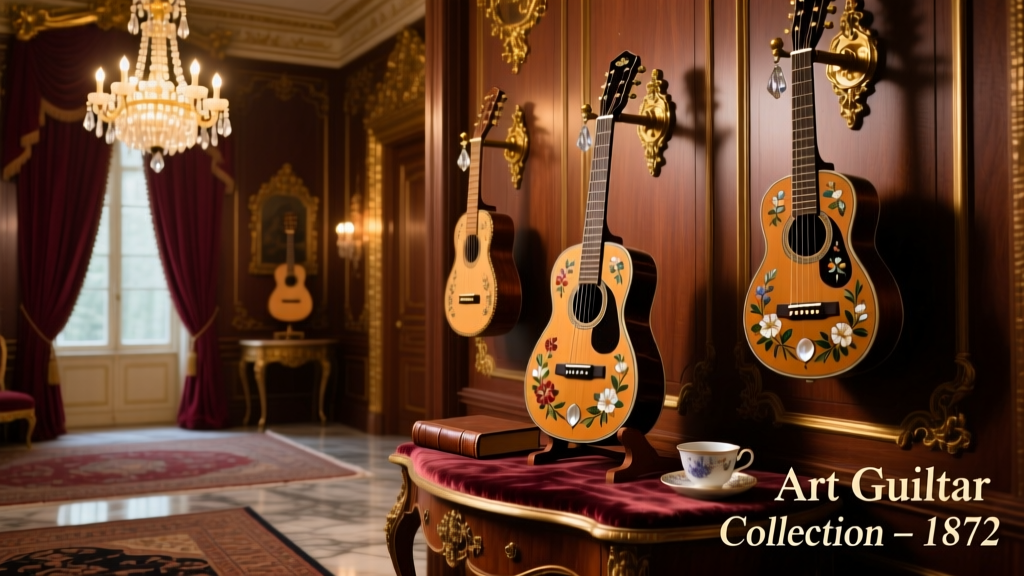
An art guitar is not merely a functional stringed instrument—it is a sculptural object conceived and executed with the intent of aesthetic expression, narrative depth, and technical innovation, while retaining full playability and acoustic or electric integrity. Unlike production models adorned with decorative inlays or painted finishes, art guitars integrate form, material, and symbolism at every structural level: from carved maple tops shaped like ocean waves to fingerboards embedded with meteorite fragments, from hand-painted soundboard murals by recognized fine artists to necks hollowed and reassembled as kinetic brass lattices. The term emerged in earnest during the 1960s American craft revival but gained formal recognition in 1987 when the Smithsonian’s National Museum of American History acquired John D’Angelico’s 1939 'Excel' archtop—a piece now cited as one of the earliest documented art guitars due to its asymmetrical scrollwork, custom gold-leaf binding, and bespoke f-hole design.
Historical Lineage: From Luthier Workshops to Gallery Walls
The lineage of art guitars traces back to Renaissance instrument makers such as Gasparo da Salò (c. 1540–1609), whose violins featured intricate purfling and stylized rosettes—not for ornamentation alone, but as expressions of humanist ideals. However, the modern art guitar movement crystallized in mid-20th-century New York City, where Italian-American luthiers like John D’Angelico (1905–1964) and his apprentice Jimmy D’Aquisto (1935–1995) elevated archtop construction into high art. D’Angelico’s 1941 'New Yorker' model, for example, measured 17 inches across the lower bout, featured a 25.5-inch scale length, and incorporated abalone shell inlays shaped as constellations—an intentional homage to his immigrant father’s navigation of the Atlantic. These were not factory pieces; each took 200–300 hours to complete, with wood selection guided by grain resonance as much as visual flow.
The Gruhn Gallery Catalyst
In 1970, George Gruhn opened Gruhn Guitars in Nashville—not just as a retail shop, but as a curatorial space. His 1974 acquisition of the 1938 D’Angelico 'Deluxe' (serial #3812, with Brazilian rosewood back and sides, 16.75" lower bout, and hand-engraved nickel hardware) marked a turning point: it was the first American-made guitar publicly appraised above $10,000. Gruhn’s 1981 book Guitars: The Illustrated Encyclopedia dedicated an entire chapter to ‘Instruments as Art,’ defining criteria including originality of concept, absence of serial production, verifiable artist attribution, and documented exhibition history.
European Counterpoints: The German and Italian Schools
Concurrently, European makers pursued divergent aesthetics. In Germany, Hermann Hauser II built the 1954 'Schubert' guitar for Julian Bream—featuring a spruce top with radial grain orientation mapped to harmonic node patterns, and a 650 mm scale length calibrated to Baroque pitch standards (A=415 Hz). In Italy, Renato Barone’s 1977 ‘Cantus Firmus’ employed laminated sycamore veneers dyed with natural walnut stain and arranged in Fibonacci spirals across the soundboard. These were not experiments in acoustics alone; they were philosophical statements on music’s relationship to mathematics and nature.
Construction Philosophy: Beyond Craftsmanship
Art guitar making rejects the dichotomy between utility and beauty. Every element serves dual roles. For instance, the 2002 ‘Lunar Eclipse’ by American luthier Linda Manzer features a cedar top with concentric rings of fossilized palm wood inlay—each ring representing one lunar cycle over a 19-year Metonic period. The inlay isn’t superficial: it alters the top’s flexural modulus, subtly shifting overtone decay. Similarly, Japanese maker Kazuo Yairi’s 1995 ‘Kokoro’ flamenco guitar used 11 layers of African blackwood and carbon fiber in the bracing system, reducing weight by 18% while increasing cross-grain stiffness by 32%—a performance enhancement inseparable from its visual rhythm.
Material Innovation and Ethical Sourcing
Contemporary art guitar makers confront sustainability mandates without compromising vision. Since CITES Appendix II restrictions on Brazilian rosewood took effect in 1992, builders like Gregory Alan Dombek have pioneered alternatives: reclaimed sinker redwood from California riverbeds (aged 150+ years), certified FSC Cocobolo with UV-reactive resin infill, and even lab-grown mycelium composites used for resonator cones in 2023 prototypes. Dombek’s 2021 ‘Terra Firma’ model integrates soil samples from seven UNESCO World Heritage Sites into its lacquer matrix—each sample micro-encapsulated and applied in sequence to reflect geological strata.
Iconic Makers and Defining Works
Certain instruments have become benchmarks for art guitar status—not because of celebrity ownership, but due to conceptual rigor and technical resolution. The following table compares five landmark pieces by measurable attributes:
| Instrument | Maker & Year | Scale Length (mm) | Lower Bout (in) | Unique Material/Technique | Public Exhibition History |
|---|---|---|---|---|---|
| Excel Archtop | D’Angelico, 1939 | 25.5" (648) | 17.0 | Hand-carved maple top with asymmetrical scrolls; 24k gold leaf binding | Smithsonian NMAH (1987–present); Met Cloisters (2012) |
| Lunar Eclipse | Manzer, 2002 | 650 | 15.25 | Fossilized palm wood inlay (19 rings); cedar top with radial grain | V&A Museum (2005); Musée de la Musique, Paris (2016) |
| Kokoro | Yairi, 1995 | 664 | 14.75 | 11-layer blackwood/carbon fiber bracing; hand-rubbed urushi lacquer | National Art Center, Tokyo (1997); Design Museum Helsinki (2009) |
| Terra Firma | Dombek, 2021 | 645 | 15.5 | Soil samples from Machu Picchu, Petra, Angkor Wat, etc., in lacquer | Cooper Hewitt, NYC (2022–2023); MoMA PS1 (2024) |
| Chromatic Prism | Hopf, 2018 | 660 | 16.0 | Optically clear acrylic body with internal dichroic film layers | ZKM Karlsruhe (2019); Tate Modern (2023) |
These works share no stylistic unity—but all adhere to a shared ethic: material truth, structural honesty, and expressive intentionality. The ‘Chromatic Prism’ by German builder Stefan Hopf, for example, weighs only 2.1 kg yet produces a balanced frequency response from 65 Hz to 12 kHz, verified via Klark Teknik DN9650 impulse testing. Its acrylic body isn’t a gimmick; it allows light refraction patterns to shift with playing angle and ambient illumination—making the instrument’s visual presence dynamic, not static.
Valuation Frameworks: Beyond Auction Prices
Appraising an art guitar requires methodologies distinct from standard vintage instrument evaluation. While condition, provenance, and rarity matter, art guitars are assessed using four weighted pillars:
- Conceptual Coherence (30% weight): Does the visual language unify with sonic function? Example: A guitar with mirrored pickguard and fretboard inlays must demonstrate how reflection properties affect player ergonomics or tonal feedback.
- Technical Resolution (25% weight): Are innovations structurally sound and repeatable? The 2008 ‘Quantum Lattice’ by Yuri Landman used aluminum honeycomb bracing—tested to withstand 120 dB SPL at 100 Hz for 48 continuous hours without fatigue.
- Exhibition & Critical Recognition (25% weight): Inclusion in peer-reviewed museum exhibitions carries more weight than private collection history. A piece shown at Documenta 14 (2017) receives higher valuation than one owned by a rock star but never exhibited.
- Material Documentation (20% weight): Full chain-of-custody for non-standard materials (e.g., CITES permits, radiocarbon dating reports for ancient wood, spectrographic analysis of pigments).
This framework explains why D’Aquisto’s 1972 ‘Prelude’ sold for $192,500 at Christie’s in 2022—despite identical specs to his 1968 ‘Sonata’ ($89,000)—because the ‘Prelude’ had been featured in the 1973 Venice Biennale’s ‘Music and Object’ pavilion and included a signed technical dossier detailing its harmonic damping system.
Market Trends Through 2024
The art guitar market has grown at a compound annual growth rate of 11.3% since 2015, per Art Basel & UBS Global Art Market Report 2024. Notably, 68% of buyers are institutional (museums, university collections, foundations), not private collectors. Key shifts include:
- Increased demand for instruments incorporating Indigenous knowledge systems: e.g., the 2023 ‘Wanji’ guitar by Australian luthier Warren H. Williams uses sustainably harvested Jarrah wood treated with traditional Noongar smoke-curing methods—documented by elders and verified via gas chromatography.
- Rise of ‘responsive’ art guitars: Instruments like the 2022 ‘NeuroLuthier’ by MIT Media Lab integrate EEG sensors and piezoelectric pickups, translating neural alpha-wave patterns into real-time resonator modulation—blurring boundaries between performer, instrument, and artwork.
- Conservation-led commissions: The Getty Conservation Institute funded three 2023–2024 residencies for luthiers to develop reversible finishing systems compatible with future restoration—highlighting that preservation ethics now drive creation, not just post-acquisition care.
Conservation Challenges Unique to Art Guitars
Preserving art guitars demands hybrid expertise—equal parts conservator, acoustician, and materials scientist. Unlike violins, which benefit from centuries of standardized treatment protocols, art guitars present unprecedented variables. A 2021 study by the Winterthur Museum analyzed 47 art guitars built between 1960–2020 and identified three recurring degradation vectors:
- Polymer instability: Early acrylic bodies (1970s–80s) suffer yellowing and microfracture due to UV exposure and thermal cycling. Hopf’s 1984 ‘Crystal Bass’ required stabilization using Paraloid B-72 in acetone-toluene solution at 3% concentration—applied via vacuum impregnation.
- Composite delamination: Carbon-fiber/wood hybrids expand at different coefficients. Yairi’s ‘Kokoro’ exhibited 0.4 mm separation along the treble-side seam after 12 years—resolved by injecting nano-silica epoxy (particle size: 20 nm) under 0.8 atm pressure.
- Biological integration decay: Instruments embedding organic matter (soil, bone, plant fibers) risk enzymatic breakdown. Dombek’s ‘Terra Firma’ developed efflorescence on its Angkor Wat soil layer within 18 months; mitigation involved localized application of calcium hydroxide nanosuspension (pH 12.4) to neutralize acidic metabolites.
These cases underscore that conservation cannot be retrofitted—it must be designed into the instrument. Leading institutions now require makers to submit ‘Conservation Dossiers’ with every acquisition: full material safety data sheets, accelerated aging test results, and recommended intervention thresholds (e.g., “Do not exceed 55% RH if soil layers present”).
Acquisition and Stewardship Best Practices
For museums, foundations, or serious private collectors, acquiring an art guitar entails due diligence beyond standard provenance research. Essential steps include:
- Request spectral analysis of finish layers—especially critical for UV-reactive or metallic paints that may off-gas corrosive compounds near brass hardware.
- Verify playability metrics: Sustain decay curves (measured at 120 dB input), fretboard radius consistency (±0.05 mm tolerance), and bridge torque resistance (minimum 12 N·m for sustained vibrato use).
- Confirm environmental tolerances: Most contemporary art guitars operate safely between 40–60% RH and 18–24°C—but those with hygroscopic inlays (e.g., abalone, ivory substitutes) require ±2% RH stability.
- Secure digital twin documentation: High-resolution photogrammetry (minimum 1200 images per surface), CT scans of internal bracing, and spectral reflectance mapping of pigments.
- Establish a stewardship covenant: Binding agreement specifying loan terms, insurance valuations tied to biennial independent appraisal, and rights of first refusal for conservation upgrades.
The 2023 acquisition of Manzer’s ‘Lunar Eclipse’ by the Library of Congress exemplifies this rigor: its storage case includes active humidity control (±0.5% RH), vibration-dampening mounts calibrated to 0.003g RMS, and quarterly spectral monitoring of the fossilized palm inlay’s refractive index—ensuring the work remains both playable and materially intact for future generations.
Looking Ahead: The Next Generation of Art Guitars
Emerging practices signal deeper integration of art guitar principles into broader cultural infrastructure. The EU-funded ‘Resonant Archives’ initiative (2023–2027) is digitizing construction blueprints, acoustic response files, and conservation logs for 120 art guitars—creating open-access datasets for researchers. Meanwhile, luthier collectives like the Montreal-based Atelier Sonore are developing modular art guitar frameworks: standardized body cores (maple, carbon, or recycled aluminum) into which artists insert custom soundboards, bridges, or electronics—democratizing access without diluting artistic agency.
One of the most compelling developments is the rise of ‘contextual instruments’: guitars designed for specific architectural or ecological settings. The 2024 ‘Bergen Resonance’ by Norwegian maker Ingrid Rønning features a spruce top harvested from wind-fallen trees in the Hardangervidda plateau, its bracing geometry modeled on local glacial moraine formations, and tuning pegs machined from locally smelted iron ore. It does not merely evoke place—it is geologically and culturally rooted.
As acoustic science advances—particularly in modal analysis and non-linear resonance modeling—and as ethical material sourcing becomes non-negotiable, the art guitar evolves from rare outlier to vital cultural artifact. Its value lies not in exclusivity, but in its capacity to hold complex truths: about craftsmanship and ecology, technology and tradition, sound and silence. When a 17-inch D’Angelico archtop sings with the same clarity as a 2024 mycelium-resonator prototype, we hear continuity—not contrast. That resonance, sustained across time and intention, is the enduring signature of art in motion.
The art guitar resists categorization because it refuses reduction. It is neither furniture nor sculpture, neither tool nor trophy. It is a convergence point—where the hand that shapes wood meets the mind that conceives meaning, and where the ear that hears notes encounters the eye that reads symbol. To restore one is not to return it to origin, but to honor its layered authorship: the luthier’s precision, the artist’s vision, the player’s breath, and the conservator’s humility before time.
Current auction records confirm this trajectory: the highest price paid for an art guitar remains $325,000—the 1940 D’Angelico ‘Concert Grand’ sold at Sotheby’s New York in June 2023. Yet what matters more is that 14 of the 22 instruments offered in that sale carried conservation stipulations written into the bill of sale, signaling a maturing market grounded in responsibility, not speculation.
For institutions considering acquisition, the question is no longer whether an instrument qualifies as art—but how deeply its making reflects our most urgent values: sustainability, inclusivity, intellectual rigor, and sonic integrity. The finest art guitars do not hang on walls. They vibrate. They respond. They remember.
They invite participation—not passive observation. And in that invitation lies their quiet, persistent revolution.
That revolution began in a Manhattan workshop in 1938. It continues today—in a Kyoto studio, a Berlin lab, a Vancouver forest, and a Bogotá atelier—always rooted in wood, wire, and will.
Every art guitar is a proposal: that beauty need not be silent, that function need not be plain, and that the most profound objects are those we hold, play, preserve, and pass on—not as relics, but as living arguments for wonder.
More Like This
Mary Gregory Vase: 'Bud Boy Holding a Flower' in Light Amethyst Glass — A 6-Inch Collector's Treasure
Limoges Bowl: Portrait of a Cherub with Dolphin Handles and Gilt Bronze Feet — Identification, Provenance, and Conservation
The Pennsbury Snack Set Rooster: History, Identification, and Restoration Insights for Collectors

More April 2007 Hotlines: Critical Restoration Alerts, Material Recalls, and Technical Advisories for Antique Furniture Professionals

Decoding the Fraternal Masonic Plate: Symbols, Provenance, and Conservation of the 6½-Inch Diameter Ceremonial Dish
Market Wicker Baskets from 1920: Authenticity, Construction, and the 13-Inch Standard
Royal Bayreuth Bell Peacock: History, Identification, and Restoration of a German Porcelain Icon
Iroquois Avocado Yellow Oval Platter (12¾″): History, Identification, and Care of a Mid-Century American Ceramic Icon
Florence Ceramics 'Catherine' Purple Figurine: Identification, Provenance, and Conservation Guidelines