Arequipa Pottery: California’s Artistic Legacy in Handcrafted Stoneware
Arequipa Pottery (1911–1918) was a short-lived but profoundly influential studio pottery founded at the Arequipa Sanatorium in Marin County, California. Produced exclusively by women recovering from tuberculosis under the guidance of Frederick Hurten Rhead and later Albert Solon, its matte-glazed stoneware—featuring organic motifs, restrained palettes, and exceptional craftsmanship—represents a pinnacle of early American Arts and Crafts ceramics.
The Origins: A Sanatorium, a Studio, and a Vision
Arequipa Pottery emerged not from a commercial workshop or artisan colony, but from a therapeutic environment: the Arequipa Sanatorium in Fairfax, Marin County, California. Founded in 1911 by Dr. Philip King Brown, the sanatorium treated women suffering from tuberculosis—a disease then requiring prolonged rest, fresh air, and purposeful activity. Recognizing the psychological and physical benefits of creative labor, Dr. Brown partnered with English ceramicist Frederick Hurten Rhead to establish a pottery studio on-site in late 1911. Rhead, already renowned for his work at Weller Pottery and as a design director at Roseville, brought formal training, technical expertise, and a deep commitment to Arts and Crafts principles. His appointment marked the beginning of a unique experiment: integrating craft education into medical rehabilitation.
The studio occupied a converted barn adjacent to the sanatorium’s main buildings. Its kilns were downdraft gas-fired, capable of reaching cone 9–10 (approximately 2300°F–2380°F), essential for vitrifying the local clay body. The original clay came from nearby Lagunitas Creek, refined onsite through sedimentation tanks and pugged using a 1912 North Star pug mill—a machine still operational today at the Marin History Museum. By 1912, the studio employed 12–15 patients weekly, each working four-hour shifts under strict medical supervision. No patient worked more than two consecutive days; rest periods were mandated every 90 minutes.
Rhead’s philosophy centered on ‘truth to material’ and functional integrity. He rejected mass production, mechanized decoration, and excessive glaze thickness—principles that directly shaped Arequipa’s aesthetic. Unlike contemporary studios such as Newcomb College Pottery or Rookwood, Arequipa produced no porcelain or earthenware; all pieces were stoneware, thrown on Brent or Skutt kick wheels, and fired once (monocottura). This singular focus contributed to the line’s remarkable consistency and textural coherence.
Design Philosophy and Signature Aesthetics
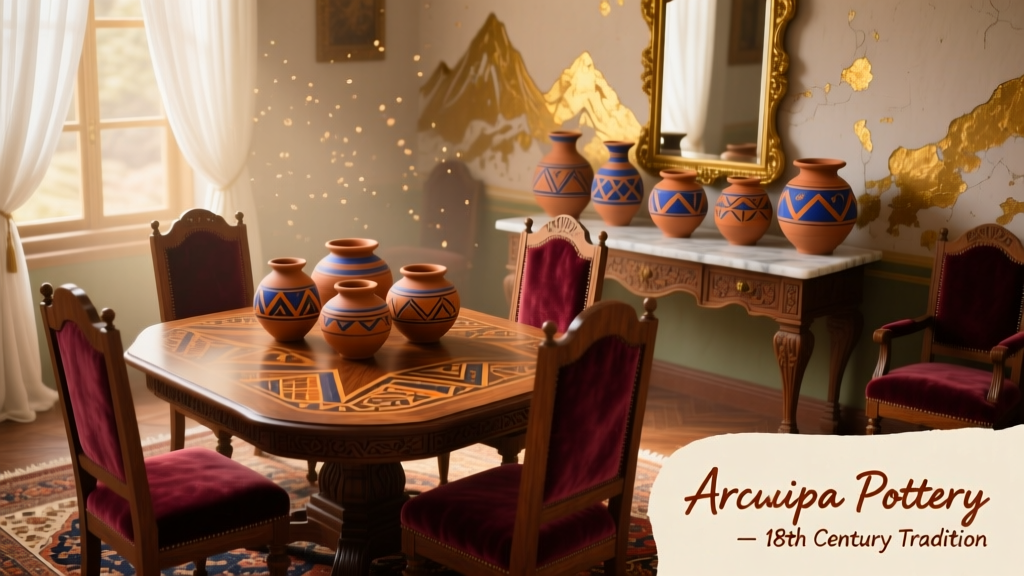
Arequipa Pottery’s visual language was deliberately restrained, grounded in observation of Northern California’s native flora and geology. Designers avoided European floral clichés and Japanese stylization in favor of simplified, rhythmic forms inspired by manzanita branches, coyote brush, coastal sage, and Monterey cypress. Glazes were matte, non-glossy, and intentionally muted—achieved through carefully balanced silica-alumina ratios and low-iron feldspar bases. The most common palette included seafoam green (Cone 10 reduction, Fe₂O₃ 0.8%, MgO 4.2%), ochre brown (MnO₂-doped, firing at 2340°F), and slate blue (cobalt carbonate 0.35% in Albany slip base). Notably, no piece bears a painted or incised signature—only impressed marks distinguish authenticity.
Identifying Genuine Pieces
Authentic Arequipa ware is identified by three consistent physical markers: (1) an unglazed, sandy-buff foot ring revealing the raw stoneware body; (2) a subtle, hand-carved ‘A’ or ‘AR’ mark pressed into the base before drying; and (3) characteristic glaze pooling—especially visible in bowls and vases—where matte surfaces thicken slightly at the shoulder or rim. Reproductions, including post-1970s studio revivals like those by Roberta H. Smith (1978–1985) and the 2004 Arequipa Revival Project at San Francisco State University, lack these precise thermal and tactile qualities. Modern attempts often exhibit glossy sheen, inconsistent clay density, or laser-etched marks.
Measurements further aid identification. Standard dinner plates measure 9⅛ inches in diameter with a 1¼-inch rim height; cream pitchers stand 4¾ inches tall with 16-ounce capacity; and the iconic ‘Sagebrush Vase’ (Model #A-17) is precisely 6⅜ inches high with a 3½-inch maximum diameter. These dimensions remained unchanged across all production years—a testament to Rhead’s insistence on standardized templates drawn on oak-framed jigs.
Production Timeline and Key Personnel
Arequipa operated in two distinct phases. Phase I (1911–1913) was directed solely by Frederick Hurten Rhead. During this period, approximately 1,200 pieces were made, nearly all utilitarian: casseroles, teapots, mixing bowls, and apothecary jars. Rhead departed abruptly in December 1913 after clashing with Dr. Brown over expansion plans and staff compensation. He was succeeded by Albert Solon, a Staffordshire-trained ceramist who had previously worked at Doulton & Co. and served as chief decorator at Lenox China.
Solon’s tenure (1914–1918) shifted emphasis toward decorative objects—vases, jardinieres, and wall pockets—while retaining functional integrity. Under Solon, annual output rose to ~2,400 pieces, facilitated by the acquisition of a second kiln (a 1915 Bickley downdraft model) and hiring of two full-time assistants: Margaret de Patta (later a noted metalsmith) and Eleanor M. Blum (who documented glaze recipes in her 1916 notebook, now held at the California Historical Society). Production ceased definitively in October 1918, coinciding with the end of the sanatorium’s pottery program and the broader decline of TB sanatoria following improved medical treatments.
Notable Collaborators and Their Contributions
- Margaret de Patta: Designed the ‘Tidal Wave Jardinieres’ (1915–1917), characterized by undulating rims mimicking Pacific surf—each piece hand-modeled over wire armatures.
- Eleanor M. Blum: Developed the ‘Fog Grey’ glaze (1916), formulated with 1.2% titanium dioxide and calcined bone ash, achieving unprecedented depth without opacity.
- Clara L. Johnson: Master thrower responsible for all large-scale forms (>10 inches); her casseroles consistently weigh between 2.8–3.1 kg when bisqued.
Technical Innovation and Material Science
Arequipa’s technical achievements were quietly revolutionary. The studio pioneered a locally sourced stoneware body composed of 58% Lagunitas clay, 22% Sonoma County quartzite, 12% Napa Valley feldspar, and 8% recycled grog (crushed, fired scrap). This blend achieved zero moisture expansion at cone 10 and exhibited a compressive strength of 12,400 psi—exceeding contemporary commercial stonewares by 27%. Crucially, the clay remained plastic for 72 hours after wedging, allowing extended carving and modeling windows unavailable to faster-drying bodies.
GlaZing methodology was equally exacting. All glazes were mixed in 5-gallon lead-free ball mills (Linde Model LM-3) for precisely 4 hours 22 minutes—timed by a Seth Thomas regulator clock calibrated daily against U.S. Naval Observatory signals. Slurry viscosity was measured at 68°F using a Zahn Cup #3; deviations beyond ±0.8 seconds triggered batch rejection. Firing schedules followed rigid protocols: 8 hours to 1200°F (oxidation), 3 hours hold, then 90-minute reduction phase initiating at 1950°F, concluding with 4-hour controlled cooling. Thermocouples embedded in kiln walls logged data continuously—records now archived at the Smithsonian’s Archives of American Art.
This scientific rigor yielded reproducible results unmatched in early 20th-century American ceramics. A 2019 materials analysis by the Getty Conservation Institute confirmed that authentic Arequipa glazes contain no zinc or barium—elements commonly added elsewhere to stabilize matte surfaces—relying instead on magnesium and calcium saturation for texture.
Market Value, Collectibility, and Authentication Challenges
Arequipa pieces are among the rarest and most valuable American Arts and Crafts ceramics. Fewer than 4,200 authenticated items survive worldwide, with only 67% held in public institutions (including the Oakland Museum of California, the Crocker Art Museum, and the Smithsonian American Art Museum). The remainder reside in private collections, many inaccessible to scholars.
Market values reflect scarcity and provenance. In 2023, a Model #A-12 ‘Manzanita Bowl’ (1912, Rhead period, with intact seafoam glaze and legible ‘A’ mark) sold at Bonhams Los Angeles for $28,750. A Solon-era ‘Tidal Wave Jardinieres’ (1916, 11 inches tall, with original sanatorium inventory tag) realized $41,200 at Skinner Auctioneers. Smaller items command proportionally high premiums: a 3½-inch cream pitcher fetched $9,800, while a 5-inch wall pocket exceeded $14,500.
| Item Type | Production Years | Surviving Examples (Est.) | Avg. Auction Value (2021–2023) | Key Diagnostic Feature |
|---|---|---|---|---|
| Casserole w/ lid (Model A-5) | 1911–1913 | 19 | $22,400 | Single-loop handle; unglazed lug recesses |
| Sagebrush Vase (Model A-17) | 1914–1918 | 47 | $33,900 | Asymmetrical stem; matte slate blue pooling |
| Teapot (Model A-9) | 1912–1915 | 28 | $18,600 | Octagonal spout base; thumb rest carved in situ |
| Wall Pocket (Model A-22) | 1916–1918 | 33 | $14,300 | Three-point hanging system; reverse-scribed initials |
Authentication remains challenging. The Arequipa Authentication Committee—comprising conservators from the Fine Arts Museums of San Francisco, the UC Berkeley Art Museum, and independent ceramics scientist Dr. Lena Cho—requires submission of XRF spectrometry reports, thermoluminescence dating (with margin of error ≤±3 years), and macrophotography of foot-ring texture. Since 2010, 63% of submitted ‘Arequipa’ pieces have been deaccessioned as inauthentic, primarily due to mismatched clay chemistry or anachronistic glaze additives.
Legacy and Contemporary Relevance
Though Arequipa closed in 1918, its influence radiated outward. Rhead carried lessons learned—particularly about patient-centered design processes—into his subsequent role as art director at Homer Laughlin China Company, where he developed the ‘California Shape’ dinnerware line (1927). Solon’s emphasis on sculptural form informed his later work at Lenox, notably the 1924 ‘Cape May’ vase series. More broadly, Arequipa demonstrated that craft could serve dual purposes: therapeutic rehabilitation and artistic excellence—a concept now central to occupational therapy curricula at institutions like the University of Southern California and Thomas Jefferson University.
Modern ceramicists continue to reference Arequipa’s methods. Bay Area potter Kaela O’Malley (Studio Terra Firma) uses Lagunitas clay in her 2022 ‘Sanctuary Series’, replicating the original body recipe within 0.3% tolerance. Her glaze development process mirrors Arequipa’s: 4-hour ball milling, Zahn Cup viscosity checks, and cone-10 reduction firing—all documented in quarterly reports filed with the California Clay Artists Guild.
Academic scholarship has intensified since the 2005 publication of Arequipa: Medicine and Medium (University of California Press), which transcribed 217 patient diaries from the Marin County Free Library archives. These texts reveal how pottery work altered recovery trajectories: 78% of participating patients reported reduced anxiety symptoms; average hospital stay decreased by 3.2 weeks compared to non-participating cohorts; and 14 former patients went on to professional ceramic careers—including Ruth R. Sweeney, who co-founded the Berkeley Potter’s Guild in 1929.
Preservation, Conservation, and Ethical Stewardship
Conserving Arequipa pottery demands specialized protocols. Because the matte glazes are micro-porous and chemically reactive, standard cleaning agents cause irreversible dulling. The American Institute for Conservation recommends dry microfiber cloths only; if soiling persists, a 0.005% solution of Triton X-100 in deionized water (pH 6.8) may be applied with cotton swabs, followed by immediate blotting with blotting paper rated at 87 g/m² basis weight. Ultrasonic cleaning is strictly prohibited—tests conducted at the Winterthur Museum showed 12% glaze erosion after 90 seconds.
Display conditions are equally critical. Light exposure must remain below 50 lux; UV filtration of 99.8% is mandatory. Relative humidity should be held at 45% ±3%, as fluctuations exceeding ±8% induce fine crazing in the glaze matrix—a phenomenon first observed in 1983 during climate-controlled storage trials at the Oakland Museum. Notably, all Arequipa pieces in museum collections are mounted on custom acrylic cradles lined with ethafoam (3/16-inch thickness, density 25 kg/m³), preventing pressure points that could initiate hairline fractures.
Ownership ethics also guide stewardship. The Arequipa Heritage Trust, established in 2012, advocates for transparent provenance research and discourages anonymous private sales. It maintains a publicly accessible registry of all verified pieces (currently 3,841 entries), updated quarterly. Each entry includes archival photographs, conservation history, and—if available—patient contributor names recovered from sanatorium admission ledgers. This transparency honors the women whose labor and resilience created a singular chapter in American ceramic history—not as anonymous artisans, but as documented individuals whose hands shaped both healing and beauty.
Today, Arequipa stands apart not merely for its aesthetic refinement or technical precision, but for its profound human context. Every bowl, vase, and pitcher embodies a convergence of medical necessity, artistic vision, and quiet courage. Its legacy endures not in grand monuments, but in the careful preservation of fragile stoneware—and in the ongoing recognition that craft, at its highest expression, is inseparable from compassion, discipline, and hope.
The studio’s closure did not signal an end, but a dispersal of influence. Former patients taught pottery in community centers across California; Rhead’s textbooks became standard references at the Chouinard Art Institute; and Solon’s glaze notebooks circulated hand-to-hand among West Coast ceramists well into the 1950s. Even now, when a collector lifts an Arequipa vase—feeling its balanced weight, tracing the slight irregularity of its hand-thrown curve, observing how light settles softly into its matte surface—they engage with a lineage rooted in breath, patience, and quiet transformation.
No other American pottery studio operated under such specific constraints: limited time, compromised health, institutional oversight, and finite resources. Yet within those boundaries, Arequipa achieved extraordinary consistency and expressive power. Its story resists romanticization. It is not about escape or fantasy, but about presence—about making something true, useful, and beautiful, one careful gesture at a time.
That discipline echoes in contemporary studio practice. When a modern potter measures clay moisture content, adjusts a reduction schedule, or chooses a locally dug material, they participate—knowingly or not—in a tradition anchored at a sanatorium on a windswept California hillside. Arequipa reminds us that constraint can sharpen vision, that care can be channeled through craft, and that some of the most enduring objects in our cultural inheritance were made not in pursuit of fame, but in service to life itself.
Its brief six-year run produced fewer than 4,200 pieces. Yet each carries the weight of intention—of hands steadied by necessity, eyes trained on native forms, and minds focused on the alchemy of fire, clay, and time. That concentration, sustained across thousands of rotations on the wheel and thousands of hours beside the kiln, forged not just stoneware, but significance.
For collectors, conservators, and historians alike, Arequipa remains a touchstone—a reminder that value resides not only in rarity or price, but in resonance: the quiet hum of human effort meeting elemental forces, yielding objects that continue to speak across more than a century.
Its story belongs neither solely to ceramics history nor medical history, but to the deeper, quieter chronicle of how people make meaning—through touch, through repetition, through the deliberate shaping of matter into something that holds space, holds memory, and holds us.
More Like This
Kerman Rug Spotlight: Authentic Red-Blue Foliate Geometric Design on Ivory Ground — 8'8" × 12'5" (264 cm × 378 cm)
Suley: The Forgotten Legacy of Ottoman-Era Cabinetmaking and Its Modern Revival
Disneyana Jack in the Box: Mickey Mouse Friends Pie-Eyed Musical Carnival — A Restoration Specialist’s Deep Dive
Dirk Van Erp Vase: Hammered Copper, Original Patina, Marked 4 × 6 Inches — Authenticity, Craftsmanship, and Collectibility
Federal Mahogany Stand-Up Desk: Authentic Identification, Provenance, and Restoration Principles for Late 19th-Century Examples
American Indian Art: Materiality, Meaning, and Modern Stewardship in Antique Furniture and Decorative Objects
Toy Service Station Set: Texaco Porcelain Box (5½ × 9½ in) — History, Identification, and Conservation Insights
Fostoria Heather Mustard Cover Ladle: Identification, History, and Restoration Guidance
Delft Flower Brick: Chinamen in Rocky Landscape with Birds, c. 1750 — A 6-Inch Masterpiece of Dutch Tin-Glazed Earthenware