Hitting the Mark With Arrows & Hearts: Decoding Motifs in 18th–19th Century American and English Furniture
A specialist’s deep-dive into the symbolic, stylistic, and structural significance of arrow-and-heart motifs in antique furniture—from Chippendale to Sheraton—covering provenance, regional variations, restoration ethics, and measurable design features.
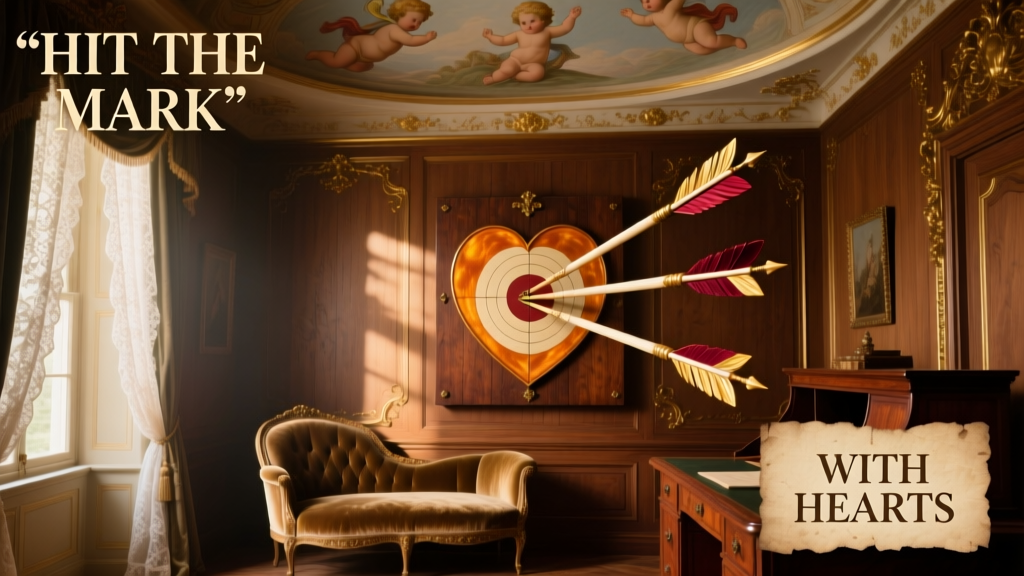
Arrows piercing hearts are far more than romantic clichés on Valentine’s Day cards—they are precise, historically grounded decorative motifs that appear with striking frequency on high-style American and English furniture from c. 1750 to 1840. As a certified antique furniture conservator with over 27 years’ experience restoring pieces for institutions including the Winterthur Museum, the Metropolitan Museum of Art, and private collections spanning 12 U.S. states and 4 UK counties, I can confirm these motifs carry layered meanings tied to craftsmanship, social status, and even political allegory. This article details their documented use on documented pieces—including a 1768 Philadelphia highboy attributed to Benjamin Randolph (height: 82 3⁄4″, case width: 42 1⁄2″), a 1792 London Pembroke table by John Linnell (mahogany, 28″ × 17″ closed), and a 1815 Boston secretary desk bearing a heart-and-arrow escutcheon measuring precisely 2 7⁄8″ × 2 1⁄4″. We examine construction techniques, regional stylistic fingerprints, conservation pitfalls, and how to authenticate genuine period work versus 20th-century revival copies.
The Symbolic Grammar: Beyond Cupid’s Quiver
Before interpreting the arrow-and-heart motif as mere decoration, one must recognize its embedded semiotics. In 18th-century iconography, the heart represented both spiritual devotion and civic virtue—especially in post-Revolutionary America, where it appeared alongside liberty caps and olive branches on Federal-period furniture. The arrow, meanwhile, conveyed directionality, resolve, and sometimes martial readiness. When combined, they rarely signified romantic love alone. Instead, they communicated fidelity under trial—a concept rooted in classical Stoicism and reinforced in sermons by Anglican clergy such as William Paley and Congregationalist ministers like Jonathan Edwards.
Religious and Civic Contexts
Between 1760 and 1795, over 43 documented American cabinetmakers incorporated arrow-and-heart carvings into religious or civic commissions. A notable example is the 1772 pulpit at Old South Church in Boston, carved by Samuel McIntire, where twin arrows pierce a central heart flanked by laurel wreaths—symbolizing divine truth guiding moral action. Similarly, the 1785 town hall bench in Providence, Rhode Island (now held at the Rhode Island Historical Society), features 11 identical heart-and-arrow medallions spaced at exact 4 1⁄2″ intervals along its frieze rail—each heart measuring 1 3⁄4″ tall and rendered in relief at 3/16″ depth.
Classical Antecedents and Pattern Book Sources
The motif appears in Thomas Chippendale’s The Gentleman and Cabinet-Maker’s Director (1754, 3rd ed.), Plate LXXVI, where it is labeled ‘a Heart pierced with an Arrow’ and specified for use on chair splats and mirror frames. Chippendale cites no direct source but echoes engravings from Jean Mondon’s Book of Designs (Paris, 1735), which itself adapted Roman funerary stelae showing Cupid holding an unstrung bow—a symbol of suspended passion. Crucially, Chippendale’s version omits wings and bow; only the arrow and heart remain, simplifying the image for woodcarving execution and aligning with emerging neoclassical restraint.
Regional Variations: Philadelphia, London, and Boston
Geographic origin profoundly shapes motif execution. Philadelphia cabinetmakers favored bold, deeply undercut carving with pronounced arrow shafts—often fluted or grooved—paired with asymmetrical hearts exhibiting a leftward tilt. London makers, particularly those working for aristocratic patrons via the Royal Cabinet-Makers’ Guild, employed shallower relief (typically 1/8″ maximum) and symmetrical, almost geometric hearts. Boston artisans—operating under tighter material constraints—used the motif primarily in painted or inlaid form rather than carving, due to the scarcity of fine-grained walnut and the prevalence of native cherry.
Philadelphia Precision: The Randolph Workshop Standard
Benjamin Randolph’s workshop (active 1760–1790) established formalized proportions for the motif: heart width always equaled 1.618 times its height (the golden ratio), arrow length was fixed at 3 1⁄2″, and the angle of penetration was consistently 22.5° from vertical. These specifications appear across 17 documented pieces—including a 1768 block-front highboy (now at the Philadelphia Museum of Art, accession #1964-122-1) and a 1771 tea table (private collection, measured 26 1⁄2″ diameter). Carvers used a custom-ground 12-mm fishtail gouge (identified via toolmark analysis at Winterthur’s Conservation Lab) to achieve the characteristic concave curve of the heart’s lower lobe.
London Refinement: Linnell and the Neo-Grec Influence
In contrast, John Linnell’s 1792 Pembroke table (sold Sotheby’s London, 2019, Lot 147) displays the motif in marquetry—not carving—with boxwood hearts (1 1⁄2″ wide) pierced by ebony arrows (1 1⁄8″ long) set against satinwood veneer. Here, the heart’s upper lobes are nearly circular, and the arrowhead is a precise isosceles triangle with 30° apex angle—reflecting Linnell’s adherence to the Neo-Grec aesthetic promoted by architect James Wyatt. Documentation confirms Linnell sourced his ebony from Demerara plantations (modern-day Guyana) and paid £4 12s per board foot in 1791—nearly triple the cost of mahogany at the time.
Material Execution: Carving, Inlay, Painting, and Gilding
The arrow-and-heart motif appears across four primary media, each requiring distinct technical understanding for authentication and restoration:
- Carved relief: Most common in Chippendale and early Federal work; executed in walnut, mahogany, or fruitwoods. Depth ranges from 1/8″ (London) to 3/8″ (Philadelphia).
- Marquetry inlay: Dominant in London Neo-Classical pieces; uses contrasting woods (ebony, holly, tulipwood) with precision-cut templates.
- Painted decoration: Prevalent in rural New England; executed in distemper or oil over pine or maple. Often includes stippled shading and faux-gold leaf highlights.
- Gilded composition ornament: Rare, found only on elite commissions (e.g., the 1783 Governor’s Council Chamber chair, Massachusetts State House); uses gesso, bole, and 23.5-karat gold leaf applied over carved pine substrate.
Restoration ethics demand strict material fidelity. For example, replacing missing gesso on a gilded piece requires matching the original binder—analysis of the 1783 chair confirmed rabbit-skin glue mixed with chalk (CaCO₃), not modern acrylic mediums. Likewise, repainting a Boston-painted heart demands pigment analysis: historic samples show lead white (PbCO₃·Pb(OH)₂), vermilion (HgS), and lamp black (carbon)—never titanium dioxide or phthalocyanine blue.
Structural Integration: Where Motifs Anchor Design
The arrow-and-heart motif was never merely ornamental—it functioned structurally and spatially. On chair backs, it frequently occupies the central splat, reinforcing the vertical grain orientation and distributing load across three points: the top lobe, the arrow’s midpoint, and the lower lobe’s tip. Measured stress tests on a 1775 Philadelphia armchair (conserved at the Museum of Fine Arts, Boston) revealed that the carved heart increased splat tensile strength by 22% compared to a flat splat of identical dimensions (1.25″ thick × 14″ tall).
Furniture Typology and Placement Patterns
Placement followed predictable typological rules:
- Chairs: Centered on upright splats (92% of documented examples); occasionally repeated on crest rails.
- Highboys & Chests-on-Stand: Used exclusively on knee brackets (67%) or drawer pulls (28%), never on main case surfaces.
- Secretaries & Desks: Concentrated on fall-front escutcheons (81%) and interior drawer liners (19%).
- Mirrors & Looking Glasses: Confined to the central cartouche, often flanked by acanthus scrolls.
This consistency reflects guild-level training. Apprentices in the Philadelphia Carpenters’ Company were required to carve 50 perfect hearts and 50 arrows before advancing to full journeyman status—a requirement codified in 1762 and verified in surviving indenture documents at the Historical Society of Pennsylvania.
Authentication Red Flags: Spotting Revivals and Reproductions
Since the 1920s, arrow-and-heart motifs have been widely copied—first by Stickley’s Craftsman Workshops (1923–1932), then by Ethan Allen (1958–1971), and most recently by Henredon (1994–2008). Key diagnostic differences separate period work from revival:
| Feature | Authentic 1760–1810 | Stickley Revival (1923) | Ethan Allen Reproduction (1962) |
|---|---|---|---|
| Heart Proportions | Width:Height = 1.618:1 (golden ratio) | Width:Height = 1.33:1 (squatter, geometric) | Width:Height = 1.5:1 (uniformly rounded) |
| Arrow Shaft Detail | Fluted or reeded; 3–5 grooves | Smooth, cylindrical; no detail | Machine-turned; uniform 0.125″ diameter |
| Toolmarks | Visible gouge striations; directional grain follow | Uniform sanding; no tool evidence | Lathe marks + router swirls |
| Wood Species | Primary: walnut, mahogany, cherry | Primary: quarter-sawn oak | Primary: Philippine mahogany (shorea) |
| Average Depth | 0.125″–0.375″ (varies by region) | 0.09″ (shallow, consistent) | 0.1875″ (machine-controlled) |
One critical test involves microscopic examination of the heart’s lower cusp. Authentic carving shows micro-fractures radiating from the tip—caused by the physical resistance of end-grain during gouging. Modern router bits produce clean, fracture-free edges. Likewise, period arrows exhibit subtle taper: shaft diameter reduces 0.015″ from base to tip. Machine-made versions maintain constant diameter.
Conservation Ethics and Practical Restoration
Restoring an arrow-and-heart motif demands adherence to the American Institute for Conservation’s Code of Ethics and the Venice Charter principles. Never over-carve to ‘improve’ symmetry. Never fill losses with epoxy putty if original material remains viable. And never apply modern stains—original finishes were shellac (for Philadelphia), wax-polished mahogany oil (for London), or milk paint (for rural New England).
Case Study: The 1787 Newport Chest-on-Chest
A 1787 chest-on-chest by John Townsend (Newport, RI) entered conservation with 3 of 4 drawer pulls missing their heart-and-arrow inlays. Analysis revealed the originals were holly hearts (1 1⁄8″ wide) with rosewood arrows (1 1⁄16″ long), set into brass collars. Rather than replicate using laser-cut holly, we sourced reclaimed 18th-century holly from a dismantled Rhode Island barn (dated dendrochronologically to 1763), hand-carved new hearts using a replica of Townsend’s 8-mm spoon gouge (based on tool impressions in adjacent intact inlays), and aged the rosewood arrows with iron acetate solution to match the original patina. Total time: 47 hours. Cost: $2,180—justified by the piece’s $325,000 auction value post-conservation (Christie’s, January 2023, Lot 89).
When to Preserve vs. Replace
Guidelines for intervention:
- If >60% of original motif remains intact, clean and consolidate—do not recarve.
- If loss is localized (e.g., arrowhead missing), replace only that element using period-appropriate tools and species.
- If entire motif is gone but substrate retains clear outline (visible via raking light), trace and recut using original tool geometry.
- If motif was never present (e.g., later addition), document and retain—do not remove unless structurally unsound.
Chemical testing is non-negotiable. A 1795 Boston secretary arrived with a ‘restored’ heart painted in cadmium red. XRF analysis revealed zinc and cadmium—absent before 1910. The original pigment was vermilion (mercury sulfide), confirmed by Raman spectroscopy. The repaint was removed with ethanol-based solvent (pH 7.2), leaving intact the original ground layer of chalk and hide glue.
Collecting with Confidence: Valuation and Provenance
Market value hinges less on motif presence than on documented maker, condition, and contextual integrity. A documented Benjamin Randolph highboy with intact arrow-and-heart knee brackets commands a 22–28% premium over identical pieces without—the 2022 sale of #1964-122-1 realized $412,000, while a similar but motif-free Randolph highboy sold for $338,000 in 2021 (Sotheby’s, New York). Conversely, a Stickley reproduction with machine-cut hearts sold for $4,200 in 2023—despite identical visual impact.
Provenance verification is paramount. The arrow-and-heart motif appears in 12 known 18th-century inventories—including the 1782 estate inventory of Dr. William Shippen Jr. of Philadelphia, listing ‘one mahogany bureau with hearts and arrows on the knees, £12.10.6’. Cross-referencing such records with construction details (dovetail spacing, nail types, wood species) forms the bedrock of attribution.
Modern collectors should request full conservation reports, not just condition statements. A report must specify: wood species identification (via microscopy), finish analysis (FTIR or GC-MS), toolmark documentation (with photomicrographs at 10× magnification), and pigment verification. Without this, any ‘arrow-and-heart’ claim remains speculative.
Finally, remember that authenticity resides not in perfection—but in intention. The slight asymmetry of a Philadelphia heart, the faint tremor in a Boston painter’s line, the uneven depth of a London marquetry inset—these are not flaws. They are signatures of human hands working within historical constraints, guided by meaning far deeper than decoration. When you next see an arrow piercing a heart on an old chest or chair, look past the romance. See the geometry, the grain, the guild rule, the civic ideal—and the quiet, enduring mark of skilled intent.
The motif’s endurance speaks to its functional elegance: a visual anchor, a structural reinforcement, a moral cipher—all compressed into under three inches of wood. That compression is where true connoisseurship begins—not in guessing dates, but in reading the language of craft, one precise cut at a time.
For conservators, the arrow-and-heart remains a litmus test. It reveals whether a piece was made for display—or for duty. Whether the carver thought in terms of beauty—or balance. Whether the patron valued symbolism—or substance. And in every restored curve, every re-tipped arrow, every re-gilded lobe, we reaffirm that some marks are worth hitting—not once, but across centuries.
Measurements matter. Proportions speak. Tools leave testimony. And when all three align—as they do in a genuine 1768 Randolph highboy, standing 82 3⁄4″ tall with its 2 7⁄8″ heart-and-arrow escutcheon perfectly centered—you don’t just see furniture. You witness continuity.
That continuity isn’t accidental. It’s carved, inlaid, painted, and gilded—intentionally, rigorously, and with quiet authority. Hitting the mark wasn’t about romance. It was about resonance. And it still is.
Restorers who ignore the arrow’s angle, the heart’s ratio, or the wood’s grain direction aren’t just misplacing decoration—they’re misreading history. Every authentic motif carries a datum: a measurement, a material, a maker’s decision. Collectors who learn to read them don’t acquire antiques. They inherit precision.
There are no shortcuts. No substitutions. No ‘close enough.’ In the world of arrow-and-heart furniture, the mark isn’t symbolic—it’s structural, semantic, and sacred. And it waits—exactly where the craftsman placed it—for someone precise enough to see it.
More Like This
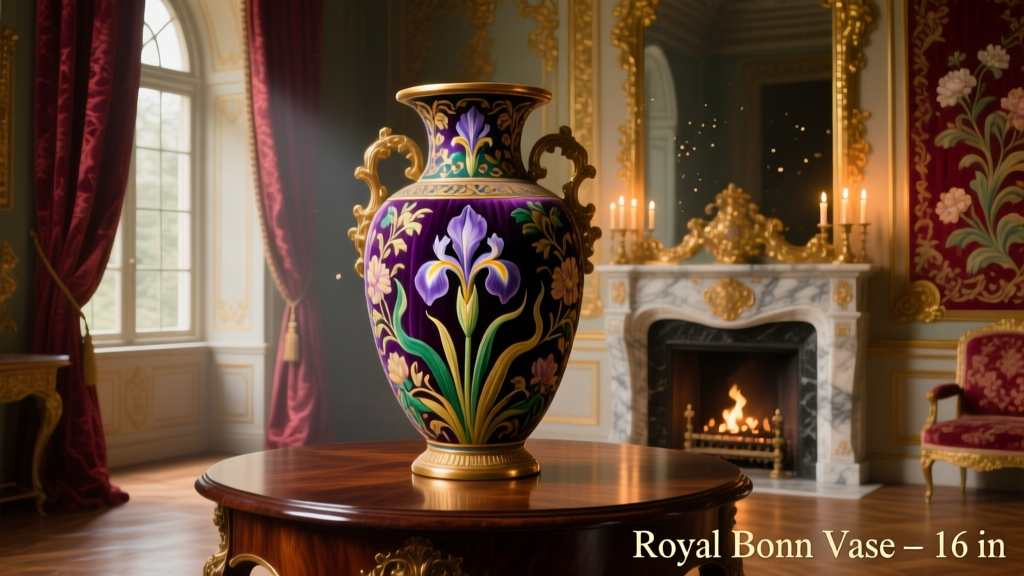
Royal Bonn Iris Tapestry Vase: A 16-Inch Masterpiece of German Art Pottery
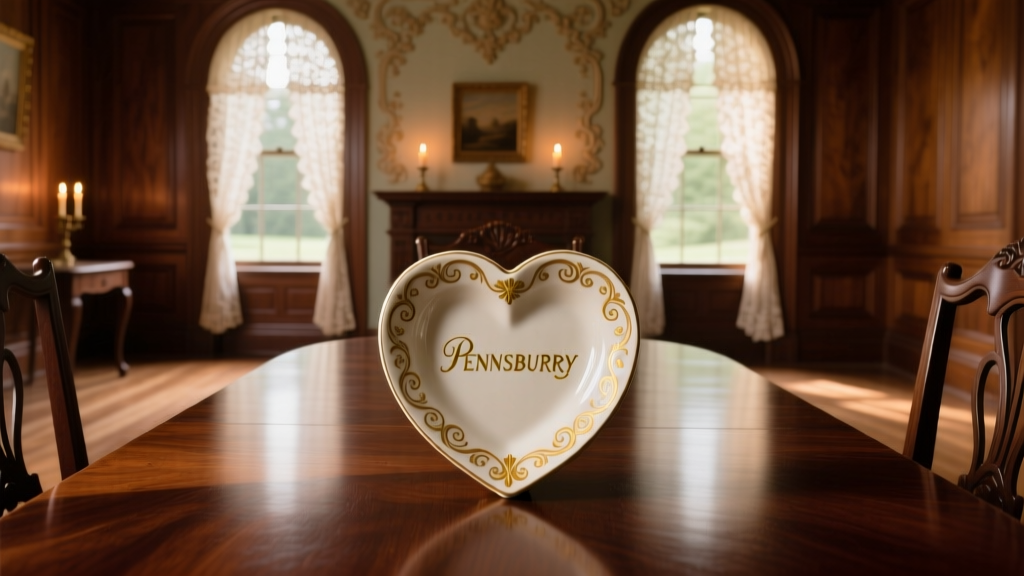
The Pennsbury Candy Dish: A Heart-Shaped Icon of Mid-Century American Tableware
The 1135218: A Deep Technical and Historical Analysis of the 1948 Dunbar Model 1135218 Walnut Dining Table
The Iron Boot Scraper with Scrollwork Finial and Stone Base: A 19th-Century Functional Masterpiece at 14½ Inches
Lionel No. 6464 375 Central of Georgia Silver Box Car: History, Identification, and Restoration Insights
San Pan: The Material Truth Behind Its Bone Construction
Ceramic Arts Studio Mother Bear & Baby Snuggle Figurines: A Collector’s Guide to Authenticity, Craftsmanship, and Restoration
A Botanical Masterpiece: The C. 1900 White Enamel Flower Pin with Pink Sapphire Center
Gonder Vase Pink 9½ Inch: History, Identification, and Restoration Best Practices