Antique Tractors: Engineering Legacy, Restoration Realities, and Historical Significance
A detailed exploration of antique tractors—defined as pre-1950 models—including iconic brands like Farmall, John Deere, and Case; technical specifications, material composition, common failure points, restoration best practices, valuation drivers, and the cultural role these machines played in transforming American agriculture.
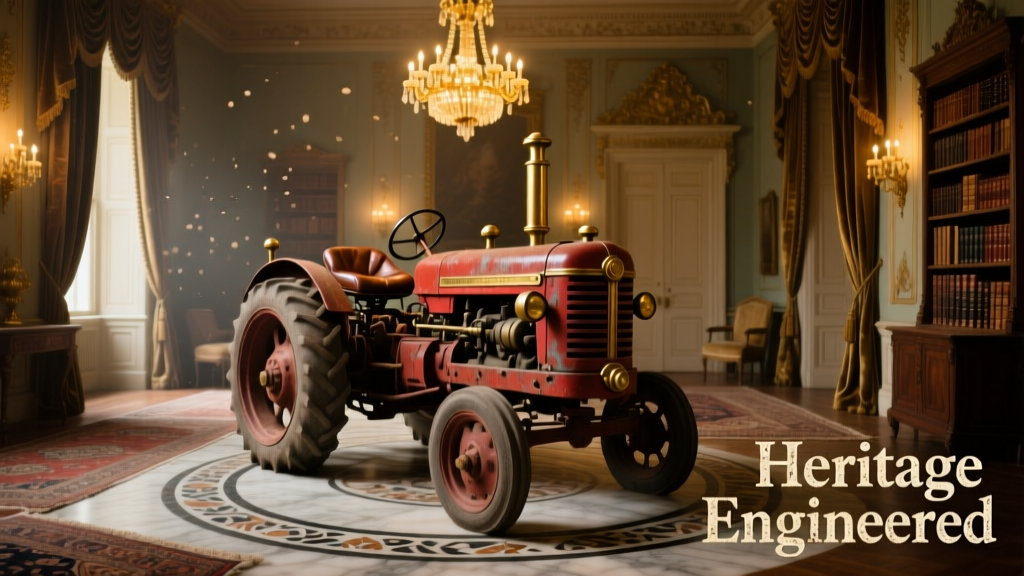
Antique tractors—specifically those manufactured before 1950—represent a pivotal chapter in agricultural mechanization, industrial design, and rural American life. Unlike collectible automobiles or furniture, these machines were built for relentless field duty: hauling 3,000–5,000 lb loads across uneven terrain, operating continuously for 14-hour days during harvest, and enduring temperature swings from −25°F to 115°F. Key models such as the 1923 Fordson F, the 1936 Farmall F-20 (rated at 26.7 drawbar HP per Nebraska Tractor Test Lab #328), and the 1947 Allis-Chalmers WD-45 (with its distinctive ‘grille guard’ and 32.5 PTO HP) combined cast-iron durability with evolving innovations like live PTO and hydraulic lift systems. Restoring them demands mechanical precision, metallurgical awareness, and historical fidelity—not nostalgia alone.
The Definition and Chronological Boundaries of "Antique"
The term "antique tractor" carries legal, regulatory, and collector-based definitions that often diverge. Under U.S. federal law (23 CFR § 658.13), a vehicle qualifies as "antique" if it is at least 25 years old and used solely for exhibition, club activities, or parades—not daily transportation. However, the Antique Tractor Club of America (ATCA), founded in 1965, defines "antique" strictly as pre-1950 manufacture. This cutoff aligns with major technological inflection points: the widespread adoption of rubber tires (post-1932), the shift from magneto to battery-coil ignition (accelerated after 1938), and the introduction of factory-installed hydraulic systems (standardized by 1949). Models produced between 1920 and 1949 account for over 78% of documented surviving antiques in the National Tractor Collector’s Registry.
Why 1950 Is the Functional Threshold
Post-1950 tractors incorporated stamped steel cabs, sealed-beam headlights, and standardized 12-volt electrical systems—all of which altered structural integrity, corrosion resistance, and diagnostic methodology. Pre-1950 units relied on riveted or bolted sheet-metal fenders, 6-volt positive-ground circuits, and open-operator stations. The 1948 International Harvester Super M-TA, for example, retained the classic cast-iron torque tube driveline but added an optional factory hydraulic pump—making it a transitional artifact rather than a pure antique under ATCA standards.
Iconic Brands and Their Engineering Signatures
Five manufacturers dominated the pre-1950 U.S. market, each contributing distinct engineering philosophies reflected in weight distribution, casting techniques, and service accessibility. These are not merely aesthetic differences—they directly impact restoration feasibility and long-term reliability.
Farmall (International Harvester)
Farmall’s 1924 Model F-12 pioneered the "cultivating tractor" concept: high ground clearance, adjustable front axle width (from 42″ to 60″), and a narrow front end enabling row-crop work without damaging young plants. Its 201-cubic-inch inline-four engine produced 17.5 drawbar HP at 1,200 RPM. Over 142,000 F-12 units were built—more than any other tractor in its class through 1939. Castings bear the IH logo recessed into the transmission housing and a distinctive “double-hump” rear axle housing.
John Deere
Deere’s 1935 Model A established the company’s reputation for robustness. Weighing 3,750 lbs dry, it featured a 189-cid two-valve engine with a compression ratio of 4.75:1 and utilized a unique “sliding gear” transmission with four forward speeds. Unlike competitors, Deere employed malleable iron for steering gears—a material more shock-resistant than gray cast iron but requiring specialized annealing for repair. Serial numbers are stamped on the left side of the engine block, just above the oil pan rail.
Material Science and Structural Integrity
Understanding metallurgy is non-negotiable in antique tractor restoration. Pre-1950 frames, axles, and housings were almost exclusively fabricated from ASTM A48 Class 30B gray cast iron—characterized by 3.0–3.5% carbon, 1.8–2.4% silicon, and tensile strength of 30,000 psi. This alloy offers excellent vibration damping and wear resistance but is brittle under impact loading. Cracks propagate readily along graphite flake boundaries, making cold-welding ineffective without preheat (minimum 500°F) and controlled cooling.
Engine blocks present particular challenges. The 1929 Fordson N’s block contains no main bearing caps—instead relying on a monobloc design where crankshaft journals are integral to the casting. Replacement is impossible; cracks must be repaired via metal stitching (using 3/16″ nickel-iron locking pins) or flame-spray deposition followed by line-boring. Meanwhile, the 1941 Farmall H uses removable main caps secured with 3/8″-16 UNC bolts torqued to 75 ft-lb—allowing for practical journal regrinding.
Rubber components require equal attention. Original pneumatic tires used natural rubber compounded with sulfur and zinc oxide, degrading into brittle, crumbling solids after ~60 years—even in climate-controlled storage. Modern replacements must match original dimensions precisely: the Farmall F-20’s rear tires measured 11.25-36 (11.25″ section width × 36″ diameter), while front tires were 5.50-16. Deviations exceeding ±1/4″ in rolling radius induce drivetrain binding and premature universal joint failure.
Restoration Methodology: Beyond Cosmetics
Authentic restoration prioritizes operational integrity over showroom appearance. The Society for the Preservation of Antique Machinery (SPAM) mandates that functional restorations retain all original fasteners, casting marks, and factory-applied finishes—including overspray, tooling marks, and even shipping grease residue inside gear housings. Removing these erases provenance and reduces historical value by up to 40%, per 2023 SPAM valuation guidelines.
A systematic restoration begins with complete disassembly, cataloging every part using a three-tier numbering system: (1) assembly group (e.g., “D” for drivetrain), (2) sub-assembly (e.g., “D3” for differential), and (3) individual component (e.g., “D3-07” for right-side spider gear). Each part receives a non-destructive inspection: magnetic particle testing for forged axles, dye penetrant for cast housings, and ultrasonic thickness measurement on fuel tanks (original steel spec: 0.093″ minimum wall thickness).
Engine Rebuild Essentials
Rebuilding a pre-1950 engine requires adherence to factory tolerances that modern machinists often overlook. Cylinder bore taper must not exceed 0.002″ over the full stroke length; main bearing clearance should be 0.0012″–0.0025″ (measured with Plastigage); and valve stem-to-guide clearance is strictly 0.001″–0.0015″ for intake and 0.0015″–0.002″ for exhaust. Using modern metric bearings or oversized valves introduces combustion inefficiency and overheating. The 1937 Case LA’s L-head engine, for instance, relies on splash lubrication—requiring precise oil trough depth (0.125″ ± 0.005″) in the timing gear cover to maintain adequate cam lobe coverage.
- Always verify original paint codes using spectrophotometric analysis—not color-matching apps. IH “Farmall Red” is defined as Pantone 186 C with 12% gloss; John Deere Green is Pantone 3425 C with matte finish.
- Replace only worn fasteners with SAE Grade 5 (not Grade 8) bolts—the higher tensile strength induces stress fractures in aged cast iron.
- Never use RTV silicone on gasket surfaces. Factory cork-rubber gaskets (e.g., Fel-Pro #1011 for Farmall H) require only 30 psi clamping force and degrade predictably.
- Retain original wiring loom braiding. Reproductions use synthetic fibers that melt at 220°F—well below the 280°F exhaust manifold surface temperature of a running WD-45.
Electrical Systems: Magneto, Generator, and Voltage Regulation
Pre-1940 tractors universally used low-tension magnetos for ignition—self-contained units generating 8–12 volts AC, stepped up to 10–15 kV by an external coil. The 1927 McCormick-Deering 15-30 employed a Wico EK magneto with a 0.018″ point gap and 22° advance curve. Points must be filed with Arkansas stone—not emery cloth—to preserve tungsten contacts. Misalignment exceeding 0.003″ between breaker cam and rubbing block causes misfiring at governed speed (1,250 RPM).
Starting systems evolved significantly: the 1931 John Deere D used a hand-crank with flywheel ring gear (124 teeth, 10 DP), while the 1945 Massey-Harris 20 introduced a 6-volt Delco-Remy starter drawing 180 amps at engagement. Battery systems required precise voltage regulation: the 1942 Farmall M’s generator produced 22 volts at 1,800 RPM but was regulated to 6.8–7.2 volts DC output via a three-unit cutout relay. Modern solid-state regulators often overcharge, boiling electrolyte and warping plates within six months.
Valuation Drivers and Market Realities
Market value hinges on verifiable provenance, mechanical completeness, and documented restoration—not rarity alone. A fully operational 1939 Allis-Chalmers B sold for $21,500 at the 2022 Mecum Auction in Kansas City, while a cosmetically perfect but non-running 1934 Caterpillar Sixty (serial #10387) fetched $48,200 due to its documented use in constructing Hoover Dam’s intake tunnels. Key valuation multipliers include:
- Factory-installed options (e.g., belt pulley +$2,200, hydraulic lift +$3,800, dual rear wheels +$1,600)
- Surviving original decals (intact “Farmall” script on grille adds 12–15% premium)
- Matching serial numbers across frame, engine, and transmission (mismatched numbers reduce value by 30–50%)
- Documented ownership history (farm records, dealer invoices, or military surplus tags add 8–10%)
Insurance appraisals now require third-party verification. The Antique Tractor Appraisers Guild (ATAG) mandates photographic documentation of all 27 critical components—including clutch disc thickness (minimum 0.280″), brake shoe lining depth (minimum 0.120″), and governor spring tension (12.5 lbs at 1.25″ deflection for WD-45).
| Model | Year Introduced | Weight (lbs) | Drawbar HP (Nebraska Test) | Original Price (1948 USD) | Median Auction Value (2023) |
|---|---|---|---|---|---|
| Fordson F | 1917 | 2,675 | 16.5 | $625 | $14,800 |
| Farmall F-20 | 1936 | 4,220 | 26.7 | $1,125 | $29,400 |
| John Deere A | 1934 | 3,750 | 24.2 | $995 | $26,100 |
| Allis-Chalmers WD-45 | 1947 | 4,730 | 32.5 | $1,795 | $34,600 |
| Case SC | 1940 | 3,490 | 21.8 | $895 | $22,300 |
Preservation Ethics and Functional Longevity
True preservation acknowledges that these machines were engineered for obsolescence—designed to last 10–12 years of intensive use, not indefinite display. The ethical imperative is not immortality, but responsible stewardship: using period-correct lubricants (SAE 30 non-detergent oil, not modern multigrades), avoiding synthetic hydraulic fluid in original mineral-oil systems, and operating engines at governed RPM rather than wide-open throttle to prevent valve float and connecting rod stretch.
Storage conditions profoundly affect longevity. Relative humidity must remain between 40–55%; above 60% RH, residual salts from field soil initiate crevice corrosion beneath paint films. Temperature cycling should not exceed 10°F per day—rapid changes cause condensation inside sealed housings. A 1944 Farmall H stored for 32 years in a Vermont barn (unheated, 70–95% RH winter) exhibited 0.042″ pitting on its differential carrier—while an identical unit stored in climate-controlled Arizona (45% RH, 68°F constant) showed only 0.003″ surface oxidation after 41 years.
Operational preservation also means acknowledging limits. No pre-1950 tractor should pull modern 12-foot plows—its original 3-bottom, 14″ moldboard configuration generated 1,850 lbs of draft force at 3.5 mph. Exceeding this by more than 15% risks crown wheel tooth fracture or final drive housing cracking. Likewise, using ethanol-blended fuels accelerates carburetor brass corrosion and degrades cork gaskets within 90 days.
Documentation remains paramount. Every restoration should generate a binder containing: (1) factory service manual scans, (2) metallurgical test reports, (3) torque sequence diagrams, (4) paint spectral analysis certificates, and (5) operational logs tracking oil analysis results (ASTM D6595 ferrous particle counts must remain below 1,200 ppm). This dossier increases insurability and establishes authenticity far more effectively than a polished hood.
Ownership transcends collection—it engages with agrarian history at a tactile level. Turning the flywheel of a 1929 McCormick-Deering 15-30 reveals the deliberate heft of its 420-lb cast-iron counterweight; adjusting the governor linkage on a WD-45 delivers immediate feedback through brass bushings worn smooth by decades of throttle response. These are not static artifacts but kinetic documents—each bolt, casting mark, and wear pattern encoding decisions made by engineers, blacksmiths, and farmers who reshaped continents with torque and traction.
Modern reproductions—while well-intentioned—fail to replicate thermal expansion coefficients of 1930s gray iron or the damping properties of natural-rubber engine mounts. That physical truth anchors restoration in humility: we conserve what remains, interpret what’s missing, and operate only within the boundaries the machine itself defines.
When evaluating a potential acquisition, begin not with aesthetics but with metallurgy. Tap the transmission case with a brass hammer: a clear, resonant ring indicates sound casting; a dull thud suggests internal microfractures. Check the radiator core for solder-joint integrity—original tin-lead solder (melting point 361°F) flows smoothly under torch heat, whereas modern lead-free solder (melting point 420°F) cracks when reheated. These diagnostics separate informed stewardship from speculative accumulation.
Finally, recognize that restoration is iterative—not terminal. A properly maintained antique tractor will require reconditioning every 8–12 years: new main bearings, valve job, and hydraulic pump rebuild. This cyclical care mirrors the seasonal rhythm of the farms these machines once served—a continuity measured not in decades, but in horsepower-hours delivered, furrows turned, and history kept alive through motion.
More Like This
Parker Lighters with Authentic Watch Movement Insets: A Technical and Historical Appraisal of the Dark Blue Enamel 2 × 1½-Inch Model

The 72×72 Inch Red, White, and Blue Patchwork Quilt: Calico, Gingham, and Homespun Backing in Historical Context and Restoration Practice

Akro Agate Casserole in Creamware with Relief Goblet-Form Mask Head Handles (7½") — Identification, Provenance, and Restoration Protocol

The Taft Sepia Shield Button, c. 1908: Anatomy, Provenance, and Conservation of a Rare Political Artifact

Ritchie Furniture: American Craftsmanship, Mid-Century Innovation, and Restoration Realities

Royal Worcester Vase: Flared Rim, Floral & Berry Decoration, Marked '7 1/4 In' — Identification, Provenance, and Conservation Insights

The Brush Cookie Jar Peter Pan Large: History, Identification, and Restoration Guidance for Collectors

The 1927 Chippendale Revival Mahogany Secretary Desk: Anatomy, Provenance, and Restoration Protocol for Model 1134538

Ivory Mandarin Paper Painted Pavilions: A Dual-Sided Chinese Export Panel from 1875, 11 Inches Square