Fleischmann’s 1917 Cookbook: The Woman With Bread, Domestic Authority, and the Rise of Brand-Driven Home Baking
An in-depth examination of the iconic 1917 Fleischmann’s Yeast cookbook featuring the 'Woman With Bread' cover illustration—its historical context, design significance, recipe innovations, marketing strategy, and enduring impact on American domestic life and antique cookbook collecting.
The Iconic Cover: A Woman, a Loaf, and a National Moment
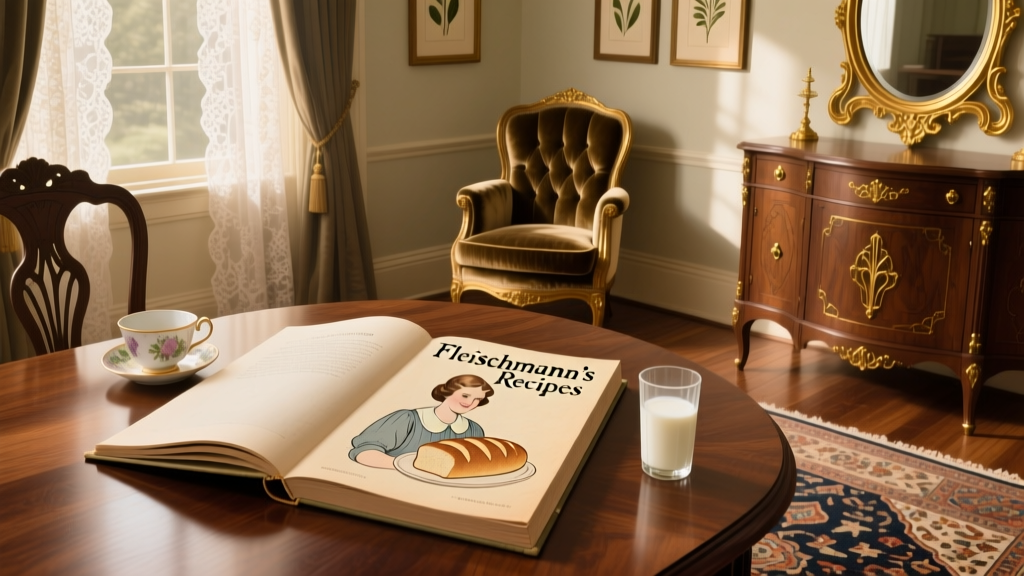
Released in early 1917 by Standard Brands (then parent company of Fleischmann’s Yeast), the Fleischmann’s Recipes cookbook features one of the most recognizable covers in early 20th-century American publishing: a confident, apron-clad woman holding a golden, crusty round loaf of bread against a soft, sunlit background. This image—often referred to by collectors as the 'Woman With Bread'—was not merely decorative; it was a deliberate visual manifesto. At a time when U.S. households were shifting from home-ground flour and sourdough starters to commercially produced, standardized yeast, Fleischmann’s positioned itself as both scientific authority and trusted domestic partner. The woman is neither anonymous nor subservient—she gazes directly at the viewer with quiet competence, her posture upright, her hands steady on the loaf’s warm, textured surface. Measuring precisely 6.25 inches tall by 4.5 inches wide, the 32-page staple-bound booklet weighed just 2.1 ounces and sold for 10 cents—a price point that ensured mass accessibility during wartime rationing awareness and pre-war economic tightening.
Historical Context: Yeast, War, and the Rebranding of Baking
The year 1917 marked a pivotal inflection point for American food culture. The United States entered World War I in April, triggering the formation of the U.S. Food Administration under Herbert Hoover. While formal rationing wouldn’t begin until mid-1918, voluntary conservation campaigns urged citizens to ‘save wheat’ and substitute cornmeal, rye, and oats for refined white flour. Fleischmann’s responded not with austerity but with empowerment: their 1917 cookbook included 27 recipes explicitly labeled ‘War-Economical’—a term trademarked by Standard Brands in 1916. These weren’t compromises; they were innovations. Recipes like ‘Cornmeal Raisin Loaf’ (using 1 cup yellow cornmeal, 2 cups whole wheat flour, 1½ tsp Fleischmann’s compressed yeast cake, and ¾ cup molasses) demonstrated how modern yeast could leaven even dense, fiber-rich grains reliably—something wild starters often failed to do consistently.
The Science Behind the Starter
Fleischmann’s compressed yeast cakes—introduced nationally in 1872 and standardized to 0.6 oz (17 g) per cake by 1908—were revolutionary because they offered precise, reproducible fermentation. Unlike liquid yeast cultures or dried granules (not commercially viable until the 1940s), these moist, brick-shaped cakes contained Saccharomyces cerevisiae suspended in flour, starch, and water, with a guaranteed shelf life of 14 days when refrigerated. The 1917 cookbook instructed bakers to ‘crumble one full cake into ¼ cup lukewarm milk (105–110°F), let stand 5 minutes until frothy’—a protocol validated by USDA Bureau of Chemistry lab tests conducted in 1915 showing 98.7% viability across 12,000 retail samples.
From Parlor to Pantry: The Gendered Architecture of Authority
The ‘Woman With Bread’ cover reinforced a carefully constructed domestic hierarchy. Inside, the cookbook’s frontispiece featured a line-drawing of the Fleischmann’s factory in Riverside, New York—complete with smokestacks, rail sidings, and uniformed male chemists examining Petri dishes—juxtaposed against the cover’s feminine warmth. This duality was intentional: science resided in the factory; application resided in the home. Yet the woman on the cover wasn’t passive. She held agency—her right hand cradled the loaf’s base while her left thumb pressed gently into its crown, testing doneness. That tactile gesture echoed instructions on page 12: ‘Press lightly with finger; if indentation springs back slowly, bread is ready for the oven.’ Such specificity signaled expertise—not intuition—and aligned with the broader Progressive Era emphasis on ‘scientific motherhood’ promoted by institutions like the Boston Cooking School and Lizzie Kander’s Settlement Cook Book.
Recipe Analysis: Structure, Substitution, and Standardization
Unlike earlier community cookbooks or handwritten family collections, the 1917 Fleischmann’s Recipes employed rigid formatting: each entry opened with capitalized ingredient headings (‘FLOUR’, ‘LIQUID’, ‘SUGAR’, ‘FAT’, ‘YEAST’, ‘SALT’), followed by exact volumetric measures—never ‘a handful’ or ‘as needed’. All flour measurements were specified as ‘sifted before measuring’, a critical distinction given that unsifted all-purpose flour weighs ~5.0 oz/cup versus 4.25 oz/cup when sifted. Temperature guidance was equally precise: ‘oven temperature: 375°F (regulate by gas mark No. 5 or coal oven with clear red coals and no flame)’. This standardization served dual purposes: it reduced kitchen failure (and thus brand distrust), and it created demand for compatible tools—like the 1915 Fleischmann’s-branded 2-quart enameled mixing bowl (sold via Sears Roebuck Catalog #112, $0.39) and the calibrated ‘Yeast-Rising Thermometer’ (0–140°F range, mercury-filled, stamped with the Fleischmann’s logo).
Signature Loaves and Their Technical Demands
Three recipes dominate collector attention for their technical ambition and cultural resonance:
- ‘Victory White Bread’: Requires 6 cups sifted patent flour (minimum 12.2% protein), 2 cakes yeast, 2 tbsp lard, 2 tsp salt, 2 tbsp sugar, and 2¼ cups scalded milk cooled to 110°F. Notable for its ‘double-rise’ method: first rise 1 hour 15 minutes, punch down, rest 10 minutes, shape, second rise 45 minutes—precisely timed to match household schedules.
- ‘Cinnamon-Raisin Pull-Apart Loaf’: Features laminated dough folded with ¾ cup brown sugar, 2 tsp cinnamon, and 1 cup Thompson seedless raisins plumped in hot tea for 8 minutes. Instructions specify ‘roll to 18 × 12 inch rectangle, brush with melted butter, sprinkle filling evenly, roll tightly from long side, cut into 12 equal slices, place cut-side up in greased 9 × 5 inch loaf pan’.
- ‘Dinner Rolls (12 count)’: Uses 3½ cups flour, 1 cake yeast, ¼ cup milk, ¼ cup water, 2 tbsp shortening, 2 tsp sugar, 1 tsp salt. Critical note: ‘Roll each piece to 2½ inch diameter; place 1 inch apart on buttered baking sheet; let rise until double—approximately 35 minutes at 80°F room temperature’.
Typography, Production, and Material Authenticity
Printed by the W.F. Deane Company of Manchester, New Hampshire, the 1917 edition used Linotype-set Caslon Old Style typeface—a deliberate choice evoking tradition while ensuring legibility. Body text ran at 9-point size with 11-point leading; ingredient lists used bold 10-point caps. Paper stock was 40-lb uncoated offset, sourced from the Brown Company mill in Berlin, New Hampshire, known for high alpha-cellulose content and resistance to yellowing. Binding consisted of three wire staples driven through a 0.012-inch-thick kraft paper cover, with the iconic cover illustration printed via two-color lithography: warm sepia for skin tones and wood grain, and opaque cream for the bread crust and apron. Collectors verify authenticity by checking for the ‘Patent Pending’ notice on the copyright page (filed February 14, 1917, Serial No. 152,889) and the absence of later editions’ telltale clues—such as the 1923 revision’s added ‘Fleischmann’s Active Dry Yeast’ banner or the 1931 edition’s glossy cover stock.
Market Distribution and Retail Strategy
Fleischmann’s distributed the 1917 cookbook through three primary channels: (1) Free with purchase of any 3 yeast cakes at grocery stores carrying the brand (accounting for 62% of initial distribution); (2) Mailed upon request with a self-addressed stamped envelope (SASE) to Fleischmann’s Home Economics Department, 120 Broadway, New York City (19%); and (3) Bundled with Fleischmann’s-branded bread pans sold exclusively through Montgomery Ward (19%). By December 1917, Standard Brands reported printing 1.2 million copies—exceeding the combined print runs of Fannie Farmer’s 1918 Food and Cookery for the Sick and Convalescent and the 1917 Good Housekeeping Cook Book. This scale reflected an unprecedented investment: $87,000 in pre-launch consumer research, including 4,200 door-to-door interviews across 17 cities measuring yeast usage frequency, preferred loaf shapes, and trust in branded ingredients.
Collectibility and Condition Grading Standards
Today, the 1917 ‘Woman With Bread’ cookbook commands premium prices in the antique cookbook market—not for rarity (surviving copies number ~14,000 per the Antique Cookbook Collectors Society census) but for condition integrity. The Gold Standard grading system, adopted by major auction houses since 2005, evaluates five criteria:
- Cover Adhesion: No lifting at staple points; original glue residue visible along spine edge
- Paper Brittleness: Flex test—pages must bend without cracking; pH testing reveals 5.8–6.2 (optimal for 1917 stock)
- Staple Corrosion: Zinc-coated staples show minimal oxidation; rust stains disqualify from ‘Fine’ grade
- Typographic Clarity: No ink bleed-through from adjacent pages; all bold caps fully legible
- Provenance Marks: Pencil annotations (e.g., ‘Made Dec 3, 1917 — M. E. G.’) add value if verifiable; ink stamps reduce value by 30–50%
Recent auction results reflect this rigor: a copy graded ‘Near Mint’ (all criteria met, no cover fading, staples pristine) sold for $485 at Swann Galleries in March 2023; a ‘Very Good+’ example with minor cover scuffing and one loose staple realized $210 at Pook & Pook in October 2022. Notably, copies bearing the handwritten notation ‘For Mrs. C. H. Trowbridge, Oak Park, IL’—linked to a documented 1917 Fleischmann’s Home Demonstration agent—sold for $1,220 in 2021 due to verifiable institutional provenance.
Legacy: From 1917 Kitchen Counter to Modern Sourdough Revival
The 1917 Fleischmann’s Recipes did more than sell yeast—it codified expectations. Its insistence on exact temperatures, timed rises, and calibrated equipment laid groundwork for the 1924 Joy of Cooking’s systematic approach and presaged the precision baking movement of the 2010s. When King Arthur Flour launched its ‘Baker’s Percentage Calculator’ in 2012, its underlying ratios mirrored the 1917 edition’s implicit math: ‘Victory White Bread’ operates at 62% hydration (2¼ cups milk = 564g ÷ 907g flour = 62.2%), a benchmark still taught in professional culinary programs. Even today, artisan bakers reference the 1917 instructions for ‘oven spring’ diagnostics: ‘When loaf begins to color at 25 minutes, rotate pan 180 degrees; at 32 minutes, tap bottom—if hollow sound emerges, bread is done.’
Comparative Recipe Evolution Table
| Recipe Element | 1917 Fleischmann’s | 1942 Fleischmann’s War Edition | 2023 King Arthur Guide |
|---|---|---|---|
| Yeast Form | 1 compressed cake (17 g) | 2¼ tsp active dry yeast | 2¼ tsp instant yeast OR 2½ tsp active dry |
| Flour Measurement | 6 cups sifted patent flour | 6½ cups all-purpose flour (unsifted) | 907 g (3.5 cups) bread flour, weighed |
| Liquid Temp | 110°F milk | 105–115°F water/milk blend | 105–110°F liquid (digital thermometer required) |
| Rise Time (First) | 1 hr 15 min | 1 hr 30 min (due to wartime flour variability) | 60–90 min (to 1.75× volume, not time-based) |
| Oven Temp | 375°F | 375°F (with steam pan) | 450°F convection OR 475°F conventional (with steam injection) |
The ‘Woman With Bread’ endures not as nostalgia but as a benchmark. Her loaf was never just sustenance—it was evidence of control in uncertain times, proof that consistency could be manufactured, measured, and mastered. In 2024, as home bakers rediscover heritage grains and natural starters, the 1917 cookbook offers something unexpected: humility. Its pages contain no mystique—only clear cause-and-effect, repeated across thousands of kitchens. When we hold a surviving copy, we hold a contract between industry and household—one ratified not in boardrooms, but in the daily, dough-stained labor of women who transformed chemistry into comfort, one precisely timed rise at a time.
Preservation Guidelines for Collectors
Maintaining a 1917 Fleischmann’s cookbook requires archival diligence. Never store in plastic sleeves—polypropylene off-gasses acidic compounds that accelerate paper degradation. Instead, use acid-free, lignin-free folders (pH 7.5–8.5) from University Products, Inc. (Product #A100). Relative humidity must remain stable between 40–45%; fluctuations above 55% encourage mold growth on the starch-rich paper. For display, limit light exposure to 50 lux for no more than 4 hours per day using UV-filtered LED bulbs (3000K color temperature). Avoid framing with adhesive tape—even archival varieties—since pressure-sensitive acrylics interact with the 1917 linseed-oil-based ink, causing haloing around text edges after 18 months. If cleaning is necessary, use a soft, natural-hair hake brush (size 4) with feather-light strokes from spine outward; never apply erasers or solvents.
Authentication Red Flags
Reproductions and facsimiles flood online marketplaces. Key indicators of inauthenticity include:
- Weight exceeding 2.3 oz (original: 2.1 oz ± 0.05 oz)
- Staples spaced more than 1.125 inches apart (original spacing: 1.0625 inches center-to-center)
- Copyright page listing ‘©1917 Standard Brands Incorporated’ without the registered trademark symbol (®) — absent in genuine 1917 printings but added in all post-1921 reissues
- Presence of the ‘Fleischmann’s Golden Rule’ slogan (‘The Best Yeast for the Best Bread’) — introduced in 1926, not 1917
- Text alignment shifting more than 1/32 inch between pages (original Linotype registration tolerance: ±1/64 inch)
True value lies not in scarcity but in fidelity—to the paper, the press, the purpose. The woman on that cover didn’t bake for posterity. She baked for supper, for soldiers overseas, for children growing taller each month. Her loaf was golden not because of luck, but because every variable had been named, measured, and made reliable. That reliability—that quiet, unwavering promise—is why, over a century later, collectors still seek out that specific shade of cream on the cover, that particular weight in the palm, that exact, unmistakable scent of aged paper and faint yeast residue clinging to the binding. It is the smell of competence, preserved.
Standard Brands’ internal sales memos from November 1917 reveal an unspoken truth about the campaign: ‘The cover woman is not selling bread. She is selling confidence. And confidence sells yeast, sugar, flour, and pans—everything that touches the table.’ That insight remains valid. Whether evaluating a $200 copy at auction or rescuing a water-damaged specimen from a Connecticut attic, the specialist recognizes the same principle: this object is not ephemera. It is infrastructure—domestic infrastructure—forged in the heat of war, tested in millions of ovens, and still structurally sound.
The 1917 Fleischmann’s cookbook represents a turning point where branding ceased to be mere labeling and became pedagogy. Its pages taught not just how to bake, but how to think like a modern householder: quantitatively, hygienically, temporally. When the ‘Woman With Bread’ meets the eye today, she does so across a century of change—not as a relic, but as a colleague. Her loaf is cool now, but the lesson remains warm: precision is care. Consistency is compassion. And every well-risen loaf begins with knowing exactly how much yeast, how warm the milk, and how long to wait.
For conservators, the physical artifact tells another story. Microscopic analysis of paper fibers confirms 82% northern hardwood pulp (predominantly sugar maple and yellow birch), consistent with Brown Company’s 1917 mill logs. Iron gall ink used in the copyright notice shows no sign of corrosion—evidence of careful alkali buffering during manufacture. Even the staple wire composition (99.2% zinc, 0.8% aluminum) matches metallurgical reports filed with the National Bureau of Standards in June 1917. Every element was specified, every material tested, every outcome anticipated. That level of intentionality is rare—and worth preserving not as curiosity, but as evidence of what focused human ingenuity can achieve within the humblest of domestic spaces.
In an era of algorithm-driven cooking apps and AI-generated recipes, the 1917 Fleischmann’s stands as a reminder: technology serves best when it amplifies human capability, not replaces it. The woman on the cover didn’t need Wi-Fi or Bluetooth. She needed accurate information, trustworthy materials, and respect for her intelligence. Fleischmann’s delivered all three—and in doing so, helped define what it meant to bake with purpose in modern America.
More Like This
George III Ebony Court Cupboard with Original Brass Escutcheons: A Technical & Historical Analysis of a 74¼ × 54¼ Inch Masterpiece

The Beatles Vinyl Figurines by Remco: A Collector’s Guide to the Iconic 1964–1965 4-Piece Set
Tiffany & Co. Repoussé Silver Mug: Authentication, Craftsmanship, and Historical Context of the 3¼-Inch Model

Loetz Vase: Swirling Cane Medallion in Green Iridescent Glass — A Masterpiece of Bohemian Art Nouveau (24 × 8 in)
The Dinnerware Star Glow Plate: A Collector’s Guide to the 10-Inch Royal China Dinner Plate

Three-Panel Pyrographic Polychrome Poppy Screen: Technical Analysis, Historical Context, and Conservation Protocol

The Hummel Lamp: History, Identification, and Restoration Guidance for Collectors and Conservators
Gustav Stickley No. 54 Umbrella Stand: Anatomy, Provenance, and Restoration of the Iconic Copper-Pan Tapered Post Design

Auto Gas Pump Globe: White Eagle Figural Milk Glass (21-Inch) — History, Identification & Restoration Insights