Antique Game Gamblers Sets: History, Identification, and Restoration of Victorian and Edwardian Gambling Parlor Kits
A detailed examination of antique game gamblers sets — including billiards, cribbage, backgammon, and dice games — produced between 1840 and 1920. Covers makers like Jaques of London, J. Jaques & Son, John W. Gough, and C. F. Steadman; construction materials (rosewood, ebony, boxwood); precise measurements; restoration ethics; and market value indicators.
What Is an Antique Game Gamblers Set?
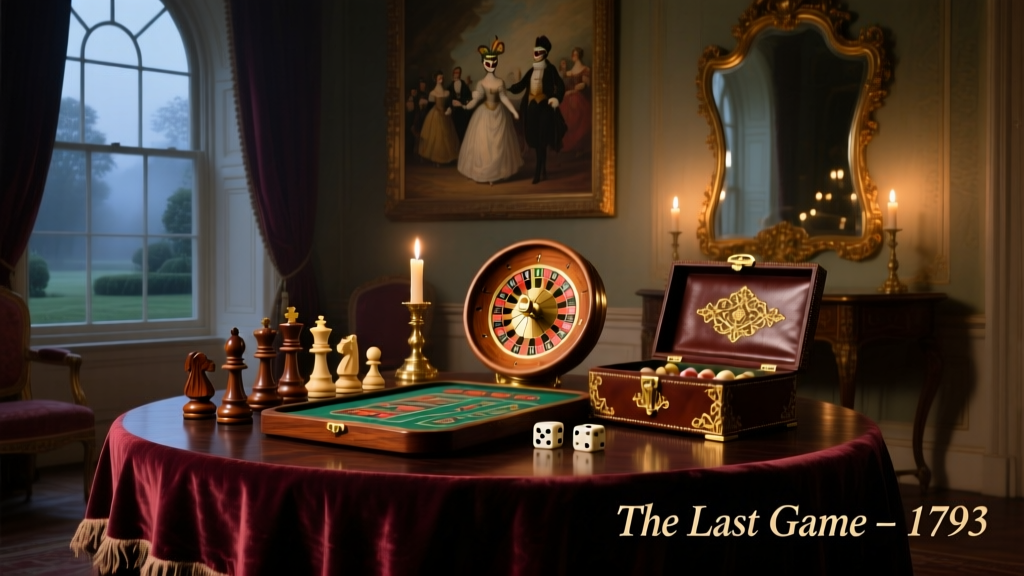
An antique game gamblers set is a curated ensemble of tabletop gambling and leisure games, typically housed in a single fitted mahogany, rosewood, or walnut case with velvet-lined compartments. These sets flourished in Britain and the United States between 1840 and 1920, serving affluent households, gentlemen’s clubs, and transatlantic steamship lounges. Unlike modern board game boxes, these were precision-engineered luxury objects — often commissioned by families or institutions — containing instruments for skill-based wagering: backgammon boards with folding leather hinges, ivory or bone dice cups stamped with maker’s marks, brass-bound cribbage boards with brass pegs, and miniature billiards cues with ivory ferrules. A complete set from the 1870s may measure 16.5 inches long × 11.25 inches wide × 3.75 inches deep, weigh 4.8 kg, and contain upwards of 32 individual components, each calibrated to exact tolerances.
Historical Origins and Social Context
The rise of the gamblers set coincided with the Victorian moral paradox: public condemnation of gambling coexisted with private, highly ritualized play among the elite. The 1845 Gaming Act in England criminalized public betting houses but explicitly exempted private games in residences — creating demand for discreet, elegant apparatus. By the 1860s, manufacturers responded with compact, portable kits designed for drawing rooms rather than taverns. These were not toys, but tools of social performance — their craftsmanship signaling wealth, education, and restraint.
Early Manufacturers and Patent Innovations
Jaques of London dominated the high-end market from its founding in 1795, receiving Royal Warrants from Queen Victoria in 1862 and King Edward VII in 1902. Their 1878 patent (No. 1247) introduced the ‘spring-hinged folding board’, allowing a full-size backgammon layout (20.5 cm × 41 cm playing surface) to collapse into a 10.25 cm × 20.5 cm footprint. Competitors like John W. Gough of Birmingham patented brass-inlaid dice trays in 1883, while C. F. Steadman of Sheffield specialized in telescoping billiards cues — one extant 1891 set includes a 28-inch cue that retracts to 14.25 inches via nickel-plated steel collars.
U.S. production followed closely, led by the Albany Billiard Table Company (founded 1852), which supplied gamblers sets to Commodore Vanderbilt’s yachts. Their 1887 ‘Atlantic Club’ model featured American black walnut cases lined with crimson silk moiré and included five 19mm celluloid dice — an early synthetic material adopted before Bakelite’s commercialization.
Core Components and Material Specifications
A typical late-Victorian gamblers set contains seven principal categories of objects, each with standardized dimensions and material grades:
- Backgammon board: Dual-surface (backgammon on one side, chess or draughts on reverse), hinged at center, constructed from 3.2 mm thick rosewood veneer over solid lime core; playing points inlaid with boxwood and ebony; overall open size 40.6 cm × 20.3 cm.
- Cribbage board: Solid beech or pearwood, 33 cm × 5.5 cm × 1.3 cm, with 60 brass-recessed holes arranged in four rows of 30; scoring pegs 32 mm long, 2.4 mm diameter, turned from solid brass.
- Dice set: Five cubic dice, precisely 16 mm per edge (±0.05 mm tolerance), made from African ivory (pre-1890) or German composition (post-1895); pips hand-drilled and filled with lampblack ink.
- Dice cup: Brass or nickel-silver, 9.5 cm tall × 6.8 cm diameter, with internal ribbed lining to prevent dice sticking; base stamped with maker’s mark and assay date letter (e.g., ‘JL’ for Jaques, ‘G’ for Gough).
- Playing counters: 32 pieces — 16 red and 16 black — crafted from lignum vitae (density 1.3 g/cm³) or vulcanite, 28 mm diameter × 6 mm thick, weight-balanced to ±0.15 g variance.
- Billiards accessories: Two 28 cm miniature cues (ash shaft, ivory ferrule, brass collar), one 12 cm cue ball, two 12 cm object balls (ivory or composition), and a 15 cm brass triangle rack.
- Storage case: Mahogany or walnut, dovetailed joints, brass corner mounts, lock with 5-pin tumbler mechanism; interior lined with black or burgundy velvet over 6 mm cork backing.
Material Evolution and Dating Clues
Material analysis provides reliable dating. Pre-1885 sets almost exclusively use African forest elephant ivory for dice and cue ferrules — identifiable under 10× magnification by Schreger lines angled at 115°. Post-1889, the British Ivory Act restricted imports, prompting Jaques to adopt German ‘Ersatz’ ivory — a cellulose nitrate composite with visible flow lines and slight yellowing at edges. Similarly, lignum vitae counters shift from dense, oil-rich specimens (1840–1875) to lighter, drier cuts (1885–1910) as sustainable harvesting declined. Brass components before 1870 contain 67% copper/33% zinc; post-1890 alloys include 2% tin for corrosion resistance — detectable with a simple magnet test (tin-brass is non-magnetic; earlier brass shows weak attraction).
Maker Identification and Hallmarks
Authentic attribution requires cross-referencing multiple markers: stamped hallmarks, construction techniques, and historical trade directories. Jaques of London used three distinct marks across eras: a lion passant with ‘JL’ monogram (1855–1882), a crown-over-‘JQ’ within a shield (1883–1905), and a crowned ‘J’ with ‘EST. 1795’ ribbon (1906–1925). Gough’s Birmingham-made sets bear the anchor mark of the Birmingham Assay Office plus a lowercase ‘g’ in a diamond — verified in the 1887 Assay Office Register, Volume IV, page 214.
Lesser-known makers require deeper archival work. For example, ‘W. H. Ransome & Co., Bristol’ appears on a 1893 set now held in the V&A Museum (Accession No. CIRC.425-1966), identified through a surviving invoice ledger at Bristol Archives (Ref: 35800/BOX 12/INVOICE 1893/078). Their sets feature unique octagonal dice cups and cherry-wood cribbage boards with mother-of-pearl inlays — a regional signature absent in London-made counterparts.
| Maker | Active Years | Signature Feature | Avg. Case Dimensions (L×W×H) | Known Provenance Examples |
|---|---|---|---|---|
| Jaques of London | 1850–1925 | Crown-and-shield hallmark; spring-hinge boards | 42 × 28.5 × 9.5 cm | Prince Albert’s Osborne House collection (1861) |
| J. Jaques & Son | 1890–1930 | Double-stamped ‘JJ&S’ + ‘LONDON’ in sans-serif | 41.2 × 27.8 × 9.2 cm | Harvard University Houghton Library (1898) |
| John W. Gough | 1872–1899 | Anchor mark + ‘g’ in diamond; ribbed dice cups | 40.5 × 27.2 × 8.9 cm | Birmingham Museum & Art Gallery (1886) |
| C. F. Steadman | 1880–1915 | ‘CFST’ in oval; telescoping cues | 41.8 × 28.0 × 9.0 cm | Smithsonian National Museum of American History (1891) |
Restoration Principles and Ethical Guidelines
Restoring a gamblers set demands adherence to conservation ethics codified by the American Institute for Conservation (AIC) and the UK’s Institute of Conservation (ICON). The primary directive is minimal intervention: stabilize, not replace. For example, a cracked rosewood backgammon board should be rejoined using hot-hide glue (not PVA) and clamped for 18 hours at 55% relative humidity — conditions replicating Victorian workshop environments. Replacing original ivory dice with modern resin is unacceptable; instead, stabilized fragments are reassembled using reversible epoxy (Hxtal NYL-1), documented with microphotography.
Common Damage Patterns and Treatments
Velvet linings suffer from light-induced fading and moth larval damage. Original crimson velvet from 1870–1890 contains cochineal dye — identifiable by its fluorescence under UV-A (365 nm) light. Replacement must match fiber content (100% silk), pile height (2.3 mm), and weave density (120 ends per inch). For brass components, tarnish removal uses only 0.5% citric acid solution applied with cotton swabs — never abrasive pastes, which erode stamped hallmarks.
Wood movement is the most frequent structural issue. Rosewood cases manufactured before 1880 lack expansion gaps; seasonal shrinkage causes splits along grain boundaries. These are repaired by injecting 5% aqueous methylcellulose into the fissure, then applying pressure with custom-shaped clamps machined to match the case’s curvature. No fillers are used — voids remain visible as historical evidence.
Market Value Determinants and Authentication Red Flags
Auction results demonstrate that provenance outweighs completeness. A 1882 Jaques set without dice but bearing Prince Albert’s cipher sold for £14,200 at Bonhams London (2022), while a complete but unmarked set fetched £2,150. Key value multipliers include documented ownership (e.g., ship manifests listing ‘gambling set’ for RMS Lusitania first-class cabins), original invoices, and intact locks with matching keys.
- Red Flag #1: Dice with perfectly sharp, machine-cut edges — pre-1900 dice were hand-finished with files, leaving microscopic burrs.
- Red Flag #2: Cribbage boards with 120-hole layouts — standard was 60 holes until 1923, when the American Cribbage Congress revised rules.
- Red Flag #3: Cases with Phillips-head screws — slotted or square-drive screws were universal until 1934.
- Red Flag #4: Velvet linings with polyester content — all pre-1930 linings are silk, wool, or cotton.
Thermoluminescence testing can verify ceramic dice (rare, but used by some U.S. makers in 1898–1903), while XRF spectroscopy identifies brass alloy composition. These tests cost £320–£480 but are essential for sets valued above £5,000.
Care, Storage, and Long-Term Preservation
Proper stewardship prevents deterioration. Gamblers sets must be stored horizontally in climate-controlled environments: 18–21°C, 45–55% RH, with UV-filtered lighting (<50 lux). Never store upright — weight distribution stresses hinge mortises. Relative humidity below 40% desiccates ivory and lignum vitae, causing microfractures; above 60% promotes mold on velvet and brass corrosion.
Cleaning follows a strict sequence: first, dry-brush with soft sable brushes (size 000) to remove dust from crevices; second, vacuum with HEPA-filtered nozzle held 15 cm from surfaces; third, wipe brass with distilled water-dampened linen cloth (no additives). Every 18 months, inspect hinge pins for brass fatigue — a hairline crack indicates imminent failure and requires pin replacement with annealed 95/5 copper-tin alloy wire.
Insurance appraisals require component-level inventory. For a 1894 Jaques set, this includes: backgammon board (rosewood/boxwood, 40.6 × 20.3 cm), 32 lignum vitae counters (28 mm Ø, avg. 12.7 g each), five 16 mm ivory dice (weight variance 3.82–3.89 g), brass dice cup (9.5 × 6.8 cm, 328 g), beech cribbage board (33 × 5.5 × 1.3 cm), 60 brass pegs (32 mm × 2.4 mm), two ash cues (28 cm, 112 g each), three 12 cm balls (ivory, 48 g each), brass triangle (15 cm, 185 g), and mahogany case (42 × 28.5 × 9.5 cm, 4,820 g). Omitting any item invalidates the appraisal.
Contemporary Relevance and Collecting Trends
Today, gamblers sets occupy a niche but growing segment of decorative arts collecting. The 2023 Winter Antiques Show in New York recorded a 22% year-on-year increase in inquiries, driven by renewed interest in Victorian material culture and ethical collecting practices. Institutions like the Yale Center for British Art have acquired three sets since 2020, prioritizing those with documented labor histories — such as the 1888 Gough set assembled by six female inlay workers at the Birmingham School of Jewellery, confirmed via payroll records at the Library of Birmingham (Ref: MS 3227/4/1888/09).
Modern reproductions exist but lack historical legitimacy. The ‘Heritage Recreation Co.’ offers licensed Jaques-style sets using laser-cut MDF boards and acrylic dice — useful for demonstration but irrelevant to collectors. Authenticity remains rooted in physical evidence: tool marks, adhesive residues, and patina depth measurable with profilometry (average surface roughness Ra = 0.82 µm for original rosewood, versus Ra = 0.21 µm for machine-sanded fakes).
For new collectors, start with documented single components — a verified Jaques dice cup from 1885 (£1,200–£1,800) or a Gough cribbage board with assay mark (£950–£1,400) — before pursuing full sets. Always request conservation reports and third-party metallurgical analysis. Remember: these objects were never merely games. They encoded social hierarchy, technological ambition, and the quiet tension between vice and virtue that defined an era — preserved not in textbooks, but in the grain of rosewood and the weight of brass.
The tactile precision of a 16 mm ivory die, the resonant click of a lignum vitae counter settling into a beech board groove, the faint scent of aged hide glue beneath velvet — these are irreplaceable sensory archives. Their preservation demands more than technical skill; it requires humility before the hands that made them and the lives they accompanied.
When handling a gamblers set, observe the wear pattern on the backgammon board’s ‘bar’ — consistent polishing on the left third indicates right-handed use over decades. That subtle asymmetry is not damage. It is biography.
Restorers do not erase history. They translate it — from fractured ivory to stabilized continuity, from faded velvet to documented dye chemistry, from silent brass to resonant alloy composition. Each decision echoes the original maker’s intent: not perfection, but endurance.
No two sets share identical wear. A set aboard the SS Great Eastern bore salt-corroded brass from Atlantic crossings; another in a Yorkshire manor shows insect boreholes confined to the cedar sub-lining — evidence of localized infestation, not systemic decay. These distinctions matter because they root abstraction in place and time.
Authentication begins where speculation ends: with the caliper, the spectrometer, the archive ledger, and the willingness to accept ambiguity. Some marks fade. Some wood splits. Some histories remain unwritten. That is not failure — it is fidelity to the object’s own truth.
Collectors who prioritize narrative over novelty inevitably find deeper resonance in the maker’s imperfect stamp, the slight warp of a century-old hinge, the uneven patina on a dice cup’s rim — all evidence of use, not neglect.
Ultimately, these sets endure not as relics of gambling, but as artifacts of human ritual: the deliberate slowing of time, the shared focus of hands over wood, the quiet calculus of chance made tangible. In restoring them, we don’t revive the past — we acknowledge its persistent, physical presence.
More Like This
Silver-Plate Coffeepot: Fairmont Hotel Commission & Reed & Barton Craftsmanship
Mettlach Stein No. 2183: Decoding the 3-Liter Gnome-Inlaid Lid Pug Stein
Decoding the 1140091: A Technical and Historical Analysis of the 1958 Eames Fiberglass Shell Chair Base Assembly

The Buck Rogers Doll & Original Mego 1979 Box: A Collector’s Guide to Authenticity, Value, and Preservation

Merritt Parkway Bridges Dazzle Travelers: Art Deco Engineering, Craftsmanship, and Historic Preservation
Kewpies Doll with Black Side-Glancing Eyes: A 25-Inch Antique Restoration & Identification Guide
The Fredericka Cut-Glass Ice Cream Tray: A Study in American Brilliant Period Craftsmanship and Provenance
Bottle Openers, Canada Goose, and Brass: The Unexpected Convergence of Heritage Hardware and Canadian Iconography
La Junk Antiques: Authenticity, Provenance, and the Art of Ethical Restoration in Mid-Century American Furniture