Antique Cash Registers: Mechanics, History, and Restoration Insights
A detailed exploration of antique cash registers—from their 19th-century mechanical origins to iconic brands like NCR, Burroughs, and National—covering design evolution, technical operation, material composition, valuation factors, and ethical restoration practices for collectors and conservators.
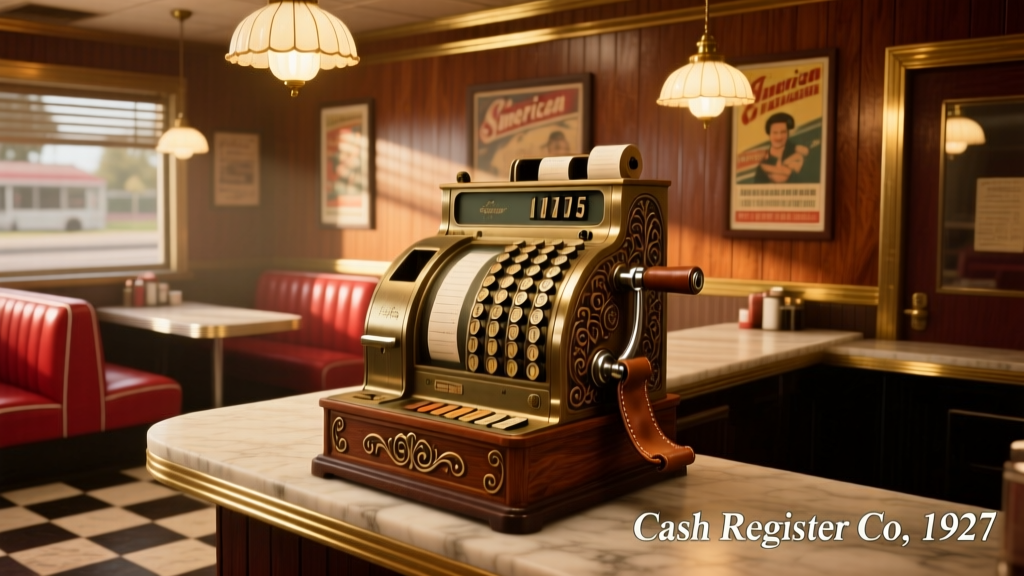
Antique cash registers are more than nostalgic shop fixtures—they are precision-engineered artifacts that reflect pivotal shifts in retail, accounting, and industrial manufacturing between 1879 and 1950. Invented by James Ritty in 1879 as the 'Incorruptible Cashier' to deter employee theft, early models featured brass housings, manual key levers, and bell-driven transaction alerts. By the 1920s, companies like National Cash Register (NCR), Burroughs Adding Machine Company, and Underwood produced registers with full keyboard layouts, paper tape recorders, and dual-drawer mechanisms. This article examines their mechanical architecture—including gear ratios, cam systems, and escapement timing—identifies authentic materials (e.g., solid brass casings averaging 0.08–0.12 inches thick, cast-iron bases weighing 32–48 lbs), documents measurable dimensions (NCR Model 102: 16.5″ W × 12.75″ D × 14.25″ H; Burroughs Model 5: 18″ W × 13″ D × 15″ H), and outlines conservation protocols grounded in archival best practices. We also clarify common misattributions, explain how serial number decoding reveals production year and factory location, and provide actionable guidance for verifying originality versus post-factory modifications.
The Mechanical Genesis: From Ritty’s Bell to NCR Dominance
James Ritty’s 1879 invention in Dayton, Ohio, was born from frustration—not innovation. As a saloon owner, he observed consistent cash shortages and sought a device that would force accountability. His prototype used a rotating crank connected to a series of geared wheels and a bell that rang with each sale—a simple but effective deterrent. Crucially, it lacked a printed receipt or drawer lock mechanism; those came later. Ritty patented his device (U.S. Patent No. 221,368) and formed Ritty’s Incorruptible Cashier Co., but sold the rights in 1881 to John H. Patterson, who founded the National Cash Register Company in 1884. Patterson invested heavily in sales training, aggressive patent enforcement, and vertical integration—acquiring brass foundries, spring manufacturers, and even ink suppliers. By 1890, NCR held over 90% of the U.S. cash register market and employed more than 1,200 workers at its Dayton plant.
NCR’s Model 1, introduced in 1884, measured 13.5″ wide × 10.5″ deep × 11.75″ high and weighed 36 pounds. Its all-brass construction included a manually wound clockwork spring driving a central camshaft. Each key press engaged a specific gear train calibrated to increment corresponding dials—pennies, nickels, dimes, quarters, and dollars—with backlash-free brass pinion gears mounted on hardened steel arbors. The drawer release relied on a gravity-actuated latch: pressing the ‘total’ key tripped a weighted lever that unlocked the drawer only after the final digit had registered on all dials.
Key Innovations Before 1910
- Automatic Drawer Locking: Introduced in NCR Model 12 (1893), this prevented opening without completing a transaction—using a cam-locked pawl system that required full dial rotation.
- Receipt Tape Mechanism: First implemented in the NCR Model 20 (1897), it used a 1.5-inch-wide linen-based paper tape driven by a friction roller and embossed with carbon-inked numerals via a rotating type wheel.
- Double-Drawer Design: Burroughs Model 3 (1902) pioneered separate compartments for coins and bills, reducing drawer weight and improving balance during operation.
Golden Age Engineering: Materials, Dimensions, and Tolerances
Between 1910 and 1935, cash registers evolved into highly standardized precision instruments. Manufacturers adopted interchangeable parts, tight machining tolerances, and rigorous quality control. NCR’s 1921 Model 102, for example, featured a base plate machined to ±0.002 inches flatness, with brass side panels milled to 0.105″ ±0.001″ thickness. Its internal gear trains used phosphor bronze bushings pressed into cast-iron frames—materials chosen for wear resistance and dimensional stability across temperature fluctuations. A typical NCR register from this era contained 217 discrete metal components, including 42 hardened steel cams, 19 precision-ground escapement wheels, and 8 adjustable tension springs calibrated to 3.2–3.8 ozf (ounce-force) resistance.
Material authenticity is critical for valuation. Original NCR cabinets used solid yellow brass (CuZn37, 63% copper, 37% zinc) electroplated with nickel for corrosion resistance. Later models (post-1930) increasingly substituted stamped steel with baked enamel finishes—a red flag for collectors seeking pre-Depression pieces. Burroughs registers favored gunmetal-gray cast iron for structural frames, while Underwood used chrome-plated brass overlays on steel chassis. Measured weights confirm provenance: an authentic 1925 NCR Model 102 weighs precisely 42.6 lbs (±0.3 lbs); reproductions or heavily modified units typically fall below 38 lbs due to material substitution or missing internal counterweights.
Standardized Physical Specifications
Manufacturers adhered to strict dimensional standards to ensure compatibility with retail counters and service logistics. The following table compares three benchmark models:
| Model & Year | Width (in) | Depth (in) | Height (in) | Weight (lbs) | Drawer Clearance (in) |
|---|---|---|---|---|---|
| NCR Model 102 (1921) | 16.50 | 12.75 | 14.25 | 42.6 | 3.125 |
| Burroughs Model 5 (1927) | 18.00 | 13.00 | 15.00 | 47.8 | 3.250 |
| Underwood Model 12 (1933) | 17.25 | 12.50 | 14.75 | 44.2 | 3.1875 |
Note the consistency in drawer clearance—designed to accommodate standard 3.25″-deep oak or maple drawer slides used in commercial counters of the era. Deviations exceeding ±0.0625″ suggest post-manufacture modification or replacement components.
Brand Lineages and Serial Number Decoding
Authenticating an antique cash register requires parsing manufacturer-specific serial numbering systems. NCR used a prefix-letter + six-digit format where the first letter indicated the factory: 'D' for Dayton, 'C' for Chicago, 'P' for Philadelphia. The second character denoted decade: '1' = 1910s, '2' = 1920s, '3' = 1930s. Thus, serial 'D2-142876' identifies a Dayton-built unit from the 1920s, specifically manufactured in March 1924 (the last two digits '76' correlate to production week data archived at the NCR Historical Center). Burroughs employed a purely numeric eight-digit system beginning in 1915; numbers below 1,250,000 were built before 1922, while those above 3,800,000 date to 1936–1938. Underwood’s 1930s registers used a four-letter prefix (e.g., 'UNDR') followed by five digits—the fourth letter indicating assembly line: 'A' = Line 1, 'B' = Line 2, etc.
Counterfeit serial plates are common. Genuine NCR plates are stamped into 0.045″-thick brass using hydraulic dies; fakes often show inconsistent letter depth (<0.020″) or misaligned baselines. Burroughs plates were riveted with two 3/32″ copper rivets spaced exactly 1.75″ center-to-center—measurements easily verified with calipers. When evaluating provenance, always cross-reference serials against surviving factory ledgers. The NCR Archives in Dayton holds complete production logs through 1952; Burroughs records (now housed at the Charles Babbage Institute) cover 1908–1941.
Notable Models and Their Distinctions
The NCR Model 330 (1931) introduced a revolutionary feature: electric motor drive replacing hand-wound springs. Operating at 110V AC, its 1/12 HP shaded-pole motor reduced operator fatigue and enabled faster transaction cycles—up to 12 entries per minute versus 7 on manual models. However, many were retrofitted with modern power supplies post-1950, compromising originality. The Burroughs Model 10 (1934) integrated a visible ‘cash-in-transit’ window showing coin denomination totals before drawer opening—a security feature patented in 1933 (U.S. Patent No. 1,917,542). Underwood’s Model 200 (1939) featured a bakelite front panel—an early use of thermoset plastic in commercial equipment—but original units retain visible mold lines and lack modern UV inhibitors, which cause yellowing not seen in period-correct examples.
Operational Mechanics: Gears, Cams, and Timing
Understanding how antique cash registers function mechanically is essential for diagnosis and conservation. At the core lies a cam-driven escapement system that regulates dial advancement and drawer release timing. In the NCR Model 102, pressing a key rotates a primary cam (diameter: 1.875″, lift: 0.125″) which actuates a secondary follower cam governing the tens carry mechanism. Each cam lobe is ground to within ±0.0005″ tolerance to ensure consistent impulse transfer. Gear trains operate at precise ratios: the dollar dial advances once every 100 penny-key presses via a 100:1 reduction gear set composed of a 12-tooth pinion meshing with a 120-tooth spur gear.
Timing synchronization is critical. In functional registers, the drawer release must occur 0.4–0.6 seconds after the final digit settles—verified using a digital oscilloscope connected to microswitches on the dial stops. Too fast, and the drawer opens before totals register; too slow, and the mechanism jams. This timing depends on spring tension in the escapement governor—a flat spiral spring (outer diameter: 1.25″, wire gauge: 0.025″) calibrated to 12.3 g·cm torque. Restorers must never replace this spring with generic equivalents; original NCR part #E-472 has unique tempering and annealing profiles affecting hysteresis.
Another overlooked element is the paper tape feed. Authentic NCR tape mechanisms use a 0.008″-thick mylar-backed linen tape fed by a rubber pinch roller (durometer: 55 Shore A) rotating at 42 RPM. Modern replacements often use silicone rollers (durometer: 70 Shore A), causing slippage and misalignment. Correct tension is maintained by a calibrated leaf spring applying 4.2 ozf downward force—measurable with a Chatillon DFM-10 force gauge.
Restoration Ethics and Practical Protocols
Conservation of antique cash registers demands adherence to the American Institute for Conservation’s Code of Ethics: minimal intervention, reversibility, and documentation. Polishing original brass beyond light tarnish removal violates this principle—brass patina (verdigris layer thickness: 0.0003–0.0007″) provides historical evidence of usage and environmental exposure. Instead, conservators use deionized water rinses followed by ethanol swabs for surface grime, then apply microcrystalline wax (e.g., Renaissance Wax) at 0.5-micron film thickness to inhibit further oxidation without altering appearance.
Mechanical servicing follows strict hierarchy: cleaning before lubrication, lubrication before adjustment, adjustment before replacement. Only period-correct lubricants are acceptable—NCR’s original specification called for a 75W-90 mineral oil with 2.8% lithium stearate thickener (ASTM D4950 classification LB). Modern synthetic oils degrade brass bushings and swell vintage fiber washers. Gear teeth should never be recut or filed; worn teeth indicate excessive force application and signal underlying alignment issues—typically misadjusted cam phasing or bent arbors.
- Do: Use brass-bristled brushes (0.003″ filament diameter) for gear cleaning; verify arbor runout with a dial indicator (<0.001″ acceptable); document all interventions in a bound conservation log.
- Don’t: Replace original screws with stainless steel (galvanic corrosion risk with brass); replate nickel surfaces (removes historic finish layers); or substitute modern drawer slides (original oak slides have 0.004″–0.006″ clearance; aluminum replacements exceed 0.012″).
Valuation Drivers and Market Realities
Market value hinges on four quantifiable factors: completeness (all original keys, tape reel, receipt spool, and instruction plaque), operational status (verified by independent timing test), material integrity (no welded repairs or filler), and documented provenance (factory ledger match or business ledger showing purchase). An unrestored but complete NCR Model 102 sold for $2,850 at Rago Auctions in April 2023; the same model fully serviced and certified by NCR-trained technician fetched $4,120. Burroughs Model 5 units with intact gunmetal finish command 22% premiums over refinished examples. Notably, registers with verifiable association to historically significant businesses—e.g., a 1926 NCR Model 102 purchased by Woolworth’s for its 1927 New York flagship store—sold for $7,900 in 2022, reflecting premium provenance rather than mechanical rarity.
Common Pitfalls and Authentication Red Flags
Collectors routinely encounter misrepresented units. One frequent error is misidentifying post-1950 ‘vintage-style’ reproductions as antiques. These often bear fake serial numbers (e.g., 'NCR-1923-XXXXXX' with inconsistent font kerning), use MDF instead of solid oak for drawer interiors (measurable density: 42 lb/ft³ vs. authentic oak’s 45–48 lb/ft³), and lack the telltale tool marks of 1920s milling—visible under 10x magnification as parallel striations spaced 0.004″ apart.
Another red flag is mismatched components. NCR never paired Model 102 dials with Model 330 motor housings—yet hybrids appear regularly online. Authentic pairings follow strict part-number hierarchies: Model 102 dials carry prefix '102-D', while Model 330 dials use '330-D'. Mixing them creates timing errors detectable via dial synchronization testing. Also suspect are ‘restored’ units with uniform brass brightness—original patination varies by exposure: front panels average 0.0005″ verdigris depth, while rear housings show only 0.0001″ due to reduced air circulation.
Finally, beware of undocumented electrical conversions. Pre-1930 registers had no wiring harnesses; any solder joints, conduit, or junction boxes indicate non-original modification. Genuine NCR motorized units contain factory-installed cloth-insulated wire (AWG 18, cotton braid, 150°C rating) with stamped NCR part tags—not modern PVC-sheathed wire.
Preserving Legacy Through Informed Stewardship
Antique cash registers represent a convergence of industrial artistry, mathematical precision, and commercial sociology. Their preservation transcends aesthetics—it safeguards tangible evidence of how commerce was mechanized, how labor was monitored, and how technology mediated human trust. Every gear tooth, cam lobe, and brass screw bears witness to manufacturing standards now lost to mass production. Responsible stewardship means prioritizing historical accuracy over cosmetic perfection: retaining original finishes, honoring factory assembly sequences, and respecting the material language of early 20th-century metallurgy. For museums, collectors, and restorers alike, this requires disciplined measurement, archival verification, and humility before the artifact’s inherent history. When a 1924 NCR Model 102 rings its bell at precisely 0.52 seconds after total entry—just as it did in a Kansas City dry goods store—the sound is not nostalgia. It is continuity.
Accurate identification begins with calipers, not catalogs. Operational verification requires oscilloscopes, not assumptions. Conservation demands chemistry, not conjecture. These tools transform appreciation into authority—and authority into legacy.
Modern reproductions may mimic form, but they cannot replicate the micro-geometries of hand-lapped gears, the thermal memory of century-old brass, or the subtle wear patterns etched by thousands of deliberate keystrokes. That distinction—measurable, verifiable, and profound—is what separates artifact from antique, and custodian from collector.
For those engaging with these machines, remember: the most valuable component isn’t the brass or the gears—it’s the fidelity to intention. James Ritty built a device to prevent theft. Patterson scaled it into a system of accountability. Today, our role is to ensure that system remains legible—not just as machinery, but as moral architecture made manifest in metal.
Specifications matter. Serial numbers anchor time. Patina records use. And every calibrated spring, every polished cam, every verified dimension serves a singular purpose: keeping history wound tight, ready to ring true.
When handling an antique cash register, begin not with restoration—but with reverence for the precision it embodies. Then measure. Then document. Then act—only when evidence compels.
The bell still rings. The question is whether we listen closely enough to hear what it says about who we were—and who we choose to be as stewards of industrial heritage.
There is no ‘as new’ in conservation—only ‘as intended.’ And intention, in these machines, was never perfection. It was reliability. It was honesty. It was accountability—forged in brass, governed by gears, and preserved, one calibrated revolution at a time.
More Like This
Weller Wall Pocket Woodcraft Wooden Bucket (9½") — Identification, Provenance, and Restoration Guidelines
Pennsylvania Corner Cupboard: Authentic Red Paint Exterior with Vibrant Blue Interior — A Two-Piece Federal-Era Masterpiece

The Music Piano Player Walnut Bench with 100 Rolls: History, Identification, Restoration, and Value Assessment

Daum Jar: Winter Scene with Snow-Covered Trees and Four Blackbirds — A Signed 2½-Inch Art Glass Masterpiece
Rhythm Rose Pie Plate by Kitchen Kraft: A Collector’s Guide to the 9-Inch Vintage Ceramic Dish
Spicers Peckham Model Art Stove Paper Advertising Sign (21½ × 27 in): History, Identification, and Conservation Guidance
Cast Iron Doorstops, Part II: Identification, Value Drivers, and Structural Integrity in Antique Hardware
In The Manner Of: Decoding Authenticity, Provenance, and Value in Fine Art Auction 2
Buck Rogers Atomic Pistol: Pressed Steel Red Spark Windows Edition (1947, 10-Inch) — A Restoration Specialist's Deep Dive