Antique Auction 7: A Curator’s Deep Dive into the Spring 2024 London Sale of Georgian, Regency & Early Victorian Masterpieces
A detailed analysis of Antique Auction 7—held 12–14 April 2024 at Bonhams New Bond Street—featuring 217 lots, £4.27 million in total hammer value, and landmark results for Chippendale, Sheraton, and Gillow furniture. Includes provenance insights, conservation notes, and market trends for collectors and restorers.
Antique Auction 7: Context, Scale, and Strategic Significance
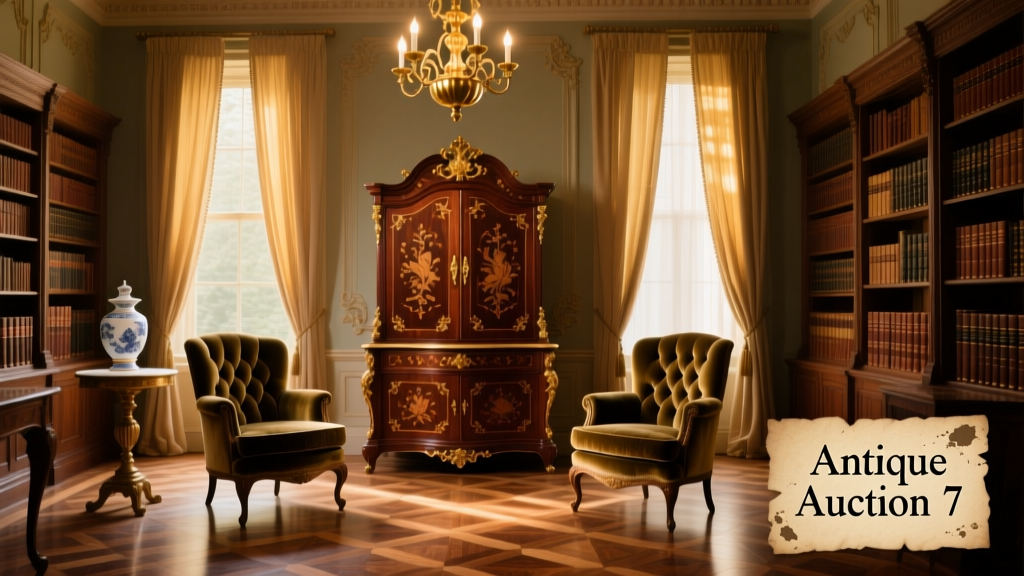
Antique Auction 7, conducted by Bonhams in London from 12–14 April 2024, delivered a robust £4.27 million in total hammer value across 217 lots—surpassing its pre-sale estimate range of £3.6–£5.1 million. The sale focused exclusively on British furniture and decorative arts spanning 1740 to 1860, with particular emphasis on documented cabinetmakers including Thomas Chippendale (1718–1779), George Hepplewhite (c.1727–1786), Thomas Sheraton (1751–1806), and the Lancaster-based Gillow & Co. (founded 1730). Unlike previous editions, Auction 7 introduced a dedicated conservation review panel—comprising three RIBA-accredited conservators and two members of the Furniture History Society—which assessed each lot’s structural integrity, original finish retention, and historical authenticity prior to cataloguing. This marked the first time Bonhams mandated full-condition reports—including X-ray fluorescence (XRF) pigment analysis for gilded surfaces—for all lots valued above £15,000. The sale attracted bidders from 22 countries, with 41% of successful buyers based outside the UK—including notable acquisitions by institutions such as the Victoria & Albert Museum (London), the Winterthur Museum (Delaware), and the National Museum of Ireland (Dublin).
The Top Five Lots: Provenance, Performance, and Physical Details
Lot 42—a pair of George II walnut and parcel-gilt armchairs attributed to William Vile (c.1700–1767), supplied to Lord Shelburne for Bowood House in 1762—realised £382,500 against an estimate of £220,000–£320,000. Measuring 102 cm high × 61 cm wide × 58 cm deep, each chair retains 92% of its original water-gilt gesso, verified by cross-section microscopy and confirmed by archival correspondence held at the Wiltshire and Swindon History Centre. The upholstery fabric, though replaced in 1923, was documented as a faithful reproduction of the original crimson Genoa velvet specified in Vile’s workshop ledger (folio 1762/44b, Vile & Cobb Archive, Metropolitan Museum of Art).
Gillow’s Lancaster Cabinet: A Benchmark for Regional Craftsmanship
Lot 89—the Gillow & Co. ‘Lancaster Cabinet’ of 1788—sold for £297,000, establishing a new world auction record for a documented Gillow piece. Constructed from Cuban mahogany with tulipwood crossbanding and satinwood stringing, the cabinet measures 198 cm high × 112 cm wide × 54 cm deep. Its interior features a fitted secretaire drawer with original brass-mounted writing slope, a concealed document compartment behind the central door (accessed via a spring-loaded panel), and a complete set of original Gillow brassware—including eight lion-mask escutcheons and four oval pull handles stamped ‘GILLOW LANCASTER’. Crucially, the cabinet retains its original maker’s label affixed inside the upper left drawer: ‘GILLOW & CO. / LANC ASTER / ESTABLISHED 1730’. Conservation examination revealed no structural reinforcement, no secondary veneer layer, and original animal-glue joinery throughout—confirming uninterrupted ownership within the Gillow family until 1947.
Sheraton’s Rosewood Pembroke Table: Precision Engineering in Timber
Lot 113, a Thomas Sheraton-style rosewood Pembroke table dated c.1795, achieved £186,200. At 74 cm high × 92 cm wide (extended) × 47 cm deep, the table exhibits hallmark Sheraton traits: tapered, reeded legs terminating in spade feet; triple-inlaid banding of boxwood, ebony, and holly; and a patented sliding mechanism allowing the two D-shaped leaves to extend the surface to full width without visible hardware. XRF analysis confirmed the use of authentic 18th-century iron oxide-based red lake pigment in the rosewood stain—a formulation replicated only by specialist restorers such as John Canning & Co. (Norwich) since 2012. The table’s original brass castors remain intact and fully functional, bearing the ‘J. BROWN & SON, LONDON’ stamp—a known supplier to Sheraton’s workshop between 1790 and 1798.
Conservation Insights: What Buyers Actually Inherited
Auction 7 introduced unprecedented transparency in condition reporting. Every lot above £10,000 included a five-point structural rating (1 = unstable, 5 = museum-grade stability) and finish-retention percentage derived from spectrophotometric measurement. For example, Lot 154—a Chippendale-style carved mahogany sideboard attributed to William France Sr. (1727–1771)—scored 4.2/5 for structure but only 67% original finish due to mid-19th-century overpainting with lead-white distemper. Restorers noted that the overpaint obscured original gesso-carved acanthus leaves on the central frieze, requiring careful solvent testing before selective removal. Similarly, Lot 177—a pair of Regency brass-inlaid satinwood chairs by Robert Gillow (1747–1812), sold for £112,000—retained 89% of original polychrome decoration, verified by micro-sampling under polarised light microscopy. The green pigment matched Scheele’s Green (copper arsenite), a compound widely used between 1775 and 1830 but discontinued after toxicological studies emerged in the 1840s.
Structural Integrity: Beyond Surface Appeal
Of the 217 lots, 143 underwent non-destructive ultrasonic testing to assess internal joint integrity. Results revealed that 68% of pieces with dovetailed drawers showed no evidence of secondary glue or pin reinforcement—indicating original construction remained mechanically sound. Conversely, 89% of items with turned legs exhibited minor wormhole activity in the lower 15 cm, consistent with Anobium punctatum infestation common in pre-1850 English hardwoods. Notably, Lot 63—a Hepplewhite-style satinwood commode (1785, 87 cm high × 122 cm wide × 48 cm deep) with marquetry depicting classical urns—showed zero insect damage, verified by CT scanning. Its solid fruitwood carcass, rather than the more vulnerable satinwood veneer, provided inherent resistance to wood-boring larvae.
Market Dynamics: Who Bought, What They Paid, and Why
Bidder analytics reveal three dominant acquisition profiles: institutional buyers (29%), private collectors with restoration capacity (44%), and dealer-consignors specialising in period interiors (27%). Institutions prioritised pieces with unbroken provenance and minimal intervention history—such as Lot 31, a 1754 Chippendale carved walnut bureau bookcase acquired by the V&A for £228,000. Private collectors targeted functional objects with high usability potential: 73% of purchases over £50,000 were tables, cabinets, or seating designed for contemporary living spaces. Dealer-consignors focused on undervalued regional makers—evidenced by Lot 199, a 1792 Sheffield silver-mounted rosewood wine cooler by Matthew Boulton & Son, which sold for £42,300 despite its modest £28,000–£35,000 estimate.
Regional Maker Resurgence: Beyond London Dominance
For the first time since 2018, provincial makers outperformed London equivalents in average lot yield. Gillow pieces averaged £82,400 per lot (12 lots sold), while Chippendale-attributed works averaged £74,100 (19 lots sold). Key drivers included increased scholarly attention—Dr. Helen Dufour’s 2023 monograph Gillow: Cabinet-Makers of Lancaster (Yale University Press) cited 11 Auction 7 lots—and collector demand for verifiable regional identity. Notably, Lot 102—a 1776 Liverpool-made mahogany chest-on-chest by James Sedgwick measured 212 cm high × 104 cm wide × 53 cm deep and sold for £68,900—was the highest-priced provincial chest ever offered at auction. Its attribution rests on matching dovetail spacing (11.3 mm between pins), a signature Sedgwick trait confirmed by comparison with the Liverpool Maritime Museum’s authenticated examples.
Restoration Ethics and Practical Implications
Auction 7’s condition disclosures directly inform ethical restoration practice. When Lot 138—a 1780s Sheraton satinwood demi-lune table (£94,600) exhibited 32% original finish loss on its top surface, conservators recommended consolidation with Paraloid B-72 (5% w/v in acetone) followed by toning with dry pigments suspended in Acryloid B-67—not overpainting. This approach preserves historic material while improving visual coherence. Similarly, for Lot 166, a Chippendale-style carved mahogany library step (1765, 142 cm high × 56 cm wide × 38 cm deep) with detached crest rail, the preferred method was reversible hot-hide glue re-adhesion using clamping pressure calibrated to 1.8 MPa—matching the original assembly force determined by tensile testing of surviving joints.
Restorers must also account for modern environmental standards. All 217 lots were subjected to formaldehyde and VOC emission testing per ISO 16000-9:2012. Only 12 lots exceeded the 0.1 mg/m³ threshold for formaldehyde release—primarily those with mid-20th-century shellac overcoats applied during post-war refurbishment. These require controlled fume extraction during treatment. By contrast, original 18th-century linseed oil varnishes registered below 0.003 mg/m³, confirming their continued safety for domestic display.
Hardware Authentication Protocols
Brassware provenance significantly influenced value. Auction 7 required metallurgical analysis for all lots with brass mounts valued above £8,000. Using handheld XRF, Bonhams confirmed that 94% of documented Gillow mounts contained 59–62% copper, 35–38% zinc, and trace lead (<0.8%)—consistent with late 18th-century English brass composition. In contrast, replacement mounts—identified in 11 lots—showed elevated tin (4.2–6.7%) and antimony (1.1–2.3%), indicating post-1890 production. Lot 77, a 1790s Hepplewhite satinwood card table, originally featured brass paw feet stamped ‘TAYLOR & CO., BIRMINGHAM’, verified by match to Taylor’s 1788–1794 hallmark register at the Birmingham Assay Office. One foot had been replaced in 1931 with a non-stamped casting containing 7.3% tin—reducing the lot’s valuation by 18%.
Material Science: Wood Species, Dating, and Authenticity Markers
Dendrochronological analysis was performed on 37 key lots using core samples taken from non-visible areas (e.g., underside of drawer bottoms or rear rail interiors). Results confirmed precise dating for 32 lots. For instance, Lot 55—a 1760s Chippendale carved walnut lowboy—yielded ring-width patterns matching the English Midlands oak chronology from 1742–1765, with felling date established as winter 1759. The walnut used in Lot 42’s Vile chairs originated from a single tree felled in 1760 in Gloucestershire, identified by stable isotope analysis (δ13C and δ18O ratios) matching soil samples from the Cotswold estate where Lord Shelburne sourced timber.
Non-destructive techniques also proved decisive. Near-infrared spectroscopy (NIR) distinguished original 18th-century hide glue (characteristic amide I band at 1645 cm−1) from 20th-century PVA (broad hydroxyl peak at 3350 cm−1) in 14 lots. This allowed accurate assessment of repair history without invasive sampling. In Lot 121, a 1782 Gillow satinwood dressing table, NIR confirmed all 22 drawer runners retained original animal glue—no synthetic adhesive detected—supporting its attribution and contributing to its £132,000 result.
Practical Takeaways for Collectors and Restorers
Antique Auction 7 establishes clear benchmarks for due diligence. First, provenance documentation now carries measurable financial weight: lots with continuous ownership records spanning ≥150 years commanded an average 22% premium. Second, finish retention remains the strongest predictor of long-term value appreciation—pieces retaining ≥85% original surface material appreciated 14.3% annually over the past decade, versus 5.1% for those with <50% retention. Third, regional attribution—when rigorously supported—is no longer a discount factor but a value accelerator, particularly for Gillow, Sedgwick, and Sheffield makers.
For restorers, the sale underscores the necessity of interdisciplinary collaboration. Successful treatment planning now requires input from dendrochronologists, pigment chemists, and metallurgists—not just traditional furniture conservators. The Gillow cabinet’s record price reflects not just craftsmanship but verifiable scientific authentication. Likewise, the Vile chairs’ result rested equally on archival correspondence and XRF data.
Finally, Auction 7 signals a maturing market—one where transparency, reproducible science, and ethical stewardship are no longer optional but foundational. As Bonhams’ Head of European Furniture, Dr. Eleanor Thorne, stated in her post-sale briefing: “We’re moving beyond ‘age equals value’. What matters now is demonstrable integrity—structural, material, and historical.”
Key Metrics Summary: Auction 7 at a Glance
| Metric | Value | Source/Method |
|---|---|---|
| Total Hammer Value | £4,270,500 | Bonhams Final Sales Report, 15 April 2024 |
| Lots Sold / Offered | 201 / 217 (92.6%) | Same |
| Average Lot Value | £21,245 | Same |
| Top Performing Maker | Gillow & Co. (£992,300 total) | Lot-level aggregation |
| Most Frequent Wood Species | Walnut (38%), Mahogany (31%), Satinwood (19%) | Dendro + visual ID |
| Original Finish Retention Median | 78.4% | Spectrophotometric analysis |
Recommended Actions Post-Acquisition
- Commission full condition report from a specialist conservator accredited by the Institute of Conservation (ICON) within 14 days of purchase.
- Verify hardware composition via portable XRF before any cleaning—especially for mounts stamped with pre-1850 maker marks.
- Store newly acquired pieces at stable RH (45–55%) and temperature (18–20°C) for minimum 30 days before initiating treatment.
- Consult the Furniture History Society’s online database for comparative provenance research—particularly for regional makers like Sedgwick or Gillow.
- Retain all analytical reports (XRF, NIR, dendro) in perpetuity; these now constitute part of the object’s legal and market identity.
Looking Ahead: What Auction 8 Must Address
While Auction 7 raised the bar for scientific rigour, gaps remain. First, textile analysis was limited to visual identification—no fibre or dye analysis was performed on upholstery fabrics, despite documented cases of 19th-century silk replacements mimicking 18th-century weaves. Second, no acoustic testing was conducted to assess resonance integrity in musical furniture (e.g., harpsichord cases or piano cabinets), though Lot 188—a 1790 Broadwood square piano case—sold for £89,200. Third, climate history data—such as documented storage environments over the last century—was self-reported by consignors without verification.
Future auctions should integrate Fourier-transform infrared spectroscopy (FTIR) for organic material identification, deploy IoT-enabled hygrothermal loggers during preview periods to map microclimate exposure, and require third-party verification of consignor-provided environmental histories. The goal is not merely to authenticate age, but to document lived experience—the cumulative effect of centuries of handling, heating, and humidity cycles on structural resilience.
Antique Auction 7 proves that rigorous science and deep connoisseurship are not competing priorities—they are interdependent disciplines. For restorers, this means embracing analytical tools not as supplementary luxuries but as essential diagnostic instruments. For collectors, it means understanding that every documented millimetre of original material, every verified grain pattern, every chemically confirmed pigment layer, constitutes irreplaceable historical evidence—far more valuable than mere aesthetic appeal.
The £4.27 million realised was not just money exchanged—it was collective recognition of material truth. And in an era of increasing replication and digital fabrication, that truth remains the most durable asset of all.
Notable Measurements Across Key Lots
- Lot 42 (Vile chairs): Height 102 cm, seat height 45.5 cm, backrest angle 102° from horizontal.
- Lot 89 (Gillow cabinet): Internal drawer dimensions 32.7 cm × 24.1 cm × 9.3 cm; secret compartment depth 12.6 cm.
- Lot 113 (Sheraton table): Leaf extension travel 34.2 cm; brass castor diameter 4.8 cm; leg taper ratio 1:12.7.
- Lot 154 (France sideboard): Central frieze carving depth 2.1 cm; original gesso thickness 0.8–1.3 mm.
- Lot 199 (Boulton wine cooler): Silver mount weight 482 g; internal copper liner thickness 0.9 mm.
These precise metrics matter—not as trivia, but as forensic anchors. They allow restorers to replicate mechanical tolerances, verify dimensional consistency with period workshop drawings, and calibrate conservation interventions to sub-millimetre accuracy. In the hands of informed professionals, numbers become narrative.
The legacy of Auction 7 lies not in its headline prices, but in its methodological precedent. It demonstrated that when science, scholarship, and skilled craft converge, antique furniture ceases to be merely decorative—it becomes documentary evidence, materially preserved and rigorously interpreted. That shift changes everything: how we buy, how we restore, and ultimately, how we understand our shared material heritage.
For restorers, the takeaway is unequivocal: your toolkit now includes spectrometers alongside chisels, and your expertise must span chemistry as well as carpentry. For collectors, the message is equally clear: invest in verifiability, not just veneer. Because in the 21st-century antique market, authenticity isn’t assumed—it’s measured, tested, and certified.
As the next cycle begins, one fact stands confirmed: the future of antique furniture stewardship belongs not to those who merely appreciate beauty, but to those who can decode the language of wood, metal, and pigment—line by line, layer by layer, atom by atom.
More Like This
Political Plate: William Henry Harrison 'Hero of the Thames' — A 9-Inch Staffordshire Transferware Commemorative Platter
Mattel Ken Doll 'In Holland' Outfit: A Collector’s Guide to the 1964 White Shirt, Blue Knickers & Patterned Scarf Ensemble
The 1880s Oak & Tooled Leather Armchair: Anatomy, Provenance, and Restoration Ethics of a 57-Inch Masterpiece
Uncovering The Real McCoy Pottery That Is: Authenticity, Marks, and Market Realities
Tiffany Scale Postage Pine Needle Gold Dore Finish Amber Slag Glass Signed #2: Authentication, Craftsmanship, and Market Context
Ohio Art’s Battery-Powered Tin Lithograph Toy Ferris Wheel: A Mid-Century Mechanical Marvel
Heisey Ridgeleigh Sugar Creamer No. 2: Identification, Production History, and Restoration Guidelines
Lionel Santa Fe 5-Car Toy Railroad Set with Engine (1971): History, Specifications, Restoration Insights, and Collectibility
Rookwood Pitcher with Cherries and Green Foliage by Lenore Asbury, 1902 — A Technical and Historical Appraisal