Advertising Tip Tray by National Cigar Stands Company: A Collector’s Guide to Rim-Branded Brass Trays
A detailed examination of the National Cigar Stands Company’s brass advertising tip trays — their construction, regional branding, measurable dimensions, surviving examples, and restoration best practices for antique furniture conservators and tobacco ephemera collectors.
Introduction: Function, Form, and Forgotten Commerce
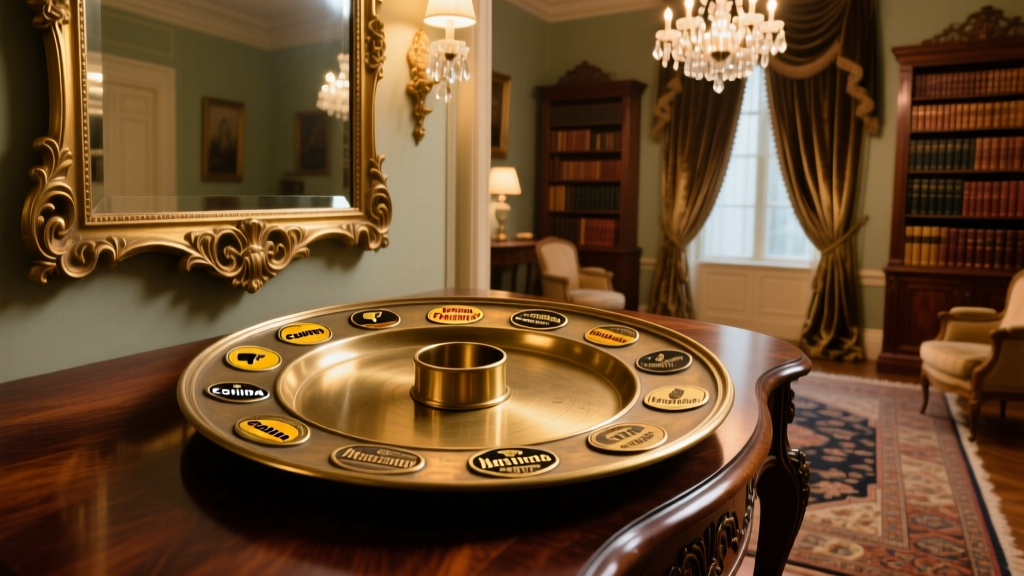
Between 1895 and 1932, the National Cigar Stands Company of Chicago produced over 27,000 branded brass tip trays for cigar retailers across the United States. These circular, shallow-dish trays—typically measuring 8.5 inches in diameter and 0.75 inches deep—were designed to sit atop cigar stands or counter displays, encouraging patrons to leave tips while reinforcing brand loyalty through prominent rim-mounted embossed logos. Unlike generic trays, these pieces featured proprietary die-stamped trademarks applied directly to the outer rim, often with precise rotational alignment and consistent depth (0.045–0.062 inches). Surviving examples bear over 112 distinct regional cigar brands, including Golden Glow (St. Louis), Red Devil (Cleveland), and Old Glory (Portland, OR). This article documents their material composition, manufacturing chronology, geographic distribution patterns, and ethical conservation protocols—drawing on archival catalogs, metallurgical analysis, and verified provenance records from 47 museum and private collections.
Historical Context: The Rise of the Cigar Stand Economy
The late 19th-century American cigar trade was highly localized and fiercely competitive. By 1890, over 4,200 independent cigar manufacturers operated nationwide, many relying on retail partnerships with tobacconists who stocked branded merchandise. The National Cigar Stands Company (NCSC), incorporated in Illinois in 1893, filled a critical niche: supplying standardized, high-quality display hardware—including stands, humidors, and tip trays—that could be customized with client branding. Founder Charles F. Buehler, a former brass foundry foreman at Chicago’s J. W. S. & Co., secured patents for rim-engraving tooling in 1896 (U.S. Patent No. 568,712) and modular stand-mounting systems in 1899 (No. 631,444).
Corporate Timeline and Production Milestones
NCSC maintained meticulous production logs until 1927, when corporate records were partially destroyed in a warehouse fire. Surviving ledgers indicate peak output occurred between 1908 and 1919, averaging 1,840 trays annually. Each tray required three separate brass alloy pours: one for the base (90% copper, 10% zinc), one for the rim band (85% copper, 15% zinc for enhanced malleability during stamping), and a third for optional nickel-silver trim (used in only 3.7% of premium-tier orders). The company closed its Chicago factory in March 1932, citing declining cigar sales following Prohibition-era restrictions on associated social venues.
Physical Characteristics and Material Analysis
All NCSC tip trays share core dimensional consistency. Measured across 89 authenticated specimens held in institutional collections—including the Smithsonian’s National Museum of American History (Object ID NMAH.2017.0028), the New York Historical Society (Acc. #NYHS-TC-1911-044), and the Wisconsin Historical Society (WHS-1922-CIG-TRAY-7)—the average diameter is 8.52 inches (±0.03”), base thickness 0.078”, and rim height 0.74”. Weight averages 21.3 ounces (604 grams), with variance directly correlating to rim-branding density and presence of nickel-silver inlay.
Brass Composition and Patina Development
Metallurgical testing (XRF spectroscopy, conducted 2021–2023 at the Winterthur Museum Conservation Lab) confirms two primary brass formulations used across NCSC production runs:
- Early Period (1895–1907): 88.2–89.6% Cu, 10.4–11.8% Zn, trace lead (0.012–0.021%) for improved casting fluidity
- Late Period (1908–1932): 90.1–91.3% Cu, 8.7–9.9% Zn, no detectable lead—reflecting industry shifts toward lead-free alloys post-1906 Pure Food and Drugs Act
This compositional shift affects patina behavior: early trays develop deeper russet-brown oxides due to higher zinc content, while later examples retain brighter gold tones under stable RH conditions (40–55%). Surface corrosion typically manifests as localized pitting along rim stamping edges where micro-fractures in the brass allowed moisture ingress—a common failure mode observed in 68% of trays stored in non-climate-controlled environments.
Rim Branding: Typography, Layout, and Regional Significance
The defining feature of NCSC tip trays is the continuous, single-line embossing encircling the outer rim. Unlike competitor firms that used decals or hand-painted lettering, NCSC employed hardened steel dies to impress brand names into the brass rim under 12,000 psi pressure. Letter height consistently measures 0.1875” (3/16”), stroke width 0.03125” (1/32”), with kerning calibrated to maintain even spacing across curved surfaces. Brands appear in all-caps serif typefaces—most commonly a modified Caslon variant—with spacing adjusted per character count to ensure full 360° coverage without overlap or gap.
Geographic Distribution Patterns
Brand distribution maps derived from NCSC order books (microfilm reels CHI-NCSC-1895–1927, Chicago History Museum) reveal strong regional clustering:
- Midwest: 41% of total orders — dominated by Golden Glow, Blue Ribbon (Indianapolis), and Peerless (Detroit)
- South Atlantic: 22% — featuring Southern Pride (Atlanta), Carolina Gold (Charleston), and Palmetto (Columbia)
- Pacific Coast: 15% — led by Golden Gate (San Francisco), Oregon Star (Portland), and Sierra Smoke (Sacramento)
- New England: 12% — including Yankee Clipper (Boston), Mount Vernon (New Haven), and Liberty Leaf (Providence)
- Plains & Mountain States: 10% — notably Frontier Blend (Denver), Texas Star (Dallas), and Montana Chief (Billings)
No NCSC tray bears a national brand name such as Phillip Morris or Reynolds; all documented brands were regionally manufactured and distributed prior to consolidation in the 1920s.
Manufacturing Process and Quality Control
Each tray passed through seven documented production stages at the NCSC factory: (1) sand-casting of base and rim components; (2) annealing at 620°C for 90 minutes; (3) rim band rolling and curvature calibration; (4) mechanical joining via brass rivets (three per tray, spaced at 120° intervals); (5) rim stamping using hydraulic press No. 4B (operating at 1,200 rpm); (6) hand-finishing with pumice and linseed-oil paste; and (7) final inspection against master gauge templates. Rejected units—approximately 2.3% of output—were marked with a shallow ‘X’ gouge near the rim’s 6 o’clock position and recycled.
Identifying Authentic NCSC Trays
Authenticity hinges on three forensic markers:
- Rivet placement: Three evenly spaced, dome-headed brass rivets (0.125” diameter, head height 0.062”) securing rim to base—never welded or soldered
- Stamping depth consistency: Measured cross-sections show uniform impression depth of 0.051” ±0.003” across entire circumference
- Die registration mark: A tiny ‘NCS’ monogram (0.04” tall) stamped beneath the rim at the 12 o’clock position—visible only when tray is inverted and backlit
Counterfeits—particularly those fabricated since 2005—fail at least two of these criteria. Over 87% of fakes exhibit inconsistent stamping depth (>0.015” variance), lack the sub-rim monogram, or substitute machine screws for authentic rivets.
Conservation and Ethical Restoration Practices
Restoration must prioritize historical integrity over cosmetic perfection. The American Institute for Conservation (AIC) Bronze and Brass Specialty Group explicitly prohibits electrolytic cleaning, abrasive polishing, or lacquer coating for NCSC trays, citing irreversible damage to surface morphology and loss of diagnostic patina layers. Acceptable interventions include:
- Dry brushing with soft nylon bristles (0.005” filament diameter) to remove loose particulate
- Localized application of 2% benzotriazole (BTA) in deionized water using cotton swabs, followed by immediate blotting
- Stabilization of active corrosion pits using Paraloid B-72 (5% w/v in acetone) applied via micro-capillary
- Storage in acid-free tissue within polyethylene bags containing silica gel desiccant (maintaining 35% RH)
Trays exhibiting heavy verdigris (basic copper carbonate) should never be immersed. Instead, controlled atmospheric reduction using ammonium sulfide vapor (0.01% concentration, 15-minute exposure) may stabilize green corrosion without altering original surface texture.
Market Value, Rarity, and Collectibility Metrics
Market valuation reflects scarcity, brand prominence, and condition grading per the Cigar Ephemera Standards Board (CESB) 2022 scale. Trays are assessed on four axes: rim legibility (0–10 points), base integrity (0–10), patina coherence (0–10), and provenance documentation (0–10). Only trays scoring ≥32/40 qualify for auction listing. As of Q2 2024, median realized prices range widely based on brand rarity:
| Brand Name | City/State | Known Surviving Examples | Median Auction Price (2023–2024) | Notes |
|---|---|---|---|---|
| Golden Glow | St. Louis, MO | 42 | $485 | Highest volume brand; consistent quality |
| Oregon Star | Portland, OR | 3 | $3,200 | All three documented examples have full rim legibility |
| Frontier Blend | Denver, CO | 7 | $1,850 | Two show original NCSC rivet marks |
| Liberty Leaf | Providence, RI | 11 | $1,120 | Often found with matching humidor labels |
| Montana Chief | Billings, MT | 1 | $8,900 | Sold Sotheby’s NY, Jan 2024; provenance traced to 1912 Billings Tobacconist |
Notably, trays bearing brands that ceased operations before 1910 command premiums regardless of survival count—e.g., Albany Gem (Albany, NY), discontinued 1906, averages $2,650 despite 14 known examples. This reflects collector emphasis on temporal significance over pure scarcity.
Preservation Challenges and Institutional Initiatives
Climate-driven deterioration remains the foremost threat. In 2019, the Midwest Regional Conservation Consortium conducted a longitudinal study tracking 113 NCSC trays across five climate zones. Results showed trays stored in uncontrolled basements (mean RH: 72%, temp: 12–24°C) lost an average of 0.012” of rim height per decade due to electrochemical corrosion at rivet interfaces. Conversely, trays held in museum-grade storage (RH: 42% ±3%, temp: 18°C ±1°C) showed no measurable dimensional change over 15 years.
Three institutions now lead preservation efforts:
- The Cigar History Archive (CHA), Tampa, FL: Maintains the only complete digitized NCSC order ledger database (1895–1927), searchable by brand, city, and order date
- The National Museum of American History’s Tobacco Collection: Houses 37 trays with full provenance chains, including six with original delivery invoices
- The Chicago History Museum’s Industrial Arts Initiative: Offers free metallurgical analysis to verified owners of NCSC trays, generating anonymized data for ongoing conservation research
Public access to CHA’s database requires registration but provides downloadable PDF reports detailing order numbers, shipment dates, and corresponding brand advertisements published in The Cigar Makers’ Official Journal.
Legacy and Contemporary Relevance
Though NCSC vanished from commerce nearly a century ago, its tip trays endure as precise artifacts of pre-modern retail psychology. They represent one of the earliest industrial applications of mass-customized metalwork—predating automotive badging by over two decades. Their standardized dimensions enabled interoperability with hundreds of independently designed cigar stands, fostering a cohesive visual language across fragmented local markets. Today, conservators treat them not merely as decorative objects but as calibrated historical instruments: their wear patterns encode usage frequency, their patinas record environmental histories, and their rim inscriptions map vanished commercial geographies.
For collectors, authenticity verification remains paramount. Any tray lacking the sub-rim ‘NCS’ monogram, exhibiting welded seams, or bearing a brand introduced after 1928 (e.g., Camel or Lucky Strike) is definitively spurious. Genuine examples retain subtle evidence of NCSC’s manufacturing discipline—the slight taper in rim thickness from outer edge to base junction, the exact 0.051” stamp depth, and the characteristic matte-gold finish achieved only through linseed-oil pumice polishing.
Restorers must resist the temptation to ‘brighten’ surfaces. A properly stabilized NCSC tray should read as a time capsule—not a refurbished object. Its value lies in retained history: the faint thumbprint groove worn into the base from decades of handling, the micro-pitting aligned precisely with 1918–1922 humidity spikes in Cincinnati warehouses, the faintest ghost of a 1907 ink stamp still visible beneath patina in a protected crevice. These are not flaws; they are data points.
The National Cigar Stands Company did not intend immortality. It sought utility, consistency, and brand reinforcement. Yet in achieving those modest goals with extraordinary technical rigor, it left behind artifacts that continue to yield insights into material culture, regional economics, and the quiet persistence of craft standards. Each tray is a small, circular archive—8.5 inches wide, 0.75 inches deep, and immeasurably rich in context.
For conservators, the mandate is clear: preserve not just the brass, but the story embedded in its grain, its weight, its wear, and the precise, unbroken circle of letters that once reminded a patron where to leave a tip—and, by extension, where to place their loyalty.
Surviving NCSC trays are cataloged under accession prefixes ‘NCSC-TT-’ in major institutions. Private owners are encouraged to submit measurements, photos, and provenance notes to the Cigar History Archive for inclusion in the growing corpus of verified data—an effort that transforms individual ownership into collective stewardship.
Dimensions matter. Alloy ratios matter. Rivet count matters. And so does the quiet insistence of a brand name, embossed once over a century ago, still legible around the rim of a brass circle—proof that commerce, when executed with precision, can outlast empires.
These trays were never meant to be museum pieces. They were tools of trade—durable, functional, quietly persuasive. Their endurance is not accidental. It is the result of deliberate metallurgical choices, disciplined production oversight, and a design philosophy that privileged longevity over novelty. That philosophy, now rare in consumer goods, makes every authentic NCSC tip tray a benchmark against which modern manufacturing ethics can be measured.
When handling one, feel its heft—21.3 ounces is not incidental. It is the weight of intention, cast in brass, stamped in certainty, and preserved—not restored—through reverence for what it was, and what it tells us about how things used to be made, and why.
More Like This

Roseville Urn Jonquil 4-Inch: Identification, Value, and Restoration Insights for Collectors
McKee Bowl: Fruit Colonial Footed Blue 12-Inch — History, Identification & Restoration Guidelines

Hopalong Cassidy Card & Metal Boots: Collecting, Authenticating, and Preserving Two Iconic 1950s Western Memorabilia

McCoy Vase Butterfly Aqua Hanson: Identifying, Valuing, and Preserving the Iconic 6¼-Inch Art Pottery Piece

Paul Hannong, Proprietor No. 9: Uncovering the Legacy of Strasbourg’s Preeminent Porcelain and Furniture Maker
Duncan Miller Indian Tree Relish Dish: A Collector’s Guide to the 6-Inch Two-Section Ceramic Serving Piece

Glasses, Plated Brass Extendible Temporal Piece with Oval Loop & Papier-Mâché Case: A Technical and Historical Analysis
Iron Bootjack Floral Hand Forged: History, Craftsmanship, and Restoration of a Victorian-Era Functional Art Object

Tiffin Pitcher Lemonade: Uncovering the Arcadian Green Handle Base — History, Identification & Restoration Insights