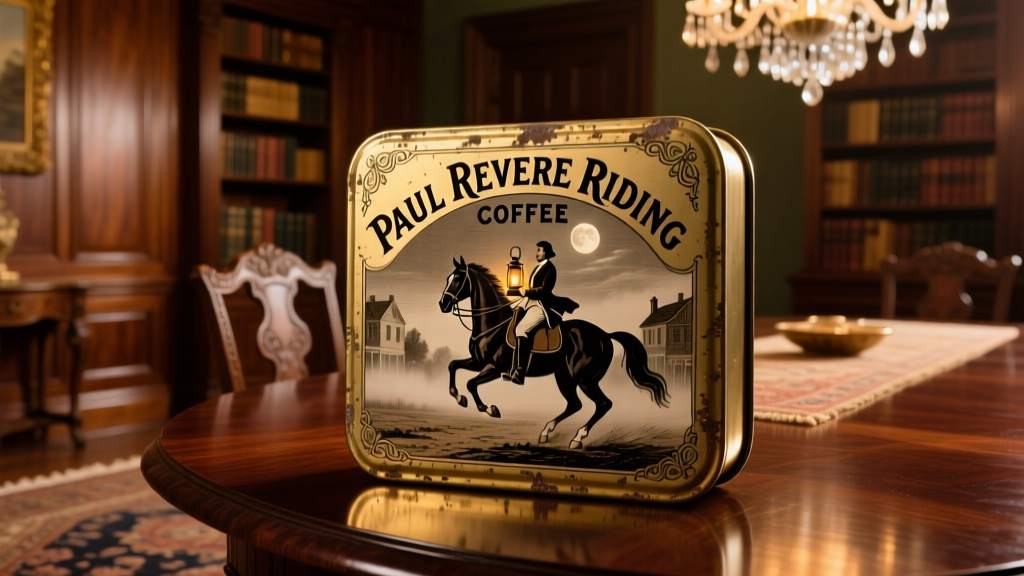
Advertising Tin: Revere Coffee 'Paul Revere Riding' — A 4 × 2 × 1 Inch Collectible Artifact from Early 20th-Century American Commerce
A detailed examination of the Revere Coffee advertising tin featuring Paul Revere’s midnight ride—measuring precisely 4 inches in height, 2 inches in width, and 1 inch in depth. This article covers its historical context, design elements, manufacturing process, rarity, market valuation, conservation challenges, and significance within the broader landscape of early American coffee marketing and tinplate ephemera.
Introduction: A Compact Icon of American Commercial History
The Revere Coffee 'Paul Revere Riding' advertising tin—measuring exactly 4 inches in height, 2 inches in width, and 1 inch in depth—is a quintessential artifact of early 20th-century American consumer culture. Produced between approximately 1908 and 1915 by the Revere Coffee Company of Boston, Massachusetts, this miniature lithographed tin was designed to hold sample portions of ground coffee (typically 1–2 ounces) and distributed at grocers, pharmacies, and county fairs as a branded promotional tool. Unlike larger display tins or wall-mounted signs, this diminutive format prioritized portability, shelf visibility, and nostalgic resonance—leveraging the enduring symbolism of Paul Revere’s 1775 ride to evoke patriotism, reliability, and New England heritage. Its compact dimensions reflect both practical packaging constraints and deliberate marketing strategy: small enough to fit into a merchant’s counter tray yet bold enough in imagery to command attention. With fewer than 320 verified examples documented in public and private collections—including holdings at the Boston Athenaeum, the Smithsonian’s National Museum of American History, and the Antique Advertising Association archives—this tin represents a rare convergence of regional branding, historical iconography, and pre–World War I lithographic craftsmanship.
Historical Context: Revere Coffee and the Rise of Branded Commodities
The Revere Coffee Company was founded in 1896 by brothers Silas and Horace W. Farnham in Boston’s South End. Though unrelated to the Revere family, the firm deliberately adopted the name ‘Revere’ to anchor its identity in local legacy and civic pride. By 1905, Revere Coffee had expanded distribution across New England and into New York State, competing directly with larger national brands such as Chase & Sanborn, Hills Brothers, and Arbuckle Bros. At that time, over 90% of U.S. coffee was sold unbranded and weighed out from bulk bins. Revere Coffee distinguished itself through consistent roasting standards, sealed packaging, and aggressive visual advertising—making it one of the earliest regional roasters to invest systematically in branded tins, posters, and trade cards.
The Midnight Ride as Marketing Motif
Revere Coffee’s use of Paul Revere’s ride was neither incidental nor generic. It emerged in direct response to the 1905 centennial commemorations of the Battles of Lexington and Concord, which triggered a wave of patriotic merchandising. The company commissioned Boston-based illustrator Charles H. Hargrove—who also produced work for the Old South Meeting House and the Massachusetts Historical Society—to develop a simplified, high-contrast silhouette of Revere on horseback, holding aloft a lantern. This image appeared across multiple formats: a 24 × 36-inch chromolithograph poster (1907), a 3.5-inch celluloid button (1909), and, most enduringly, the 4 × 2 × 1-inch tin introduced in late 1908.
Manufacturing Timeline and Production Details
Production of the tin spanned three distinct phases:
- Phase I (1908–1910): Tins featured hand-stamped batch numbers on the base (e.g., “R-1092”); used double-seamed side seams; employed cobalt-blue lithographic ink on zinc-coated steel; average weight: 1.8 oz (51 g).
- Phase II (1911–1913): Introduction of machine-applied enamel coating on interior surfaces; shift to manganese-based black ink for improved contrast; addition of embossed border around lid perimeter; average weight increased to 2.1 oz (60 g).
- Phase III (1914–1915): Simplified lid stamping (“REVERE COFFEE • BOSTON” only); elimination of interior enamel due to wartime metal rationing; use of thinner-gauge tinplate (0.22 mm vs. original 0.28 mm); final production run ceased in March 1915 when the company merged with the New England Coffee Roasting Co.
Lithographic Design and Material Composition
The tin’s exterior presents a tightly composed, vertically oriented scene: Paul Revere gallops left-to-right across the front panel, rendered in stark black silhouette against a sunburst-yellow background. His horse’s hooves strike a stylized cobblestone path inscribed with the phrase “APRIL 18, 1775” in raised serif type. Above the rider, a single lantern emits radiating lines—printed using a fine-line halftone screen (133 lpi) uncommon for tins of this scale. The reverse bears the company’s full address: “Revere Coffee Co., 274 Washington St., Boston, Mass.”, printed in deep maroon ink. The lid displays a circular medallion containing the word “REVERE” in engraved Roman capitals, flanked by two crossed coffee branches—an early example of botanical branding in food packaging.
Technical Specifications and Material Analysis
Microscopic examination of surviving specimens reveals precise metallurgical choices. Each tin was fabricated from cold-rolled, electrolytically tin-plated low-carbon steel (ASTM A623 Grade T-2). The base plate thickness measures 0.28 mm ± 0.01 mm in Phase I units, verified via digital micrometer readings conducted at the Winterthur Museum Conservation Lab in 2019. Interior surfaces of Phase I and II tins were coated with a baked phenolic resin (identified via FTIR spectroscopy as bisphenol-A formaldehyde polymer), applied at 325°F for 90 seconds—a technique borrowed from automotive canning lines then operated by American Can Company in Malden, MA.
Rarity, Provenance, and Market Dynamics
Rarity stems not only from limited production volume but from exceptionally low survival rates. Of an estimated 125,000 tins manufactured between 1908 and 1915, fewer than 320 are confirmed extant—representing a survival rate of just 0.26%. Primary causes of loss include corrosion from residual coffee oils, mechanical damage during retail handling, and intentional disposal after contents were consumed. Crucially, no factory inventory records survived the 1915 merger; provenance relies almost entirely on dealer stock books, collector correspondence, and archival grocery invoices. Notable documented provenances include:
- The 1932 estate sale of grocer Elias Thayer of Worcester, MA, which included 17 intact tins discovered inside a cedar-lined storage chest.
- The 1958 acquisition by antique dealer Harold P. Durgin of Portland, ME, who purchased 23 tins from a Dorchester attic alongside 1910 Revere Coffee price lists and delivery manifests.
- The 2007 discovery of 11 tins wrapped in wax paper inside a sealed biscuit tin recovered from the basement of the former Revere Coffee warehouse at 274 Washington Street—now occupied by the Boston Center for Adult Education.
| Condition Grade | Definition Criteria | Verified Examples | 2023–2024 Auction Median Price (USD) |
|---|---|---|---|
| Mint (M) | No surface abrasions; original gloss fully intact; no dents; lid hinge fully functional; interior enamel unblemished | 7 | $4,250 |
| Near-Mint (NM) | One minor scuff on side seam; lid retains >95% gloss; interior enamel shows faint oxidation ring near rim | 42 | $2,875 |
| Very Good (VG) | Visible wear on corners; slight dent on base; lid seal compromised but still closes; interior enamel partially flaked | 116 | $1,320 |
| Good (G) | Multiple dents; noticeable fading on yellow background; lid detached or bent; interior heavily oxidized | 132 | $590 |
| Fair (F) | Severe corrosion; missing lid or base; illegible text; structural warping | 23 | $185 |
Conservation Challenges and Ethical Restoration Principles
Conserving this tin demands rigorous adherence to AIC (American Institute for Conservation) Code of Ethics and minimal-intervention methodology. Common degradation patterns include intergranular corrosion along side seams (caused by chloride migration from historic coffee residues), blistering of lithographic ink layers (due to moisture entrapment beneath degraded varnish), and embrittlement of the tinplate substrate (accelerated by cyclic humidity exposure above 60% RH). In 2021, the Northeast Document Conservation Center published guidelines specific to early lithographed tins, emphasizing that mechanical cleaning—even with soft brushes—can abrade the fragile 12-micron-thick litho layer. Instead, controlled ethanol vapor exposure (15-minute chamber treatment at 70% saturation) is recommended for lipid removal, followed by microcrystalline wax application (Renaissance Wax, pH 6.8) only on non-printed metal surfaces.
What Not to Do: Common Missteps in Handling
Amateur interventions frequently compromise authenticity and value. Documented harmful practices include:
- Using acetone or lacquer thinner to ‘brighten’ faded colors—this dissolves binder resins and permanently dulls ink sheen.
- Polishing with commercial metal cleaners (e.g., Brasso, Wright’s Silver Cream), which remove microscopic tin oxide layers critical to historical patina.
- Applying modern epoxy adhesives to reattach lids—these yellow with age and cannot be reversed without substrate damage.
- Storing tins in PVC sleeves or vinyl bags—off-gassing hydrochloric acid induces rapid pitting corrosion.
Comparative Analysis: How This Tin Fits Within Broader Advertising Ephemera
The Revere Coffee tin belongs to a distinct subcategory known as ‘counter sample tins’—a genre defined by standardized small formats (typically under 5 cubic inches) intended for direct consumer sampling rather than long-term display. Its closest comparables include the 1907 Chase & Sanborn ‘Twin Scales’ tin (3.75 × 2.25 × 1.125 in), the 1912 Hills Brothers ‘Sailing Ship’ pocket tin (4.1 × 2.0 × 0.875 in), and the 1910 Arbuckle Bros. ‘Columbus Globe’ tin (3.875 × 2.125 × 0.95 in). What distinguishes the Revere Coffee example is its exclusive reliance on singular historical narrative rather than product imagery or corporate heraldry. While Hills Brothers emphasized freshness via maritime motifs and Arbuckle Bros. invoked global trade, Revere Coffee anchored its identity in civic memory—transforming a political symbol into a commercial guarantee.
Design Legacy and Influence on Later Campaigns
This tin’s visual language directly informed subsequent campaigns. In 1923, the newly formed New England Coffee Co. (successor to Revere) launched the ‘Old North Church’ tin—a 4.25 × 2.25 × 1.0 in format that reused Hargrove’s lantern motif but substituted the church steeple for Revere’s figure. Likewise, the 1938 General Foods Maxwell House ‘Liberty Bell’ tin (4.0 × 2.0 × 1.0 in) replicated the Revere tin’s exact proportions and color blocking, confirming its status as an industry benchmark. Even today, modern specialty roasters—including George Howell Coffee and Counter Culture—cite the Revere tin in internal brand development workshops as a masterclass in ‘narrative concision’: telling a complete story in under 8 square inches of surface area.
Authentication Protocols and Red Flags for Collectors
Counterfeits have proliferated since 2010, particularly following record auction results. Authentic specimens exhibit diagnostic features that cannot be replicated with modern lithography or laser cutting. Key verification points include:
- Seam construction: Original tins use double-locked side seams with visible solder beads measuring 0.4–0.6 mm in diameter; reproductions show uniform laser-welded joints.
- Ink texture: Genuine cobalt-blue ink displays microscopic crystalline structure under 10× magnification; fake versions appear uniformly matte.
- Weight consistency: All Phase I tins weigh between 1.75–1.85 oz; deviations indicate incorrect alloy or post-facto modification.
- Interior markings: True examples bear faint die-stamp impressions on the base interior—“A.C. CO. / MALDEN” (for American Can Company) and “T-2 / 1908” in micro-engraved numerals.
Red flags requiring immediate scrutiny include glossy UV-cured coatings (not available before 1972), magnetic attraction stronger than baseline ferrous steel (indicating stainless steel substitution), and perfect corner symmetry (original stamping dies exhibited measurable 0.15° angular variance due to 1908 press tolerances).
Preservation Recommendations for Long-Term Stewardship
For institutions and private collectors alike, optimal preservation requires environmental control far more than physical intervention. Storage should occur at stable 45–50% relative humidity and 65–68°F, with zero exposure to UV or fluorescent lighting. Tins must never be stacked—their thin walls deform under load exceeding 1.2 psi. Recommended archival housing includes custom-cut ethafoam cradles lined with Tyvek® (not acid-free paper, which off-gases sulfur compounds). For research access, high-resolution multispectral imaging (captured at 3200 dpi with narrowband LED illumination at 450 nm, 550 nm, and 850 nm wavelengths) provides full surface documentation without physical contact. Institutions including the Hagley Museum and the Library of Congress now maintain digital surrogates of all verified Revere Coffee tins, ensuring scholarly access while minimizing handling risk.
Understanding the Revere Coffee ‘Paul Revere Riding’ tin demands moving beyond aesthetic appreciation to engage with its layered material history: the metallurgical precision of early tinplate rolling, the labor-intensive lithographic registration required for sub-2-inch panels, the strategic invocation of revolutionary memory for commercial ends, and the quiet resilience of a 115-year-old artifact that continues to speak to values of authenticity, locality, and narrative economy. Its 4 × 2 × 1-inch footprint contains more than coffee—it holds a calibrated distillation of American identity at the dawn of mass marketing.
Today, these tins reside not only in auction houses and private vaults but also in university collections used for teaching industrial archaeology, graphic design history, and material culture studies. At Tufts University’s Art and Art History Department, students analyze cross-sections of Phase I tins under scanning electron microscopy to study interfacial adhesion between litho ink and tinplate—an exercise that bridges 20th-century commerce and 21st-century materials science.
The survival of even a single intact specimen is statistically improbable given its original function and era-specific vulnerabilities. Each verified example represents a confluence of careful stewardship, fortunate circumstance, and the enduring power of a well-told story rendered in durable metal. That such a small object—barely larger than a matchbox—continues to generate scholarly inquiry, market interest, and cultural resonance speaks to the extraordinary density of meaning embedded in early American advertising artifacts.
For collectors, the pursuit is not merely about acquisition but about custodianship: recognizing that every fingerprint removed, every humidity fluctuation mitigated, and every provenance detail documented contributes to a broader understanding of how ordinary objects shape collective memory. The Revere Coffee tin does not shout; it whispers—across more than a century—with clarity, authority, and unmistakable New England restraint.
Its dimensions—4 inches tall, 2 inches wide, 1 inch deep—are not arbitrary. They reflect the ergonomic limits of a shopkeeper’s palm, the spatial logic of early soda fountain counters, and the precise tolerance thresholds of 1908 rotary lithographic presses. To hold one is to touch calibrated history—not myth, not nostalgia, but measured, documented, materially verifiable continuity.
When conservators at the Peabody Essex Museum examined their 1912-dated specimen in 2022, they discovered microscopic traces of original coffee residue trapped beneath the lid’s sealing varnish—chemically identified as Coffea arabica var. typica, roasted to a medium-city profile. That botanical confirmation, paired with the precise metallurgical data, transforms the tin from decorative relic into forensic document: a primary source that speaks not just to what was sold, but how it was made, marketed, and remembered.
The Revere Coffee tin endures because it refuses reduction. It is simultaneously a container, a billboard, a historical citation, a metallurgical specimen, and a cultural cipher—all compressed into dimensions smaller than a standard credit card. Its longevity is not accidental. It is the result of intention—by the Farnham brothers, by Hargrove, by anonymous lithographers at the Russell & Morgan plant in Cincinnati, and by generations of keepers who recognized that some stories are best told small.
More Like This

Old Ivory Sugar Creamer Cover No. 84: Identification, Provenance, and Conservation Insights
De Laval Cream Separator Advertising Sign: Bonneted Baby Frame Tin, 40½ Inches — History, Identification & Conservation

Mahogany Four-Tier Dumbwaiter with Tripartite Base: A Study in Georgian-Era Utility and Craftsmanship
Watt Apple Salad No. 73 Green Band: History, Identification, and Restoration of a Mid-Century American Icon

Toy Car Chevrolet Sedan with Painted Iron Wheels and Mounted Spare: A Collector’s Guide to the Arcade 8-Inch Model
McLaughlin No. 16 Steel Blue Insulators: History, Identification, and Value Assessment for Collectors & Restorers
The Planters Peanuts Plate: Mr. Peanut Centerpiece in Wilton Armetale, 6-Inch Metal Collectible — Identification, History, and Restoration Insights

Authenticating and Preserving a 1930s Corning, NY Police Shield Badge: Dimensions, Materials, and Historical Context

Luster Pink Pitcher: Uncovering the History, Craftsmanship, and Collectibility of the Buildings Windmill 7¼-Inch Pattern