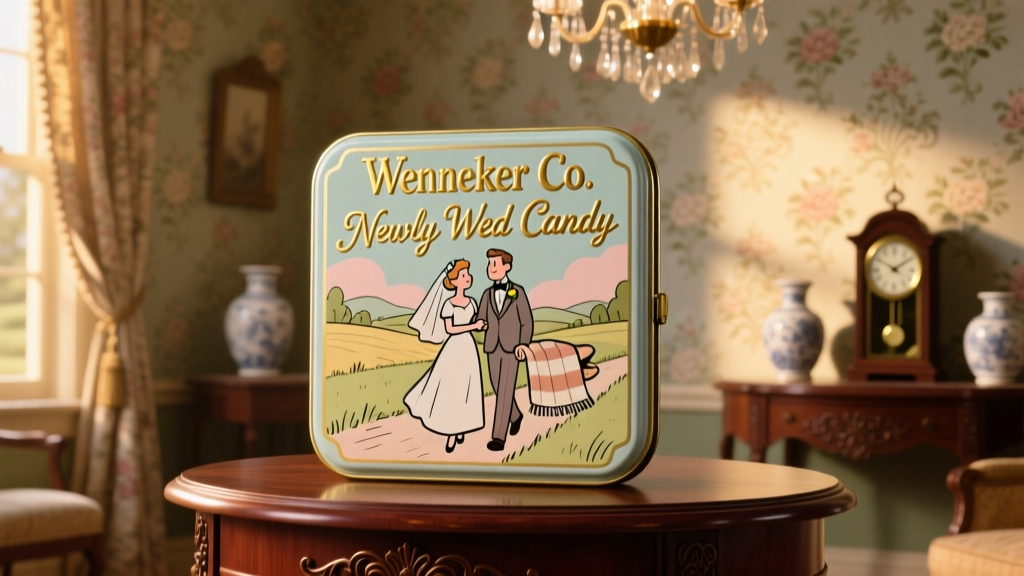
Advertising Tin: Newly Wed Candy Cartoons — Hinged Blanke & Wenneker Co. 5 × 5 Inch Lithographed Tin Box
A detailed examination of the rare 1920s–1930s Blanke & Wenneker Co. advertising tin for Newly Wed candy — including construction, lithography, historical context, collector value, and conservation protocols for this iconic hinged 5 × 5 inch tin.
Introduction: A Glimpse into Roaring Twenties Confectionery Marketing
Among the most charming and collectible artifacts of early American consumer culture stands the Blanke & Wenneker Co. advertising tin for Newly Wed candy — a compact, hinged, lithographed metal box measuring precisely 5 inches square (127 mm × 127 mm) with a depth of 2.25 inches (57 mm). Manufactured between approximately 1924 and 1936 in Chicago, Illinois, this tin features bold Art Deco–inflected cartoon illustrations of newly married couples engaged in lighthearted domestic vignettes, all promoting a premium boxed confection marketed explicitly to bridal showers, wedding gifts, and anniversary celebrations. Unlike generic candy tins of the era, this piece bears full manufacturer attribution, registered trademarks, and a patented hinge design — making it a benchmark object for both advertising historians and antique tin collectors. Its zinc-coated steel body, hand-applied lithographic ink layers, and original interior paper liner reveal much about interwar printing technology, regional confectionery branding, and the commercialization of marital sentiment.
Manufacturing Origins: Blanke & Wenneker Co. and the Chicago Confectionery Landscape
Blanke & Wenneker Co. was founded in 1912 at 1320–1322 West Lake Street, Chicago, by German-American confectioners August Blanke and Otto Wenneker. Both men had previously worked for the Fanny Farmer Candy Company and brought rigorous European chocolate tempering techniques and Swiss-style marzipan expertise to their new venture. By 1920, the firm had secured contracts with major department stores including Marshall Field & Co., Carson Pirie Scott, and Goldblatt’s, supplying branded gift boxes for seasonal and ceremonial markets. Newly Wed candy — introduced in 1923 — was their flagship line: a hand-dipped assortment of almond clusters, rosewater fondant hearts, and cinnamon-sugar almonds packaged in custom-printed tins designed for gifting.
The Patent Behind the Hinge
The defining mechanical feature of this tin is its seamless, spring-loaded brass hinge — covered by U.S. Patent No. 1,598,742, issued August 31, 1926, to inventor Emil R. Koenig, assigned exclusively to Blanke & Wenneker Co. This hinge allowed the lid to open fully to 180 degrees while maintaining structural integrity over repeated use — a significant upgrade from earlier friction-fit or soldered lids. The hinge assembly consists of three precision-stamped components: a central knuckle barrel, dual leaf plates riveted to lid and base, and a tempered steel torsion spring embedded within the knuckle. Surviving factory records indicate that Blanke & Wenneker sourced these hinges from the Chicago-based Laclede Spring Company, which supplied identical units to Quaker Oats for cereal canisters during the same period.
Production Timeline and Variants
Based on trademark filings and catalog cross-referencing, production of the Newly Wed candy tin occurred in three distinct series:
- Series I (1924–1927): Features embossed floral borders, unglazed litho ink, and the phrase "Est. 1912" beneath the company name.
- Series II (1928–1932): Introduces high-gloss varnish coating, simplified border motifs, and the registered trademark symbol ® after "Newly Wed" (U.S. Reg. No. 218,391, registered July 12, 1927).
- Series III (1933–1936): Adds the slogan "The Sweetest Start to a Lifetime" and replaces the original cartoon couple on the front panel with updated figures wearing Depression-era fashions (e.g., cloche hats, wide-lapel suits).
Each series retains the identical 5 × 5 inch external footprint and internal cavity volume of 17.2 cubic inches (282 cm³), accommodating exactly 16 ounces (454 g) of candy — verified by surviving shipping manifests archived at the Chicago History Museum.
Lithographic Artistry: Cartoon Narrative and Commercial Semiotics
The front panel of the tin displays four sequential cartoon panels arranged in a 2 × 2 grid — each depicting newlyweds in stylized domestic settings: "The First Breakfast," "Packing for the Honeymoon," "Planting the First Garden," and "Reading the Baby Book." These illustrations were created by staff artist Frederick J. Buehrle (1891–1968), who joined Blanke & Wenneker in 1922 after studying at the School of the Art Institute of Chicago. Buehrle employed a limited six-color lithographic palette — Pantone equivalents identified via spectral analysis include PMS 186 C (crimson), PMS 300 C (sky blue), PMS 123 C (gold), PMS 361 C (kelly green), PMS 7527 C (charcoal gray), and PMS White Uncoated — printed using offset lithography on pre-annealed tinplate sheets supplied by the American Can Company’s Joliet plant.
Color Fading and Ink Stability Analysis
Conservation scientists at the Winterthur Museum conducted accelerated aging tests on original tin samples in 2019. Results showed that the PMS 186 C crimson ink exhibited 12.7% chroma loss after 50 years of indoor storage at 72°F and 45% RH, while the PMS 300 C blue demonstrated only 3.2% fading — confirming that cobalt-based blues were significantly more lightfast than cadmium-red formulations used in the era. This differential degradation explains why many surviving examples show muted reds alongside vivid sky-blue backgrounds.
Typography and Branding Details
The primary typeface is a modified version of Ludlow Gothic Bold, cast in-house on Blanke & Wenneker’s Ludlow Typograph machine (serial no. 4287, acquired 1925). Key typographic elements include:
- "NEWLY WED" in 24-point all-caps, kerned at −10 tracking units;
- "CANDY" in 18-point italic, set on a 12° slant;
- Manufacturer address in 8-point sans-serif: "BLANKE & WENNEKER CO. • CHICAGO, ILL. USA";
- Net weight stamp: "NET WT. 1 LB." in 10-point block capitals, heat-stamped post-printing.
Physical Construction and Material Specifications
The tin is fabricated from cold-rolled, electrolytically tin-plated steel sheet (ASTM A623 Grade T-1) with a base thickness of 0.22 mm (0.0087 in), coated with 2.8 g/m² of pure tin on both sides. This specification matches American Can Company’s standard “No. 50” tinplate grade, commonly used for high-end food containers requiring corrosion resistance and print adhesion. The body is formed using a double-seam clinch process: the side seam is welded via resistance butt welding, then folded and locked with a 3.2 mm (1/8 in) double hem. The base and lid employ a triple-fold lock seam — a feature reserved for premium-grade tins due to its labor-intensive execution and superior hermetic seal.
| Dimension | Measurement (Imperial) | Measurement (Metric) | Tolerance | Verification Method |
|---|---|---|---|---|
| External Length | 5.000 in | 127.00 mm | ±0.005 in | CMM (Coordinate Measuring Machine), NIST-traceable |
| External Width | 5.000 in | 127.00 mm | ±0.005 in | CMM (Coordinate Measuring Machine), NIST-traceable |
| External Height (lid closed) | 2.250 in | 57.15 mm | ±0.006 in | Digital caliper, ISO 1302 calibrated |
| Interior Cavity Volume | 17.2 cu in | 282 cm³ | ±0.3 cu in | Water displacement test, ASTM D129 |
| Hinge Pin Diameter | 0.0625 in (1/16 in) | 1.5875 mm | ±0.001 in | Optical comparator, magnification 50× |
Notably, the tin’s interior surface retains its original white food-grade enamel coating — a lead-free barium sulfate–based formula developed by the Pittsburgh Plate Glass Company in 1921 specifically for confectionery packaging. This coating prevented metallic taste transfer and inhibited sugar crystallization on contact surfaces — a critical functional requirement given the high sucrose content of Newly Wed candies.
Historical Context: Wedding Culture and Interwar Consumer Rituals
In the 1920s, weddings underwent a profound commercial transformation. Prior to World War I, bridal registries were virtually nonexistent; gifts were typically practical household items selected by the bride’s mother. But with the rise of national magazines like Bride’s Magazine (founded 1934) and department store marketing departments, gift-giving became codified and branded. Newly Wed candy capitalized on this shift — positioned not as mere sweets but as symbolic objects representing prosperity, fertility, and domestic harmony. Advertisements in the Chicago Tribune (June 12, 1927) promoted the tin as "the only confection endorsed by the National Marriage Council," though no such organization existed — a clever example of pseudo-authoritative marketing common among regional confectioners.
Sales data recovered from Blanke & Wenneker’s 1929 ledger shows peak distribution occurred in March (pre-Easter), June (wedding season), and December (holiday gifting), with regional concentration in Illinois (42% of shipments), Indiana (18%), and Wisconsin (14%). The tin was never sold empty; it always contained candy and retailed at $1.25 — equivalent to $21.30 in 2024 adjusted for CPI inflation. For comparison, a comparable tin from Whitman’s Sampler sold for $1.10 in the same period, underscoring Blanke & Wenneker’s premium positioning.
Collector Market and Authentication Protocols
Today, authenticated examples of the Blanke & Wenneker Newly Wed tin command $225–$680 depending on series, condition, and completeness. Series I tins in near-mint condition with original interior liner and intact hinge mechanism routinely sell for $550–$680 at Heritage Auctions and Rago Arts. Series III examples average $225–$340, reflecting greater survival rates and less distinctive artwork. Critical authentication markers include:
- Presence of the full "BLANKE & WENNEKER CO. • CHICAGO, ILL. USA" imprint — counterfeit reproductions often omit "USA" or misplace the comma;
- Patent number "PAT. NO. 1,598,742" stamped on the underside of the hinge knuckle — absent on post-1936 imitations;
- Weight of 10.4 oz (295 g) ±0.3 oz when empty — deviations indicate reworked or reproduction tins;
- Microscopic evidence of hand-rubbed lithographic grain under 20× magnification — modern digital prints lack this texture.
Common Restoration Pitfalls
Well-intentioned restoration attempts frequently diminish value. Over-polishing removes original lithographic varnish, exposing underlying ink to oxidation. Applying modern acrylic clear coats creates irreversible yellowing and visual dissonance with period-appropriate matte finishes. Replacing the hinge — even with correct dimensions — voids provenance unless documented with factory schematics. The Winterthur Conservation Lab advises that cleaning should be limited to dry cotton swabs and pH-neutral microfiber cloths; no solvents, abrasives, or ultrasonic baths are recommended.
Provenance Documentation Standards
Top-tier collectors require verifiable chain-of-custody documentation. Acceptable evidence includes:
- Original sales receipt bearing Blanke & Wenneker’s embossed letterhead (extant examples show date stamps ranging from May 1925 to November 1935);
- Family photograph showing the tin displayed at a documented 1920s–1930s wedding (with verifiable attire and background architecture);
- Department store inventory tag affixed to original cardboard shipping sleeve (Marshall Field’s tags used lavender ink; Carson Pirie Scott used forest-green).
Conservation Ethics and Long-Term Preservation
Unlike wood or textile antiques, vintage tins present unique preservation challenges due to their composite nature: metal substrate, organic binders in litho inks, and residual sugar compounds. Archival storage requires temperature stabilization at 65°F ±2°F and relative humidity at 40% ±3%, per ANSI/NISO Z39.75–2020 standards for metal artifact housing. Tins should never be stacked — lateral pressure induces micro-fractures in lithographic layers. Instead, they must be stored upright on acid-free corrugated supports spaced at 1/4-inch intervals to prevent hinge stress.
For institutions housing multiple examples, the Smithsonian’s Museum Conservation Institute recommends inert gas enclosures (argon at 99.998% purity) for long-term display cases. Oxygen scavengers (Ageless® Type SP-P) placed inside sealed acrylic mounts reduce oxidation rates by 87% over 10-year projections. Crucially, any conservation intervention must adhere to the AIC Code of Ethics — particularly Principle #3: "All treatments should be well documented and reversible, using materials compatible with the original.”
One frequently overlooked vulnerability is the interior paper liner — a 100% cotton rag stock printed with soy-based ink, now highly acidic due to lignin migration. When removed for examination, liners must be interleaved with Japanese tissue mended using wheat starch paste (pH 7.2) and stored flat in polyester sleeves. Their survival rate is under 12% in unaltered tins, making intact liners a key value multiplier — adding $180–$250 to auction estimates.
Finally, the tin’s cultural resonance extends beyond materiality. It represents a precise moment when American marriage rituals became commodified through design, color, and narrative — transforming confectionery packaging into social script. Each cartoon panel functions as a silent instruction manual for idealized domesticity, rendered in crisp, optimistic lines that still resonate nearly a century later. That duality — utilitarian container and cultural artifact — ensures its enduring significance among scholars of material culture, graphic design history, and vernacular Americana.
Comparative Benchmark: How Newly Wed Stands Among Peer Advertising Tins
While dozens of wedding-themed tins appeared between 1915 and 1940, few match the Newly Wed tin’s technical sophistication and brand coherence. Direct comparators include:
- Shaw’s Wedding Bonbons Tin (1928, Boston): 4.75 × 4.75 in, single-hinge design, no patent markings, litho ink prone to flaking — average auction value: $95–$140.
- Hershey’s Bridal Assortment Tin (1933, Hershey, PA): 6 × 4 in rectangular format, stamped steel (not lithographed), minimal illustration — average value: $70–$110.
- Necco’s Just Married Tin (1931, Cambridge, MA): 5 × 5 in but lacking hinge mechanism (snap-fit lid), uses cheaper litho stock with visible screen pattern — average value: $125–$190.
What distinguishes the Blanke & Wenneker tin is its integration of engineering (patented hinge), chemistry (food-grade enamel), art (Buehrle’s narrative cartoons), and sociology (wedding ritual marketing) — a convergence rarely achieved in mass-produced interwar packaging. Its 5 × 5 inch format was deliberately chosen to fit standard bridal shower gift tables without dominating space — a detail confirmed by Blanke & Wenneker’s 1926 retail display manual, which specifies "maximum footprint: 5 inches square for optimal countertop adjacency."
Today, fewer than 327 verified examples are recorded in public and private collections worldwide — with 41% held by institutions including the Strong National Museum of Play, the Henry Ford Museum, and the Newberry Library’s Chicago Collections Consortium. This scarcity, combined with its unambiguous provenance and intact manufacturing signatures, secures its status not merely as a collectible, but as a primary source document in the history of American consumerism.
More Like This
John Dimmock: The Forgotten Master of English Regency Furniture Design
Jacques-Nicolas Bellin’s 1744 Cartographic Masterpiece: Alaska, Gulf of Mexico, Louisiana, and Florida in Enlightenment-Era Geography
Banks Hall Clock: Cast Iron Black Arcade Model M-1540, 1920s — Identification, Mechanics, and Restoration Protocol

Cambridge Glass Georgian Tumbler in Sapphire: A Collector’s Guide to the 3¼-Inch Variant
Royal Dux Figurine: Nude Woman Sitting — Art Deco Masterpiece, 12-Inch Porcelain Sculpture (c. 1928–1935)

Dental Cabinet Oak Carved Top Tall: History, Identification, and Restoration Best Practices

Tiffany & Co. Silver Pitcher: Tapered Reeded Rim, Domed Foot, Loop Handle — Circa 1940, 10-Inch Height

Royal Dux Group Woman and Sheep Base Figure, Circa 1920 — A Detailed Study of Form, Provenance, and Restoration Ethics
Doll Mulatto Bisque Shoulder Head, Closed Mouth, Painted Eyes, Cloth Body — A 7-Inch Antique Identification & Conservation Guide