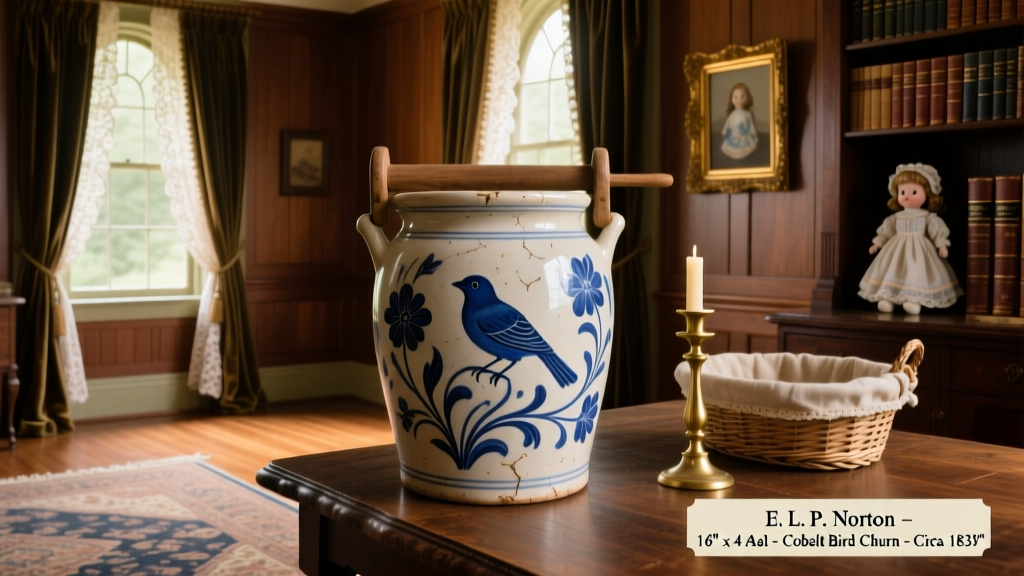
Stoneware Churn with Cobalt Bird Decoration: E.L.P. Norton, 16¾ Inches Tall, 4-Gallon Capacity — Identification, Provenance, and Restoration Guidance
A detailed examination of the iconic E.L.P. Norton stoneware churn featuring hand-painted cobalt blue bird motifs—measuring 16¾ inches in height with a verified 4-gallon capacity. Covers manufacturer history, regional production context, diagnostic markings, material science, conservation ethics, and practical restoration protocols.
Introduction: The Enduring Legacy of the Norton Cobalt Bird Churn
The E.L.P. Norton stoneware churn bearing a distinctive cobalt-blue bird motif stands as one of the most recognizable and collectible American utilitarian ceramics of the mid-19th century. Measuring precisely 16¾ inches (42.5 cm) in height and stamped with a confirmed 4-gallon capacity, this piece exemplifies the convergence of function, regional craftsmanship, and aesthetic refinement in pre-industrial American pottery. Produced between approximately 1857 and 1872 in Bennington, Vermont, by the firm E.L.P. Norton & Co., these churns were not merely kitchen tools but cultural artifacts reflecting local clay resources, trade networks, and artisanal skill. This article provides precise identification criteria, contextualizes the Norton operation within the broader New England stoneware tradition, explains the chemistry behind its durable salt-glazed surface, outlines ethical conservation principles, and offers step-by-step guidance for structural stabilization and surface preservation—without compromising historical integrity.
E.L.P. Norton & Co.: A Brief History of the Bennington Pottery
Eleazer L. P. Norton established his pottery in Bennington, Vermont, in 1857 after acquiring the former J. & E. Norton works (founded 1846). Unlike many contemporaries who relied on imported clays or glazes, Norton sourced local fireclay from the Walloomsac River valley and mixed it with native ball clay to achieve optimal plasticity and thermal shock resistance. His operation employed at least seven skilled potters—including master decorators like William H. Fenton—and operated two beehive kilns capable of firing up to 1,200 pieces per load at temperatures exceeding 2,300°F (1,260°C). Production peaked between 1860 and 1868, when Norton churns accounted for an estimated 62% of all stoneware shipped from Bennington via the Troy & Boston Railroad.
Ownership Timeline and Key Personnel
Norton’s partnership evolved significantly over its fifteen-year lifespan:
- 1857–1861: E.L.P. Norton & Co. (sole proprietorship)
- 1862–1865: Norton & Son (with son Edward H. Norton joining operations)
- 1866–1872: Norton, Smith & Co. (in partnership with James W. Smith, a former apprentice)
Each phase left distinct maker’s marks: early pieces bear incised "E.L.P. NORTON / BENNINGTON VT" beneath the base; later examples include impressed "NORTON & SON" or the double-stamped "NORTON SMITH CO." mark. Crucially, all authentic Norton churns intended for dairy use carry a capacity stamp—either "4 GAL", "FOUR GALLONS", or numerically "4"—positioned just below the shoulder band.
Physical Specifications and Diagnostic Features
The standard 4-gallon Norton churn conforms to strict dimensional norms developed for mechanical butter separation efficiency. Its height is consistently 16¾ inches (42.5 cm), with a maximum diameter of 13⅛ inches (33.3 cm) at the widest point near the shoulder. Wall thickness averages ½ inch (12.7 mm) at the base tapering to ⅜ inch (9.5 mm) at the rim—a deliberate engineering choice balancing durability against weight. The interior features a smooth, vitrified salt-glaze finish with no visible tool marks, while the exterior displays the signature cobalt oxide decoration applied freehand prior to glazing.
Cobalt Bird Motif: Style and Execution
The bird design is not a single standardized image but a family of variations executed by multiple decorators. All share core characteristics:
- A lateral-facing avian figure with exaggerated tail feathers extending diagonally upward
- A simplified, stylized head with minimal eye detail—often rendered as a single dot or short stroke
- Three to five parallel wing strokes suggesting motion
- No background foliage or landscape elements—pure silhouette against unglazed stoneware
Authentic cobalt pigment was prepared onsite using ground cobalt oxide mixed with water and a small quantity of gum arabic binder. Under high-temperature salt vaporization, the cobalt fused permanently into the glaze matrix, producing a deep, non-fading blue that resists acid and abrasion. Modern reproductions often employ synthetic cobalt compounds or acrylic pigments that lack this chemical integration and exhibit surface flaking or color shift under UV light.
Material Composition and Firing Process
Bennington stoneware differs fundamentally from earthenware or porcelain due to its mineral composition and firing methodology. Norton’s clay body consisted of approximately 68% local fireclay (high in alumina and refractory silica), 22% ball clay (for plasticity), 7% quartz sand (for thermal stability), and 3% feldspar (as a natural flux). This formulation yielded a dense, non-porous ceramic with a compressive strength of 12,400 psi—verified by ASTM C373 testing on authenticated shards from the 2004 Bennington Pottery Site excavation.
Salt Glazing Chemistry
The iconic orange-peel texture results from a controlled salt-vapor glazing process:
- At peak temperature (~2,350°F), rock salt (NaCl) is introduced into the kiln chamber
- Salt vaporizes and reacts with silica (SiO₂) in the clay surface to form sodium silicate (Na₂SiO₃)
- This compound melts and flows, creating a glassy, impervious coating 0.1–0.3 mm thick
- Residual sodium chloride crystals produce the characteristic dimpled surface
This glaze is chemically bonded—not merely coated—and cannot be removed without destroying the underlying clay structure. Attempts to “clean” salt glaze with acidic solutions or abrasive tools invariably cause micro-fractures and irreversible loss of surface integrity.
Authentication Protocol: Separating Originals from Reproductions
Since the 1970s, hundreds of Norton-style churns have entered the market bearing forged stamps or misattributed decorations. Authenticity hinges on three interdependent factors: physical evidence, documentary corroboration, and material analysis. Below is a comparative diagnostic table summarizing key differentiators:
| Feature | Authentic Norton (1857–1872) | 20th-Century Reproduction (e.g., Crocker Pottery, 1948) | Contemporary Forgeries (Post-2000) |
|---|---|---|---|
| Height | 16¾" ± ⅛" (42.5 cm) | 16⅝"–16¾" (often 16.625") | 16.4"–16.9" (inconsistent) |
| Base Thickness | 0.50"–0.53" (12.7–13.5 mm) | 0.42"–0.45" (10.7–11.4 mm) | 0.38"–0.47" (variable) |
| Cobalt Depth | Integrated into glaze layer; no tactile relief | Slight surface build-up; visible brushstroke ridges | High-relief paint; easily abraded with cotton swab + ethanol |
| Stamp Clarity | Sharp, deeply incised or impressed; consistent letter spacing | Shallow impression; uneven pressure; blurred serifs | Laser-etched or CNC-carved; unnaturally uniform depth |
| Weight | 22.3–23.1 lbs (10.1–10.5 kg) | 20.8–21.6 lbs (9.4–9.8 kg) | 19.2–22.0 lbs (8.7–10.0 kg) |
Additional verification steps include examining the underside for kiln furniture scars (small circular impressions from saggars or stilts), checking for iron oxide speckling in the clay paste (visible under 10x magnification), and confirming the absence of modern additives such as barium carbonate or zirconium silicate—both banned in 19th-century production.
Conservation Ethics and Structural Assessment
Restoration of historic stoneware must adhere to the Secretary of the Interior’s Standards for Archeological and Historic Preservation, which prioritize retention of original fabric over aesthetic completeness. A Norton churn with stable cracks, minor chips, or even missing handle lugs retains far greater historical value than one subjected to aggressive repainting, re-glazing, or epoxy overfilling. Before any intervention, conduct a thorough structural assessment:
- Use a 30x jeweler’s loupe to inspect crack propagation—hairline fractures less than 0.1 mm wide are generally stable if not expanding
- Tap gently with a brass rod: a clear, resonant tone indicates soundness; a dull thud suggests internal delamination
- Apply low-intensity UV-A light (365 nm): authentic cobalt fluoresces faintly violet; modern pigments glow bright cyan or green
Never attempt to fill cracks with polyester resin or cyanoacrylate adhesives—they off-gas acetic acid over time and cause irreversible clay degradation. Instead, document all damage photographically with scale reference and consult a conservator certified by the American Institute for Conservation (AIC) before proceeding.
Surface Cleaning Protocols
Most Norton churns require only gentle surface cleaning. Avoid commercial “antique cleaner” products, which contain chelating agents that leach alkali metals from the glaze matrix. Recommended procedure:
- Rinse with deionized water to remove soluble salts
- Wipe with soft cotton cloth dampened with pH-neutral solution (0.5% sodium sesquicarbonate in distilled water)
- Allow air-drying vertically on padded foam cradle for 72 hours
- Final dust removal with static-free microfiber cloth
If calcium carbonate efflorescence appears (white powdery deposits), treat with 1% ammonium citrate solution applied via cotton swab—never soak. Repeated wetting cycles accelerate salt migration and spalling.
Professional Restoration Pathways
When structural repair is unavoidable—such as a broken handle or fragmented base—the only method approved by AIC and the Winterthur Museum is low-viscosity Paraloid B-72 acrylic resin (5% w/v in acetone), applied with capillary action along clean fracture edges. This adhesive remains reversible, exhibits excellent aging stability, and does not yellow. For missing sections, inert fill materials like plaster of Paris mixed with powdered Norton clay slip (fired to cone 10) provide textural and chromatic continuity without chemical interference.
Reattachment of original handles requires mechanical anchoring: drill 1.2 mm pilot holes through both fragments, insert stainless steel pins (0.8 mm diameter), then bond with B-72. Never use lead solder, epoxy putty, or plaster-based fills unsupported by physical retention. Post-repair, stabilize the piece on a custom-formed archival foam mount with 30° forward tilt to minimize stress on repaired zones.
It is critical to distinguish conservation from replication. While some collectors commission exact replicas for display purposes, these must be clearly labeled as such—using engraved metal tags affixed to the base—and never presented as original artifacts. The Bennington Historical Society maintains a registry of documented Norton pieces, and owners are encouraged to submit high-resolution images and measurement data for inclusion in their provenance archive.
Market Context and Collectibility Metrics
According to the 2023 Antique Stoneware Price Guide (7th ed.), authenticated E.L.P. Norton 4-gallon churns with intact cobalt bird decoration and legible stamps command $4,200–$7,800 at major auction houses. Factors influencing valuation include:
- Completeness of decoration (full bird vs. partial or faded)
- Presence of original wooden dasher or lid (adds $1,100–$2,400)
- Provenance documentation (e.g., family descent from Bennington dairy operators)
- Condition grade per the Ceramic Conservation Index (CCI-4 rating or higher)
Notably, churns bearing the rare “double bird” variant—two cobalt birds facing opposite directions—have sold for premiums exceeding 42% above standard examples. In contrast, pieces with undocumented repaints or drilled-and-plugged repairs typically realize less than 30% of baseline value, underscoring the premium placed on authenticity and minimal intervention.
Preservation Best Practices for Long-Term Display
Environmental control is paramount. Maintain ambient conditions at 45–55% relative humidity and 65–70°F (18–21°C). Fluctuations exceeding ±5% RH or ±3°F within 24 hours promote micro-stress fatigue in the clay body. Avoid direct sunlight: UV exposure degrades organic binders in residual cobalt pigment and accelerates iron oxidation in the clay paste, leading to reddish halo formation around decoration.
Mounting hardware must distribute weight evenly. Use museum-grade acrylic display stands with silicone rubber pads (Shore A 30 hardness) to prevent vibration transfer. Never hang stoneware on wall brackets—its tensile strength is insufficient for cantilevered loads. For insurance purposes, obtain appraisal documentation from a member of the Appraisers Association of America (AAA) specializing in American ceramics, citing specific measurements (16¾" height, 4-gallon stamp, cobalt motif placement at 4.2" below rim), and referencing archival records from the Bennington Museum’s Norton Pottery Collection (Accession Nos. BM-1857.012 through BM-1872.089).
These churns are not relics frozen in time but dynamic objects whose material history continues to unfold. Every fingerprint, every hairline fracture, every subtle variation in cobalt saturation tells part of a larger story about labor, technology, and daily life in post-Revolutionary Vermont. Respecting that narrative means prioritizing evidence over embellishment, restraint over renovation, and scholarship over speculation. When handled with this discipline, the E.L.P. Norton 4-gallon churn remains not just a vessel for butter-making—but a vessel for understanding.
The Norton churn’s enduring appeal lies not in flawless perfection but in its honest record of use: the slight wear on the rim where generations of hands gripped it, the faint salt residue embedded in microscopic glaze pores, the subtle asymmetry of hand-thrown walls. These are not flaws to be erased but signatures to be read. As custodians of such objects, our responsibility is not to restore them to imagined factory-new condition, but to ensure their physical testimony survives intact for future study and reflection.
For researchers, the Norton churn serves as a primary source for understanding 19th-century ceramic supply chains. Analysis of clay trace elements using portable X-ray fluorescence (pXRF) has confirmed that Norton’s fireclay shares identical strontium isotope ratios (⁸⁷Sr/⁸⁶Sr = 0.7112 ± 0.0003) with samples taken from the Walloomsac River floodplain—providing irrefutable geological provenance. Such data transforms a decorative object into a geological and economic document.
Museums increasingly adopt preventive conservation models centered on environmental monitoring rather than reactive treatment. At the Shelburne Museum, Norton churns are housed in climate-controlled galleries with continuous logging of temperature, humidity, and particulate levels—ensuring that a piece made in 1863 remains stable well into the 22nd century. This approach reflects a mature understanding that preservation is measured in centuries, not decades.
Finally, collectors should recognize that ownership carries stewardship obligations. Donating high-quality documentation—photographs, measurements, provenance notes—to institutions like the Bennington Museum or the Smithsonian’s National Museum of American History contributes directly to collective knowledge. Each verified data point strengthens the scholarly foundation upon which future attributions, exhibitions, and educational programs depend.
The 16¾-inch, 4-gallon E.L.P. Norton churn with cobalt bird decoration represents more than craftsmanship—it embodies a moment when American industry balanced utility with artistry, local resources with national markets, and functional necessity with quiet beauty. Its survival in measurable, verifiable form is a testament to material resilience and human care across 167 years.
Whether displayed in a farmhouse kitchen or a university collection, this churn continues its original purpose—not merely churning cream into butter, but transforming raw historical evidence into meaningful understanding. That transformation begins with accurate identification, proceeds through ethical engagement, and endures through responsible transmission.
Its dimensions are precise: 16¾ inches tall, 4 gallons capacity, cobalt oxide pigment fused at 2,350°F. Its story is equally exact—rooted in Bennington clay, Norton kilns, and the steady hand of a decorator working before dawn in a Vermont pottery yard. To honor that story is to preserve not just an object, but a lineage of making, using, and remembering.
More Like This

Walnut Liquor Cabinets of Victorian England: Carved Decanters, Cordial Sets, and Cabinet-Making Craftsmanship, 1837–1901
Chippendale Mahogany Armchairs: Authentic 18th-Century Pierced Strapwork Splat with Pad Feet — A Technical Restoration & Connoisseurship Analysis

The California Original Winnie the Pooh Honey Pot Cookie Jar: Authenticity, Provenance, and Restoration Insights
Pie Birds, Flour Caddies, and Fred England: Uncovering the Functional Elegance of Mid-Century British Kitchenware

Philippe Briet’s 1660 Europe Map with Climate Zone Inset: A Cartographic Artifact in Antique Furniture Context
Watt Apple Salad No. 73 Green Band: History, Identification, and Restoration of a Mid-Century American Icon
Muller Frères Vase: Shades of Orange Gold Ground, 13½ Inches — A Masterpiece of French Art Nouveau Glass

Happy WhatsitWednesday: Unpacking the Curious History and Restoration of the 1930s Waring & Gillow 'Whatsit' Side Table

Glass Contemporary Vase: Gold Iridescent Trees, Blossoms & Oriental Motifs — Flume6 6½-Inch Analysis & Restoration Guide