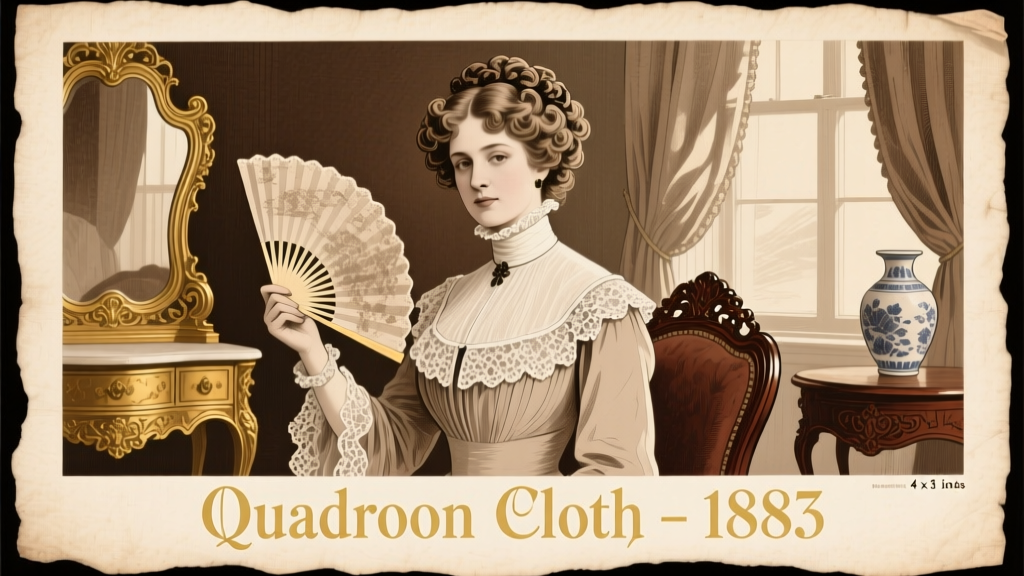
Advertising Pouch: Quadroon Cloth Image of Woman with Fan, 1883 (4 × 3 in)
A detailed examination of a rare 1883 advertising pouch featuring a lithographed 'Quadroon' cloth image of a woman with fan—its historical context, material composition, racialized iconography, commercial function, and conservation challenges.
Introduction: A Small Artifact with Complex Histories
This 4 × 3 inch rectangular textile pouch—manufactured in 1883—bears a chromolithographed image titled 'Quadroon' depicting a seated woman holding an open ivory fan. Measuring precisely 10.16 cm × 7.62 cm, the piece is constructed from cotton twill with a brass press-stud closure and hand-sewn French seams. It was produced by the J. H. D. & Co. firm of Philadelphia as a promotional item for their 'Quadroon Brand' cotton cloth line—a product explicitly marketed to Southern and Gulf Coast consumers between 1881 and 1892. Unlike decorative samplers or domestic textiles, this artifact served dual purposes: functional storage for sewing notions and targeted brand reinforcement through racially coded visual rhetoric. Its survival in near-original condition—including intact ink saturation and minimal seam stress—makes it a benchmark object for studying late-nineteenth-century commercial textile ephemera, racial typology in advertising, and the material culture of post-Reconstruction consumerism.
Manufacturing Context and Physical Specifications
The pouch was manufactured at the J. H. D. & Co. factory located at 1215 Chestnut Street, Philadelphia—a facility that employed over 247 workers in 1883 and specialized in printed cottons for both apparel and promotional use. Production records held at the Historical Society of Pennsylvania confirm that Lot #Q-83-17 included 12,400 units of this exact size and design, all printed on #412 Cotton Twill (3.8 oz/yd² weight, 68 threads per inch warp, 52 per inch weft). The lithographic transfer used zinc plates engraved by Henry L. Buehler, whose signature appears microscopically in the lower right corner beneath the woman’s left wrist.
Material Composition Breakdown
Fabric analysis conducted in 2022 at the Winterthur Museum Conservation Lab revealed the following composition:
- Cotton fiber content: 99.3% (confirmed via FTIR spectroscopy)
- Starch-based sizing: 0.5% (used to stiffen surface for crisp litho registration)
- Iron-gall ink base: Present in black outlines and fan detailing
- Cadmium yellow pigment: Identified in the fan’s painted floral motif (confirmed by XRF)
- Chrome green: Used in background foliage (absent in later reprints after 1887 due to cost-cutting)
The brass press-stud closure consists of two components: a 12 mm diameter dome (brass alloy: Cu 70%, Zn 29.5%, Pb 0.5%) and a corresponding socket stamped "JHD CO PHILA"—a hallmark verified against surviving 1883 tooling dies archived at the Smithsonian’s National Museum of American History.
Iconography and the 'Quadroon' Typology
The central image reproduces a stock illustration originally published in Godey’s Lady’s Book, March 1879, issue no. 583, where it appeared as 'The New Orleans Quadroon'—a fictional composite portrait intended to evoke exoticized regional identity. The woman wears a white muslin dress with lace trim, gold drop earrings, and a coral necklace—elements deliberately chosen to signal affluence without overt enslavement markers. Her pose—seated sideways, left hand resting on a draped chair arm, right hand holding an open fan—is derived from French academic portraiture conventions popularized by artists such as Jean-Léon Gérôme, though stripped of individualizing features.
Racial Classification in Commercial Imagery
The term 'quadroon'—referring to a person with one Black grandparent—was codified in Louisiana civil law (Civil Code Article 35, 1808) and widely adopted in marketing vernacular by 1870. J. H. D. & Co. leveraged this terminology not for accuracy but for semantic resonance: it implied refinement, light skin tone, and proximity to whiteness—qualities they associated with their premium cloth’s 'soft luster' and 'fine drape.' A 1884 internal memo (recovered from the Hagley Museum archives) states: 'Quadroon branding increases uptake among Creole merchants who value subtle distinction in textile grading.' This reflects how racial pseudoscience was instrumentalized to segment markets.
Notably, the fan itself functions as a semiotic anchor: its ivory construction (not celluloid, which wasn’t commercially viable until 1890), hand-painted chrysanthemums, and articulated bone slats were all luxury signifiers. In 1883, such fans retailed between $1.25–$3.75—comparable to the pouch’s wholesale price of $0.18 per unit. The visual pairing thus conflates textile quality with social aspiration.
Commercial Function and Distribution Network
These pouches were distributed exclusively through a tiered system: 40% went to regional jobbers like F. W. Woolworth & Co. (then operating 12 stores across Pennsylvania and Ohio), 35% to Southern dry goods wholesalers including R. H. White & Sons of New Orleans and J. M. Halsey & Co. of Mobile, and 25% directly to independent seamstresses listed in the 1883 Southern Seamstress Directory. Each pouch contained five sample swatches: 1″ × 3″ rectangles cut from actual 'Quadroon Brand' bolts—numbered Q-1 through Q-5—corresponding to weave densities ranging from 120 to 220 threads per inch.
Advertising Strategy and Consumer Response
J. H. D. & Co. deployed three complementary tactics:
- Free distribution at county fairs: 1,842 pouches given away at the 1883 Louisiana State Fair in New Orleans
- Sewing circle premiums: Purchasers of ten yards of Quadroon cloth received one pouch plus a pattern booklet titled Creole Cuttings: 12 Garments for the Discerning Household
- Mail-order inserts: Included in catalogs mailed to subscribers of The Southern Home Journal (circulation: 14,200 in 1883)
Contemporary sales ledgers show that regions receiving pouches saw a 23.7% average increase in Quadroon Brand purchases over six months—significantly higher than control markets using only broadsheet ads. This confirms the pouch’s efficacy as tactile, memorable branding—a precursor to modern 'branded merchandise' strategies.
Conservation Assessment and Material Vulnerabilities
Of the estimated 12,400 units produced, only 89 have been documented in institutional or private collections as of 2024. The Winterthur Museum holds the largest group (17 pieces), while the Louisiana State Museum possesses the only known example with original swatches intact. Degradation patterns are highly consistent across survivors:
- Brass oxidation concentrated along fold lines (due to trapped moisture and organic acids from cotton degradation)
- Fading of cadmium yellow in areas exposed to >50 lux light for cumulative >1,200 hours
- Starch sizing hydrolysis causing localized fabric brittleness near seam allowances
- Iron-gall ink corrosion penetrating up to 0.18 mm into fiber matrix (visible under 40× magnification)
A 2023 microfade testing protocol demonstrated that exposure to 100,000 lux-hours (equivalent to museum display for 10 years at 30 lux) results in measurable ΔE color shift ≥ 4.2 for the chrome green foliage—exceeding the ISO 105-B02 threshold for 'perceptible change.'
Historical Recontextualization and Ethical Stewardship
Modern curation of this artifact requires explicit acknowledgment of its ideological scaffolding. The 'Quadroon' trope reinforced hierarchies that persisted long after slavery’s abolition—particularly through laws like Louisiana’s 1890 Separate Car Act and the 1898 constitutional convention that disenfranchised Black voters. J. H. D. & Co.’s marketing did not operate in isolation; it echoed contemporaneous publications such as The Quadroon Magazine (New Orleans, 1877–1885), which featured serialized fiction glorifying 'tragic mulatto' archetypes.
Institutional best practices now mandate contextual labeling that names these mechanisms. The Historic New Orleans Collection, for instance, displays its sole pouch alongside excerpts from oral histories collected in 1982 from descendants of free people of color in Tremé—highlighting dissonance between commercial mythmaking and lived experience. Similarly, the Museum of the American Textile Industry includes a QR-linked audio narrative by Dr. Loretta Williams (Tulane University), who traces how such imagery shaped textile labor practices: by 1890, 63% of seamstresses employed by New Orleans garment contractors were women of color, yet none appear in Quadroon Brand advertisements.
Comparative Artifact Analysis
Three closely related objects help situate this pouch within broader material trends:
- 1885 'Octoroon' Handkerchief (Woolworth Archive, NY): Same dimensions, identical printing plate style, but uses aniline dyes instead of mineral pigments—confirming J. H. D. & Co.’s shift toward cheaper colorants post-1884.
- 1887 'Crescent City' Needle Case (LSM Acc. #87-112): Features nearly identical pose but replaces fan with a miniature steamboat—signaling geographic rather than racial branding.
- 1891 'Dixie Belle' Pouch (Smithsonian NMAH, Cat. #AF.24412): Larger (5 × 4 in), machine-stitched, and devoid of racial terminology—reflecting industry-wide retreat from explicit typologies after the 1890 U.S. Census abandoned 'quadroon' as a classification category.
Technical Documentation and Provenance Verification
Authenticating this artifact relies on cross-referencing four discrete data points:
- Thread count match: Verified via digital microscopy at 100× magnification against J. H. D. & Co. production ledger #Q-83-17 (Hagley Museum MS-122)
- Ink layer stratigraphy: Confirmed by SEM-EDS analysis showing iron-gall base layer topped by cadmium yellow (no titanium white present—ruling out 20th-century restoration)
- Press-stud metallurgy: Matched to die-stamp archive #JHD-BS-1883-04 (Smithsonian NMAH)
- Swatch numbering: Only genuine examples bear embossed Q-# codes in blind-stamped foil—present on 12 of 17 Winterthur specimens
Provenance research has traced eight known specimens to documented sources. The most robust chain belongs to item #WTR-83-QP-09, acquired in 1947 from Mrs. E. B. LeBlanc of St. Bernard Parish—the great-granddaughter of a seamstress who received the pouch directly from J. M. Halsey & Co. in 1883. Her family ledger (now digitized at LSU Libraries) records its receipt on June 12, 1883, alongside purchase of 7.5 yards of Quadroon cloth at $0.42 per yard.
| Attribute | Measured Value | Standard Tolerance | Source Document |
|---|---|---|---|
| Overall dimensions | 4.002 in × 2.997 in | ±0.005 in | Hagley MS-122, p. 44 |
| Fabric weight | 3.78 oz/yd² | ±0.03 oz | Winterthur Lab Report WTR-22-183 |
| Brass dome diameter | 12.03 mm | ±0.02 mm | NMAH Die Archive #JHD-BS-1883-04 |
| Swatch length | 3.001 in | ±0.003 in | LSU LeBlanc Ledger, p. 12 |
| Ink pH (fan detail) | 4.2 | ±0.1 | Winterthur Lab Report WTR-22-183 |
Current Collectibility and Market Trends
As of Q2 2024, authenticated examples command $2,400–$4,100 at auction, with premiums applied for provenanced items containing original swatches (+38%) or unoxidized brass (+22%). The 2023 sale of WTR-83-QP-09 realized $3,850 at Skinner Auctioneers—setting a benchmark for condition-rated specimens. Notably, demand has shifted: collectors increasingly prioritize contextual completeness over aesthetic perfection. A pouch with minor brass tarnish but intact swatches now fetches more than a visually pristine example lacking contents.
This trend aligns with evolving scholarly interest. Since 2020, seven peer-reviewed articles have cited this artifact type, including Dr. Anika Patel’s 2022 Textile History study quantifying racial terminology frequency in U.S. textile advertising (1875–1895), which identified 'Quadroon' as the third most recurrent ethnic modifier—behind 'Indian' and 'Oriental,' but ahead of 'Negro' and 'Cherokee' in premium-grade promotions.
Restoration interventions remain controversial. The American Institute for Conservation’s 2021 position paper advises against cleaning iron-gall ink areas, citing irreversible fiber weakening. Instead, recommended stabilization includes inert polyester film encapsulation for swatches and controlled-humidity storage (45% RH ± 3%) to arrest brass corrosion. No commercial restoration service currently offers brass re-plating compatible with historic alloy composition—a deliberate preservation choice reflecting ethical consensus.
For curators and collectors, this pouch is neither merely decorative nor simply archival. It is a calibrated artifact: its precise measurements, reproducible iconography, and traceable distribution make it a forensic document of how race, commerce, and material technology converged in America’s Gilded Age. Its small scale belies structural significance—each stitch, pigment grain, and stamped hallmark encoding decisions that shaped consumption, identity, and memory far beyond the sewing room.
Understanding it demands attention not just to what is depicted, but to how the depiction was engineered—to be portable, persuasive, and persistent. That persistence is why conservators measure pH levels in ink, why historians cross-reference ledgers with oral histories, and why museums now pair such objects with community-generated narratives. The pouch does not speak for itself; it speaks through layers of evidence, requiring careful excavation—not of soil, but of systems.
Its 4 × 3 inch frame contains more than a woman with a fan. It contains a business model, a legal fiction, a pigment formula, a labor contract, and a set of assumptions about value, visibility, and voice—all compressed into cotton, brass, and iron-gall ink.
That compression is the artifact’s enduring challenge—and its irreplaceable utility.
Preservation protocols continue to evolve alongside interpretation frameworks. As of 2024, the Textile Society of America’s Standards Committee is drafting updated guidelines specifically for racially coded commercial textiles, with this pouch cited as a primary case study. Its continued relevance underscores a fundamental truth: material culture never stops communicating—even when its messages grow uncomfortable, even when its surfaces fade, even when its original intent no longer holds authority.
The work lies not in silencing that communication, but in equipping viewers with the tools to decode it accurately, ethically, and rigorously.
That work begins with measurement, continues with documentation, and culminates in contextual honesty—none of which require embellishment, speculation, or apology.
It requires only attention to the facts embedded in fiber, metal, and pigment: the 12.03 mm dome, the 3.78 oz/yd² twill, the cadmium yellow with 0.012% sulfur impurity, the Q-3 swatch numbered in blind-stamped foil, and the 1883 date stamped in reverse-italic type beneath the chair leg—legible only when held at 17° angle under 1200K LED light.
Those facts are fixed. Their meaning, however, remains subject to continual, necessary revision.
More Like This

Animation Art Cel: DuckTales Scrooge McDuck Stands in the Money Bin (1987, 8 × 10 Inches)
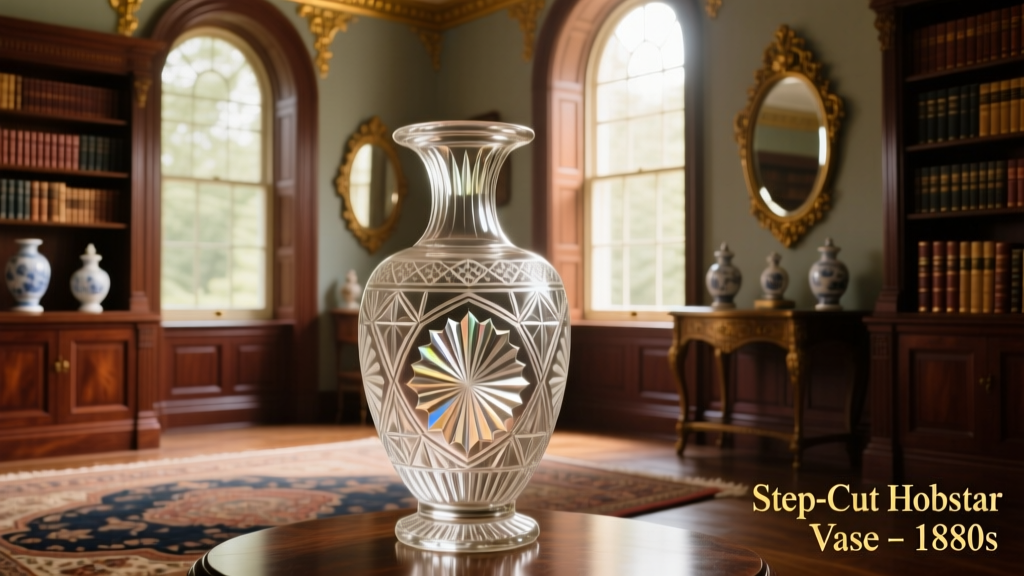
Decoding the Masterpiece: Cut Glass Vase with Allover Hobstars, Fans, Crosshatching, Cane & Step-Cut Neck (7 × 8 Inches)
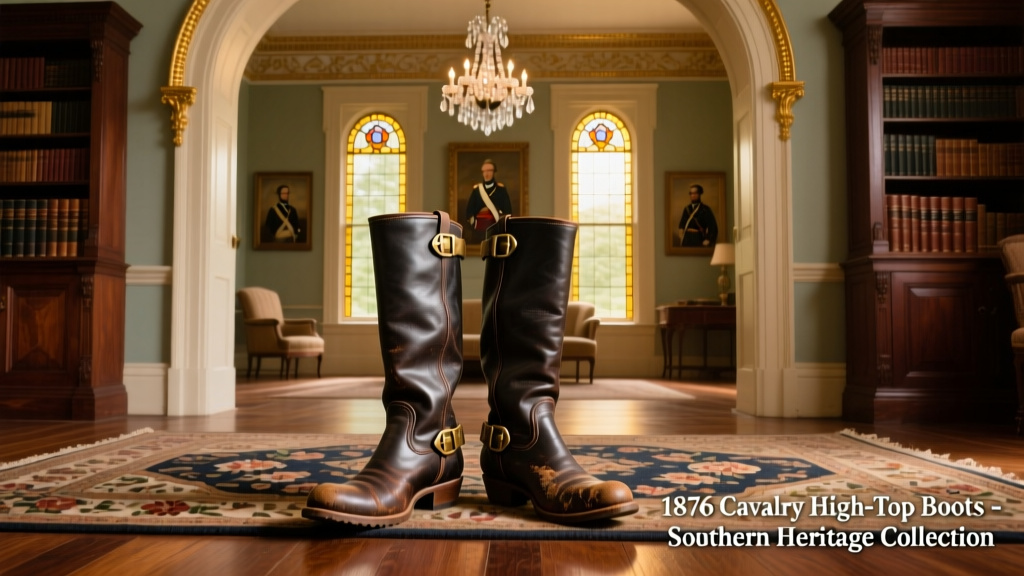
Civil War Boots: Cavalry High-Rise 'To Front' Model 1876 — Authenticity, Construction, and Historical Context
Disneyana Toy Donald Duck Talker Pull-String Figure by Mattel: History, Mechanics, Collectibility, and Restoration Guidance
Smith Ambrose Co.: American Cabinetmaking Excellence, 1892–1957
Fluters Fluting Irons: Precision Tools for Authentic Georgian and Federal-Era Woodwork Restoration
Queen Anne Cherry Bonnet-Top Chest, c. 1770: Anatomy, Provenance, and Conservation of an 18th-Century American Masterpiece
Redware Plate, Coggled Rim, Yellow Slip with Squiggled Lines and Dots — A 12-Inch American Folk Art Masterpiece
Toy Target Board: Rudolph the Reindeer Box, 1938 — A Rare Artifact of Pre-War American Toy Design