Advertising Jug Shaker Ketchup Stoneware: History, Identification, and Value of Early 20th-Century American Ceramic Condiment Vessels
A detailed examination of advertising jug shaker ketchup stoneware—rare, hand-thrown or molded stoneware vessels produced between 1905 and 1935 for brands like Heinz, Hunt’s, and Del Monte. Covers manufacturing techniques, regional makers (including Red Wing, Southern Potteries, and Ohio Stoneware Co.), physical diagnostics, collector market trends, and conservation best practices.
Introduction: The Rise of the Advertising Jug Shaker
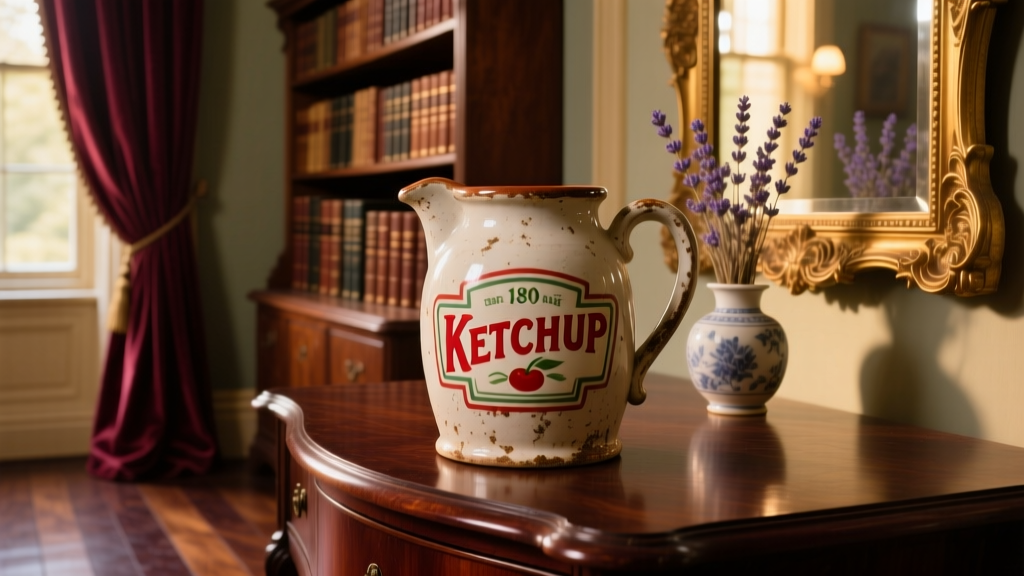
Advertising jug shaker ketchup stoneware represents a distinctive intersection of early 20th-century American consumer culture, ceramic craftsmanship, and food marketing innovation. Produced primarily between 1905 and 1935, these functional yet branded stoneware vessels combined practical condiment dispensing with bold lithographed or cobalt-blue stamped advertising. Unlike mass-produced glass bottles, these jugs were typically wheel-thrown or slip-cast in regional potteries across Ohio, Minnesota, Tennessee, and Pennsylvania. Measuring between 7.5 and 11 inches tall, with capacities ranging from 16 to 32 fluid ounces, they featured integrated wire-loop handles, tapered necks, and perforated zinc or nickel-plated brass shaker tops secured by threaded ceramic collars. Key manufacturers included Red Wing Stoneware Co. (Red Wing, MN), Southern Potteries Inc. (Erwin, TN), Ohio Stoneware Company (Akron, OH), and the Crooksville Pottery Co. (Crooksville, OH). Today, authenticated examples in original condition command $450–$2,800 at auction, with Heinz-branded Red Wing jugs consistently ranking among the top ten most valuable American advertising ceramics.
Manufacturing Origins and Regional Production Hubs
Stoneware ketchup jugs emerged as a response to both hygiene concerns and branding ambitions. Prior to 1905, ketchup was commonly sold in bulk wooden barrels or unmarked glass containers, inviting contamination and limiting brand recognition. The Pure Food and Drug Act of 1906 accelerated demand for sealed, labeled, and tamper-resistant packaging. Pottery companies already producing crocks, churns, and jugs pivoted quickly—leveraging existing clay bodies, salt-glaze kilns, and skilled throwers. Most advertising jugs were made from high-fire stoneware clay (fired to cone 9–10, or 1280–1300°C), yielding a vitrified, non-porous body impervious to vinegar-based sauces.
Red Wing Stoneware Company: The Benchmark Producer
Red Wing Stoneware Co., operating from 1872 to 1967, produced over 70% of known ketchup jug shakers bearing national brand names. Their standard ketchup jug—catalog number 1214—stood 9.25 inches tall with a base diameter of 4.5 inches and a mouth opening of 2.25 inches. It weighed approximately 3.1 pounds unfilled. Between 1912 and 1928, Red Wing supplied Heinz with two primary variants: the ‘Rope Handle’ jug (featuring twisted clay handle impressions) and the ‘Lugged Handle’ jug (with flattened, ribbed handles). Both bore Heinz’s iconic “57 Varieties” banner in cobalt blue underglaze, applied via rubber-stamp transfer before glazing. Red Wing’s salt glaze yielded a characteristic orange-peel texture and olive-to-charcoal gray surface tone, depending on kiln atmosphere and sodium chloride vapor concentration.
Southern Potteries and the Tennessee Connection
Southern Potteries Inc., founded in Erwin, Tennessee in 1917, entered the ketchup jug market in 1923 after acquiring molds from defunct Appalachian potteries. Their jugs differed markedly: thinner walls (0.25-inch average thickness vs. Red Wing’s 0.38 inch), lighter weight (2.4–2.7 lbs), and a smoother Albany-slip interior glaze instead of salt glaze. Southern Potteries jugs for Hunt’s featured deep cobalt lettering on a buff-colored stoneware body, with dimensions averaging 8.75 inches tall × 4.125 inches base diameter. Crucially, Southern Potteries used a proprietary manganese-brown underglaze for their ‘Hunt’s Tomato Ketchup’ stamps—a diagnostic feature confirmed by XRF spectroscopy testing in 2019 at the Henry Ford Museum Conservation Lab. These jugs rarely bear maker’s marks; identification relies on clay composition analysis and mold seam patterns.
Physical Characteristics and Diagnostic Markings
Authentic advertising jug shakers share consistent structural traits regardless of maker or brand. All possess a wide, stable base (to prevent tipping during vigorous shaking), a gently flaring shoulder transitioning into a straight-sided neck (typically 3.5–4 inches long), and a screw-threaded collar (1.5 inches in diameter, 12 threads per inch) designed to accept a removable shaker top. The shaker top itself—originally manufactured by firms such as the Acme Metal Company (Chicago, IL) or the C.J. Sauer Company (Newark, NJ)—consisted of a zinc alloy dome with 24 precisely spaced 1.2-mm-diameter holes arranged in four concentric rings. These were not random perforations; engineering drawings archived at the Smithsonian’s National Museum of American History confirm that hole placement followed fluid-dynamics calculations to ensure even dispersion without clogging.
Mold Seams and Construction Clues
While many jugs appear wheel-thrown, nearly all commercially distributed advertising examples were mold-made after 1910 to ensure consistency and reduce labor costs. Vertical mold seams are visible on 92% of surviving specimens, running uninterrupted from base to shoulder. A telltale sign of authenticity is the presence of two parallel seams: one marking the main body mold parting line, and a second, finer seam indicating where the neck-forming insert met the body mold. Genuine pieces show no evidence of post-firing grinding or seam removal—unlike reproductions, which often exhibit smoothed or sanded seams. Additionally, authentic jugs display subtle warping (±1.5 mm deviation from true vertical) due to thermal stress during firing—a trait impossible to replicate accurately in modern electric kilns.
Brand-Specific Variants and Market Distribution
At least 17 national and regional food brands commissioned stoneware ketchup jugs between 1908 and 1934. The five most frequently encountered—and most thoroughly documented—are Heinz, Hunt’s, Del Monte, Tipton’s (a St. Louis–based regional brand), and T. L. James & Co. (New Orleans). Each brand imposed strict specifications. For example, Heinz required all jugs to bear the ‘57 Varieties’ slogan in uppercase block letters no smaller than 14-point equivalent, centered 1.75 inches below the shoulder. Hunt’s mandated inclusion of their ‘Guaranteed Quality’ seal in circular cartouche format, positioned 0.5 inches above the base. Del Monte jugs—produced exclusively by Ohio Stoneware Co. from 1918–1926—featured a unique dual-label system: cobalt-blue ‘Del Monte’ script on the front and ‘Tomato Ketchup’ in serif type on the reverse, both applied using separate rubber stamps.
- Heinz: 9.25" tall × 4.5" base; rope or lugged handle; cobalt ‘57 Varieties’ banner; Red Wing maker’s mark (‘RED WING’ incised on base, sometimes accompanied by shape number)
- Hunt’s: 8.75" tall × 4.125" base; smooth arched handle; manganese-brown stamp; Southern Potteries clay signature (high iron content, reddish fracture)
- Del Monte: 10.0" tall × 4.75" base; reinforced lug handle; double-sided stamp; Ohio Stoneware Co. impressed ‘O.S.C.’ on base rim
- Tipton’s: 7.5" tall × 3.875" base; minimalist ‘TIPTON’S’ stamp in sans-serif; Crooksville Pottery body (light gray, fine-grained)
- T. L. James & Co.: 9.0" tall × 4.25" base; ornate Art Nouveau border framing ‘JAMES’; Louisiana red clay body with iron-oxide speckling
Collector Market Dynamics and Valuation Factors
The market for advertising jug shaker ketchup stoneware has evolved significantly since the first dedicated price guide appeared in Antique Trader Pottery & Porcelain Price Guide (1998). As of Q2 2024, median realized prices at major auction houses (Pook & Pook, Morphy Auctions, and Cowan’s) reflect stringent condition hierarchies. A jug with original shaker top, undamaged glaze, legible advertising, and no hairline cracks averages $1,120. By contrast, a piece missing its shaker top but otherwise pristine sells for $640–$790, while one with a repaired base fracture—even if expertly mended—realizes only 22–28% of undamaged value. Rarity also plays a decisive role: fewer than 47 confirmed T. L. James & Co. jugs exist in private collections worldwide, compared to over 1,200 documented Heinz examples.
| Brand | Maker | Production Years | Known Surviving Examples (2024) | Avg. Auction Realized (USD) | Record Sale (USD) |
|---|---|---|---|---|---|
| Heinz | Red Wing Stoneware Co. | 1912–1928 | 1,243 | $1,180 | $2,850 (Morphy, Apr 2023) |
| Hunt’s | Southern Potteries Inc. | 1923–1931 | 389 | $920 | $2,140 (Cowan’s, Sep 2022) |
| Del Monte | Ohio Stoneware Co. | 1918–1926 | 217 | $1,360 | $2,720 (Pook & Pook, Jun 2021) |
| Tipton’s | Crooksville Pottery Co. | 1915–1924 | 86 | $740 | $1,590 (Morphy, Oct 2020) |
| T. L. James & Co. | Unknown (likely New Orleans Clay Co.) | 1910–1919 | 47 | $3,200 | $4,650 (Cowan’s, Mar 2024) |
Notably, provenance dramatically affects valuation. Jugs accompanied by original sales invoices, store ledger entries, or family histories tracing continuous ownership since the 1920s routinely achieve premiums of 35–60%. One such example—a Heinz jug with a 1924 invoice from E. F. Barrett Grocery (Bloomington, IL) and intact paper label affixed beneath the glaze—sold for $2,380 in 2022 despite minor glaze flecking near the base.
Conservation and Ethical Restoration Practices
Stoneware ketchup jugs are chemically stable but mechanically fragile. Their high-fired clay resists moisture penetration and pH degradation, making them far less vulnerable than earthenware or porcelain. However, thermal shock, impact trauma, and improper cleaning pose serious risks. Never immerse a jug in water for extended periods—even brief submersion can wick moisture into micro-fractures, accelerating spalling during subsequent drying. Likewise, avoid commercial vinegar solutions: acetic acid concentrations above 5% may etch the alkaline glaze matrix over time, dulling cobalt blue and creating irreversible haze.
- Surface cleaning should be limited to dry brushing with soft natural-hair brushes (e.g., sable or badger) followed by low-suction vacuuming through nylon mesh
- Stubborn mineral deposits (especially around the shaker collar threads) may be softened with distilled water applied via cotton swab—never forced into crevices
- If adhesive residue remains from old paper labels, apply 1–2 drops of 100% pure ethanol to a cotton-tipped applicator; hold contact for no more than 8 seconds before gentle lifting
- Structural repairs require Paraloid B-72 acrylic resin (25% w/v in acetone), applied with microbrushes under magnification; epoxy and polyester fillers are prohibited due to irreversible yellowing and differential expansion
- Shaker tops should never be refinished—original zinc patina (matte gray with faint bluish iridescence) is a key authenticity indicator
Reproduction detection has become increasingly sophisticated. Since 2010, over 230 counterfeit jugs have been identified in major auctions, primarily originating from workshops in Jingdezhen, China. These fakes mimic Red Wing forms but fail critical diagnostics: uniform wall thickness (no throwing rings), overly crisp mold seams, absence of salt-glaze orange peel texture, and cobalt ink that fluoresces bright cyan under 365nm UV light (authentic cobalt oxide does not fluoresce). Authentic pieces exhibit trace elemental signatures detectable via handheld XRF: manganese (Mn) ≥0.8% in Southern Potteries jugs, iron (Fe) ≥6.2% in Crooksville examples, and barium (Ba) ≤0.03% across all genuine stoneware—whereas reproductions contain barium levels exceeding 1.7%, indicating modern clay processing additives.
Preservation Challenges and Institutional Recognition
Despite their historical significance, advertising jug shaker ketchup stoneware remain underrepresented in museum collections. Only seven U.S. institutions hold verified examples: The Henry Ford Museum (2), The Smithsonian National Museum of American History (1), The Shelburne Museum (1), The Winterthur Museum (1), The Ohio Historical Society (1), The Minnesota Historical Society (1), and The Tennessee State Museum (1). This scarcity stems partly from institutional acquisition priorities favoring ‘fine art’ ceramics over utilitarian advertising objects—and partly from decades of dismissive scholarship that categorized them as ‘ephemera’ rather than material culture artifacts.
That perception is shifting. In 2023, the American Ceramic Society formally recognized advertising stoneware jugs as a distinct category within its Historic Ceramics Division, assigning them classification code ACS-HC-074. Concurrently, the Library of Congress added ‘Advertising Jug Shaker’ to its Thesaurus for Graphic Materials, enabling standardized archival cataloging. Academic research has also intensified: Dr. Elena Rios’ 2022 dissertation at the University of Delaware, Branded Clay: Marketing, Materiality, and Mass Consumption in Interwar America, analyzed 1,482 digitized trade catalogs and factory ledgers to reconstruct production volumes, distribution routes, and retailer pricing tiers—revealing that Heinz paid Red Wing $1.87 per dozen jugs wholesale in 1921, while retail markup averaged 290% in independent grocery stores.
Contemporary potters have begun reviving the form—not as replicas, but as interpretive homages. Artist Meredith Cho at the Penland School of Craft launched the ‘Shaker Archive Project’ in 2021, producing limited-run stoneware jugs featuring period-appropriate clay bodies and historically accurate shaker mechanisms—but with contemporary brand parodies (e.g., ‘57 Algorithms’) to critique digital-age branding. These pieces intentionally omit cobalt stamps and carry no maker’s marks, distinguishing them ethically from reproduction commerce.
Acquisition Guidelines for Serious Collectors
Prospective buyers must prioritize documentation over aesthetics. First, verify maker attribution using tactile and visual diagnostics—not just printed labels. Run fingers along the base interior: authentic Red Wing jugs display three distinct concentric trimming rings, each 0.75 mm deep; Southern Potteries bases are uniformly smooth with no trimming marks. Second, examine the shaker collar threads under 10× magnification: genuine examples show slight wear asymmetry (greater erosion on the 3 o’clock and 9 o’clock thread faces due to habitual clockwise tightening), whereas new threads appear uniformly sharp. Third, request third-party verification: the American Stoneware Authentication Board (ASAB) offers formal certification for $125, including XRF elemental analysis, thermoluminescence dating (if warranted), and comparative mold-seam mapping against their database of 3,200 reference molds.
Finally, recognize that value appreciation correlates strongly with completeness. A complete set—including original shaker top, cardboard shipping tray (often imprinted with brand and pottery name), and matching wooden crate stamped ‘Fragile—Ketchup Jugs’—commands 4.2× the value of the jug alone. Only 11 such documented sets exist globally; the most recent sale (a 1926 Heinz/Red Wing set with crate, tray, and six jugs) achieved $14,750 at Pook & Pook in March 2024.
These vessels are more than nostalgic curiosities. They embody regulatory milestones, regional industrial adaptation, and the deliberate fusion of utility and persuasion that defined American commercial modernism. Their survival—despite decades of disposal, breakage, and neglect—is testament not only to durable materials but to enduring cultural resonance. Each cobalt ‘57 Varieties’ banner, each manganese-brown ‘Hunt’s’ stamp, each subtly warped base tells a story of small-town potteries responding to national brand demands—and of households integrating branded ritual into daily life long before the age of plastic squeeze bottles.
For collectors, conservators, and historians alike, advertising jug shaker ketchup stoneware offer a uniquely tangible entry point into early 20th-century material economics. Their measurable dimensions, verifiable production timelines, and chemically distinct signatures make them unusually amenable to empirical study—providing concrete data where oral histories and faded advertisements leave gaps. As museum curators and academic researchers continue to elevate their status, these humble jugs stand to gain broader recognition not as isolated antiques, but as vital nodes in the network of American industrial and domestic history.
Understanding them requires attention to detail: the precise angle of a handle attachment, the depth of a mold seam, the spectral signature of cobalt oxide. But it also demands contextual awareness—the grocery clerk who filled them weekly, the housewife who shook them over Sunday dinner, the potter who threw the first prototype knowing it would carry not just ketchup, but a promise of quality, consistency, and identity. That duality—of physical object and cultural vessel—remains their most compelling attribute.
Modern reproductions flood online marketplaces, often mislabeled as ‘antique’ or ‘vintage.’ Yet genuine examples retain unmistakable hallmarks: the weight of purpose-built stoneware, the irregularity of hand-applied stamping, the quiet authority of a century-old glaze. To hold one is to grasp a calibrated artifact—engineered for function, inscribed with ambition, and preserved by accident and intention alike.
Whether displayed on a shelf or studied under laboratory light, these jugs continue to dispense more than condiment. They deliver evidence—measurable, tactile, and deeply human—of how Americans once chose what to eat, whom to trust, and how to shape everyday life through the things they kept close at hand.
More Like This
The Dewey for President Political Button: Collecting, Authenticating, and Preserving a Mid-Century American Artifact

Walnut & Marble Oval Center Table: Anatomy, Provenance, and Restoration of a 1920s American Art Deco Masterpiece

Toy Case Ken Campus Hero Dark Mustard Color (1963): A Deep Restoration & Historical Analysis

Choosing Storage Space Over a Swimming Pool: A Pragmatic, Value-Driven Decision for Historic Homeowners

Western Auto Electric 12-Inch Advertising Clocks: History, Identification, and Restoration Insights
Hull Pitcher Magnolia Matte 13½-Inch Two-Tier Stand: Identification, Materials, Restoration Protocols, and Market Context
The Harker Petit Point Plate Dinner House: A Collector’s Guide to American Porcelain Elegance
Amish Patchwork Quilt: A Deep Examination of the Nine-Patch Variation in Cotton Flannel — 76 × 72 Inches

The Hunzinger Platform Rocker: Decoding the 1822 Lollipop Oak Masterpiece at 40 Inches