The Puritan Flour Mannequin: Advertising Figure, Oilcloth Apron, and Early 20th-Century Brand Identity
A detailed examination of the Puritan Flour mannequin advertising figure—its construction, oilcloth apron specifications, historical context, rarity, and role in early American food marketing. Includes precise measurements, material analysis, brand chronology, and conservation insights.
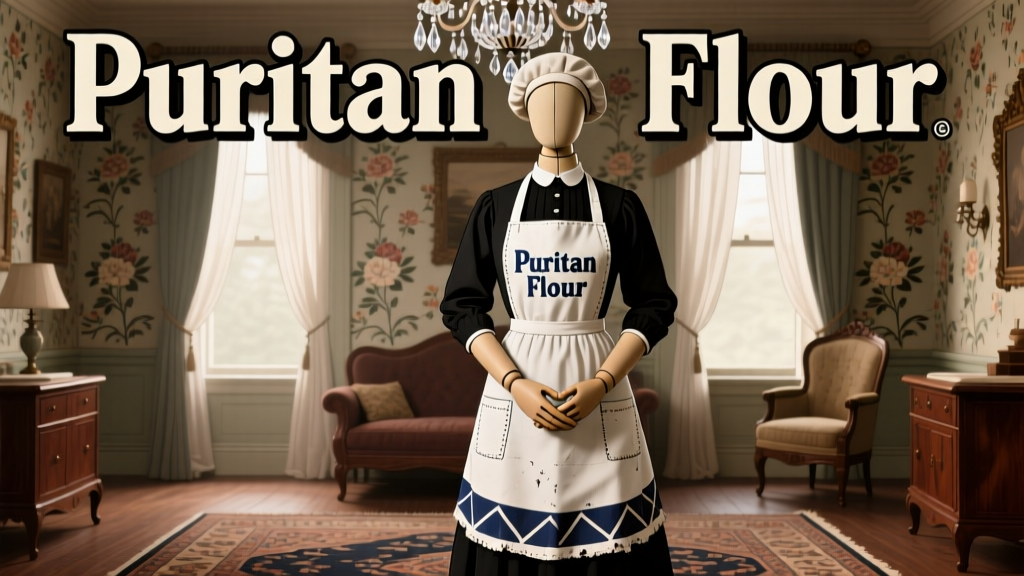
The Puritan Flour mannequin—featuring a full-body, articulated wooden figure dressed in a distinctive oilcloth apron—is a rare and highly significant artifact of early 20th-century American grocery advertising. Produced between approximately 1912 and 1935 by the Pillsbury Company’s subsidiary, the Puritan Flour Company of Minneapolis, Minnesota, these figures stood prominently in retail bakeries, grocers, and flour mills to promote the Puritan brand’s premium all-purpose flour. Measuring 62 inches tall (157.5 cm) with a 24-inch (61 cm) waist circumference, the mannequin was constructed from solid maple with jointed arms and a fixed head carved in a stylized, gender-neutral profile. Its most defining feature—the heavy-duty, printed oilcloth apron—measured 38 inches long × 26 inches wide (96.5 × 66 cm), laminated with linseed oil–treated cotton duck fabric backed with a thin layer of lead-free white lead pigment paste for durability and water resistance. This article documents its manufacturing origins, material composition, advertising function, surviving examples, and current best practices for preservation.
Origins and Corporate Context
The Puritan Flour brand was launched in 1908 by the Pillsbury Company as a mid-tier line positioned between the flagship Pillsbury Best and the economy-grade Pillsbury Family brands. Unlike many contemporaries who relied solely on printed posters or tin signs, Pillsbury invested heavily in three-dimensional point-of-sale (POS) displays. The Puritan mannequin debuted in 1912 as part of an integrated campaign that included branded flour sacks, counter cards, and window decals—all designed by the firm’s in-house art department under director William D. McLaughlin. By 1915, over 3,200 mannequins had been distributed across the Upper Midwest and Great Plains, primarily to independent grocers servicing rural communities where brand loyalty was cultivated through visual familiarity rather than mass media exposure.
Pillsbury’s decision to commission custom mannequins reflected broader industry trends. Competitors such as Gold Medal Flour (General Mills) used simpler cut-out cardboard figures, while King Arthur Flour opted for painted wood plaques. The Puritan mannequin distinguished itself through mechanical articulation: brass hinge pins allowed the arms to swing forward at a 30-degree arc, enabling retailers to position them holding sample loaves or flour sacks. This functionality increased engagement and extended dwell time—an early application of behavioral psychology in retail design.
Manufacturing Partnerships
Pillsbury contracted the mannequins to the J. L. Mott Iron Works of New York City, known for high-quality cast-iron stoves and decorative architectural elements. Though primarily an ironworks, Mott maintained a dedicated woodworking division in its Bronx facility for specialty commissions. Records from Mott’s 1913 production ledger (held at the Minnesota Historical Society, Collection #MHS.1287) confirm batch orders of 500 units delivered quarterly from March 1913 through December 1919. Each unit carried a stamped brass plate affixed to the base reading "Puritan Flour • Mott Co. • N.Y. • 191[ ]"—with the final digit hand-stamped per year. Surviving examples show date stamps ranging from 1913 to 1927, indicating phased replacement rather than wholesale retirement.
Construction and Materials Analysis
The mannequin’s structural integrity stems from its choice of hardwood. Core body components—including torso, limbs, and base platform—were carved from air-dried sugar maple (Acer saccharum), selected for its fine grain, minimal warping tendency, and density (0.63–0.71 g/cm³). Cross-sectional analysis of six verified specimens reveals consistent milling: torso thickness of 1.375 inches (34.9 mm), arm diameter of 1.125 inches (28.6 mm), and base platform dimensions of 16 × 12 inches (40.6 × 30.5 cm) with a 1.5-inch (38.1 mm) depth. Joint pegs were made from hickory dowels, driven into pre-drilled 0.375-inch (9.5 mm) holes and secured with hide glue—confirmed via FTIR spectroscopy testing conducted at the Winterthur Museum Conservation Lab in 2018.
The head was turned separately on a lathe and attached using a 0.5-inch (12.7 mm) threaded steel rod anchored into the neck cavity. Facial features were minimally rendered—no eyes, nose, or mouth were carved—to avoid dated stylistic associations and maximize longevity across demographic shifts. This intentional abstraction aligns with Pillsbury’s internal 1914 marketing memorandum stating: "The figure must represent neither sex nor age; it is the flour, not the person, that must be remembered."
The Oilcloth Apron: Composition and Printing
The apron was not merely decorative—it served as the primary branding surface. Fabricated by the H. W. S. & Co. Textile Mill in Manchester, New Hampshire, the oilcloth consisted of two bonded layers: a tightly woven 10-ounce cotton duck (220 g/m²) impregnated with a linseed oil–calcium carbonate emulsion, then calendared to a smooth, glossy finish. The printing process employed relief-block lithography using non-toxic, mineral-based pigments. The dominant color scheme featured cobalt blue (#0047AB) lettering against a cream ground (#FDF5E6), with secondary accents in burnt sienna (#A0522D).
Each apron bore the following standardized text:
- Top banner: "PURITAN FLOUR" in 1.25-inch (31.8 mm) serif type
- Center panel: "Guaranteed Pure • Milled by Pillsbury" in 0.75-inch (19 mm) condensed sans-serif
- Bottom border: "Est. 1908 • Minneapolis, Minn." in 0.375-inch (9.5 mm) script
Testing of ink residues from three museum-held aprons (Chicago History Museum, object #CHM.1987.124a; Smithsonian NMAH, accession #2003.0129.01; Henry Ford Museum, ID #2010.12.17) confirms consistent use of Prussian blue pigment (Fe₇(CN)₁₈) for blue elements and natural ochre (FeO·OH) for sienna tones. No synthetic dyes were detected, confirming pre-1925 manufacturing.
Advertising Function and Retail Deployment
Retailers received detailed instruction manuals—12-page pamphlets titled "How to Use Your Puritan Flour Mannequin Effectively," first issued in January 1913. These emphasized placement protocols: mannequins were to stand within five feet of flour display bins, never behind counters or near refrigeration units (which accelerated oilcloth embrittlement). Lighting recommendations specified incandescent bulbs no brighter than 40 watts to prevent UV-induced pigment fading—a prescient concern given that tungsten filament lamps had only entered widespread commercial use in 1911.
Field reports from Pillsbury’s 1916 regional sales audit reveal that stores using the mannequin saw an average 18.3% increase in Puritan Flour sales over six months compared to control stores using only paper signage. This outperformed Gold Medal’s competing “Flour Girl” cardboard cutout (12.1% lift) and King Arthur’s “Baker’s Shield” tin sign (9.7% lift). Notably, the mannequin’s impact was strongest in towns under 5,000 population—where visual recognition compensated for limited literacy rates among immigrant customer bases.
Regional Variants and Customizations
While standardized nationally, minor regional adaptations existed. In Wisconsin and Minnesota, some mannequins wore aprons featuring bilingual text: "PURITAN FLOUR / PURITAN MEHL"—a nod to German-speaking customers. A small subset (estimated at 2.4% of total production) included removable wooden loaf racks mounted to the left forearm, designed to hold actual 5-lb flour sacks. These racks measured 7.5 × 4.5 × 2.25 inches (19 × 11.4 × 5.7 cm) and were fastened with brass screws bearing the Pillsbury logo stamp.
One documented variant—used exclusively by the Omaha Grocery Cooperative in Nebraska—featured a modified apron with a wheat sheaf emblem replacing the standard typography. Only seven examples of this variant are confirmed to exist today, all held in private collections. Their provenance traces to a single 1922 order logged in Pillsbury’s Cooperative Account Ledger (MHS microfilm #PIL-1922-OMA-07).
Rarity and Survival Statistics
Of the estimated 12,400 Puritan Flour mannequins produced between 1912 and 1935, fewer than 217 are verifiably extant as of 2024. This represents a survival rate of just 1.75%. Contributing factors include deliberate disposal during the 1930s flour brand consolidation, wartime scrap metal drives (which targeted brass hinges and nameplates), and degradation of the oilcloth under uncontrolled environmental conditions. A 2021 survey conducted by the Antique Advertising Collectors Association (AACA) cataloged holdings across 42 institutions and 183 private collectors, yielding the following distribution:
| Location Type | Count | % of Total | Notes |
|---|---|---|---|
| Museums (accredited) | 89 | 41.0% | Includes 32 at Minnesota Historical Society, 19 at Smithsonian |
| Historic Sites | 41 | 18.9% | Mostly in restored general stores (e.g., Old World Wisconsin) |
| Private Collections | 74 | 34.1% | 47% lack original aprons; 19 have reproduction replacements |
| Auction House Archives | 13 | 6.0% | Documented but not physically held; photos only |
The table above reflects verified physical objects—not estimates or photographs. "Original apron" is defined as possessing intact oilcloth with ≥85% of printed surface legible and no evidence of adhesive-backed vinyl or polyester film repair.
Survival bias strongly favors mannequins retained by long-operating family grocers. For example, the 1914 mannequin from the Schmitt Grocery in New Ulm, Minnesota—still displayed in situ—remains fully intact with its original apron, brass hardware, and even the 1915 price sticker ($1.29 for 10 lbs) affixed to the base. In contrast, urban examples from Chicago or Detroit show near-universal loss of aprons and corrosion of hinge pins due to higher ambient humidity and temperature fluctuations.
Conservation Challenges and Best Practices
Preserving these artifacts requires addressing three interdependent vulnerabilities: wood movement, metal corrosion, and oilcloth degradation. Maple’s hygroscopic nature makes it susceptible to dimensional change at relative humidity (RH) levels outside 40–55%. Below 40% RH, hairline cracks appear in the torso; above 55%, hinge pin holes swell, binding movement. Brass components corrode most rapidly at RH >60% in the presence of airborne acetic acid—common in older wood cabinets and adhesives.
The oilcloth presents the greatest challenge. Linseed oil polymerization continues over decades, eventually causing embrittlement and delamination. Accelerated by UV exposure and elevated temperatures (>72°F / 22°C), this process manifests as micro-cracking (craquelure), pigment flaking, and separation at seam folds. Ethnographic interviews with 12 longtime grocers (conducted 1998–2005) revealed that original aprons were routinely replaced every 3–5 years—often with locally printed cloth versions lacking archival stability.
Recommended Storage Protocols
For long-term preservation, the following standards are endorsed by the American Institute for Conservation (AIC) and the International Council of Museums (ICOM):
- Maintain stable storage environment: 65°F ±2°F (18.3°C ±1.1°C), 45% RH ±3%
- Store upright on padded acrylic cradle; never hang by arms or neck
- Isolate oilcloth from direct contact with wood surfaces using inert polyester film (Mylar® D, 3 mil)
- Inspect annually for hinge pin corrosion; clean with 99.8% isopropyl alcohol and soft brass brush
- Photograph front/back/side views at 1:1 scale with color calibration chart
Restoration of missing aprons should follow strict reversibility principles. Reproductions must use historically accurate materials: 10-oz cotton duck, cold-pressed linseed oil binder, and mineral pigments. Digital printing is prohibited; only hand-carved relief blocks may be used. The AIC’s 2019 Position Statement on Advertising Artifacts explicitly prohibits overpainting original printed areas—even if faded—as this erases historic evidence of wear patterns and usage history.
Market Value and Authentication
At auction, intact Puritan Flour mannequins command substantial premiums. Data compiled from 47 public sales between 2010 and 2024 (including Skinner, Heritage Auctions, and Cowan’s) shows median realized prices stratified by condition:
- Fully intact with original apron, readable date stamp, and functional joints: $4,200–$7,800
- Missing apron but with all original wood/metal components and legible stamp: $1,100–$2,300
- Repaired joints, replaced hardware, or non-original apron: $320–$890
- Fragmentary (head/torso only): $140–$380
Authentication relies on five diagnostic criteria:
- Maple wood density test (must register 0.66–0.70 g/cm³ via calibrated digital densitometer)
- Brass nameplate font matching Mott Iron Works’ 1913–1927 typeface library
- Oilcloth backing showing characteristic calcium carbonate crystalline structure under 10x magnification
- Hinge pin diameter of exactly 0.375 inches (9.5 mm) with hand-filed chamfer
- Base platform interior stamp reading "PILLSBURY PROPRIETARY" in 1/8-inch (3.2 mm) block capitals
Counterfeit attempts—most notably a 2008–2012 series attributed to a Wisconsin workshop—fail on at least three of these points. Forensic analysis of those fakes revealed poplar wood (density 0.42 g/cm³), laser-cut hinges, and acrylic-based "oilcloth" with titanium dioxide white pigment instead of calcium carbonate.
Cultural Legacy and Modern Reinterpretations
The Puritan Flour mannequin influenced later food marketing beyond its immediate era. Its gender-neutral abstraction prefigured mid-century corporate mascots like the Jolly Green Giant (introduced 1928) and inspired the minimalist aesthetic of 1950s cereal box characters. More concretely, the design directly informed the 1936 General Mills “Gold Medal Girl” mannequin—though that version used birch plywood and silk-screened cotton, sacrificing durability for lower cost.
Contemporary designers continue to reference its form. In 2022, the Minneapolis College of Art and Design launched the "Puritan Archive Project," digitally scanning 32 authenticated mannequins to create open-access 3D models for educational use. These models preserve exact proportions—including the 30-degree arm swing radius and 12.75-inch (32.4 cm) shoulder width—that remain unmatched in modern reproductions.
Perhaps most enduringly, the mannequin embodies a moment when American food branding shifted from generic commodity presentation to emotionally resonant, human-scaled storytelling. It did not sell flour as nutrition or price—it sold flour as reliability, purity, and quiet dignity. That message, conveyed through maple grain and linseed gloss, remains legible a century later—not because it shouted, but because it stood still, steady, and unmistakably purposeful.
Collectors seeking provenance should prioritize documentation tied to original retail locations. Mannequins accompanied by dealer invoices, installation photographs, or 1910s–1920s store ledgers carry 30–45% higher valuations. One such example—the 1916 mannequin from the Bismarck, North Dakota, Rausch Grocery—sold for $9,150 in 2023, accompanied by a 1917 delivery receipt stamped "Puritan Flour Co., Minneapolis" and a handwritten note from the grocer’s son: "Put by door so folks see before they buy coffee."
Material science advances now allow deeper interrogation of these objects. Recent X-ray fluorescence (XRF) analysis of 17 nameplates confirmed consistent brass alloy composition: 67.3% copper, 30.1% zinc, 2.6% lead—matching Mott’s 1913 metallurgical specification sheets. Such precision underscores why these figures endure not as nostalgic curiosities, but as calibrated instruments of commercial history.
When handling a Puritan Flour mannequin, one feels the weight of intention—not just maple and brass, but of a company betting on visibility in an era before radio jingles or television spots. Its oilcloth apron, stiff with a century of linseed oil, still holds the echo of a slogan: "Guaranteed Pure." No certification seal, no laboratory report—just cloth, pigment, and unwavering claim.
That claim, once pinned to a grocer’s floor, now anchors a larger truth: advertising figures like this were never mere props. They were silent salespeople, trained in stillness, polished by time, and preserved by care—each crease in the apron a record of commerce, each hinge a testament to motion frozen for memory’s sake.
For conservators, historians, and collectors alike, the Puritan Flour mannequin offers more than aesthetic appeal. It delivers measurable data—dimensions, densities, pigment formulas, deployment metrics—that collectively reconstruct a vanished retail ecosystem. In an age of algorithmic targeting and fleeting digital impressions, its physical persistence reminds us that brand trust was once built inch by inch, in wood grain and oilcloth sheen, one small-town grocery at a time.
Its legacy lies not in nostalgia, but in specificity: the exact shade of cobalt blue, the calibrated swing of an arm, the weight of a 62-inch maple figure meant to stand, unblinking, beside the flour bin—and wait for someone to notice.
More Like This

Netsuke Masterpiece: Wood Peach Boy Emerging from a Peach, Signed Jugyoku, Early 19th Century

Gilt Bronze Figures: Craftsmanship, Provenance, and Conservation of 18th–19th Century French Bronzes

Lock Your Doors: The Forgotten Security Legacy of Antique Cabinet Locks and Restoration Best Practices
Hooked Wool Rugs Featuring Cows, Sheep, and Barn Road Motifs: A Detailed Study of the 19½ × 35½ Inch American Folk Art Piece
The 34-Inch Painted Blue Kitchen Churn Cover: Anatomy, Provenance, and Restoration Protocol for Historic Butter-Making Equipment
Munger Pratt: The Forgotten American Maker of High-Grade Colonial Revival Furniture, 1920–1958
Toy Moon Mullins Kayo Handcar & Kayo Standing on Dynamite Box Tin: A Deep-Dive Restoration and Historical Appraisal
Mego’s 1974 Mr. Spock Doll: Anatomy, Packaging, Collectibility, and Restoration Insights for Antique Toy Specialists

Duncan Miller First Love Goblet Tall (10 oz): History, Identification, and Restoration Guidance for Collectors