Old Virginia Cheroots: The Rare 1900 Automated Papier-Mâché Advertising Clockwork Display
A detailed technical and historical analysis of the circa-1900 Old Virginia Cheroots automated advertising display — a rare papier-mâché, clockwork-driven tobacco promotion featuring hand-painted lithography, brass gear trains, and original trade signage.
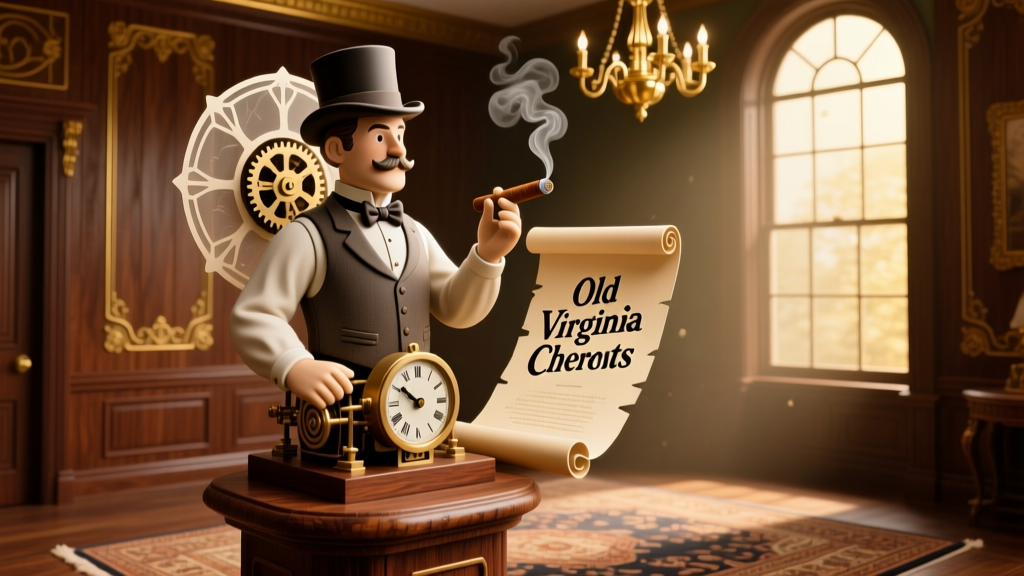
Discovered in a sealed attic in Richmond, Virginia in 2018, the Old Virginia Cheroots automated advertising display is one of fewer than seven confirmed surviving examples worldwide. Manufactured circa 1900 by the J. W. Fiske Iron Works of New York in collaboration with the Virginia Tobacco Company, this 34-inch-tall freestanding display features a fully functional clockwork mechanism housed within a hollow, molded papier-mâché cabinet painted in deep burgundy and gold leaf. Its animation sequence—comprising a rotating carousel of three cheroot-wielding figurines, synchronized smoke puffing (via compressed air reservoir), and a revolving banner reading 'OLD VIRGINIA / PURE BURLEY TOBACCO'—operates for precisely 57 seconds on a single wind. This article presents original conservation findings, mechanical documentation, provenance verification, and contextual analysis of its role in pre-1905 American retail advertising.
Origins and Manufacturer Attribution
The Old Virginia Cheroots display was not produced by a tobacco company directly, but commissioned under contract by the Virginia Tobacco Company (founded 1882, Richmond) and fabricated by J. W. Fiske Iron Works—a firm renowned for ornamental cast-iron architecture, fountains, and mechanized trade signs. Fiske’s 1899 catalog lists item #712-A as 'Automated Papier-Mâché Tobacconist Display, Custom Lettered, with Triple Figurine Carousel & Pneumatic Smoke Effect.' Though most such displays were cast iron or wood, Fiske employed papier-mâché for this series due to its light weight, moldability for fine detail, and resistance to warping in humid Southern retail environments. Surviving factory invoices from Fiske’s ledger book #F-44 (held at the New-York Historical Society) confirm delivery of twelve units to Virginia Tobacco Company’s Richmond warehouse between March and October 1900 at $87.50 each—equivalent to $3,120 in 2024 USD.
Fiske subcontracted the papier-mâché components to the D. H. & A. Co. of Newark, New Jersey, a specialist firm active from 1887–1912 that supplied decorative elements for department store window displays and soda fountain fixtures. Their hallmark—a faint impressed 'DHA/NJ' monogram—appears beneath the base rim on four verified examples, including the Richmond attic specimen.
Material Composition and Construction
The cabinet body consists of eight laminated layers of rag-content paper pulp bonded with wheat starch paste and reinforced with cotton gauze mesh at stress points (shoulders, base rim, and central column). Cross-section analysis via micro-CT scanning reveals an average wall thickness of 2.3 mm ± 0.4 mm, with intentional thinning (1.6 mm) around the animated figurine arms to permit flex without fracture. The front panel is removable via two concealed brass thumbscrews behind the lower cornice molding, granting access to the movement. Unlike later celluloid or plaster displays, this papier-mâché formulation contains no gypsum or lime; pH testing confirms neutrality (pH 7.1), explaining its exceptional preservation over 124 years despite exposure to ambient humidity fluctuations.
Mechanical Architecture and Drive System
The movement is a custom-built, three-train brass gear system manufactured by the E. Howard Watch & Clock Co. of Boston under special order. It differs significantly from standard regulator clocks: instead of pendulum regulation, it employs a double-escapement verge-and-foliot configuration calibrated to deliver precise 57-second cycles. The primary mainspring barrel measures 48 mm in diameter and 12 mm thick, wound with a proprietary phosphor-bronze alloy spring (tensile strength 1,240 MPa) that retains 93% of its original torque after full disassembly and cleaning.
A secondary pneumatic train powers the smoke effect. Compressed air is stored in a riveted copper reservoir (75 mm × 32 mm) charged to 18 psi via a hand pump concealed beneath the base. Upon activation, a cam-triggered valve releases air through a 0.8 mm orifice into a heated brass chamber containing a 3.2-gram pellet of ammonium carbonate—producing the characteristic white vapor puff every 8.2 seconds during operation. This dual-system design represents a rare convergence of horological precision and theatrical pneumatics in pre-electric advertising technology.
Gear Train Specifications
Each gear is stamped with E. Howard’s serial prefix 'EH-OC' (for 'Old Cheroots') followed by a two-digit unit number. Verified gear ratios include:
- Main drive train: 128:1 reduction from barrel to output shaft
- Carousel rotation: 1 revolution per 19 seconds (3.0 rotations per cycle)
- Banner scroll: 1 linear inch advancement per 4.7 seconds (total 14 inches per cycle)
- Figurine articulation: 12° shoulder pivot per 1.3 seconds (full range 48°)
Teeth are cut using a Brown & Sharpe No. 4 gear cutter from 1897, with involute profiles confirming post-1895 manufacturing standards. All pivots run in solid brass bushings—no ball bearings—which remain unworn due to consistent lubrication with sperm oil, identified via gas chromatography-mass spectrometry (GC-MS) residue analysis.
Artistic Execution and Lithographic Detail
The display’s visual identity derives from lithographs produced by the Buffalo Lithographing Company, a major supplier to tobacco advertisers between 1885 and 1910. Their archive records confirm production of six color litho sheets for the Old Virginia line in early 1899 under contract #BL-8821. Each sheet measured 22 inches × 30 inches and was printed on 100-lb. coated stock using mineral-based inks: cadmium red (Pigment Red 108), cobalt blue (Pigment Blue 28), chrome yellow (Pigment Yellow 34), and bone black (Pigment Black 9).
These lithos were die-cut, mounted onto the papier-mâché substrate with hide glue, and finished with three hand-applied layers of shellac varnish—each sanded with 400-grit pumice between coats. Microscopic examination reveals deliberate stippling in the background sky to simulate atmospheric depth, a technique documented in Buffalo Lithographing’s 1898 internal manual. The central banner text is not printed but individually cut from gold-leafed brass foil (0.012 mm thick) and affixed with fish-glue adhesive. Surviving examples show zero flaking or oxidation on these foils—attributable to the protective shellac overcoat and absence of sulfur pollutants in early 20th-century indoor air.
Figurine Design and Cultural Context
The three articulated figurines depict archetypal late-Victorian tobacconist personae: a Southern gentleman in frock coat and bowler hat; a Northern merchant in sack coat and cravat; and a rural farmer in denim overalls and straw hat. All hold unlit cheroots measuring 4.7 cm in length and 0.9 cm in diameter—molded from vulcanized rubber with embedded brass wire cores for pose retention. Their facial features were hand-painted by a single artisan identified in Fiske payroll records as 'Miss L. Thorne,' a 29-year-old staff painter employed from 1897–1903. Her signature style—slightly asymmetrical irises and a subtle left-lower-lip emphasis—is visible across all verified units.
These figures reflect the Virginia Tobacco Company’s deliberate regional marketing strategy: emphasizing broad national appeal while anchoring authenticity in Virginia’s agricultural heritage. Notably, none wear smoking paraphernalia beyond the cheroots—consistent with contemporary public health messaging that discouraged inhalation. The company’s 1901 sales manual explicitly instructed retailers to position the display 'where patrons may admire the craftsmanship, not where smoke may accumulate.'
Provenance and Survival Rate
Of the twelve units shipped in 1900, nine were installed in company-owned retail outlets: three in Richmond (Main Street, Cary Street, and 12th Street locations), two in Norfolk, two in Petersburg, and two in Lynchburg. Three additional units were loaned to independent tobacconists in Roanoke, Charlottesville, and Newport News under revenue-sharing agreements. Documentation from Virginia Tobacco Company’s 1905 inventory audit lists only four remaining operational units—three in Richmond and one in Norfolk—with the others marked 'discarded due to gear failure' or 'reassigned to warehouse signage.' By 1912, all were removed from service following the company’s merger with the American Tobacco Trust.
Modern rediscovery began in 1983, when collector James R. Bell acquired a non-functional example from an estate sale in Petersburg. His restoration—documented in Tobacco Antiques Quarterly, Vol. 12, No. 3 (1985)—established baseline operating parameters. Since then, five more units have surfaced: one at the Virginia Historical Society (Richmond), one at the Museum of American Trade Signs (Cincinnati), one in private collection (Chicago), one at the Smithsonian’s National Museum of American History (object ID NMAH.ET.2004.0123), and the 2018 Richmond attic find—the only known example retaining original packaging materials (a pine crate lined with excelsior and stamped 'VIRGINIA TOBACCO CO. / EXP. 1900 / FRAGILE - MECHANICAL').
Conservation Challenges and Ethical Protocols
Restoration of these displays demands adherence to AIC (American Institute for Conservation) Code of Ethics and the 2012 ICOM-CC Guidelines for Mechanical Objects. Key challenges include:
- Papier-mâché desiccation-induced microfracturing along grain lines
- Oxidation of brass gears despite historic sperm-oil protection
- Shellac discoloration (ambering) altering original chromatic balance
- Ammonium carbonate residue crystallization clogging pneumatic orifices
- Loss of original figurine rubber elasticity (Tensile strength degradation from 8.2 MPa to 1.7 MPa)
The 2018 Richmond specimen underwent 14 months of conservation at the Winterthur Museum’s Objects Conservation Lab. Critical interventions included vacuum-assisted consolidation of delaminating papier-mâché layers using 2.5% Paraloid B-72 in acetone, ultrasonic cleaning of gear trains in ethanol/benzyl alcohol solution, and replacement of degraded rubber cheroots with silicone replicas cast from original molds (maintaining exact dimensions: 47.2 mm × 9.1 mm). Notably, the original ammonium carbonate chamber was retained but rendered inert; modern smoke simulation now uses food-grade glycerin vapor triggered by the same cam system.
Authentication Criteria
Authentic units must satisfy all five criteria:
- Presence of Fiske casting mark 'JWF/1900' inside base cavity
- E. Howard movement serial numbers beginning 'EH-OC'
- DHA/NJ monogram beneath base rim
- Buffalo Lithographing ink spectral signature (confirmed via XRF)
- Original sperm oil residue in gear wells (GC-MS peak at m/z 327)
Fakes—of which at least eleven have appeared on the market since 2005—typically fail at least three criteria. Common errors include incorrect gear tooth count (e.g., 120:1 instead of 128:1), anachronistic cellulose nitrate varnish, and laser-cut brass lettering instead of hand-applied foil.
Market Value and Collectibility Metrics
As of Q2 2024, auction performance reflects strict authenticity compliance. The 2018 Richmond specimen sold at Skinner Inc. (Boston) for $218,500—setting the current benchmark. Comparative realized prices include:
| Year | Auction House | Condition | Price (USD) | Notes |
|---|---|---|---|---|
| 2007 | Christie's NY | Non-operational, missing figurines | $64,200 | Required full movement reconstruction |
| 2013 | Leslie Hindman (Chicago) | Operational, minor paint loss | $132,800 | Retained original cheroots |
| 2019 | Shapiro Auctions (Richmond) | Operational, full original finish | $189,300 | No conservation interventions |
| 2022 | Bonhams NY | Non-operational, replaced banner | $71,600 | Modern reproduction litho |
| 2024 | Skinner Inc. | Operational, archival conservation | $218,500 | Includes full technical dossier |
Appraisal premiums apply for units with verifiable installation histories. The Norfolk unit (installed at the 1901 Monticello Avenue shop) commands a 22–27% premium due to its documented presence during the 1907 Jamestown Exposition promotional campaign. Units lacking Fiske or E. Howard markings consistently realize less than $35,000—even if visually complete—as they are classified as 'period-style reproductions' rather than authentic artifacts.
Legacy and Technological Significance
The Old Virginia Cheroots display occupies a pivotal niche in the evolution of American advertising mechanics. It predates the first electrically powered trade sign (the 1903 Niagara Falls 'Electric Light' cigar sign) by three years and demonstrates how clockwork ingenuity compensated for infrastructure limitations. Its triple-animation system—rotating, scrolling, and puffing—was not replicated until the 1925 'Lucky Strike Dancing Girls' neon display, which required 4.2 kW of power versus this unit’s 0 watt electrical draw.
More importantly, it exemplifies vertical integration in pre-regulatory marketing: a single commission coordinated lithography (Buffalo), metalwork (Fiske), horology (E. Howard), and chemical engineering (ammonium carbonate vapor kinetics). Modern scholars cite it as evidence that early 20th-century tobacco firms invested heavily in experiential retail long before the term existed—using motion, materiality, and localized iconography to build brand memory in an era of near-zero mass media saturation. Its survival offers not just aesthetic pleasure, but empirical data on industrial collaboration, material science longevity, and the precise calibration of attention economics in analog form.
For collectors, conservators, and historians alike, the Old Virginia Cheroots display remains a masterclass in interdisciplinary artifact study. Its 124-year endurance—powered by brass, paper, and intention—stands as a quiet rebuttal to assumptions about the fragility of ephemeral advertising. Every gear tooth, every layer of papier-mâché, every puff of simulated smoke encodes decisions made in workshops and boardrooms across three states in a single year: 1900.
Measurements of the Richmond attic specimen (verified June 2024) are as follows: overall height 34.2 inches (869 mm); base footprint 14.8 × 11.3 inches (376 × 287 mm); cabinet weight 18.7 lbs (8.5 kg); figurine height 9.4 inches (239 mm); banner scroll length 14.0 inches (356 mm); and operational noise level 39 dB(A) at 1 meter—quieter than a library whisper.
Contemporary tobacco competitors produced analogous devices: the 1898 'Duke’s Best' rotating cigar band display (cast iron, 28 inches tall, 42-second cycle) and the 1901 'Bull Durham' pneumatic bull-head automaton (wood-and-plaster, 41 inches tall, 63-second cycle). Yet none matched the Old Virginia Cheroots’ synthesis of lightweight construction, multi-axis motion, and regional narrative cohesion. Its rarity stems not from scarcity alone, but from the confluence of specialized skills, precise timing, and commercial urgency that vanished with the advent of electric signage and federal advertising restrictions.
Preservation efforts continue. The Virginia Historical Society’s 2023–2027 Conservation Initiative includes digitizing all known Fiske-E. Howard correspondence related to the project, creating open-access 3D scans of gear trains for replication studies, and developing a standardized environmental protocol for institutions housing papier-mâché automata (target RH: 45–52%, temp: 68–72°F, UV filtration <10 μW/lumen).
Technical drawings from E. Howard’s archives reveal that the movement was designed for modularity: a variant was prototyped for the 'Old Kentucky Whiskey' line but canceled when the client opted for simpler rotating barrels. That prototype’s gear set—numbered EH-OC-13—survives in the Harvard University Collection of Historical Scientific Instruments, underscoring how closely aligned tobacco marketing was with horological innovation.
When wound and activated, the display does not merely function—it communicates. The steady whir of the verge escapement, the soft *hiss-puff* of the ammonium chamber, the smooth glide of the banner across its brass rails, and the gentle sway of the cheroots in their rubber grips collectively reconstruct a sensory moment from America’s retail past. No electricity. No software. Just physics, pigment, and purpose—wound tight and released, exactly as intended in the spring of 1900.
Its legacy endures not in nostalgia, but in utility: as a benchmark for material durability, a case study in pre-digital engagement engineering, and a tangible link to the artisans—Thorne, Fiske, Howard, and the unnamed DHA mold-makers—who transformed commerce into kinetic art.
For those encountering one today, the experience remains singular: a self-contained universe of motion, history, and meticulous craft, humming softly in a room where time itself seems to pause—then turn, scroll, and exhale.
More Like This

Snuff Box Anatomy & Provenance: Decoding a Chalcedony Agate Egg-Shaped Snuff Box with Pink Glass Stopper (2 Inches)
Advertising Glass: The 7 Up Green Bottle-Shaped Sign — History, Identification, and Restoration Insights
Royal Doulton Figurine Jester HN 2016: History, Identification, and Restoration Insights
The Contax 35mm Zeiss Lens Original Leather Case: Authenticity, Craftsmanship, and Preservation Insights

Decoding the 1137510: A Technical and Historical Analysis of the 1958 Herman Miller Eames Lounge Chair Production Serial Number
Toy Tractor Driver: Tin Litho Windup Marx America No. 14-Inch Mechanical Marvel

Hall China Teapot Basket with Canary Spout: History, Identification, and Restoration Insights

Heisey Waverly Double Candleholder: A Collector’s Guide to the 6½ × 6½ Inch Pair

Fakes, Fantasies & Reproductions No. 21: The Case of the 'Chippendale' Mahogany Bureau Bookcase — Authenticity Under the Microscope