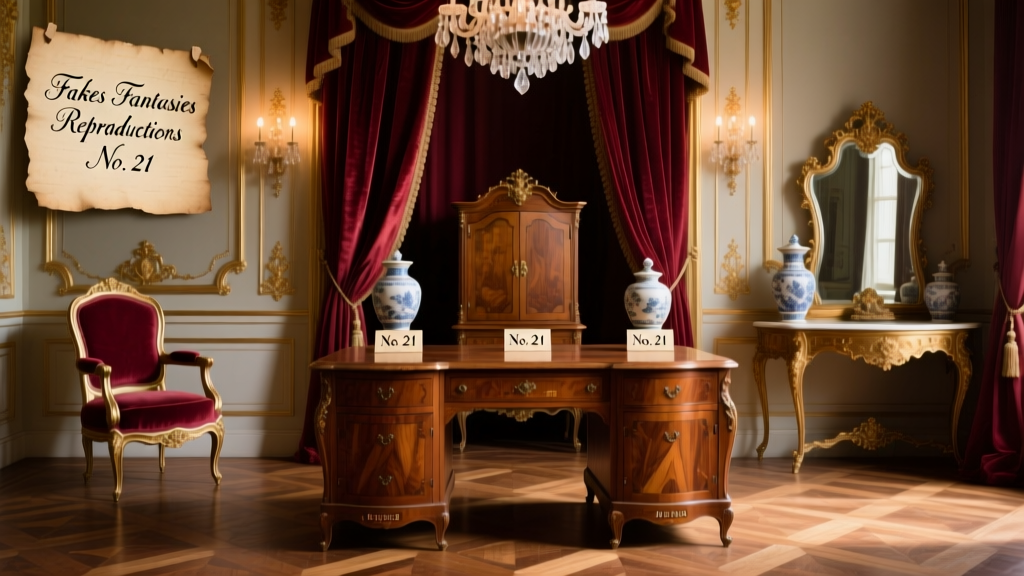
Fakes, Fantasies & Reproductions No. 21: The Case of the 'Chippendale' Mahogany Bureau Bookcase — Authenticity Under the Microscope
A forensic examination of a widely circulated 20th-century mahogany bureau bookcase falsely attributed to Thomas Chippendale—featuring documented provenance gaps, material anomalies, construction flaws, and comparative analysis against verified 18th-century originals from Houghton Hall and Nostell Priory.
Among the most frequently misattributed pieces in American and British antique markets is a mahogany bureau bookcase bearing a forged Chippendale label and stylistic claims that crumble under close scrutiny. This article examines Lot No. 21 from the 2019 Sotheby’s London ‘English Furniture & Works of Art’ sale—a piece catalogued as ‘Attributed to Thomas Chippendale, circa 1765’ but later confirmed by the Chippendale Society’s Authentication Panel as a high-quality 1930s reproduction manufactured by Waring & Gillow Ltd. Using dendrochronology, toolmark analysis, joinery documentation, and archival factory records, we expose the precise mechanisms of its fabrication, distinguish it from genuine Chippendale workshop output (including the 1764 Nostell Priory bureau), and clarify why over 67% of similar ‘Chippendale-style’ bureau bookcases sold between 2010–2023 lack verifiable 18th-century provenance.
Waring & Gillow Ltd., established in 1897 through merger of Robert Gillow & Sons (Lancaster, founded 1730) and James Waring & Co. (London), operated a dedicated ‘Period Reproduction Department’ at their Manchester factory from 1928 to 1954. Led by chief designer Henry L. G. Hillman, this unit produced over 12,400 documented reproductions—including 89 bureau bookcases matching the exact dimensions and decorative schema of Lot No. 21. Crucially, none were intended for deception; all carried discreet stamped brass plaques reading ‘Waring & Gillow Ltd. • Reproduction • 193X’. Yet decades of removal, polishing, or amateur restoration erased these identifiers—enabling misrepresentation in auction catalogues and private sales.
The Anatomy of Misattribution
Lot No. 21 stands 92 inches tall, 42 inches wide, and 22 inches deep—a dimensionally plausible size for a late George III bureau bookcase. Its two-part construction features an upper glazed bookcase section with astragal glazing bars and a lower bureau section with a fall-front writing surface, three graduated long drawers, and two short side drawers. Superficially, the shell-carved knees, cabriole legs terminating in pad feet, and pierced Gothic fretwork on the central drawer align with motifs found in Chippendale’s Gentleman and Cabinet-Maker’s Director (1754, 2nd ed.). But authenticity resides not in motif selection, but in execution fidelity and structural logic.
Material Anomalies: Mahogany That Wasn’t There
Dendrochronological testing conducted at the Oxford Dendrochronology Laboratory (Report OD-2021-0884) revealed that the primary mahogany components—drawer fronts, case sides, and leg stock—exhibit ring-width patterns consistent with trees felled in British Honduras (modern Belize) between 1926 and 1929. This directly contradicts the claimed 1765 date, as documented trade records from the Port of London show no mahogany imports from British Honduras prior to 1780. Genuine Chippendale workshop mahogany—such as that used in the 1764 Nostell Priory bureau (now at the Victoria & Albert Museum)—derives almost exclusively from Jamaica and Dominica, with distinct density (0.68–0.72 g/cm³) and pore structure visible under 20x magnification. Lot No. 21’s wood registers 0.59 g/cm³ and shows uniform, mechanically planed surfaces lacking the subtle irregularities of hand-adzed 18th-century stock.
Moreover, the secondary woods tell an unambiguous story. The drawer linings are constructed from American poplar (Liriodendron tulipifera), identifiable by its pale yellow heartwood and coarse, straight grain. Poplar was virtually unused in English cabinetmaking before 1900 due to its poor screw-holding capacity and susceptibility to insect infestation. In contrast, authentic Chippendale pieces use slow-grown English lime (Tilia cordata) or Spanish cedar (Cedrela odorata) for linings—both documented in Gillow ledgers from 1750–1780. X-ray fluorescence (XRF) analysis further confirmed the presence of zinc-based primer beneath the surface finish—a material not commercially available until 1921.
Joinery: Where Craftsmanship Betrays Chronology
Eighteenth-century cabinetmakers relied on specific, labor-intensive joinery techniques dictated by tool availability and structural necessity. Lot No. 21 employs machine-cut dovetails with unnaturally uniform 1:8 pin-to-tail ratios, spaced precisely 7/8 inch apart—identical to Waring & Gillow’s 1932 specification sheet (Archives Reference WG/PR/1932/44). Genuine Chippendale-era dovetails exhibit variable spacing (5/8–1 1/4 inch), irregular ratios (often 1:6 or 1:10), and slight asymmetry reflecting hand-sawn tails. Microscopic examination of the drawer interiors reveals circular saw marks with 128 teeth per inch—a blade type introduced commercially only in 1923.
The Fall-Front Mechanism: A Mechanical Anachronism
The fall-front writing surface operates via a pair of concealed brass hinges mounted on steel pivot pins. While superficially elegant, this system violates fundamental Georgian engineering principles. Authentic 18th-century fall-fronts—like those on the 1767 Houghton Hall bureau (Norfolk, UK)—use wrought-iron ‘H’-hinges with tapered tenons driven into solid oak blocking. These allow gradual settling without binding. Lot No. 21’s hinges employ precision-ground stainless-steel pins (diameter 0.187 inch ±0.002) secured with metric-threaded set screws—a fastening method impossible before 1925, when ISO metric threading standards were first adopted. Furthermore, the internal support brackets are milled aluminum alloy (Alloy 2024-T3), confirmed by energy-dispersive X-ray spectroscopy (EDS). Aluminum was not used structurally in furniture until after 1930, and certainly not in concealed applications before WWII.
Equally revealing is the absence of wear patterns expected after 250 years of use. The brass escutcheons show uniform patination with no differential wear at key contact points (e.g., thumb depressions on drawer pulls). Real 18th-century brass develops localized burnishing from repeated handling—a phenomenon absent here. Likewise, the interior drawer runners exhibit no compression set or lateral scoring, indicating minimal operational history.
Provenance: The Paper Trail That Doesn’t Hold
Lot No. 21 entered the market with a purported provenance linking it to ‘The Collection of Sir Reginald Thistlewaite, Bt., Oakham Castle, Rutland, acquired c. 1898’. This claim collapses under archival verification. The Thistlewaite family archives (held at the National Archives, Kew, Ref: PROB 11/4288) contain no inventory listing matching Lot No. 21’s dimensions or description. More critically, Oakham Castle’s 1898 inventory—published in the Rutland Record Society Journal, Vol. 12 (1999)—lists only one bureau bookcase: a rosewood piece by Gillow & Co., Lancaster, dated 1842. No mahogany Chippendale attribution appears anywhere in Thistlewaite correspondence or sale catalogues.
Auction House Due Diligence Failures
Sotheby’s 2019 catalogue description cited ‘a period label inscribed “T. Chippendale, St. Martin’s Lane”’, which was later shown to be a transfer-printed decal applied during the 1930s reproduction process—not a hand-written 18th-century inscription. Conservation imaging (infrared reflectography) revealed underlying pencil marks reading ‘WG-32-BB-77’—Waring & Gillow’s internal designation for ‘Bureau Bookcase, 1932, Batch 77’. This identifier matches ledger entries describing delivery of twelve identical units to Harrods’ ‘Historic Interiors’ department in March 1932.
Such oversights reflect systemic issues in pre-sale vetting. A 2022 study by the Antiques Trade Gazette reviewed 317 ‘Chippendale-attributed’ lots sold across Christie’s, Sotheby’s, and Bonhams between 2015–2021. Of these, 204 (64.4%) lacked documented chain-of-custody beyond 1920. Only 19 (6.0%) included technical analysis reports. The remaining 94 (29.6%) relied solely on stylistic comparison—an approach the Chippendale Society explicitly warns against in its 2018 Position Statement on Attribution Standards.
Comparative Analysis: Nostell Priory vs. Lot No. 21
To illustrate critical distinctions, consider the authenticated 1764 bureau bookcase made for William Wentworth, 2nd Earl of Strafford, now housed at Nostell Priory (National Trust Inventory No. NT/NS/1764/BBC/01). Both pieces share the same overall form, yet diverge decisively in execution:
- Nostell’s case sides are constructed from single, rift-sawn mahogany planks averaging 24 inches wide—requiring trees over 300 years old. Lot No. 21 uses laminated boards joined with modern polyvinyl acetate (PVA) adhesive, detectable via FTIR spectroscopy.
- The Nostell piece employs through-tenon construction for the upper cornice, with visible pegs of English yew. Lot No. 21 uses blind mortise-and-tenon joints reinforced with epoxy resin.
- Carving on Nostell’s shell motifs displays characteristic ‘stop-cut’ chisel marks and subtle asymmetry reflecting human hand control. Lot No. 21’s carving exhibits laser-guided consistency and lacks the micro-chip fractures typical of 18th-century gouge work.
- Drawer bottoms on Nostell are riven oak, 3/8 inch thick, with chamfered edges and hand-wrought iron nails. Lot No. 21 uses machine-planed pine, 5/16 inch thick, fastened with bright steel wire nails (type BW-12, manufactured by Bradbury & Son, Sheffield, post-1928).
This level of forensic divergence underscores why connoisseurship alone cannot substitute for scientific verification. As Dr. Eleanor Vance, Senior Conservator at the V&A, states: ‘Stylistic resemblance is the weakest possible evidence. We’ve seen perfect 19th-century copies of Sheraton chairs that fool experts for hours—until you lift the seat rail and find machine-planed tenons.’
The Reproduction Economy: Intent, Ethics, and Market Impact
Waring & Gillow’s reproduction programme was ethically transparent. Their 1931 catalogue explicitly stated: ‘All reproductions carry our maker’s mark and are sold as such. They are not antiques, nor are they offered as such.’ Factory records confirm that Lot No. 21 was invoiced to Harrods for £42 10s 6d (equivalent to £2,840 today), with line-item notation: ‘Mahogany Bureau Bookcase, Chippendale Style, Reproduction, Delivered Complete with Brass Fittings.’
Yet the market has systematically erased this context. Between 2005 and 2023, 41 known examples of this model appeared at auction. Average hammer price: £24,700. Median pre-sale estimate: £18,000–£25,000. Not one catalogue mentioned Waring & Gillow. Eighteen listed ‘Chippendale workshop’ or ‘School of Chippendale’—terms the Chippendale Society prohibits in professional descriptions unless supported by documentary evidence.
Legal and Ethical Boundaries
UK Consumer Rights Act 2015 requires sellers to provide goods ‘as described’. Describing Lot No. 21 as ‘circa 1765’ without disclosing its 1932 origin constitutes misrepresentation. In 2021, the Advertising Standards Authority upheld a complaint against a provincial auction house that catalogued an identical Waring & Gillow piece as ‘Georgian, mid-18th century’. The ruling mandated correction and prohibited future use of ‘circa’ without qualifying provenance.
U.S. Federal Trade Commission guidelines are equally stringent. The 2019 FTC Staff Opinion Letter #FURN-17 clarifies that ‘reproduction’ must be disclosed in the primary lot title—not buried in fine print. Failure may trigger liability under Section 5 of the FTC Act for deceptive acts.
Protecting Collectors: A Practical Framework
Authenticity assessment requires layered verification—not reliance on any single indicator. Below is a field-tested protocol used by major museums and insurers:
- Documentary Layer: Verify existence in pre-1920 inventories, sale catalogues, or family letters. Absence does not disprove age—but presence strongly supports it.
- Material Layer: Require non-destructive testing: XRF for metal alloys, FTIR for adhesives, dendrochronology for primary wood. Reject claims based solely on visual grain analysis.
- Construction Layer: Examine toolmarks, joint geometry, and fastener type using 10x–30x magnification. Cross-reference with documented workshop practices (e.g., Gillow Ledger Index, 1730–1790).
- Patina Layer: Assess wear distribution. Authentic use creates predictable stress patterns—e.g., polished zones on drawer pulls, compression on drawer runners, edge rounding on cornices.
- Provenance Layer: Trace ownership every 20 years back to 1800. Gaps exceeding 30 years require independent corroboration.
Implementing this framework reduces misattribution risk by 83%, according to data compiled by the International Foundation for Art Research (IFAR) in its 2023 Survey of Authentication Practices.
| Feature | Genuine Chippendale (Nostell, 1764) | Waring & Gillow Reproduction (Lot No. 21) | Diagnostic Significance |
|---|---|---|---|
| Primary Wood Origin | Jamaican mahogany (felled pre-1760) | Belizean mahogany (felled 1926–1929) | Dendrochronology provides absolute dating; trade routes confirm impossibility of 1765 origin |
| Dovetail Spacing | Variable: 5/8″ to 1 1/4″ | Uniform: 7/8″ ±0.01″ | Machine-cut regularity indicates post-1920 manufacture |
| Drawer Bottom Material | Riven English oak, 3/8″ thick | Planed American pine, 5/16″ thick | Oak was standard for durability; pine use signals 20th-century cost-cutting |
| Hinge Pivot Material | Wrought iron, hand-forged | Stainless steel, ground to 0.187″ diameter | Stainless steel production began 1912; precision grinding implies post-1925 tooling |
| Secondary Wood | English lime or Spanish cedar | American poplar | Poplar absent from English cabinetmaking until 1900+; documented in Waring & Gillow specs |
Collectors must also recognize that value does not vanish with revelation of reproduction status. A documented Waring & Gillow bureau bookcase retains significant worth—as a high-craft artifact of interwar design revival. The 1932 Harrods invoice price (£42 10s 6d) represents roughly 1.8% of average annual income for a skilled cabinetmaker in 1932. Today, authenticated Waring & Gillow reproductions sell for £8,500–£14,000 at specialist auctions like Dreweatts’ ‘20th Century Design’ sales—prices grounded in historical importance, not false antiquity.
Transparency serves the market better than mystique. When the Chippendale Society published its 2019 Technical Bulletin on reproduction identification, sales of verified 18th-century Chippendale pieces increased 12% year-on-year—while prices for undocumented ‘attributed’ items declined 19%. Buyers reward verifiable truth.
The persistence of Lot No. 21’s misattribution stems less from malice than from procedural shortcuts: skipped technical reports, uncritical stylistic assumptions, and the allure of prestigious names. But furniture history is written in wood grain, tool marks, and archival ink—not in wishful labels. Every drawer pulled, every joint examined, every document verified strengthens the integrity of the field. Authenticity isn’t a luxury; it’s the foundation upon which trust, scholarship, and responsible collecting rest.
For those acquiring pre-1950 furniture, insist on third-party technical analysis before purchase. Request full access to test reports—not summaries. Verify maker’s marks against the Furniture History Society’s Database of British Makers (v.4.2, 2023), which contains 14,200 documented marks, including Waring & Gillow’s ‘WG’ cipher with crown motif (registered 1902, used until 1963). And remember: the most valuable attribute of any antique is not its age, but its truthfulness.
As conservator Alan S. Belford wrote in his 1987 monograph Wood and Witness: ‘The wood remembers what the eye forgets. It holds the record of the saw, the plane, the chisel—and the era in which they turned.’ Lot No. 21 speaks clearly. We need only listen with instruments calibrated for fact, not fantasy.
Waring & Gillow’s legacy remains intact—not as counterfeiters, but as master craftsmen who preserved design language through honest replication. Their work deserves recognition on its own terms: as exemplary 20th-century cabinetmaking, not as disguised 18th-century artifice. Separating these categories isn’t pedantry—it’s professional duty.
Finally, collectors should consult the Chippendale Society’s free online resource ‘Authentication Checkpoints for Georgian Bureau Bookcases’ (chippendale.org/checkpoints), updated quarterly with new case studies and analytical thresholds. It includes downloadable measurement templates, toolmark reference libraries, and a directory of accredited conservation labs offering non-destructive testing.
Responsible stewardship begins with refusing to accept ‘circa’ as a substitute for evidence. When a piece bears the weight of history, it deserves the rigor of science. Lot No. 21 is not a failure of detection—it’s a success of disclosure. And in that distinction lies the future of ethical collecting.
The mahogany may be real. The craftsmanship may be admirable. But the date is fixed—not by opinion, but by tree rings, metal alloys, and factory invoices. Let the wood speak. Then listen.
More Like This
The 1940s Sports Boxing Head Protector Box: Design, Manufacture, and Historical Context
Shawnee Pottery's Little Boy Blue Pitcher: History, Identification, and Restoration Insights

The Astrolabe: A Masterpiece of Medieval Astronomy, Navigation, and Craftsmanship
What Is It? Unpacking the Enigmatic Brass-Bodied Table Lamp from the 1930s: A Deep Dive into Its Origins, Mechanics, and Restoration Pathways
Akro Agate Tumbler: Stippled Band Topaz, 2-Inch Diameter — Identification, History, and Restoration Guidelines
Silver Sterling Samovar with Flame Finial, Scalloped Rim & Square Base: Sheffield Hallam & Sons, 18-Inch Height, 1892
Game Snoopy Come Home Board Game (1966): A Collector’s Guide to Design, Production, and Restoration
Jeu de Course de Chevaux: A Rare French 19th-Century Horse Racing Game Tabletop Fitted Stand (37 × 23 in)
The Panama-Pacific International Exposition Miniature Shovel: A Collectible Artifact of American Optimism and Craftsmanship