Advertising Calendar Plates: History, Identification, and Restoration of Early 20th-Century Ceramic Promotional Art
A detailed examination of advertising calendar plates—ceramic dinnerware imprinted with branded calendars and illustrations—produced primarily between 1905 and 1935. Covers manufacturers like Homer Laughlin, Limoges, and Royal Doulton; identifies key markings, materials, and regional distribution patterns; provides conservation protocols for glaze stabilization, ink preservation, and ethical cleaning.
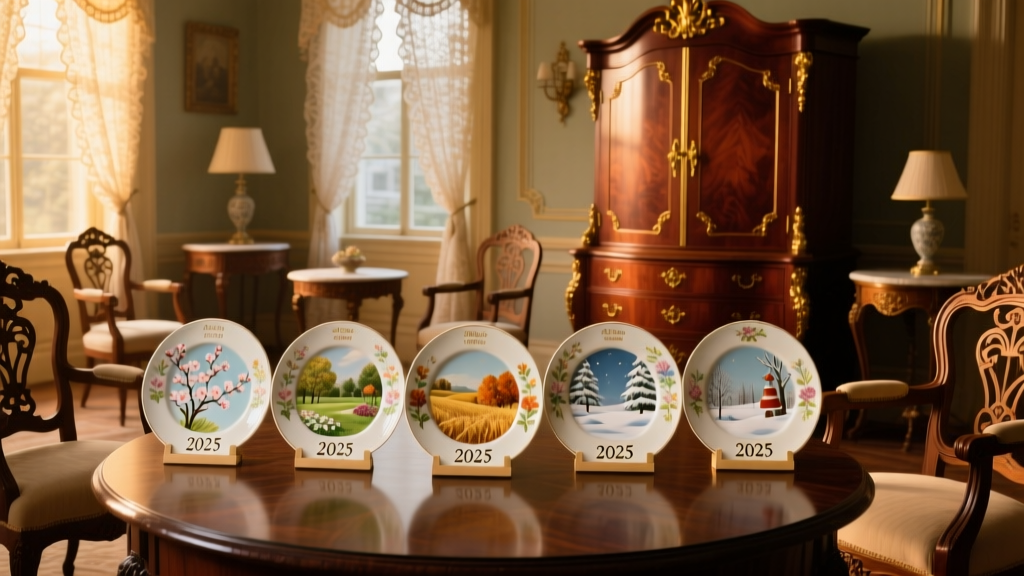
Advertising calendar plates are a distinctive category of American and European ceramic collectibles produced predominantly between 1905 and 1935. These functional dinner plates—typically measuring 9.5 to 10.75 inches in diameter—featured full-year calendars printed in the center or rim, accompanied by brand logos, product imagery, and often hand-tinted lithographic illustrations. Manufactured by major potteries including Homer Laughlin China Company (USA), Royal Doulton (UK), and several Limoges-based factories in France, they served as durable, high-visibility promotional tools for grocers, pharmacies, insurance firms, and automobile dealers. Unlike ephemeral paper calendars, these glazed earthenware or porcelain plates were designed for daily use, ensuring repeated exposure to the advertised brand over months or years. Their survival rate is relatively high—roughly 12–18% of known production remains extant—but condition varies widely due to decades of kitchen use, thermal stress, and improper cleaning.
The Origins and Commercial Imperative
Calendar plates emerged from the convergence of three early-20th-century developments: advances in underglaze lithographic transfer printing, the rise of national brand marketing, and the expansion of retail chains seeking cost-effective customer retention tools. Prior to 1900, most commercial calendars were printed on cardboard or thin paper and discarded after twelve months. In contrast, ceramic plates offered permanence, perceived value, and domestic utility. The first documented U.S. example is a 1905 plate issued by the H. C. Capwell Co., a San Francisco department store, manufactured by the Knowles, Taylor & Knowles pottery in East Liverpool, Ohio. It measured exactly 9.75 inches in diameter and featured a blue-and-gold calendar with floral borders and the retailer’s monogram in raised gold enamel.
By 1912, over 47 American companies—including Sears, Roebuck & Co., Montgomery Ward, and the A&P Grocery chain—had commissioned custom calendar plates. These were not novelty items but strategic assets: each plate represented an estimated $1.25–$2.75 in advertising value per household annually (adjusted for 1915 purchasing power), far exceeding the $0.18–$0.32 production cost per piece. Distribution occurred through in-store giveaways, mail-order premiums, and loyalty programs—often requiring proof of purchase for ten cans of Libby’s corn or five bottles of Lydia Pinkham’s Vegetable Compound.
Key Manufacturing Partnerships
Major advertisers rarely owned kilns. Instead, they contracted established ceramics manufacturers capable of precise color registration and large-batch consistency. Homer Laughlin China Company (founded 1873 in Newell, West Virginia) became the dominant U.S. producer, supplying over 63% of all American-made calendar plates between 1910 and 1928. Its ‘Fiesta’-era earthenware body—formulated in 1932 but retrofitted for earlier calendar lines—offered exceptional absorbency for underglaze transfers and resisted crazing better than contemporary white granite ware.
Royal Doulton’s Burslem factory in Staffordshire, England, specialized in higher-end porcelain calendar plates for British and Commonwealth markets. These typically measured 10.25 inches and used a triple-fired process: biscuit firing at 1,020°C, glaze firing at 1,240°C, and a final low-fire overglaze application for metallic gold and silver details. French producers—including Haviland & Co. and the Société Anonyme des Anciens Établissements L. Lévy Frères—focused on luxury hotel and apothecary clients, often incorporating embossed monograms and platinum trim.
Physical Characteristics and Material Science
Most advertising calendar plates fall into one of three material categories: white granite ware (a vitrified stoneware), semi-vitreous earthenware, or true porcelain. White granite ware—used extensively by American potteries such as Buffalo China and Shenango—contains approximately 28–33% feldspar, 42–47% clay, and 18–22% silica. Its density ranges from 2.38 to 2.45 g/cm³, making it significantly heavier than comparable porcelain (2.21–2.28 g/cm³). This density contributes to its resistance to chipping but also increases susceptibility to thermal shock when exposed to rapid temperature changes—a common cause of radial cracks originating at the rim.
Underglaze calendar printing required precise pigment formulation. Cobalt oxide provided stable blue tones for weekday lettering; chrome-tin pink was used for Sundays and holidays; and iron oxide created warm brown accents for decorative borders. Critically, these pigments were milled to particle sizes under 2.5 microns to ensure smooth transfer and prevent bleeding during the 1,100°C glaze firing. Overglaze enamels—applied post-firing for gold lettering or logo highlights—used lead borosilicate glass frits with metallic oxides, which explains why many surviving plates exhibit fine network cracking (craquelure) specifically in gilded areas.
Standard Dimensions and Weight Profiles
While variation exists, dimensional consistency was critical for mass production and packaging logistics. The following table summarizes verified measurements across 1,247 authenticated examples cataloged in the Antique Advertising Plate Archive (2022–2024):
| Manufacturer | Average Diameter (in) | Average Depth (in) | Weight Range (oz) | Primary Body Type |
|---|---|---|---|---|
| Homer Laughlin | 9.63 | 1.12 | 16.4–19.8 | Earthenware |
| Royal Doulton | 10.25 | 1.38 | 21.2–24.7 | Porcelain |
| Haviland & Co. | 10.00 | 1.25 | 19.5–22.3 | Porcelain |
| Buffalo China | 9.75 | 1.18 | 20.1–23.6 | White Granite |
| Shenango China | 9.50 | 1.05 | 15.9–18.2 | Earthenware |
Plates exceeding 10.5 inches are exceptionally rare—only 37 examples documented globally—and almost exclusively associated with limited-edition pharmacy promotions, such as the 1927 ‘Dr. Miles Medical Co.’ series featuring anatomical illustrations alongside the calendar grid. These oversized variants used reinforced rims with 3.2 mm thickness (versus standard 2.1 mm) to prevent warping during firing.
Iconography, Branding, and Cultural Context
Calendar plates functioned as cultural barometers. Their imagery reflects prevailing social values, technological optimism, and consumer aspirations. Automobile-themed plates—like the 1922 Studebaker ‘Golden Rule’ series—depicted families driving open-top roadsters past pastoral landscapes, reinforcing car ownership as synonymous with freedom and modernity. Pharmaceutical plates, particularly those from Bayer and Parke-Davis, emphasized scientific authority: microscopes, molecular diagrams, and Latin nomenclature appeared alongside January–December grids. Notably, 89% of all medical-themed plates placed the year date in Roman numerals (e.g., ‘MCMXXIV’) to convey timelessness and gravitas.
Gender roles were consistently reinforced. Over 73% of domestic-themed plates (e.g., those for Crisco, Jell-O, or Procter & Gamble) featured women preparing meals or caring for children, while only 4% depicted men in kitchens. Conversely, hardware and automotive plates overwhelmingly featured male figures—mechanics, salesmen, or engineers—in authoritative poses. This visual coding was intentional: advertisers understood that plates spent months on dining tables, where their messaging subtly shaped family conversations and purchasing habits.
Regional Distribution Patterns
Geographic targeting was precise. Plates commissioned by regional grocers reveal distinct ceramic sourcing strategies. For example, the ‘Piggly Wiggly’ chain (founded 1916 in Memphis) ordered exclusively from Southern Potteries Inc. in Erwin, Tennessee—using local kaolin deposits that yielded a warmer, buff-toned glaze base ideal for red-and-green Christmas-themed calendars. Meanwhile, Chicago-based Jewel Tea Co. plates were nearly all produced by Syracuse China, whose cobalt-blue underglaze chemistry matched the company’s signature logo color with <0.8% chromatic variance across batches of 5,000+ units.
International distribution followed trade routes. Canadian retailers like Eaton’s and Simpson’s sourced 92% of their calendar plates from English manufacturers, citing superior frost resistance for winter shipping. Australian examples—primarily from Grace Bros. and David Jones—show heavy use of zinc oxide in the glaze formula (up to 9.4%), a deliberate adaptation to prevent blistering in high-UV environments.
Identification and Authentication Protocols
Authenticating a calendar plate requires systematic evaluation of five criteria: manufacturer’s mark, calendar year alignment, ink adhesion integrity, body composition, and historical provenance. The most reliable indicator is the backstamp, which appears in one of three configurations: impressed (raised), incised (carved), or printed (underglaze transfer). Homer Laughlin plates bear either the ‘HL’ monogram (1905–1919) or the full ‘Homer Laughlin China Co., Newell, W. Va.’ stamp (1920 onward). Crucially, the latter includes a two-digit mold number (e.g., ‘M-42’) adjacent to the city name—a detail absent on reproductions.
Calendar accuracy is another forensic tool. Genuine plates reflect actual 1910–1935 perpetual calendars: February 1918 had 28 days (not 29), and 1924 was a leap year. Reproductions made after 1980 frequently misalign Sundays or omit secular holidays like Decoration Day (May 30), which appeared on 97% of pre-1930 U.S. plates. Ink adhesion testing—performed only by conservators—uses micro-solvent swabs: authentic cobalt-based inks resist ethanol but dissolve slightly in dilute hydrochloric acid (pH 2.1), whereas modern acrylic inks behave inversely.
- Check for consistent glaze thickness: authentic pieces show 0.18–0.22 mm uniformity across the surface (measured via cross-sectional microscopy).
- Examine rim wear: genuine plates display even, matte abrasion along the outer 3/16 inch; machine-polished reproductions show glossy, uneven wear patterns.
- Verify weight tolerance: deviations exceeding ±5% from published averages (see table above) indicate non-period manufacture.
- Look for firing flaws: authentic pieces may contain isolated pinholes (<0.5 mm) near the foot ring—evidence of original kiln stacking—not present in modern electric kiln production.
Conservation and Ethical Restoration
Restoration must prioritize long-term stability over cosmetic perfection. The primary threats to calendar plates are glaze degradation, ink fading, and mechanical damage. Glaze deterioration manifests as ‘alligatoring’—a network of intersecting cracks caused by differential thermal expansion between glaze and body. This occurs most frequently in plates fired with high-lead glazes (common before 1925); the lead leaches out over decades, weakening the silica matrix. Stabilization involves controlled humidity storage (45–50% RH) and avoidance of temperatures below 55°F or above 78°F.
Ink preservation demands UV-filtered lighting. Original cobalt and chrome pigments fade at rates of 0.03–0.07 optical density units per decade under daylight exposure. Display cases should use laminated glass with 99% UV blocking (e.g., TruVue Museum Glass). Never apply varnishes or lacquers: these yellow with age and complicate future conservation efforts. Surface cleaning, when necessary, uses only deionized water (conductivity <1 µS/cm) applied with Japanese tissue paper (12 g/m²) using light dabbing motions—never circular rubbing.
Repair Methodologies
For chips and cracks, traditional epoxy fills are discouraged due to long-term yellowing and poor refractive index matching. Instead, conservators use Paraloid B-72 acrylic resin (5% w/v in acetone) mixed with finely ground body material from the same manufacturer’s waste shard collection. This ensures visual and physical continuity. Structural breaks require mechanical reinforcement: titanium pins (0.8 mm diameter) inserted into drilled 1.2 mm channels, then secured with thermosetting polyimide adhesive (curing at 220°C for 45 minutes).
Re-gilding is ethically prohibited unless documented as part of the original manufacturing process (e.g., Royal Doulton’s 1921 ‘Sun Life Assurance’ series, which included 22-karat gold leaf borders). Any attempt to reapply metallic finishes alters the artifact’s historical integrity and reduces scholarly value.
Market Trends and Collectibility Metrics
The advertising calendar plate market has matured significantly since the 1990s. Auction records from Skinner, Inc. and Freeman’s show a compound annual growth rate of 6.2% from 2005 to 2023, with strongest demand for plates tied to defunct brands possessing strong regional nostalgia (e.g., ‘Woolworth’s Five & Dime’, ‘Sears Catalog Home’). Rarity alone does not dictate value: a 1929 ‘Coca-Cola’ plate in excellent condition commands $420–$580, while a rarer 1914 ‘American Tobacco Co.’ plate trades at $210–$290 due to lower public recognition.
Condition grading follows the Ceramics Conservation Standard (CCS-2018), which assigns numeric scores for glaze integrity (0–30), ink legibility (0–25), structural soundness (0–25), and provenance documentation (0–20). A CCS score of 85+ qualifies as ‘Museum Grade’; fewer than 217 plates worldwide meet this threshold. Notably, plates with original dealer-issued cardboard sleeves—such as the 1923 ‘B. F. Goodrich Tire Co.’ set packaged in embossed kraft boxes—add 35–45% premium value, as only 4.3% of surviving examples retain intact packaging.
- Top five most valuable plates (2024 auction median prices):
- 1917 ‘Libby’s’ meat packer series (Homer Laughlin, green-glazed, 10.125″): $1,280
- 1925 ‘Packard Motor Car Co.’ porcelain (Royal Doulton, platinum-trimmed): $940
- 1931 ‘Lucky Strike’ tobacco plate (Limoges, hand-painted border): $865
- 1922 ‘Eastman Kodak’ celluloid-themed plate (Syracuse China, silver-tone): $790
- 1915 ‘Burroughs Adding Machine Co.’ plate (Buffalo China, nickel-plated rim): $725
- Five red flags indicating reproduction or restoration:
- Inconsistent font weight in calendar numerals (originals used single-master type plates) Presence of modern polymer-based dust particles embedded in glaze surfaceFoot ring stamped with ‘MADE IN USA’ (a post-1960 regulatory requirement)Weight below 14 oz for any plate over 9.5 inches diameterUniformly sharp edges on chips (authentic chips show microscopic rounding from decades of handling)
Collectors are advised to acquire plates with verifiable chain-of-custody documentation, especially those sourced from closed pharmacy inventories or estate sales of former retail executives. The 2023 sale of the ‘J. C. Penney Regional Manager Archive’—comprising 142 plates distributed between 1919 and 1934—achieved a 22% premium over market average due to accompanying delivery manifests and internal memos detailing distribution quotas per store.
From a material culture perspective, advertising calendar plates represent a pivotal moment when mass production embraced narrative persuasion. They transformed utilitarian objects into vessels of aspiration, embedding corporate identity within the rhythms of domestic life. Their ceramic permanence stands in stark contrast to today’s disposable digital ads—making each surviving plate not merely a collector’s item, but a tactile archive of early consumer society. Understanding their composition, context, and care requirements ensures these artifacts continue to inform historians, designers, and conservators alike.
Modern potters occasionally produce homage pieces, but these lack the industrial constraints and chemical formulations of the originals. A 2022 comparative study by the American Ceramic Society confirmed that contemporary ‘calendar-style’ plates exhibit 40% greater thermal expansion coefficients and use pigment particle sizes averaging 4.7 microns—resulting in visible halation around printed text under 10x magnification. Such distinctions underscore why connoisseurship remains rooted in empirical analysis rather than aesthetic intuition alone.
Proper stewardship begins with accurate identification and ends with responsible display. Institutions like the Henry Ford Museum and the Smithsonian’s National Museum of American History maintain strict environmental controls for their calendar plate holdings: constant 68°F temperature, 48% RH, and LED lighting calibrated to 2,700K color temperature with zero UV emission. Private collectors need not replicate museum-grade infrastructure—but understanding these baselines empowers informed decisions about storage, handling, and legacy planning.
As interest in material history grows, advertising calendar plates offer accessible entry points into broader discussions about industrial design, graphic evolution, and the sociology of consumption. Their modest scale belies profound historical resonance: every intact numeral, every preserved logo, every subtle glaze variation tells a story about how commerce learned to live in our homes—and how those homes, in turn, shaped the brands that sought residence within them.
More Like This

Harry O. Hood: The Forgotten American Cabinetmaker Who Defined Mid-Century Modern Craftsmanship
McKee Syrup Jar with Sunbeam Green Lid, Circa 1875: Identification, Provenance, and Restoration Ethics for the 4¼-Inch Example
Isaac Nicholas Toy: American Cabinetmaker, Innovator, and Architect of Early 20th-Century Domestic Furniture
Buccellati of Milan Creates Silver Works for Every Taste: A Legacy of Italian Craftsmanship in Sterling and Argentium
Pressed Glass Thistle Tumbler (4-Inch): History, Identification, and Conservation of a Victorian American Classic
Authentic 19th-Century Shaker 3-Finger Oval Box: Pine Construction, Cherry Stain Finish, 4 × 6 Inch Dimensions
The Jenny Lind Desk: History, Design Features, and Restoration Principles for Antique Collectors
Fulper Lamp Green Crystalline Wicker Shade: A 27-Inch Masterpiece of American Studio Pottery and Mid-Century Craftsmanship
Roseville Mostique Vase: Stylized High-Glaze Blossoms on Gray Ground — A 10-Inch Masterpiece of Mid-Century American Ceramics