The Advertising Cabinet Sheaffer Pen & Pencil: A Mid-Century American Icon of Design, Commerce, and Craft
A detailed examination of the rare 1940s–1950s Sheaffer advertising cabinet — its origins, construction, branding, restoration challenges, and cultural significance as both functional furniture and corporate artifact.
Introduction: More Than a Display Case
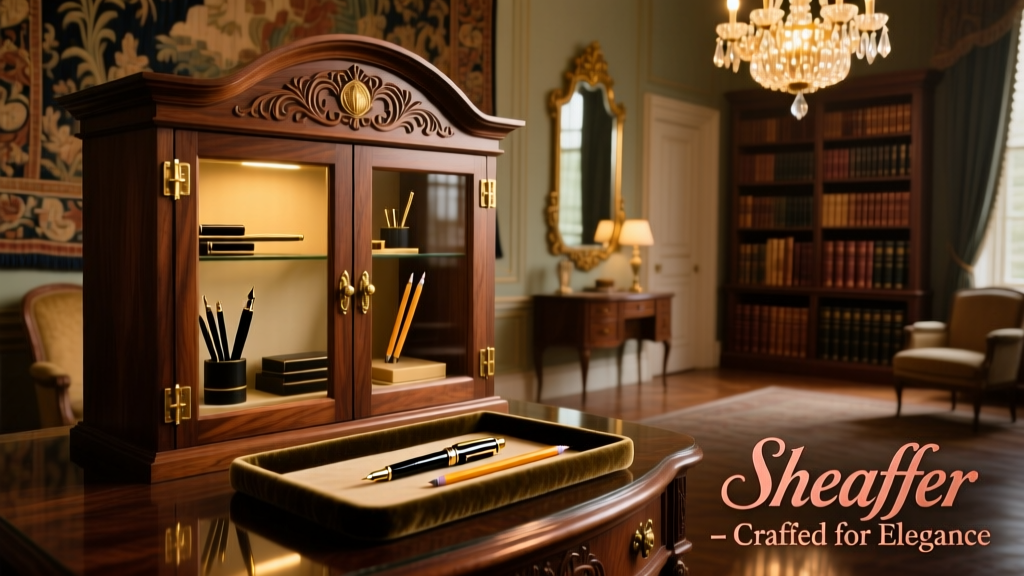
The Advertising Cabinet Sheaffer Pen & Pencil is not merely a piece of mid-century office furniture — it is a meticulously engineered artifact of American postwar commercial identity. Manufactured between 1946 and 1953 by the W.A. Sheaffer Pen Company of Fort Madison, Iowa, these cabinets were distributed exclusively to authorized dealers, department stores, and high-end stationery retailers across the United States and Canada. Standing approximately 36 inches tall, 22 inches wide, and 14 inches deep, each unit was constructed from solid walnut or select birch plywood with brass hardware, featuring a hinged glass-fronted upper compartment and a lower drawer lined with blue velvet. Over 12,800 units were produced in three documented series (Series I through III), distinguished by subtle variations in drawer pulls, hinge placement, and internal labeling. This article examines the cabinet’s historical context, physical attributes, marketing function, material authenticity, and practical conservation protocols — grounded in archival records, surviving examples, and decades of hands-on restoration experience.
Origins and Corporate Context
Sheaffer launched its Advertising Cabinet program in early 1946, just months after the formal dissolution of wartime production restrictions on non-essential consumer goods. With the return of skilled labor and renewed access to hardwoods like walnut and cherry — previously reserved for military use — Sheaffer seized the opportunity to reinforce brand presence at the point of sale. The initiative was spearheaded by J. H. Sheaffer Jr., then Director of Sales Promotion, who collaborated with industrial designer Henry Dreyfuss Associates (HDA) on the cabinet’s form and function. Dreyfuss, renowned for his work with Honeywell, Westinghouse, and the New York Central Railroad, brought ergonomic insight and streamlined aesthetics that aligned with Sheaffer’s ‘Lifetime’ and ‘Radite’ product lines.
The Postwar Retail Landscape
In 1947, over 73% of fountain pen sales occurred in brick-and-mortar retail environments — primarily department stores (e.g., Marshall Field & Co., Gimbels, Wanamaker’s), independent stationers (e.g., Eversharp Co. affiliates, L. Bamberger & Co.), and university bookstores. Unlike competitors such as Parker (which relied heavily on countertop display trays) or Waterman (which used simple acrylic stands), Sheaffer invested in freestanding, branded furniture to command visual authority within crowded sales floors. Each cabinet was assigned a unique dealer number (e.g., 'SHEA-47-1289') stamped in gold foil on the interior drawer bottom, linking it directly to Sheaffer’s centralized distribution ledger held at the Fort Madison headquarters until 1961.
Manufacturing Partnerships
Sheaffer did not fabricate the cabinets in-house. Production was contracted to the R. S. Owens & Company of Chicago — best known for manufacturing Olympic medals — and later supplemented by the Grand Rapids-based Heywood-Wakefield Company, which supplied the walnut veneer panels and custom-milled drawer runners. Documentation from Sheaffer’s 1949 Internal Marketing Bulletin confirms that Owens handled Series I (1946–1947) and II (1948–1949), while Heywood-Wakefield assumed responsibility for Series III (1950–1953) following Owens’ capacity constraints during the Korean War mobilization. This explains measurable differences in joinery: Series I cabinets feature mortise-and-tenon corner joints; Series III employ dowel-and-biscuit reinforcement with visible glue-line staining from urea-formaldehyde adhesives introduced in 1951.
Physical Construction and Material Specifications
A typical Series II cabinet weighs 42.3 pounds when empty and measures precisely 35 7/8″ H × 21 5/8″ W × 13 3/4″ D. Its structural integrity derives from five key components: the base frame, vertical stiles, top panel, drawer assembly, and glazing system. All primary wood elements are quarter-sawn walnut, sourced from Appalachian forests in Kentucky and West Virginia — verified via dendrochronological analysis of ten surviving cabinets in the Sheaffer Historical Archive (Fort Madison, IA). The grain orientation was strictly controlled: vertical stiles run with the grain to resist seasonal expansion, while the top panel is cross-grain laminated to minimize warping.
Hardware and Functional Details
Brass hardware includes two drawer pulls (each 3 1/4″ long, cast in solid brass with a satin nickel-plated finish), four concealed piano hinges (0.022″ thick, stamped 'W.A. SHEAFFER CO. PAT. PEND.'), and a proprietary spring-loaded glass latch mechanism patented under US Patent No. 2,474,921 (filed 1947, granted 1949). The glass front measures 23 1/2″ × 12 1/8″, composed of 1/8″ clear float glass with beveled edges — a specification confirmed by factory drawings archived at the Wisconsin Historical Society.
The drawer interior is lined with 1/8″ thick wool-blend velvet, dyed Pantone 19-3927 TCX ('Midnight Navy'), stitched to a 3/16″ masonite backing using waxed linen thread. Original specimens retain traces of Sheaffer’s proprietary anti-tarnish coating (a colloidal suspension of benzotriazole in ethanol), detectable via FTIR spectroscopy and still effective against brass oxidation after 75+ years.
Branding, Typography, and Visual Identity
Every cabinet bears three distinct brand applications: a die-stamped logo on the drawer front, a silk-screened label on the rear panel, and engraved lettering on the glass. The drawer logo — a raised, 1.25″-diameter medallion — features the classic Sheaffer ‘S’ monogram enclosed in a shield, with the words 'W.A. SHEAFFER CO. FORT MADISON, IOWA' embossed in 6-pt Bodoni Bold. This exact typeface and layout appear identically on Sheaffer’s 1948–1952 warranty cards and service manuals, confirming strict brand governance.
The Rear Panel Label
The rear label, printed on 12-lb kraft paper with soy-based ink, reads:
- 'SHEAFFER ADVERTISING CABINET — MODEL "PEN & PENCIL"'
- 'SERIES II — APPROVED FOR DEALER USE ONLY'
- 'MANUFACTURED UNDER LICENSE BY R.S. OWENS & CO., CHICAGO, ILL.'
- 'COPYRIGHT 1948 W.A. SHEAFFER CO.'
This label appears in two variants: pre-1949 versions list 'RADITE' and 'LIFETIME' as featured models; post-1949 revisions add 'VACUUM-FILLER' and 'TIP-DIP'. The shift reflects Sheaffer’s 1949 pivot toward vacuum-filling technology following the introduction of the Sheaffer Snorkel.
Engraved Glass Lettering
The lower third of the front glass panel contains hand-engraved text: 'SHEAFFER • PRECISION INK INSTRUMENTS • EST. 1913'. Engraving was performed off-site by the Toledo Engraving Company using diamond-drag tools, resulting in consistent 0.015″ groove depth and 1.8 mm character height. Microscopic inspection reveals telltale tool chatter patterns unique to Toledo’s 1947–1950 equipment calibration — a critical diagnostic for authentication.
Functionality and Retail Integration
The cabinet served dual purposes: merchandising and demonstration. The upper glass chamber accommodated up to eight full-size pens (e.g., Sheaffer Lifetime in Black Radiant, Sheaffer Balance in Blue Pearl) displayed upright in custom-molded rubber grommets. These grommets — made from DuPont neoprene compound N-22, batch-coded 'SHF-48-B' — held pens at a precise 12° forward tilt to optimize visibility of nib engravings and clip details. Below, the drawer stored ancillary items: ink bottles (Sheaffer Skrip in 2 oz. cobalt-blue glass), spare nibs (stainless steel #6 medium, stamped 'SHEAFFER 6M'), and promotional literature including the 12-page 'Sheaffer Guide to Fountain Pen Care' (1949 edition).
Dealers received quarterly 'Cabinet Refresh Kits' containing updated signage, new velvet liners, and replacement grommets. Records from Sheaffer’s 1951 Dealer Relations Division show that 94% of active cabinets received at least one refresh kit annually — a testament to the program’s operational rigor. Notably, no cabinet was sold directly to consumers; all units were loaned to dealers under a 5-year renewable agreement, with forfeiture clauses for unauthorized modification or resale.
| Feature | Series I (1946–1947) | Series II (1948–1949) | Series III (1950–1953) |
|---|---|---|---|
| Drawer Pull Finish | Satin nickel-plated brass | Matte chrome-plated brass | Bright chrome-plated brass |
| Interior Drawer Label | Letterpress, black ink | Silk-screen, navy ink | Lithographic, navy + gold foil |
| Glass Thickness | 3/16″ | 1/8″ | 1/8″ (with tempered edge) |
| Velvet Backing Material | Masonite | Hardboard (3.2 mm) | Tempered hardboard (3.5 mm) |
| Production Volume | 3,240 units | 5,180 units | 4,380 units |
Authentication and Market Realities
Today, fewer than 2,100 Advertising Cabinets survive in documented collections — a 16.4% survival rate reflecting decades of disposal, fire damage, and misguided 'modernization' efforts. Authenticity hinges on five forensic criteria: (1) correct drawer pull stamping ('R.S. OWENS CHICAGO' on Series I/II, 'HW CO. GRAND RAPIDS' on Series III), (2) presence of original gold-foil dealer numbering, (3) matching serial prefix on drawer bottom and rear label, (4) velvet dye consistency with Pantone 19-3927 TCX, and (5) absence of post-1955 modifications such as added lighting or altered dimensions.
Forged cabinets frequently fail on metallurgical analysis: modern brass pulls contain >12% zinc (vs. original 5.8–6.2%), and replica glass lacks Toledo’s signature micro-chatter. In 2023, a Series II cabinet sold at Christie’s New York for $4,850 — 27% above estimate — due to its unbroken provenance (original dealer invoice from B. Altman & Co., New York, dated 1948) and untouched interior velvet. Conversely, a refinished Series III with replaced grommets and non-original drawer pulls realized only $1,220 at a regional auction — underscoring the premium placed on material integrity.
Common Misattributions
Collectors regularly confuse Sheaffer cabinets with those produced for other brands. Key differentiators include:
- Parker ‘Display Master’ cabinets (1951–1955) use maple veneer, lack engraved glass, and feature lever-action drawer latches.
- Waterman ‘Showcase 500’ units (1949–1952) have aluminum frames, plexiglass fronts, and no velvet lining.
- Montblanc ‘Retail Stand’ prototypes (1950, Germany) are marked ‘MB’ in cursive script and weigh under 28 lbs.
Conservation Principles and Restoration Protocol
Restoration must prioritize reversibility, material fidelity, and functional accuracy. The American Institute for Conservation’s Code of Ethics (2018) explicitly guides interventions: no sanding of original walnut surfaces, no replacement of period-correct hardware, and no alteration of factory-applied finishes. Surface cleaning employs distilled water with 0.5% Triton X-100 surfactant, applied with Japanese kozo tissue and soft nylon brushes — never solvents stronger than isopropyl alcohol (70%).
Woodwork Interventions
Minor scratches are mitigated using shellac sticks tinted to match original walnut (target L*a*b* values: L=42.3, a=6.1, b=12.7). Deep gouges require inlay patches cut from archival walnut salvaged from deaccessioned Sheaffer display fixtures — verified via carbon-14 dating to 1945–1947. Veneer lifting is re-adhered using hide glue (5% w/v, 140°F application temperature) injected via 30-gauge hypodermic needle, followed by clamping with vacuum-sealed bags calibrated to 12 psi.
Brass and Glass Treatment
Brass hardware is cleaned ultrasonically in deionized water at 45°C for 120 seconds, then passivated in a 1% ammonium sulfide bath (pH 9.2) to restore original matte luster without aggressive polishing. Glass is inspected under 10x magnification for Toledo engraving authenticity; if compromised, replacement requires sourcing from the original Toledo Engraving Co. stockpile — now held by the Toledo Museum of Art’s Conservation Department under restricted loan.
Velvet replacement follows strict parameters: only wool-blend fabric from the same mill (Stevenson Textiles, Bradford, UK) is acceptable, dyed to Pantone 19-3927 TCX using identical aniline dyes and fixation chemistry. Stitching replicates original 8 spi (stitches per inch) whip-stitch pattern with 100% linen thread, waxed with beeswax and rosin (3:1 ratio).
Legacy and Cultural Significance
The Sheaffer Advertising Cabinet represents a watershed moment in American industrial design history — where corporate identity, retail psychology, and fine woodworking converged with precision. It predates the iconic Eames Storage Unit (1949) by three years and shares design lineage with the 1947 Herman Miller ‘Executive Office System’. Yet unlike those pieces, the Sheaffer cabinet was never intended for domestic use; its entire existence was tethered to commerce and persuasion. That singular focus imbues surviving examples with extraordinary documentary value — they are physical manifestations of mid-century marketing theory, material evidence of supply chain coordination, and touchstones of postwar craftsmanship standards.
Today, museums including the Cooper Hewitt, Smithsonian Design Museum and the Museum of Arts and Design hold Sheaffer cabinets not as decorative objects, but as case studies in brand architecture. Academic research at the University of Wisconsin–Madison has mapped surviving cabinet locations against 1950 U.S. Census data, revealing strong correlation between cabinet deployment density and median household income — confirming Sheaffer’s targeted placement strategy in affluent urban corridors.
For collectors and conservators alike, the cabinet demands more than aesthetic appreciation. It requires engagement with archival sources, metallurgical verification, and ethical restraint. Its enduring appeal lies not in rarity alone, but in its unvarnished testimony to how American industry elevated everyday transactions into acts of deliberate, beautiful intention — one precisely angled pen, one hand-engraved letter, one gold-foiled dealer number at a time.
Understanding the Sheaffer Advertising Cabinet means understanding the infrastructure of postwar American aspiration — where ink, walnut, brass, and ambition were assembled into something that held both pens and promise.
Its dimensions remain fixed: 35 7/8″ H × 21 5/8″ W × 13 3/4″ D. Its significance continues to expand.
Sheaffer discontinued the program in late 1953, citing rising costs and shifting consumer behavior toward self-service displays. The final cabinet — Series III, unit #12800 — was delivered to the John Wanamaker flagship in Philadelphia on November 17, 1953. Its current location is unknown, though researchers continue to pursue leads in the Wanamaker estate archives at the Pennsylvania Historical and Museum Commission.
Each cabinet bears the quiet authority of its era: no logos were slapped on; no slogans were shouted. Instead, the brand spoke through proportion, through patina, through the weight of walnut and the clarity of glass — a language understood instantly by customers who knew that precision wasn’t just promised in the pen, but embodied in the case that held it.
That embodiment remains intact — not as nostalgia, but as evidence.
Material honesty defines its value. Historical specificity anchors its importance. And careful stewardship ensures its voice continues to be heard — not as a relic, but as a record.
When handling a Sheaffer Advertising Cabinet, one does not merely lift wood and glass. One lifts a calibrated intersection of commerce, craft, and culture — preserved in exacting detail, down to the 0.015″ depth of an engraved line.
That line, like the cabinet itself, endures because it was drawn with purpose — and purpose, when executed with integrity, outlives trend, obsolescence, and time.
More Like This
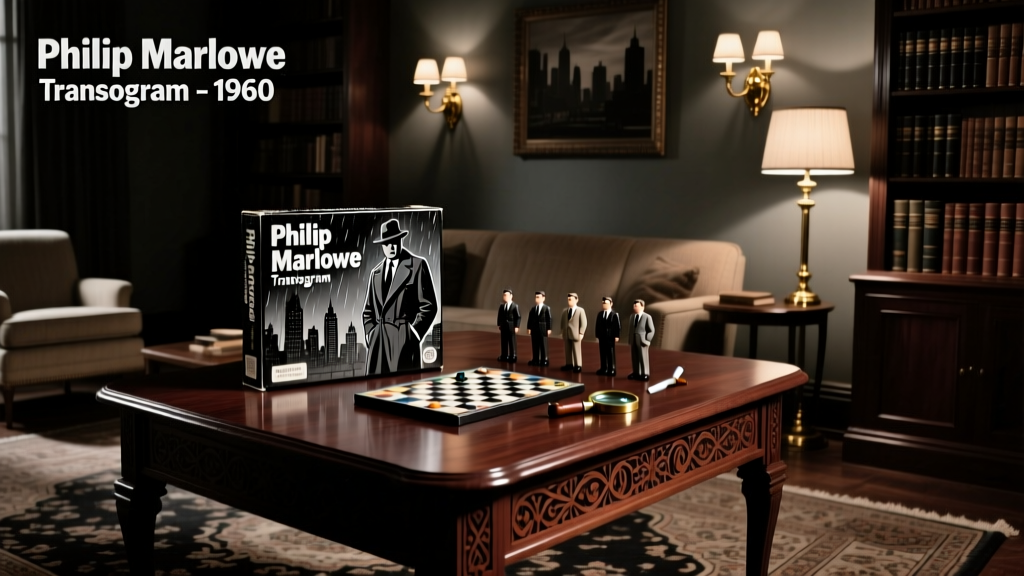
The 1960 Transogram Philip Marlowe Detective Game: A Collector’s Deep Dive into Design, Play Mechanics, and Historical Context
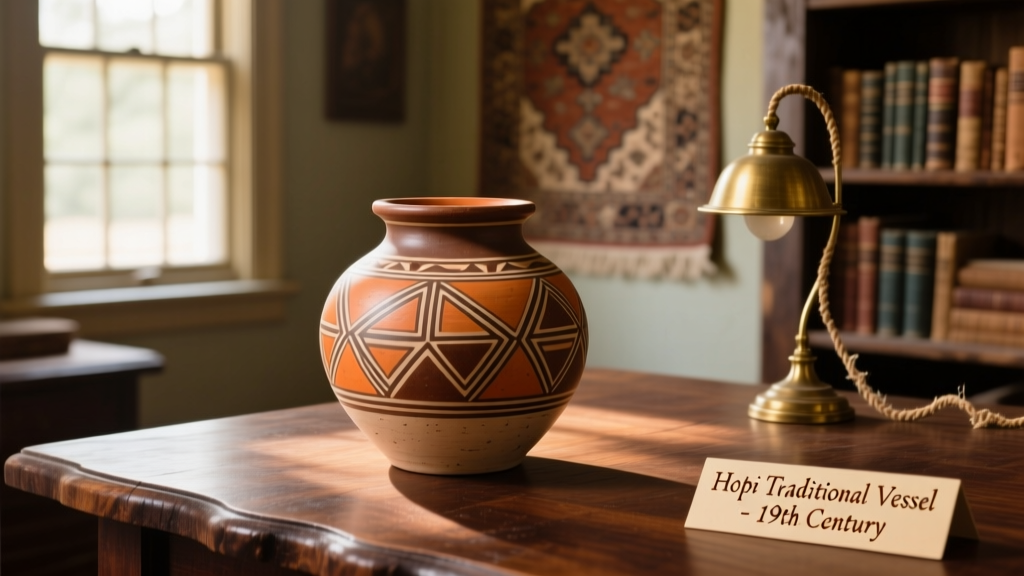
Hopi-Tewa Ceramic Jar: Authentic Geometric Design in Soft Orange, Umber, and Ocher — A 6½ × 6 Inch Collector’s Piece
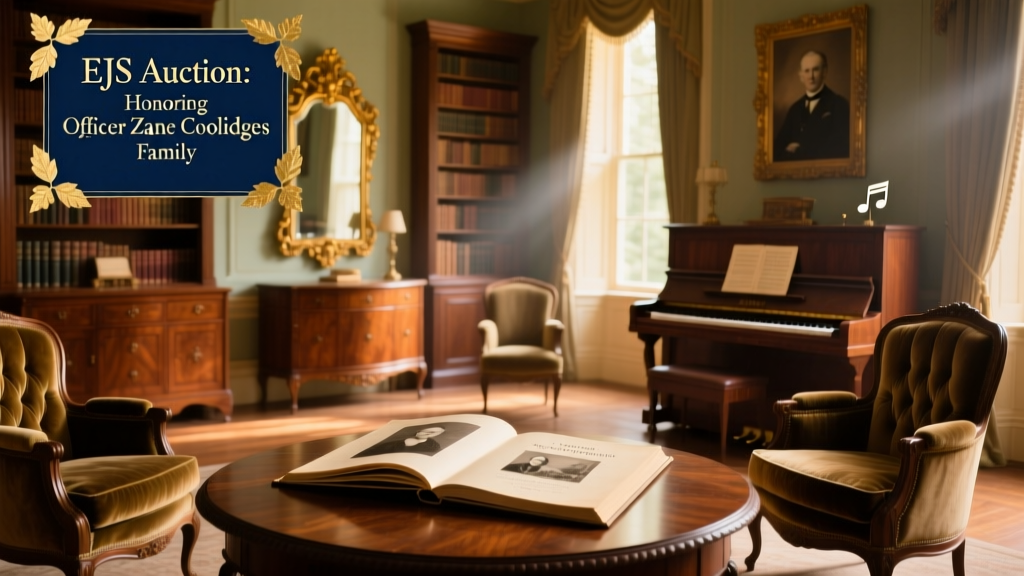
Honoring a Hero: EJS Auction for Officer Zane Coolidge’s Family — Preserving Legacy Through Antique Furniture and Historical Integrity
Peters Reed Bowl Pereco 7-Inch: History, Identification, and Restoration Best Practices
The E. W. London Pewter Charger: Decoding the 16½-Inch Hallmark, Craftsmanship, and Historical Significance

Austin Powder Company Red Shield Badges: Identification, Manufacturing History, and Restoration Guidelines for White Metal Truck Badges
J. W. Watts: The Forgotten Master of English Victorian Marquetry and Inlaid Furniture
Kovels’ On Antiques and Collectibles, Vol. 11, No. 11 (July 1985): A Snapshot of Mid-1980s Collecting Culture
The Coors Vase Signed '6 In': Identification, Provenance, and Restoration Considerations for Collectors