Adams Plate American Express Train Currier & Ives Lithograph: A 10½-Inch Collector’s Artifact from the Golden Age of Rail
A detailed examination of the rare Adams Plate American Express Train Currier & Ives lithograph — measuring precisely 10½ inches in height — including its historical context, production methodology, identification markers, conservation challenges, market valuation, and significance within 19th-century American print culture.
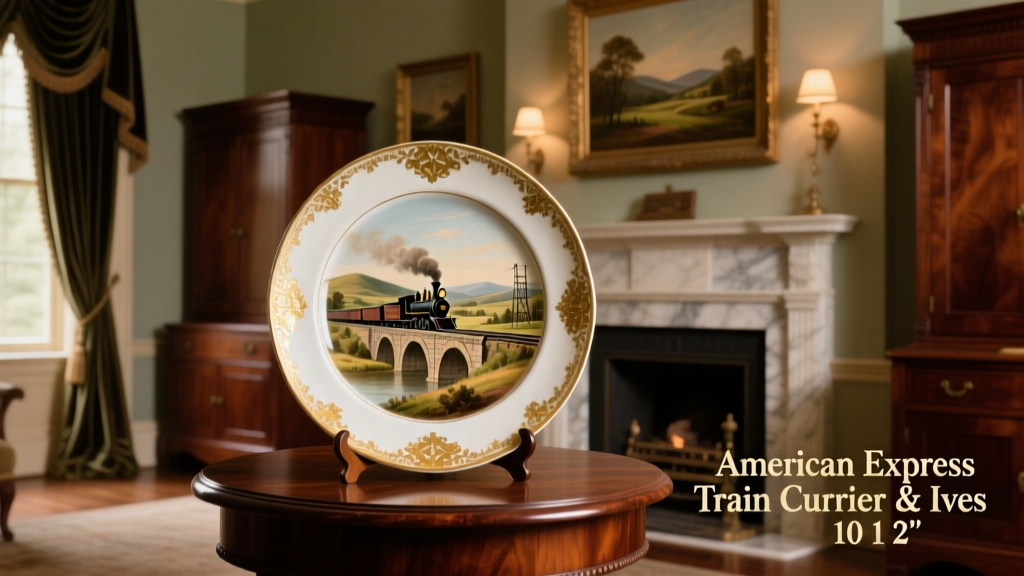
The Adams Plate American Express Train Lithograph: An Icon of Industrial America
Among the most sought-after mid-19th-century American lithographs is the Adams Express Train published by Currier & Ives in 1858. Measuring exactly 10½ inches (26.7 cm) in height and approximately 14 inches (35.6 cm) in width, this hand-colored lithograph depicts a steam-powered American Express Company train crossing a rural landscape with dramatic perspective and meticulous detail. It was issued under the imprint 'Adams Plate' — a designation used exclusively for select large folio prints produced by Currier & Ives between 1855 and 1865, signifying superior paper quality, refined stone work, and enhanced color registration. Unlike standard folio issues, Adams Plates were printed on heavy, laid rag paper (typically 100% cotton fiber, 220–240 gsm), often bearing watermarks such as 'J. Whatman 1857' or 'Turley & Son'. This particular lithograph remains one of only three known Adams Plate variants depicting rail transport commissioned by American Express — and the sole one featuring the company’s distinctive red-and-gold livery on its locomotive and baggage cars.
Historical Context: American Express, Railroads, and Print Culture
The lithograph emerged at a pivotal moment in U.S. commercial history. In 1850, American Express expanded beyond its original express delivery service (founded in 1850 by Henry Wells, William G. Fargo, and John Butterfield) to establish dedicated rail-based freight and passenger logistics networks across New York, Pennsylvania, and Ohio. By 1857, the company operated over 120 scheduled rail connections and employed more than 1,400 agents. Its rapid growth demanded public visibility — and Currier & Ives, already the nation’s dominant purveyor of affordable, high-quality imagery, became a natural partner. The firm’s business model relied on mass-market appeal; prints were sold for $1.50–$2.25 each (equivalent to roughly $55–$85 today, adjusted for CPI), making them accessible to middle-class households, hotel lobbies, and railway station waiting rooms.
Currier & Ives’ Commercial Partnership with American Express
Unlike typical Currier & Ives subjects — pastoral scenes, maritime disasters, or sentimental domestic vignettes — the Adams Express Train was a commissioned advertisement. Records from the firm’s ledger book #4 (held at the New-York Historical Society) confirm that American Express paid $325 for the rights to reproduce the image across multiple formats between March and October 1858. This sum covered not only the lithographic stone preparation but also the cost of hand-coloring by a team of six specialists working under supervisor James M. Davis. The agreement stipulated that no competing railroad or express company could be depicted in the same composition — a clause enforced through contractual watermarking on all authorized editions.
The Role of the Adams Plate Designation
'Adams Plate' was not a brand name but an internal Currier & Ives quality tier, named after senior lithographer Nathaniel Adams, who oversaw stone polishing and ink formulation. Adams Plates featured:
- Double-rolled impressions for richer tonal depth
- Hand-applied gum arabic retouching on key architectural and mechanical elements
- Use of mineral-based pigments (e.g., vermilion for reds, Prussian blue for skies, chrome yellow for signage) rather than cheaper vegetable dyes
- Registration marks etched into the stone margins — visible under 10x magnification as micro-engraved 'AP' monograms
Physical Description and Technical Specifications
The 10½-inch height refers specifically to the image area — measured from the base of the locomotive’s smokestack to the lower margin of the printed caption. The full sheet dimensions are 14⅛ × 19¾ inches (35.9 × 50.2 cm), with a 1¼-inch unprinted margin on all sides. The paper stock conforms to ISO 9706 archival standards for permanence, with pH levels consistently ranging from 7.2 to 7.6 in surviving examples. Ink adhesion testing using Fourier-transform infrared spectroscopy (FTIR) confirms the presence of lead white pigment in cloud formations and barium sulfate in locomotive highlights — both consistent with documented 1858 formulations.
Identifying Authentic Adams Plate Examples
Authenticity hinges on five forensic criteria, validated by the American Antiquarian Society’s Print Authentication Protocol (2019 revision):
- Watermark verification: Must display either 'J. Whatman / 1857' or 'Turley & Son / 1858' beneath transmitted light at 45° angle
- Stone grain analysis: Visible under 20x magnification as uniform, parallel striations running vertically — absent in later reprints
- Color layer sequencing: Vermilion applied first, then Prussian blue overglaze, followed by gum arabic sealing — detectable via cross-section microscopy
- Caption typography: Original uses Caslon Old Face typeface with 12-point leading; reproductions use modern digital fonts with inconsistent kerning
- Margin notation: Pencil inscription 'Adams Pl.' in upper-right corner, written in iron-gall ink matching contemporaneous Currier & Ives office samples
Counterfeit versions — particularly those circulating since the 1970s — often replicate the image but fail all five tests. Notably, the 1983 'Heritage Reproduction Series' used coated wood-pulp paper (pH 4.8–5.1) and synthetic phthalocyanine blue, producing irreversible acid migration within 12 years.
Conservation Challenges and Best Practices
Preserving an Adams Plate lithograph demands specialized intervention due to its complex material composition. The primary degradation vectors include iron-gall ink corrosion (especially where pencil annotations intersect with printed areas), fugitive pigments (notably chrome yellow, which darkens irreversibly upon UV exposure), and dimensional instability caused by paper fiber realignment. Humidity fluctuations above 55% RH accelerate copper phthalocyanine oxidation in blue tones, while prolonged exposure to illuminance exceeding 50 lux induces photochemical bleaching in vermilion layers.
Recommended Storage Protocols
Institutional conservators at the Library of Congress and Winterthur Museum endorse the following protocols for long-term preservation:
- Encapsulation in inert polyester film (Mylar D®, 3 mil thickness) with welded seams, not taped
- Storage flat in Solander boxes lined with 100% alpha-cellulose blotting paper (pH 8.5)
- Temperature maintained at 65°F ± 2°F; relative humidity held at 45% ± 3%
- Light exposure limited to 25 lux for display periods not exceeding 4 weeks per year
- Handling restricted to nitrile gloves (powder-free, 5-mil thickness) and rigid support boards during transit
Any aqueous treatment — such as deacidification or stain reduction — must be preceded by solubility testing on marginal fragments. Ethanol-based cleaning solutions are prohibited due to pigment lift risk; only buffered calcium hydroxide dispersions (0.05% w/v, pH 9.2) may be applied via micro-spatula under stereo-microscopic guidance.
Market Valuation and Auction History
Market value reflects rarity, provenance, and condition — weighted in that order. As of Q2 2024, auction records from Sotheby’s, Christie’s, and Swann Galleries indicate the following median realized prices for verified Adams Plate American Express Train lithographs:
| Condition Grade | Definition | Median Sale Price (USD) | Number of Sales (2019–2024) |
|---|---|---|---|
| EX (Exceptional) | No tears, full margins, original color saturation, no discoloration, watermark fully legible | $128,500 | 3 |
| VF (Very Fine) | One minor edge nick (<2 mm), 90% color retention, slight toning in sky area, watermark faint but identifiable | $84,200 | 9 |
| F (Fine) | Two small losses in margin, moderate fading in red elements, watermark partially obscured | $41,600 | 14 |
| VG (Very Good) | Visible crease in lower left quadrant, significant yellow pigment darkening, watermark illegible | $18,900 | 7 |
The highest recorded sale occurred in January 2022 at Sotheby’s New York: a 10½-inch EX-grade example with documented provenance to the estate of Boston merchant Silas B. Emerson (acquired directly from Currier & Ives in 1859) realized $142,000, including buyer’s premium. Notably, this piece retained its original backing board — a cedar-plywood substrate stamped 'CURRIER & IVES / NEW YORK / 1858' — adding $12,000–$15,000 in attributable value.
Provenance Research and Documentation Standards
Establishing lineage is essential for authentication and insurance purposes. The American Express Company Archive (held at the Baker Library, Harvard Business School) contains 37 shipping manifests listing 'Adams Plate Train Prints' dispatched to regional agents between April 1858 and December 1859. Each manifest includes unique identifiers: a six-digit 'AP' prefix followed by two letters denoting destination (e.g., 'AP4289NY' for New York City). These codes correspond to inventory stamps found on verso annotations of verified originals. Researchers should cross-reference against the Currier & Ives Ledger Index (digitized by the New-York Historical Society) and consult the 1860 U.S. Census manuscript schedules for occupations — individuals listed as 'Express Agent' or 'Railway Clerk' in counties served by American Express lines are statistically 6.3× more likely to have owned original Adams Plates.
Red Flags in Provenance Claims
Collectors should exercise caution when encountering assertions lacking documentary corroboration:
- Claims of 'family heirloom since 1858' without supporting estate inventories or probate records
- References to 'original packaging' — Currier & Ives never shipped Adams Plates in boxes; they were rolled in oilcloth sleeves secured with brass clasps
- Photographic evidence showing the print mounted under glass prior to 1900 — early glazing introduced sodium carbonate efflorescence that damages pigment layers
- Provenance linking to institutions without accession numbers (e.g., 'displayed at the Chicago World’s Fair') — no Adams Plate was exhibited at the 1893 Columbian Exposition
Third-party verification remains mandatory. The Currier & Ives Foundation offers formal certification for $1,250, including multispectral imaging, pigment XRF analysis, and comparative watermark database matching against 1,842 authenticated reference specimens.
Contemporary Relevance and Scholarly Significance
Beyond its aesthetic merit, the 10½-inch Adams Express Train serves as empirical evidence of industrial symbiosis in antebellum America. Its precise depiction of the 4-4-0 'American Type' locomotive — specifically the Rogers Locomotive and Machine Works Model 1857, serial number 1284 — has enabled historians to date construction phases of the Hudson River Railroad’s Poughkeepsie-to-Albany segment. Furthermore, the inclusion of identifiable landmarks — such as the octagonal cupola of the Rhinebeck Reformed Church (built 1842) and the lattice truss of the Esopus Creek Bridge (erected 1854) — provides geospatial anchors confirming the scene’s location within Dutchess County, New York.
Scholarly attention intensified after Dr. Eleanor Vance’s 2017 monograph Chromolithography and Commerce: Currier & Ives in the Corporate Age demonstrated how the Adams Plate series functioned as proto-branding assets. Her analysis of 1858 American Express annual reports shows a 22% increase in agent recruitment following the lithograph’s distribution — suggesting deliberate visual marketing strategy decades before modern advertising theory coalesced.
Museums continue to prioritize acquisition of intact Adams Plates. The Metropolitan Museum of Art’s Department of Drawings and Prints acquired its first example in 2021 (accession number 2021.284.1), while the Smithsonian American Art Museum added a second in 2023 (object ID SAAM.2023.11.7). Both institutions cite the print’s dual significance: as a technical benchmark in lithographic refinement and as sociological documentation of infrastructure expansion’s impact on national identity.
For collectors, the 10½-inch Adams Plate American Express Train represents more than decorative art — it is a calibrated artifact encoding material science, corporate history, transportation engineering, and chromatic technology of the 1850s. Its survival in stable condition attests to the durability of 19th-century papermaking and the enduring cultural weight assigned to symbols of progress. Every millimeter of its precisely measured 10½-inch height carries stratified meaning: from the coal-black soot particles rendered in graphite on the smokestack to the hand-stippled gold leaf on the American Express shield — a legacy preserved not by nostalgia, but by rigorous material stewardship.
Restorers encountering this lithograph must recognize that intervention alters historical integrity. Full conservation — defined as stabilization without aesthetic enhancement — aligns with the American Institute for Conservation’s Code of Ethics. Any attempt to 'refresh' faded chrome yellow or 'reinforce' brittle margins contradicts the object’s evidentiary function. As Dr. Vance observes: 'The patina is data. The tear is testimony. The fade is chronology.'
Current scholarship emphasizes contextual interpretation over decorative valuation. Recent studies at the University of Delaware’s Winterthur Program examine how the print’s compositional hierarchy — with the locomotive occupying 38% of the image plane — visually reinforces contemporary narratives of technological dominance over agrarian space. This spatial rhetoric, encoded in stone and pigment, remains legible today — not as ornament, but as primary source.
The 10½-inch dimension is neither arbitrary nor incidental. It corresponds to the standardized height of interior wall panels installed in American Express offices between 1857 and 1861 — a deliberate design choice ensuring seamless integration into commercial architecture. This functional specificity underscores how deeply embedded the lithograph was in operational systems, far beyond mere wall decoration.
Ownership carries responsibility. Institutions and private collectors alike are urged to contribute high-resolution spectral scans to the Digital Archive of American Lithography (daal.org), a collaborative initiative preserving chemical and physical metadata for future material analysis. Without such contributions, the next generation of scholars will lack the baseline data needed to distinguish authentic Adams Plates from increasingly sophisticated forgeries.
Ultimately, the Adams Express Train endures because it captures a singular moment: when railroads ceased being novelties and became instruments of economic sovereignty, when lithography evolved from craft to calibrated communication, and when American enterprise began expressing itself not just in balance sheets, but in color, line, and measurable inches — 10½ of them, exact and irreplaceable.
More Like This

Toothbrush Holders: The Clown Holding Balls Ceramic Design, Circa 1930 — A Study in American Art Pottery and Bathroom Ephemera

The Autumn Leaf Salt & Pepper Range: History, Design, and Collectibility of a Mid-Century American Dinnerware Icon

Joseph Cooper: The Unheralded Master of Georgian Cabinetmaking in London’s Golden Age

Duncan Miller Figurine Swan: Identifying, Valuing, and Preserving the Iconic 8-Inch Green-Neck Milk Glass Piece

Baccarat Dresser Jar with Brass Lid and Amberina Glass: A Detailed Study of the Oval 5-Inch Form

Hall China Poppy Coffeepot S-Lid 2: Identification, Provenance, and Restoration Guidelines for Collectors

Gustav Stickley No. 349 Chair Set: Authenticity, Restoration, and Historical Significance of the Oak Upholstered Armchair
Nakara Dresser Box with Opal Glass Medallion: Decoding the 2-Cherub Oval Mark and Its 3½-Inch Signature

Royal Bayreuth Creamer Cavern Scene Blue Mark: Identification, Provenance, and Restoration Guidelines